
This is a continuation of a story that began in Michael’s last post.
Narada took the hand of his wife and those of his older children. He placed the youngest child on his shoulder and struggled to lead them all through the raging waters to dry land and safety. But he could not hold them all together against the flood and the youngest child slipped into the rushing waters. As the torrent swept the child away, he saw his wife and the other children disappearing in the opposite direction. Torn and pulled in two directions at once and caught in the dark turbulence, Narada began to fall and soon could not rise again. He fell into unconsciousness and became as inert as a piece of wood.
His body drifted along on the current until he was cast headfirst upon a great rock which caused him to suddenly awaken. As he recovered consciousness, he remembered the great flood and the loss of his wife and family. Then, all the sorrows of the world came rushing at him and he began to lament and cry out in pain. In the midst of his wailing anguish he heard a familiar voice speaking to him: “Where have you been my child and where is the water you were bringing for me? I have been waiting here for more than half an hour.”
Narada turned towards the voice and saw the vision of Vishnu again. Suddenly, they were standing next to each other on the deserted path. All around them the earth stretched dry and cracked and parched by the blazing sun that poured heat down upon them. There was no flood, no torrent, no river and no great rock; there was no water to be seen anywhere.
“Now do you understand the secret of my power and the maya of this world?” asked Vishnu. The god of the dream of creation had granted the petition of the holy man and the great seeker had been given a little taste of the divine power. He found himself waking up between one world and the other, and found himself caught amidst a flood of additional questions.
Is it all a dream and nothing but an illusion? Was the lifetime in the village real? Did the god truly come near? In the midst of many other agreements, both sweet involvements and heavy responsibilities, do we all forget some divine errand we were on? Or in longing for the otherworld or following a dream do we lose all connection to the world around us? The story asks of us, do you understand now?
The gift of life takes us in contrary directions; we burn with holy longings and we thirst for earthly delights. We stand at one threshold and then at the other; we live in both worlds and must learn to serve them both. Then, the hard times come and the floods of change wash over the land. All that we had gained seems lost and we find ourselves amongst the rocks and in the hard places. Surprisingly however, even as we wail at all our losses and decry the pain of life, we are close to the divine source again. In the anguish of loss we may be closer to grasping again the original aim that brought us to life.
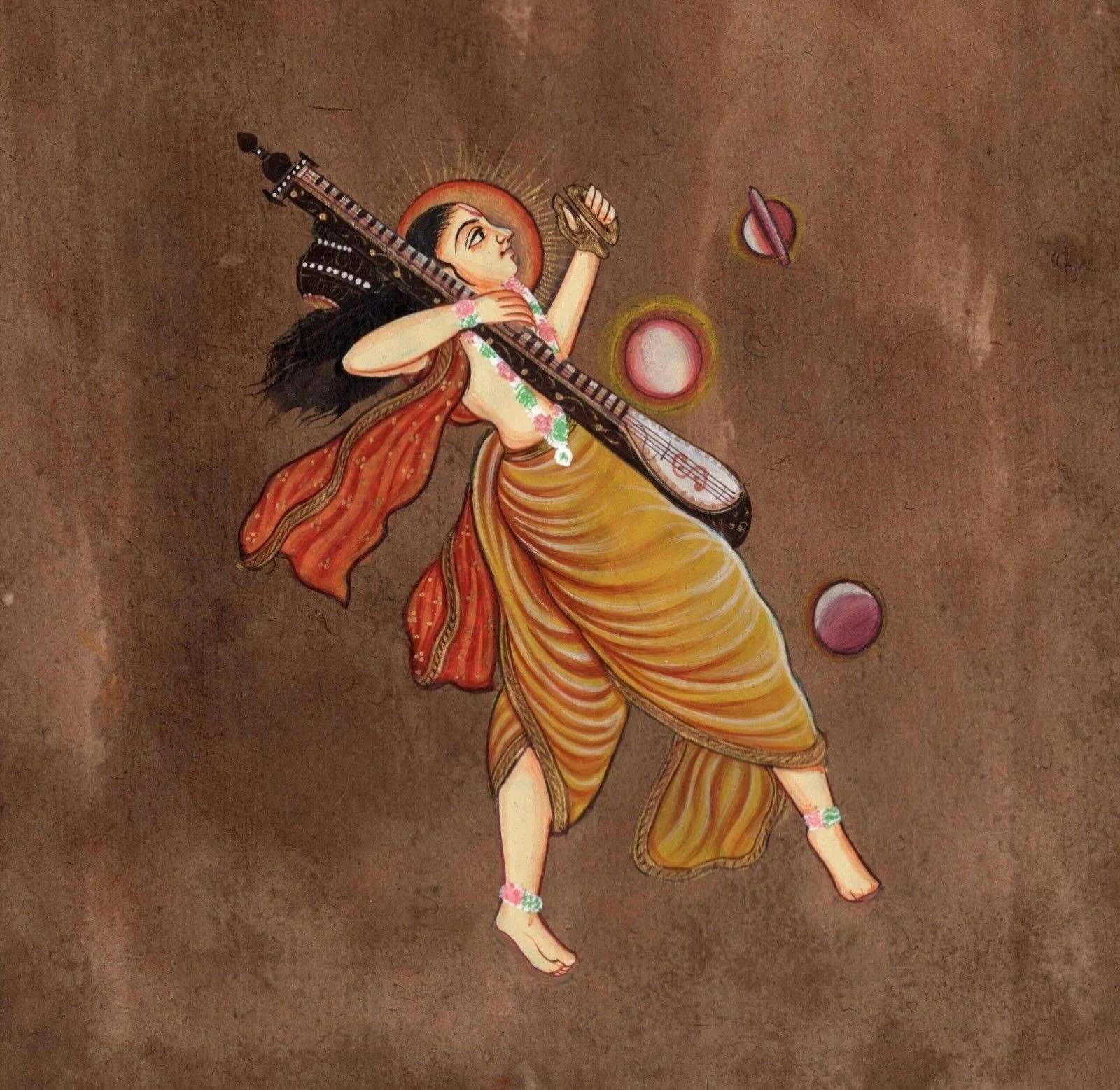
We are on an errand for the divine all along, even when we knock on doors and forget why we were knocking. We fall in love with the wonder of this world and with the beauty in the souls of those we meet in it. How else could it be, how else should it be? We succumb to the magic and maya that create the world we see each day and we also dream at night of other worlds and other lives.
The point here is not to dismiss the delight of being alive on earth. The door of life is there to be opened and the wonder of earthly life is there to be discovered again and again. Like Narada, we enter the next village or the next stage of our lives and forget again why we came to life to begin with. There’s no help for it and no simple escape from it. Isn’t that part of what Vishnu is revealing to the saint? It was precisely while he was on a direct mission from god that he fell in love with beauty, with life in the world, with children and with being a contributing member of the human community. The conversation with the divine also leads the soul of the seeker to an immersion in the dramas and delights of life on earth.
The moment of greater awakening only comes after some life experience, not from completely avoiding it. Narada awakens in the midst of the human dilemma, in the most human place, between the proverbial rock and a hard place. He wakes to the message that we are here to live and love and lose and suffer in the “real world.” And in awakening he recalls that he has forgotten his agreement with the divine. On one hand we must know what it means to be alive in the human drama that alternates between love and loss. On the other hand we must seek to know the divine and serve something that transcends all of the human experience.
This Substack is reader-supported. To receive new posts and support this work, consider becoming a free or paid subscriber.
Michael publishes a new essay/post each week.
However, if you’d like to go deeper, you can become a paid subscriber.
Paid subscribers get:
Additional in-depth essays and stories with related audio and video.
A 30% discount on all online events, in-depth courses, books and audio titles
Access the full archive of posts and the ability to post comments and join the community.
Comments
Nothing yet. Say the first thing.
Sign in to join the conversation.