
I have previously argued that philosophers cannot answer the big questions. When it comes to whether we have free will, the nature of knowledge, the mind’s relation to the body, or the foundations of morality (etc., etc.), there are no widely agreed answers after more than two millennia. In a follow-up article, I argued that anyone who pursues philosophy to settle these questions is either irrational (because they are pursuing a goal by means that reliably fail to achieve it) or arrogant (because they believe they will succeed where Plato, Aristotle, Kant, and many other greats did not).
From all this, you might think that I’m pretty pessimistic about philosophy. I am often interpreted that way, but I reject the label. In some published work, I’ve argued (with James Nguyen) that philosophy makes significant progress, despite not resolving its central questions. But whatever we call my view, Herman Cappelen defends what appears to be its polar opposite. His forthcoming book, Philosophy Is Perfect: A Defence of Philosophy, defends a “hyper-optimistic” position. He claims that philosophy is “as good as any intellectual discipline could be.” It is “better than, and more important than, say, physics, economics, forestry, biology, neuroscience, cosmology, sociology, and psychology, to mention but a few.”
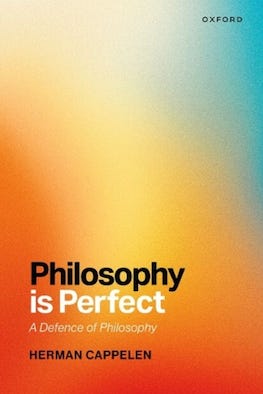
The central thesis of Cappelen’s book is that philosophy has been a “massive success.” He claims that “we philosophers have solved all the main philosophical questions.” Unlike modest optimists—who think we make progress by ruling out false theories, sharpening our questions, drawing useful distinctions, and anticipating objections more systematically—Cappelen thinks that we’ve solved all the difficult questions, including “What is knowledge?”, “Do humans have free will?”, “What is truth?”, “Is there a god?”, and “What is the meaning of life?”
You might be surprised by such claims. (I was!) How does Cappelen reach this conclusion?
Cappelen’s main argument is “The Argument from Nearly Filled Logical Space.” Here is a summary:
Philosophers have explored the space of possible answers to the big questions for more than 2,500 years.
This exploration has been so comprehensive that we have likely articulated every philosophically viable position.
Therefore, the correct answers are almost certainly already present in what he calls the “philosophical commons” (i.e., the collective, public body of philosophical writing).
This is a burden-shifting argument. For millennia, some of the most intelligent and motivated thinkers have proffered what they take to be the most viable answers to philosophy’s central questions. Let’s assume that the viable positions on, say, free will form a small, stable menu (e.g., compatibilism, hard determinism, libertarianism) and that the true position must be a viable one. It follows that the true answer is very likely somewhere on the menu. I’m happy to grant all this.
Before evaluating Cappelen’s argument, I want to get clear about the word “solved.” Cappelen claims that “we philosophers have solved all the main philosophical questions.” But what does it mean to solve a philosophical problem?
A philosophical problem has not been solved, I’d suggest, if the relevant experts continue to reasonably disagree about the correct answer. This strikes me as plausible, since it is commonly held that persistent disagreement shows that philosophy hasn’t resolved its central questions. Analogously, medical experts disagreed for much of the twentieth century about whether stomach ulcers were caused by stress or by bacterial infection. Although Barry Marshall and Robin Warren truly, and with justification, believed that bacteria were the cause, it seems correct to say that so long as experts reasonably disagreed, nobody regarded the question as solved, settled, or resolved.
Has anything like this happened for the “big” questions in philosophy? Cappelen admits that no such consensus has occurred (in fact, he argues that such consensus would be a bad thing in philosophy, but I’ll set that very interesting argument aside). Here’s what he says:
When I claim we have ‘found the correct answers,’ I do not mean that all controversy has been settled, nor that every philosopher now knows the truth. I mean that the right answer has been articulated and supported by good, sound arguments within our collective philosophical literature.
So, Cappelen does not claim that we have settled the big questions. Rather, he claims that the right answers exist, somewhere, in the pile of things philosophers have written. Does that deserve the label “solved”? I have my doubts, as I’ll argue below. How do we get from “some philosopher has found the answer” to “we have found the answer”?
Cappelen offers an analogy that he relies heavily on at numerous points in his book. Here I quote him at length:
Suppose a group of people, The Searchers, are looking for a golden coin. For easy reference, we’ll call this very special coin ‘Gold’. Let’s say there are a few thousand Searchers. They’ve got some overlapping training, they tell each other about places they’ve been to. They’re looking in different places all over the world, sometimes in small groups. Now, one person - Finder - finds Golden. My claim: the Searchers have found Golden, because Finder found it.
Let’s make it a bit more messy:
Suppose that there’s some dispute about whether the coin that Finder has really is Golden. As a matter of fact, it is the golden coin, but there are quarrelsome and grumpy Searchers who are very sceptical of discovery claims. My claim: It’s still true that the Searchers have found the golden coin.
To flesh this out a bit more, and make it closer to where I think we philosophers are:
Suppose there isn’t an available method that will convince absolutely everyone that a particular candidate is Golden. As with most matters, there’s no infallible proof that one cannot bypass by making unorthodox assumptions (about complex conspiracies or fallible instruments or divergent theories about either nature of gold or coins). My claim: We can still say that Searchers have found Golden.
Likewise, if Simon Blackburn (say) has defended the correct account of moral facts, then we philosophers have found the answer to “Are there moral truths?” — regardless of what the rest of us happen to believe.
I think the Golden Coin analogy stacks the deck in Cappelen’s favor. In his telling, there is one Finder holding one coin and many who aren’t willing to admit that he found it. An analogy closer to philosophy is quite different. It involves many Searchers who each find a coin, each insisting that theirs is the real one, and each providing good reasons to think so. Yet only one of them can be right. Moreover, nobody can establish which coin is truly Golden to the satisfaction of the others. And they are all experts about gold coins. In this scenario, Cappelen would say the Searchers have found Golden, since the real coin is in somebody’s hands. But the search is hardly over. Nobody would congratulate these Searchers for having “solved” the problem of finding Golden.
To make the point clearer, consider a case of my own. Five detectives are investigating a murder. They each produce a thorough, publicly available case file accusing a different suspect. As it happens, one of the detectives has identified the actual killer using sound reasoning from the evidence. By Cappelen’s criteria, the murder has been solved. How so? Because the correct answer has been articulated and defended with good arguments, and it now exists in the public record (or ‘commons’). And yet the case is still open, and no arrest follows, because nobody knows which detective is correct. Even if we grant that the investigators have in some sense “found” the murderer, they cannot act on the answer they have found. (Indeed, they can’t even “find” it within the pile of five options.) While it may be true that something real has been achieved, it is not what anyone ordinarily means by “solving” the case.
This is exactly our situation in philosophy. The philosophical commons contains the true answer and dozens of false ones, with no way to tell them apart. We have “found” the right answer only in the sense that it’s somewhere in the pile. But do we care about merely having the answer somewhere in the pile, while being unable to tell which it is? I doubt it.
To his credit, Cappelen anticipates this objection, which he calls the “What’s-the-Answer Challenge.” In response, he distinguishes “discovery” from “identification.” His book is a defense of discovery (i.e., the small set of viable answers being publicly available and well argued), but not identification (i.e., determining which of them is true). While this may strike some as disappointing, Cappelen argues that discovery is still hugely important, since we no longer need to explore an open-ended space or rebuild the field from scratch. We can begin from live candidates and assess them.
Fair enough, but this concedes something pretty significant. A search whose costs have been lowered is a search that is still ongoing. If each individual and each generation must still do their own “sorting,” as Cappelen puts it, then the questions remain open. What philosophy possesses, then, is not the answers but an exceptionally well-organized map of the candidates. This seems quite different from the claim that we have “solved all the main philosophical questions.”
There is a deeper irony. In the second part of his book, Cappelen argues that persistent disagreement in philosophy is not only to be expected, but celebrated. He claims there is no neutral standard of evidence to which all parties are answerable, so rival camps can each apply their own internally coherent standards and rationally dismiss one another’s candidate answers forever. Indeed, he holds that consensus in philosophy would be a symptom of something having gone wrong, a sociological artifact rather than an epistemic success. In his own words, “Disagreement is Good and Convergence is Bad.”
Thus, his brand of “hyper-optimism” turns out to be surprisingly pessimistic in its own way. Cappelen not only agrees that the central questions of philosophy have not been resolved (in the sense I have described above), he also argues that they never will be. And insofar as he thinks the absence of consensus is a good thing, he must think the absence of resolution is a good thing too. The most “hyper-optimistic” person in the literature, it turns out, seems to embrace the fact that philosophical problems are, and ought to be, irresolvable.
So, has every philosophical problem already been solved? Only if a problem can be “solved” without anyone being able to tell what the solution is. Which is another way of saying that philosophy still cannot answer the big questions.
No posts
Comments
Nothing yet. Say the first thing.
Sign in to join the conversation.