
By Michael H. Kelly, Executive Director, The Drucker Institute
“Nobody calls the mass of unorganized, panicky, stampeding humanity in a shipwreck a ‘society’,” Drucker wrote. In this case, “there is no society, though there are human beings in a group. Actually, the panic is directly due to the breakdown of a society.”
That image, of people in a shipwreck struggling for survival, is illustrative of our time. Our institutions are standing, but trust in them has faltered. We may feel that we are constantly connected to others, yet many of us lack a sense of belonging. Our crisis is not simply political. It is functional. We are living through Drucker’s metaphorical shipwreck, still afloat but struggling to survive.
“A Functioning Society” is a collection of writings by Drucker that were composed over the course of his long career. Some of the pieces that are most relevant to our time were written in the aftermath of the wave of totalitarianism that swept across Europe and Asia in the 20th century. During this period, Drucker saw institutions lose their legitimacy and societies abandon their search for meaning. Out of that experience came one central insight: a society can endure only when its people believe its institutions are both competent and just. According to Drucker, a society functions if it is moral and morality is what allows freedom to breathe.
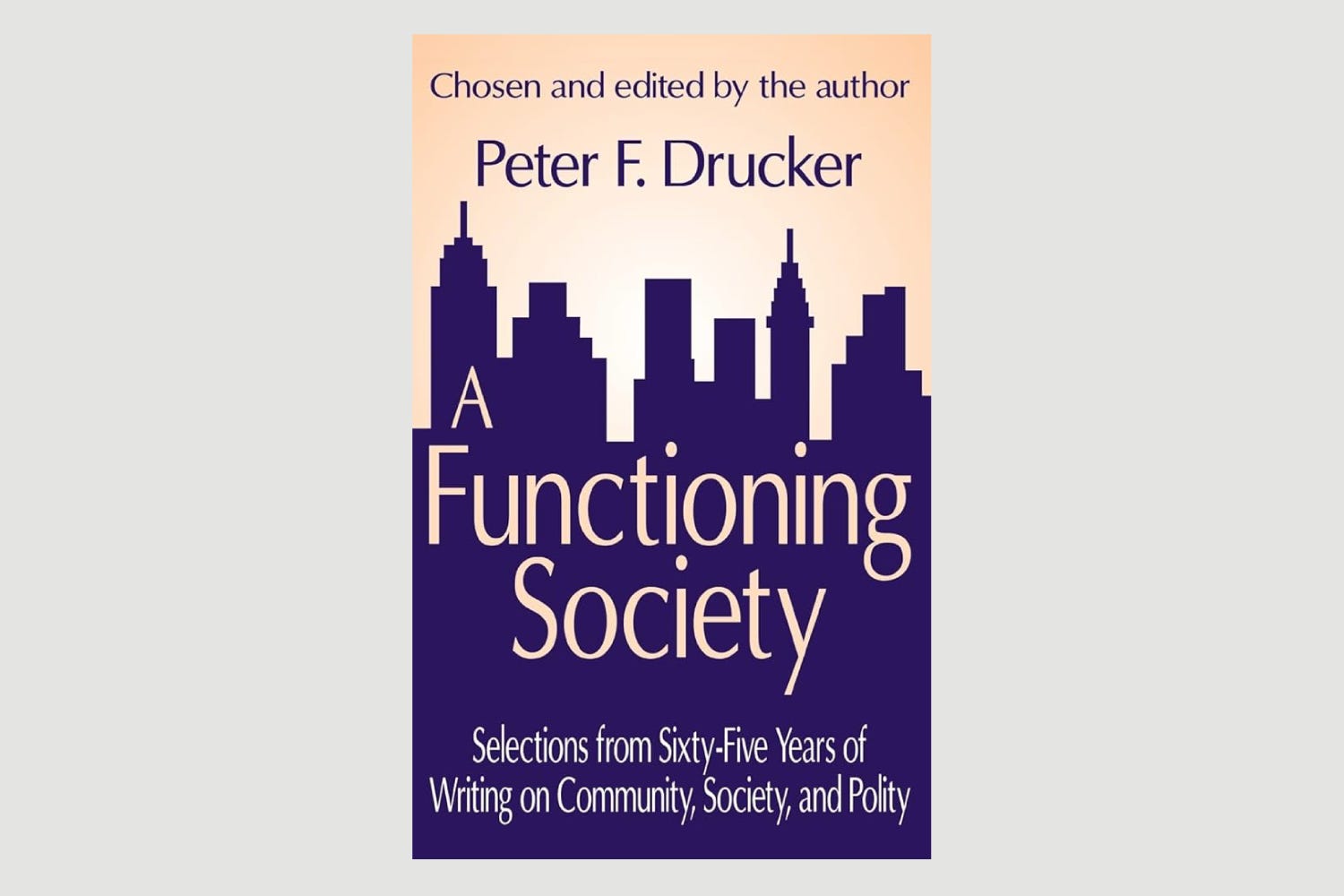
“A Functioning Society” book by Peter F. Drucker
Drucker’s vision of a functioning society was never focused on any one specific nation. He wrote as a European who had fled the continent in the 1930s, witnessing societal collapse in the 1930s and ‘40s that was followed by post-war renewal. The principles he described — responsibility, legitimacy, and service — apply to every culture seeking to balance freedom with order, progress with purpose.
“A Functioning Society” is not a relic of a previous age. It can be read as a manual for our own. Today we confront the twin breakdowns Drucker feared most: the loss of institutional legitimacy and the loss of individual meaning. Societies cannot sustain themselves on cynicism and performance alone. Service and contributions still matter.
To rebuild confidence in our society, we must recover Drucker’s ethic of responsibility — the belief that every institution exists to meet a human need, and every person has a duty to make their strengths productive for others. Functionality begins when we accept these obligations. It continues when we design systems that do more than just make promises. They must be inclusive and provide for people.
A new movement can rise from this kind of understanding. Not a movement of protest alone, but of rebuilding. The movement must span sectors and generations. It must include citizens who expect performance from government and business, leaders who measure success by service, and communities that value competence. This kind of movement is not organized around ideology but is driven by purpose, on the conviction that legitimacy and meaning can, and must, be rebuilt.
The opposite of nihilism is not optimism — it is functionalism. Drucker reminds us that freedom survives only when institutions work, and when people believe they have a valued role within them. Restoring that faith is the defining work of our time.
This audiobook edition of “A Functioning Society” is more than a reissue in a new format. It’s an invitation to think seriously about the conditions of our social life today and to act decisively to rebuild it. Drucker’s moral compass points toward performance with purpose, authority with responsibility, and power with restraint.
No posts
Comments
Nothing yet. Say the first thing.
Sign in to join the conversation.