
California is taxing itself to make up for a federal system that already takes more than its share — and the state can’t afford to keep doing it.
For years, federal tax policy has rewarded low-tax, low-investment states and penalized high-output states like California.
California residents now send billions more to Washington than they get back, while the state raises its own taxes to keep schools, hospitals, and infrastructure running.
The result is an economy that subsidizes the nation and then taxes itself again to fund its own obligations.
California’s next governor must say what few leaders have the courage to admit: we cannot keep making up for Washington’s inequity by squeezing our own citizens — especially the middle class, which already pays more than its counterparts in 47 states.
Holding the line on new taxes is not an act of austerity. It is an act of leadership — the discipline required to keep the state competitive, compassionate, and solvent.
The last decade of federal tax decisions has tilted the playing field sharply against high-cost, high-productivity states.
The 2017 federal tax overhaul cut corporate rates dramatically and reduced the top marginal income rate from 39.6 percent to 37 percent, while capping how much state and local tax Californians could deduct from their federal returns.
That change was not an isolated event. In 1944, under Franklin D. Roosevelt, the top federal marginal rate reached 94 percent to fund World War II and America’s postwar recovery. For four decades thereafter, it stayed above 70 percent — supporting investments in highways, higher education, and research that built the modern middle class.
But since the 1980s, a bipartisan consensus — first under Reagan (50 percent), then under George W. Bush (35 percent), and finally under Donald Trump (37 percent) — has steadily flattened the code.
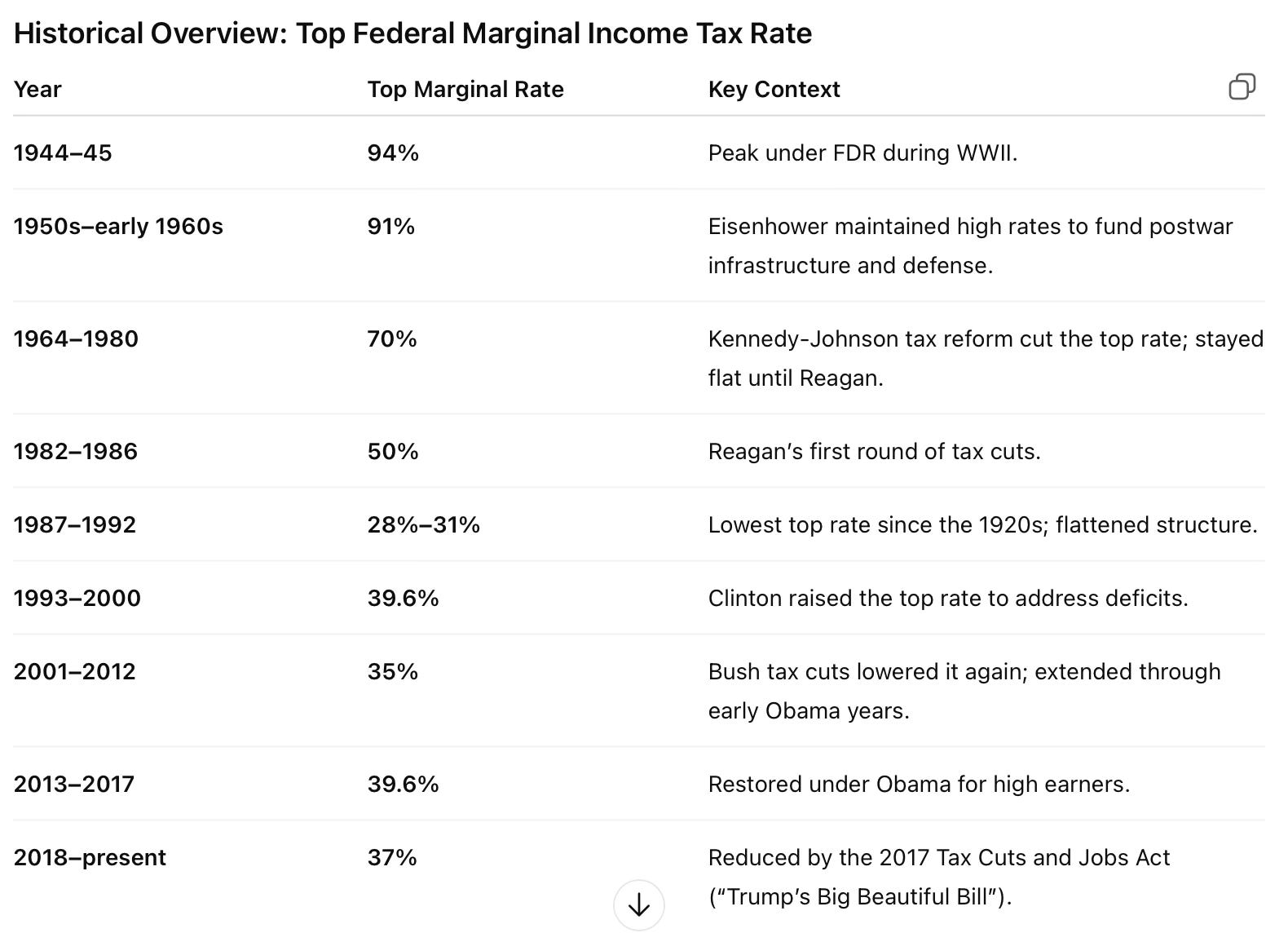
The effect has been to shift the national tax burden away from corporations and high earners at the federal level, forcing states such as California to raise more locally to fund essential services.
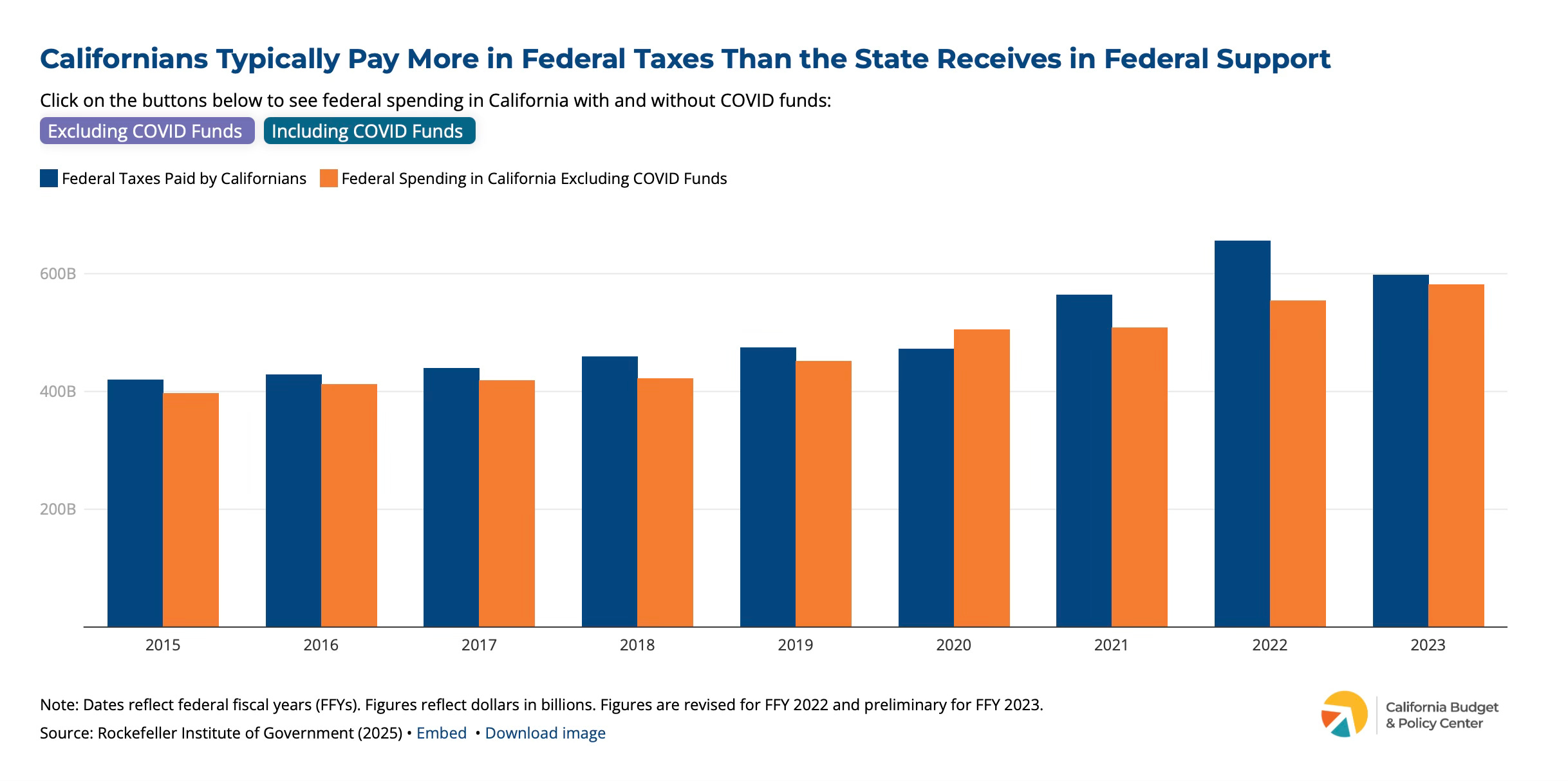
According to the California Budget & Policy Center, Californians paid more in federal taxes than they received in spending in six of the past nine years. Excluding pandemic relief, the gap reached $101 billion in 2022 and $55 billion in 2021. For every dollar Californians send to Washington, the state receives less than one back — while lower-tax states like Kentucky or Virginia receive two or three.
That imbalance has turned California into America’s largest “donor state.” We fund the federal government and then tax ourselves again to meet the needs Washington no longer shares.
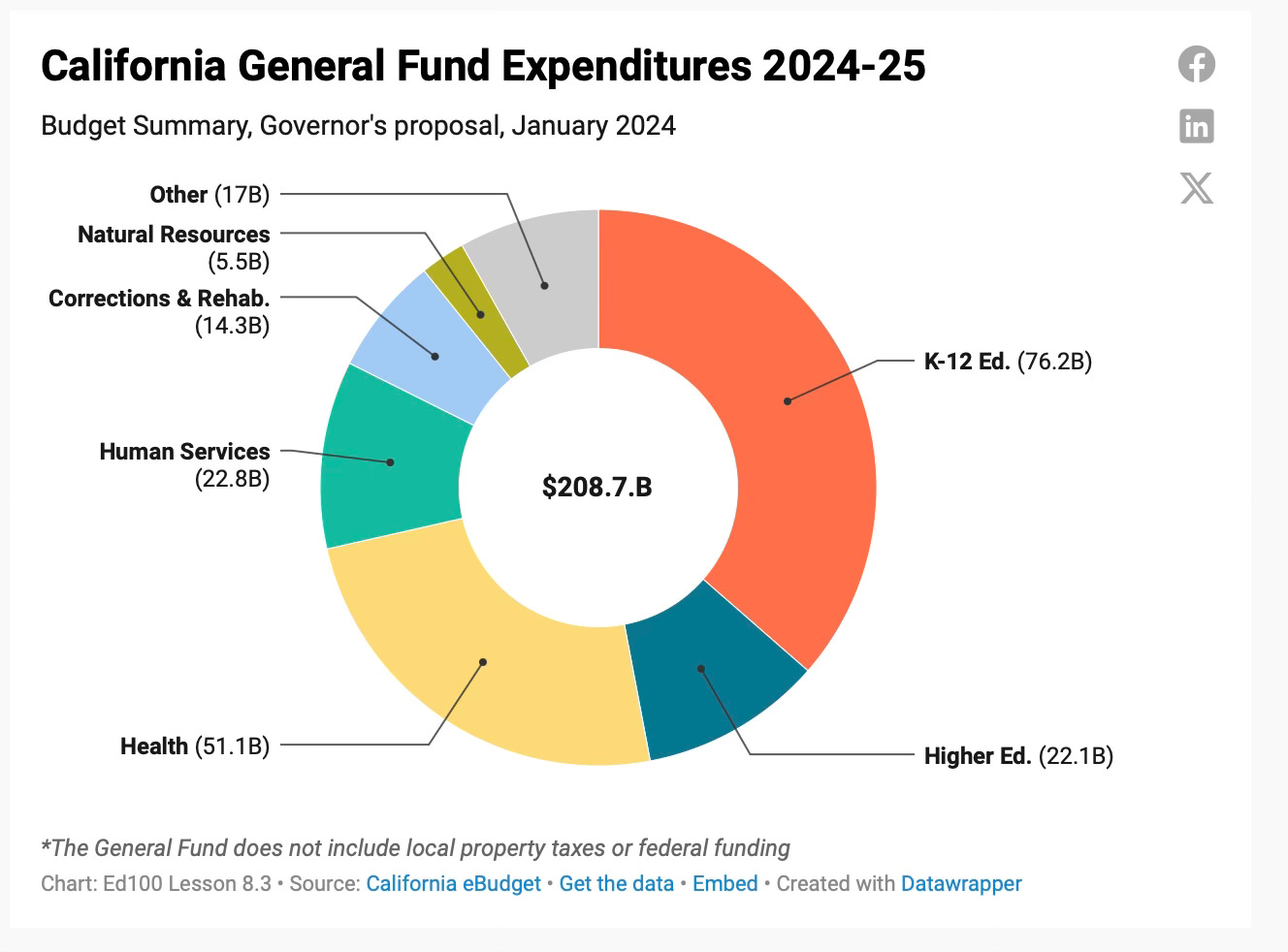
California’s 2025 budget totals about $209 billion, including $133 billion for the general fund, $63 billion in special funds, and $6 billion in bond funds. Roughly three-quarters of that budget flows to “local assistance”: K-12 schools, community colleges, Medi-Cal, CalWORKS families, and childcare providers.
Nearly 70 percent of general-fund revenue comes from personal income taxes — up from 40 percent in 2010. Proposition 30 (2012) and Proposition 55 (2016) raised and extended income taxes on the wealthy, leaving California more dependent than ever on a small group of taxpayers.
By 2018, 40 percent of income-tax revenue came from the top 0.5 percent of earners, and two-thirds came from the top 5 percent. Today, the top 0.4 percent generate nearly 40 percent of the dollars that fund California’s schools and social programs.
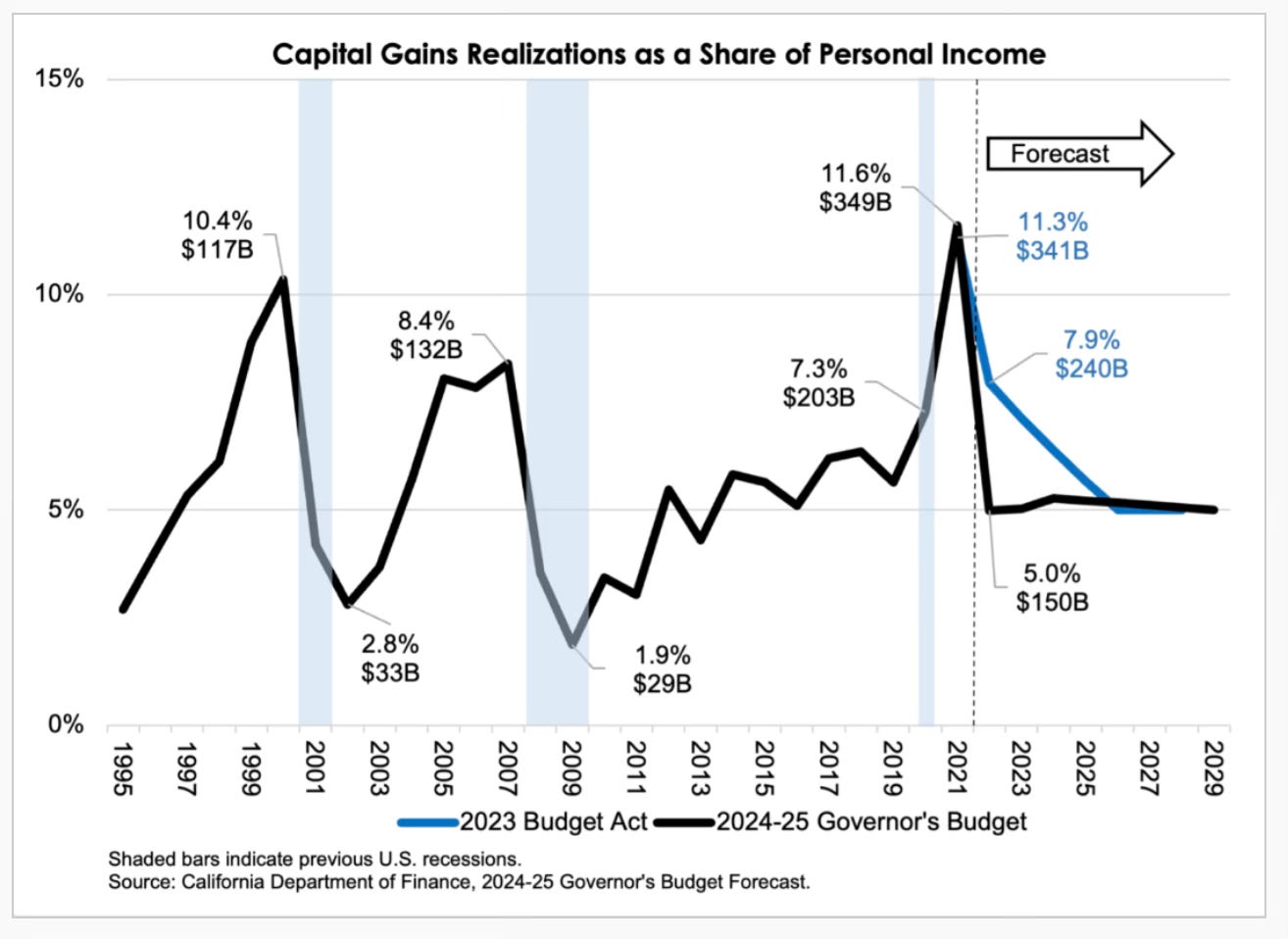
This structure is progressive in theory but perilously narrow in practice. When markets fall or capital gains slow, the state’s revenues swing wildly — as they did during the dot-com crash, the Great Recession, and the pandemic.
California’s combined state and local debt — bonds, pensions, and retiree health obligations — exceeds $1.5 trillion.Wildfires, housing shortages, and pandemic-related spending have deepened the strain.
At one point, the state faced a $54 billion deficit, which it covered largely by deferring cuts and counting on more federal relief. That choice captured the new reality: California depends on Washington even as it funds it.
To close gaps, lawmakers have proposed repeated tax hikes:
Raising the top rate from 13.3 percent to 16.8 percent, expected to bring $6.5 billion annually from roughly 70,000 households.
A 0.4 percent wealth tax on net worth above $30 million, projected to generate $7.5 billion from 30,000 Californians.
Backing Proposition 15, repealing local tax caps on commercial property to raise $12 billion a year for schools.
Each idea springs from a legitimate need. But they share the same flaw: asking more of a shrinking base while driving the very taxpayers and businesses that keep the system afloat closer to the door.
To his credit, Governor Gavin Newsom has resisted the calls for major new taxes. Under intense pressure from progressive activists and unions, he has held the line.
That restraint is politically costly but economically sound. Newsom understands that California cannot correct federal inequity by becoming less competitive itself. If Washington’s tax code rewards low-tax states, doubling down on high rates at home only compounds the disadvantage.
The next governor must decide whether to continue that discipline or abandon it. California’s fiscal stability — and its moral credibility — depend on the answer.
Over the past three years, more than 800,000 residents have left California. They include entrepreneurs, engineers, and teachers — the very workforce that defines the state’s promise.
The top 1 percent of earners provide over one-third of all state income-tax revenue. The next 5 percent contribute nearly another third. Meanwhile, California’s middle class — those earning around $57,000 — pay a top state rate of 9.3 percent, higher than millionaires pay in 47 other states.
A 2025 analysis by the Retirement Living Research Team, drawing on Census data, found that California had the largest net population loss in the country — roughly 254,000 residents in one year, nearly twice that of the next-highest state. “One thing unites every generation,” the report noted. “They’re all leaving California.”
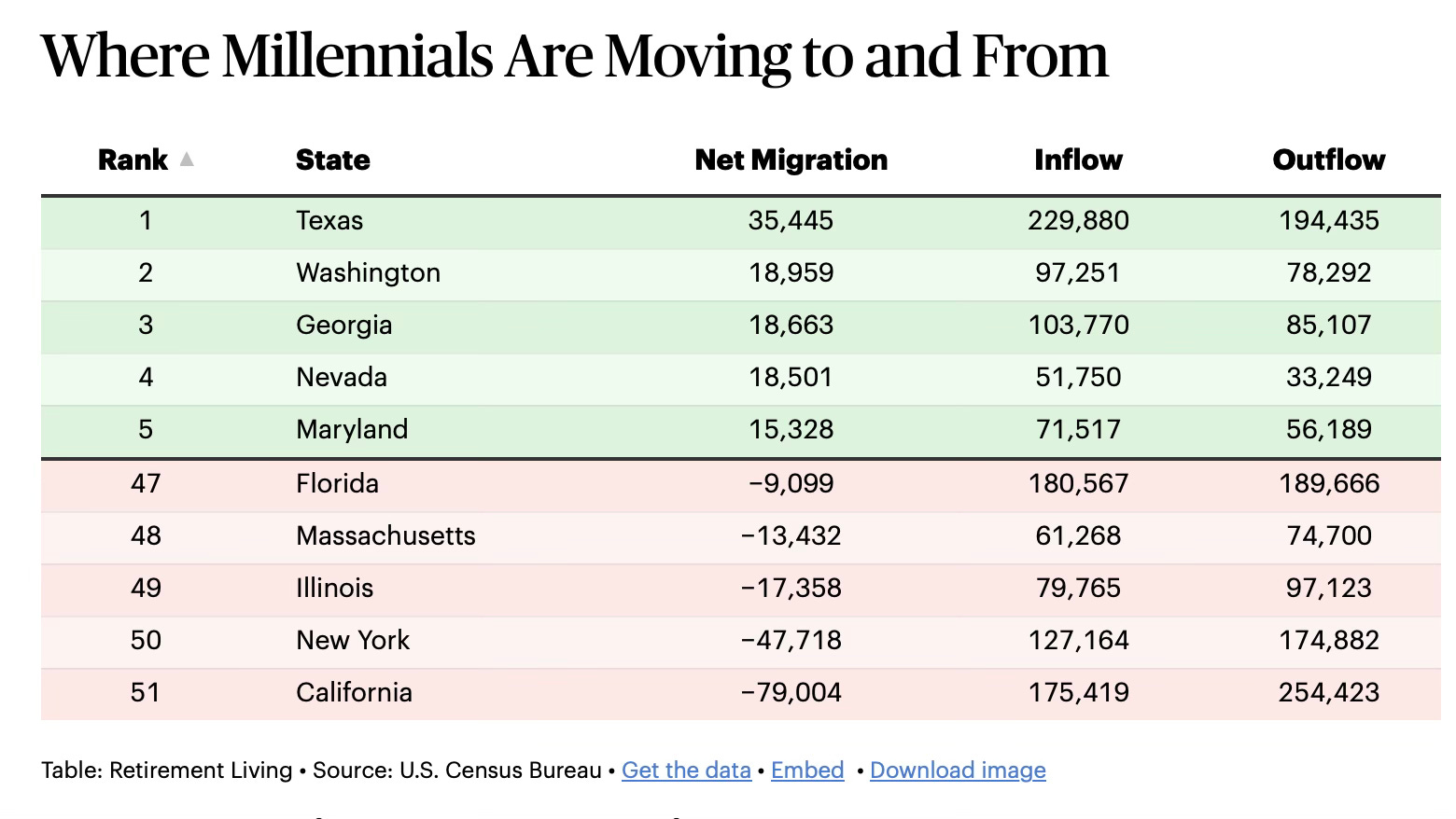
When those taxpayers depart, they take with them payrolls, consumption, and philanthropy. What remains is a smaller base expected to shoulder an even larger share of the cost.
Stanford economist Joshua Rauh found that whenever California raises taxes or federal deductions shrink, departures spike — and the losses persist.
After the 2017 tax law took effect, Californians who left earned $4 billion more in taxable income than those who arrived, costing the state $368 million a year in revenue. By 2020, during the pandemic, that gap reached $10.7 billion, a $1.17 billion annual loss.
The share of high-income Californians relocating to zero-tax states such as Texas, Nevada, and Florida has increased by more than 30 percent since 2003. These aren’t anecdotes — they are actuarial facts. And they expose how sensitive California’s revenue model has become to mobility and perception.
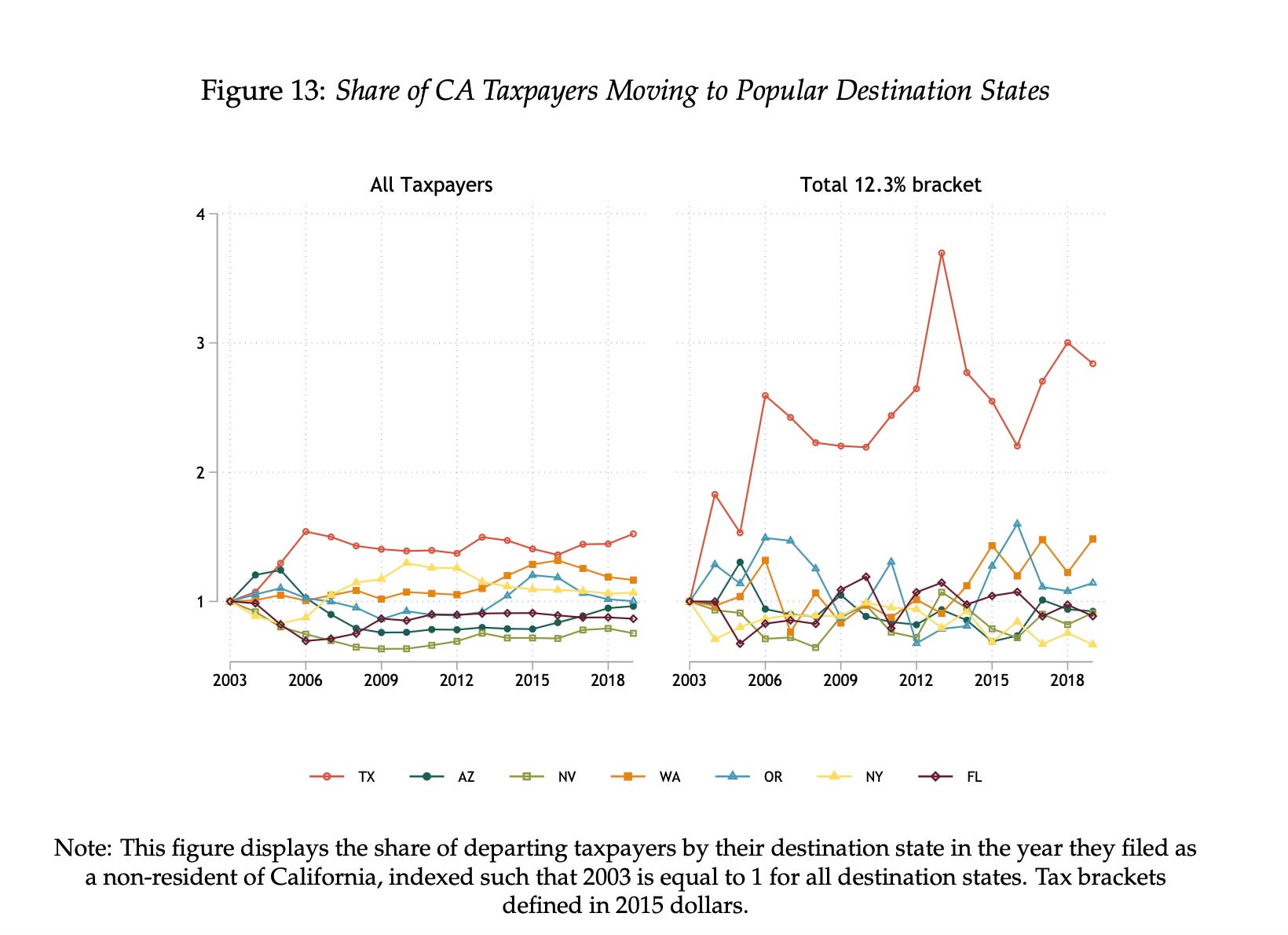
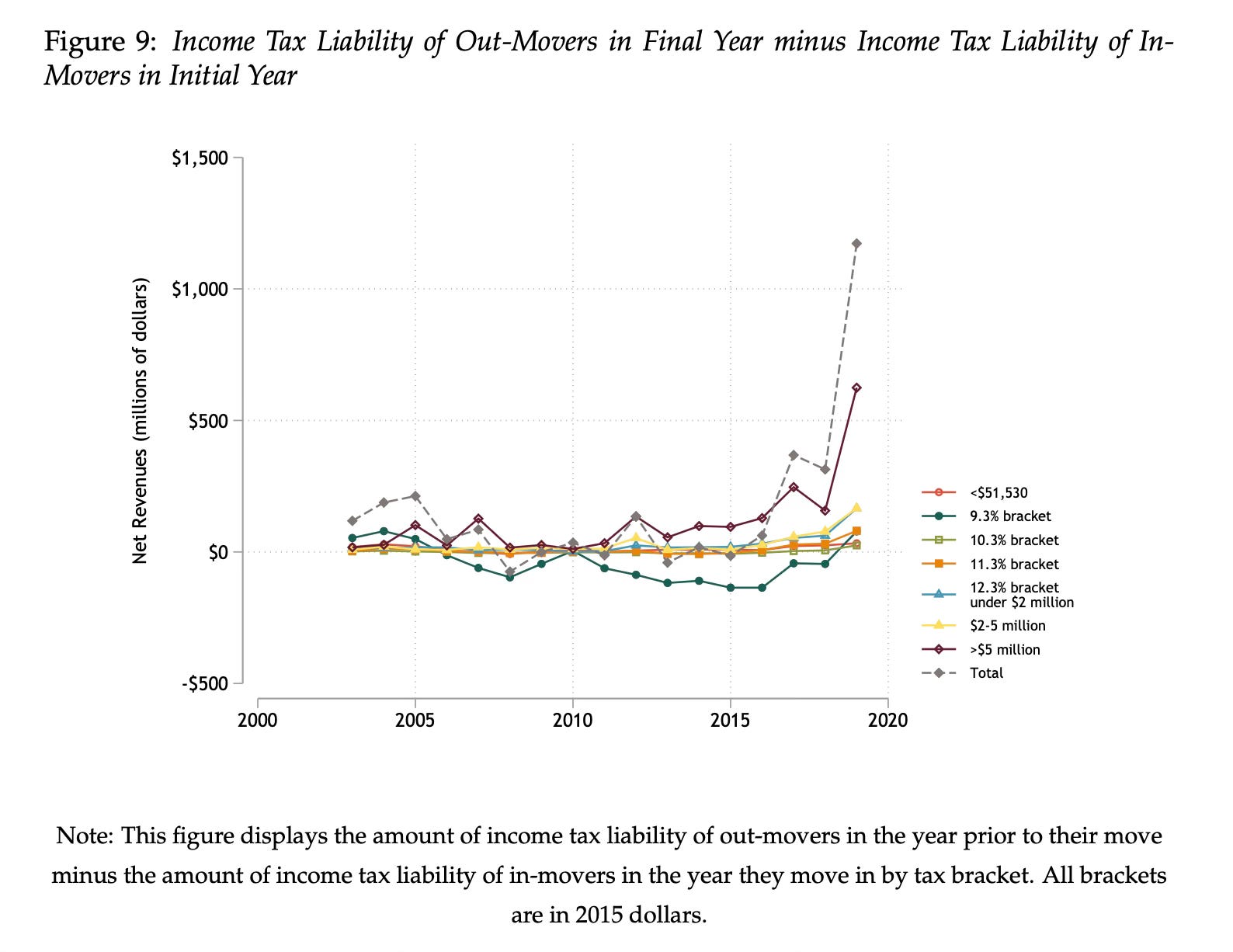
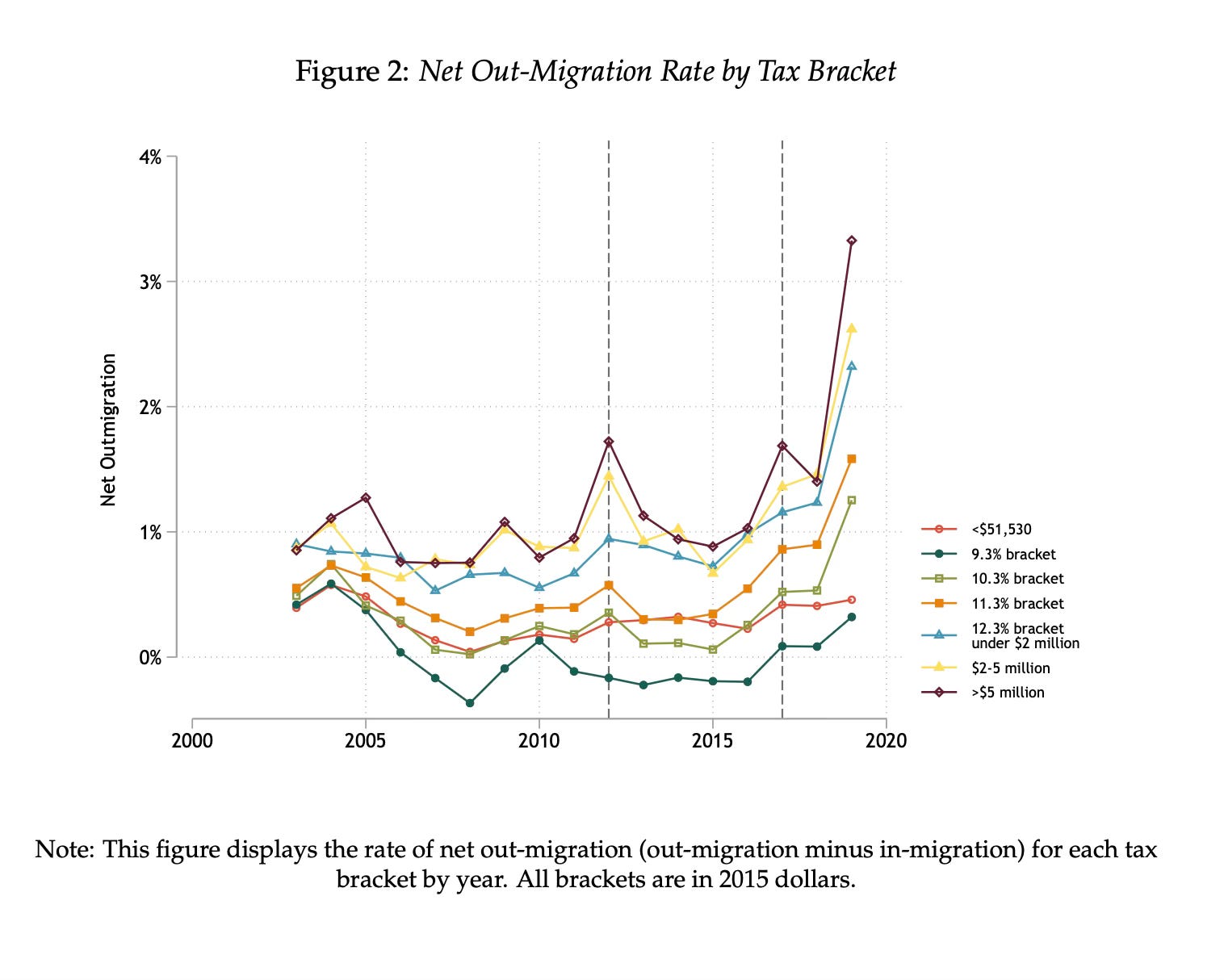
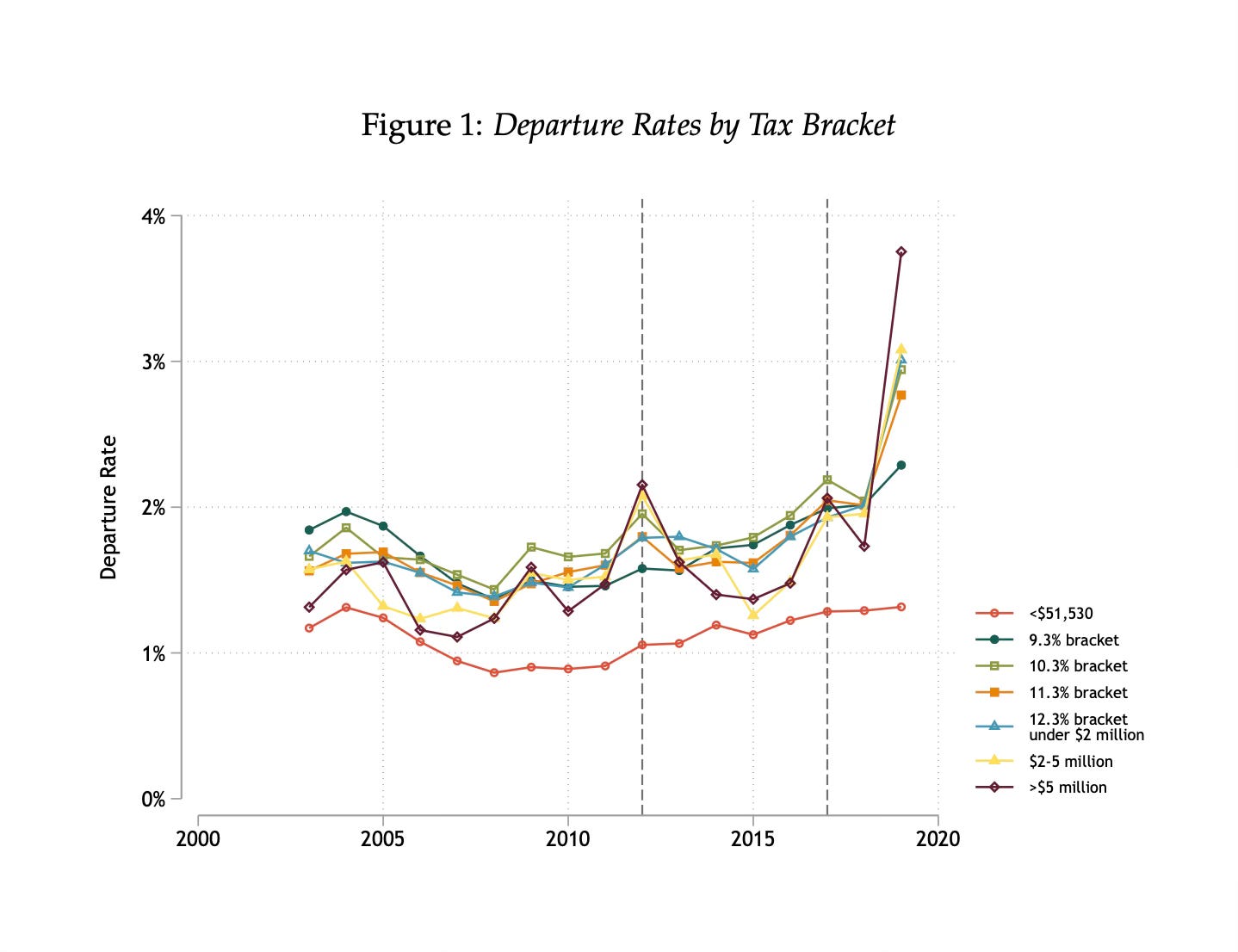
Rauh’s study was only possible because he secured special permission to access the Franchise Tax Board’s records. The agency itself lacks the funding and mandate to analyze migration in real time — a political choice, not an administrative one.
California measures earthquakes and droughts by the second but does not track how its taxpayers move or why. If the state wants to govern with competence, it must invest in real-time fiscal analytics so policymakers and voters alike can see the effects of each decision.
Ignorance may be convenient, but it is not leadership.
While California debates new taxes, other states are cutting theirs.
Since 2021, at least eight states — Arizona, Iowa, Mississippi, Georgia, Idaho, Louisiana, Kansas, and Ohio — have adopted flat income taxes. Louisiana dropped its top rate to 3 percent; Arizona to 2.5 percent. Iowa will reach 3.9 percent by 2026. Each reform was crafted to attract workers and investment from high-tax states.
They are winning that competition.
These states have paired federal advantages with predictable, simple tax codes that tell businesses and families, “You can plan here.”
California, by contrast, maintains a top marginal rate of 13.3 percent, climbing to 14.5 percent for some wage earners. That is not progressivity; it is isolation.
A recent LAist report underscores the point. California is home to 255 billionaires — about 22 percent of the U.S. total — more than any other state. Labor groups have proposed a one-time 5 percent wealth tax on net worth over $1 billion, targeting stocks, art, and intellectual property. Supporters call it fairness; critics call it folly. Business leaders warn that such measures could “drive more high-net-worth individuals and investment out of California, echoing trends seen after previous tax hikes.”
The debate captures California’s crossroads: fairness versus competitiveness — and whether the state can sustain its ambitions if it keeps raising the price of success.
California’s tax history shows both courage and volatility.
The state adopted its first income tax in 1935 with a top rate of 6 percent. Since then, the rate has changed nine times — six increases and three cuts — ranging from 6 to 15 percent. Since 1973, it has fluctuated between 9.3 and 13.3 percent.
In 2004, voters approved the Mental Health Services Tax, adding a 10.3 percent bracket for income above $1 million. In 2012, Proposition 30 raised the top rate to 13.3 percent — still the nation’s highest.
And yet the millionaire population grew. Data from Stanford and the Franchise Tax Board show that California’s millionaire households rose from 15,000 in 1990 to 150,000 in 2007, and nearly 200,000 in 2014. Researchers found that 99.5 percent of changes in the millionaire population stem from income dynamics, not migration.
But that was before COVID-19, before remote work, and before a federal tax code that rewards mobility. The dynamic has changed: wealth is now weightless.
The United States was built on fiscal federalism — a partnership between national ambition and local responsibility. The federal government collected enough to protect the whole; states collected enough to serve their people.
The 2017 tax law fractured that partnership. It transformed cooperation into competition.
California now funds a federal government that redistributes its prosperity to states that levy little and invest less. Meanwhile, California’s middle class pays higher state taxes to sustain services the federal government once shared.
That imbalance has made California both financier and fall guy of the American economy.
Restraint is not ideology. It is strategy.
California’s economy thrives when entrepreneurs, innovators, and workers believe success here is worth the effort. Each new surcharge erodes that faith.
Until Washington restores balance — until the nation stops penalizing productive states for their success — California must resist the impulse to tax its way to fairness. Over-progressivity does not solve inequality; it exports it.
Every major social goal — from education to climate resilience — depends on a stable, confident private economy. Restraint signals that California values execution over rhetoric and competitiveness over complacency.
The next governor should make that case clearly: until the federal system becomes fairer, California must not make itself poorer.
Even Governor Gavin Newsom has warned against crossing that line. Speaking about the proposed one-time 5 percent billionaire wealth tax, he cautioned that California “probably wouldn’t recover” if such a measure were enacted. His allies quickly launched a “Stop the Squeeze” campaign to oppose it — a rare act of fiscal realism in a political climate that too often prizes symbolism over solvency.
Newsom’s skepticism is rooted in history. Only four OECD countries still impose wealth taxes, down from a dozen in the 1990s. Sweden repealed its 1.5 percent wealth tax in 2007 after it drove investment abroad and stifled entrepreneurship. France and Germany abandoned theirs for the same reasons.
California should heed that lesson. A complex tax code is not a fair one; it is a fragile one.
California remains the fourth-largest economy in the world, larger than Germany’s and just behind Japan’s. But that ranking is not guaranteed.
Other states are moving fast, flattening their taxes and courting California’s people and capital. If Sacramento keeps raising its rates while others cut theirs, the state will be left competing against its own success story.
California’s greatness was built on imagination matched by execution — from aerospace to entertainment, from technology to environmental leadership. Today, the imagination remains. The discipline must return.
The next governor must defend not just California’s ideals but its balance sheet. Holding the line on taxes is not about protecting wealth; it is about protecting the state’s capacity to lead.
California has done more than its share to sustain the federal government. It should not keep punishing its own people to make up for that imbalance.
The question is no longer how much more California can tax.
The question is whether it will finally have the discipline to stop.
No posts
Comments
Nothing yet. Say the first thing.
Sign in to join the conversation.