
Following on from the 24 July essay, Coordinated Societies 15,000-5000 BCE.
“The more sharply and precisely the ideal type has been constructed, thus the more abstract and unrealistic in this sense it is, the better it is able to perform its functions in formulating terminology, classifications, and hypotheses”. [Max Weber, Economy & Society]
The purpose of this section is to show that the ideal type of Coordinated Society can be realistically illustrated by a pristine Homeric reiteration of it that reappeared several thousands of years after the original versions of coordination had disappeared.
The Coordinated Society is an evolutionary stage between Communalistic and Administered Societies. Humans experimented with coordinated governance until the opportunities and exigencies associated with agriculture, demographic concentration and territorial control motivated the inventions of writing and administration.
Coordination would have taken slightly varied forms in different places. However, it can be assumed that if for whatever reason an established administered society had suffered a major collapse, then the resulting vacuum might well be filled by the resurgence of coordinative governance. Such a retreat back to coordination would not depend on historical memory. It could arise independently as a practical response to recurrent structural problems.
One of the reasons for presenting a total historical classification of the unfolding stages in society’s evolution is to demonstrate the natural imperative for each type, which was always in some degree a need to redress limitations of the prevailing type. Humans could imagine the outlines of better societies in the future. But if pushed (or released) back into hunter gatherer life or simple household settlements they might reasonably not have rushed to recreate the administered society that had failed them.
Just such a collapse and reversal appears to have occurred in Greece 1100-800 BCE —an interlude now commonly referred to by historians as the ‘Dark Age’. There was this curious discontinuity in Greek history between 1200 and 600 BCE during which pre-administrative forms of governance were revived or rediscovered. The causes of the collapse around 1200 are much debated. A cataclysm may have combined with a conquest, a coup, and exponential growth in region-wide trade that caused Greek ruler kings to lose control over their profitable, tightly integrated and administered territorial economies. Only two facts are certain — the destruction of the palaces of the Mycenaean kings, and, in some territories, the cessation of wide-scale centralised rulership of the kind that had remained highly effective elsewhere in the Near East.
It is a ‘dark age’ because of the paucity of data, but also due to the ‘darkness’ of a catastrophic civilisational collapse with population reduction or dispersal. Alain Bresson has described what transpired in Greece after 1200 as “a genuine apocalypse”. The consequences were severe reductions in living standards and medium term shrinkage of commercial interactions. It seems possible that the skills and know-how that sustained the kingdoms—e.g. writing, administration, and all forms of artisanal expertise and specialised divisions of labour required by diversified economies for large societies reliant on mass market agricultural production—were entirely lost.
The relative security of life under laws and protections of kings was also lost. There is every indication—as in literary sources (below) and in the remains of weaponry and fortifications—that the legacy of this Dark Age was a violent, swindling, and predatory environment. Generations of survivors needed to reestablish or reinvent sustainable modes of settlement, defence, economic subsistence and political order.
In material terms it is clear that intergenerational adaptation to these circumstances in some parts of Greece initially involved a revitalisation of pre-administrative low-density small-scale householder economies combining cultivation, pastoralism and the construction of storage facilities. There is also evidence of dynamic reconstruction in some long distance exchange networks with neighbouring regions for imports and exports of diverse produce. Especially significant were the importation of new raw materials, techniques and technologies (iron, tools, writing, etc.). However, it seems that large segments of the population had little if any contact with the outside world. Or, what contact they had took the form of lawless raiding and looting. These people became the fictional fodder for Homer’s narratives. They are of interest to us because of their evolutionary reversion to oikos house-holding and coordinated governance. After the Mycenaean collapse they reinvented themselves as Stone Age coordinators.
For all these reasons, the political dynamics which Homer highlighted with great insight in his fictional depictions of Greek life in the early-to-mid 1st millennium BCE serve as valuable reconstructions of processes of governance, which are logically consonant with the theoretical ideal type of coordinated society. By examining this comparatively well-documented period and place we may identify a literal ‘structural imperative’ that might have been similarly perceived by humans many thousands of years earlier in territorially contiguous territories of the Levant and Mesopotamia at a time when the first sustainable settlements were in the process of initial formation. In that period the built structures, e.g. houses and warehouses, became indispensable.
Homeric society clearly was, in several ways, a coordinated society. Successful coordinated societies are assumed here to have been highly competitive, as was the Homeric society, and as were the two preceding types of society (Individualistic and Communalistic). Homer’s heroes competed cognitively in formulating the tactics of warfare, and physically in the display of military prowess. They also competed fiercely in athletic games, in the utilitarian giving of gifts and feasts, and in their acquisitions of marriage partners. In governance, the heroes competed in the style and content of their political proposals, which they argued over in regular Assemblies and Councils.
The individuals whose actions define the coordinated society were society’s formally delegated representatives. They were selected on the basis of merit from among the heads of leading households. Ideally, these people were competent in farming, war, organisational leadership and rhetorical discourse. Usually, they were male, mature in age, physically strong, charismatic, cognitively gifted or with specialised expertise.
Homeric society was structured by this ascending delegation of representatives who formed a leadership subgroup responsible for decision making. They regulated themselves competitively as a coherent group. From a theoretical perspective, the key universal variable is that each were independent heads of major households on their own account, regarded as being authorised by all households to represent distinct and competing subsocietal subsistence settlements in a geographically-networked area.
As such these individuals were ‘leaders’ equivalent in contribution and stature to all of the outstanding individuals we have identified in earlier societies. What had changed was the method of evaluating leadership. The difference in the coordinated society is the degree of relative permanence and structure implied by designated responsibility.
Factors that combined to demonstrate capabilities for leadership no longer had to be continually tested and proven in sight and hearing of the whole population. Instead coordinated societies created specialist subgroups—which in the Homeric society were designated as ‘councils’ and ‘assemblies’—where only leaders were present, or in which leaders were symbolically distinguished from the rest by some entitlements of leaders (e.g. their seating place, dress code, or ceremonially endorsed rights to speak).
In the literature on ancient Greece and Homeric societies these individuals are often loosely called the “basileis”. However, usage of this Mycenaean term—dating from and referring to 2nd millennium BCE monarchs—is not consistent either in the Homeric epics or in the scholarly sources. The difficulty can be avoided by following Kurt A. Raaflaub’s example, to see the 1st millennium BCE Homeric “basileis” simply as an elite subgroup who are not chiefs, kings or men of any kind of noble lineage.
In the Greek ‘Dark Ages’ we may infer from the Homeric texts that ‘councils’ of a dozen or so householders were delegated representatives of settlement societies. It may often have been the case that one among them—potentially an uneven numbered ‘thirteenth’—was regarded as a primary coordinator who might on occasions be asked to cast a deciding vote if other councillors were evenly divided on a complex matter. This ‘odd number’ position might have varied depending on whose household the meeting was held in, and the specialised nature of topics that had to be discussed.
In battle Homer has Odysseus crying out for one-man rule:
When he caught some common soldier shouting out, he’d beat him with the sceptre, dress him down: ‘You fool—sit still! Obey the commands of others, your superiors … How can all be masters here on the battlefield? Too many basileis can ruin an army—mob rule! Let there be one commander, one master only, endowed by [the gods] with a basileus’s sceptre and rights of custom: whatever one man needs to lead his people well.’ (Iliad, Book 2, 230-240)
However, ‘commanders’ were never tolerated on the ‘battlefields’ of village politics. The best scholarly interpretations of political patterns and mechanisms described in Odyssey and Iliad emphasise features of decision making that were not hierarchical. Individuals were not wielding power. Individual leadership did not rely on coercive authority. The men who became formally delegated representatives of householder settlements were selected by their peers on merit. It seems likely that these choices were based on easily demonstrable factors such as personality and physical stature, but, above all, a proven record in achieving and sustaining a level of material wealth, known abilities to diagnose problems and persuade others of the wisdom of their analysis, and known competencies in devising strategies that attain achievable ends.
In the Homeric context these leading representatives were transparently rewarded and compensated for their public services by such means as grants of land.
… these men form the backbone of the community. Although the oikos’ material and personnel resources support an individual’s claim to high status, such status depends on communal approval and needs to be justified by good leadership and service. It is the community (the assembled demos) that distributes the honorary share to the leaders and the rest of the booty equitably among all fighters, assigns to deserving persons a piece of the best land … [that] compensates the basileis for exceptional expenditures incurred in representing the community, and witnesses and approves communal action. The heralds invite all men, the entire community, to the assembly, assemblies are held whenever and wherever a decision needs to be made, and the leader ignores the assembly’s expressed opinion at his peril. The demos is thus politically significant. [Kurt A. Raaflaub ‘Society, Homeric’ in Margalit Finkelberg (Ed.), The Homer Encyclopedia, 3 Vols. Oxford: Blackwell Publishing, 2011:810]
In assessing the significance of these institutions, we should keep in mind that the men (laoi, demos) meeting in the assembly are the same who fight in the army and are militarily indispensable to the community. It is the demos who assigns the prize of honor in booty (geras) and land (temenos) to the meritorious leader and compensates the basileis for exceptional expenditures incurred in representing the community. The demos plays a role in jurisdiction as well and provides the forum for foreign policy decisions … [Kurt A. Raaflaub ‘Homeric Society’ in Morris, Ian, and Barry B. Powell. A New Companion to Homer. BRILL, 1997:644. doi:10.1163/9789004217607.]
In practical terms, what did these leading delegated representatives do? Two forms of advanced evolutions in processes of decision making are discernible in contemporary translations of Homer’s accounts — the ‘assembly’ (‘agora’, a meeting place) and the ‘council’ (‘boule’, a place of consultation and deliberation). These were two prehistoric versions of the discussion forums that would eventually acquire historical importance as fulcrums for a succeeding new ‘participatory’ society in cities such as Athens.
At this stage we need only explore the possibility that comparable ‘ideal type’ meeting places were utilised in similarly logical ways to help organise sedentary settlements of households in coordinated societies that could potentially have emerged 12,000 years earlier in the Levant or 8,000 years earlier in Mesopotamia. In Homeric contexts the two complementary forums may have operated as paired stages in a process by which communal matters were identified and debated, then decided and ratified.
Combining Homer’s insights (interpreted in the excellent historical analyses of Kurt A. Raaflaub) with what we know of earlier societies the process and function of the Assembly in the Dark Ages might be realistically reimagined as follows:
A general ‘assembly’ is ordered into existence by delegated representatives. The circular physical arrangement is the same as in the earlier forms of society but for the fact that the inner circle is now reserved only for those who have acquired the special status of representative.
The division of the labour of leadership is no longer spontaneously and repetitively reestablished on the basis of performances of charisma, intelligence, or physique, as was the case when individualistic and communalistic societies decided about subsistence, security and social order. In contrast, the Homeric coordinated society undergoes a process for the artificial selection of representatives. As such, the names and possibly the functions of the representatives are publicly announced to the audience.
The agenda of the meeting is also announced. These declarations are made by a person identified in our Homeric sources as the “convenor”.
The convenor is a senior delegate who has a distinct ‘leader’ advantage for wielding political influence. After making his preliminary announcements, he can state his own preformed opinion about matters that are on the agenda. Although he does not set the agenda, he wields disproportionate influence by preempting the opinions of others.
In Homer’s accounts the ordered and structured nature of decision making in a deliberative coordinated society is revealed to the gathered people by the fact that in order to speak one must first be handed the convenor’s ceremonial sceptre.
As in previous societies the performances are highly competitive, and speakers are often blunt in their criticisms of others. The strategy for persuading people includes the value of entertainment as well as displays of sound rationality.
But assemblies were not only for debating. Often they functioned as organised gatherings to mark occasions, to make declarations, or to negotiate and witness various distributions of goods and services within the group. In this respect Homeric coordinated societies were by no means unique.
Similarly, assemblies were the place to make public complaints and to adjudicate all matters concerning social order, the stability of the group, or agreements on acceptable and undesirable actions. As long ago as the earliest and smallest pre-coordinated societies these were always among the functions of ‘the meetings’.
The vital difference in the case of the coordinated society is that this process of airing and adjudicating responds to a radically new reality. There now exist durable settlements, a built environment of households, and dramatically larger groups. None of this was possible without substantially more organisation in the form of structures for deliberation, representation, and delegation. But the literal ‘structural imperatives’ driving those new developments were already (as will be argued in a future section) apparent in the Levant 14,000-10,000 BCE.
The political change is as follows:
Agreements reached by discussion in the assembly of the early coordinated societies were not binding. Legal thought was in its infancy, and legal enforcement lay in the future. Yet the fact that discussions were structured by organised acts of representation and delegation meant they carried more force and would be more diffusive in their impact than any agreements reached through the looser talk that had characterised discussions in earlier communalistic societies. Whatever structured discussion lost in spontaneity and creativity was compensated for by the greater predictability of procedural mechanisms and increasing likelihood that decisions would be followed through to their intended outcomes.
Furthermore, the formal application of a set of behavioural rules to regulate the intensively competitive process of decision making that was so characteristic of almost all activities in Homeric society might well have permitted more liberty to reveal truths, which in earlier societies had been avoided because of the risk that they might provoke violence and disorder. One of the well-known features of Homeric dialogue and the ‘heroic code’ is the relative lack of reverence and the willingness to give, and accept, blunt criticism regardless of the age and status of the protagonists.
In sum, the Homeric assembly enabled structured discussion with a fairly complex arrangement for representation and delegation. It was potentially efficient in giving voice to interested and representative parties in a regulated and predictable proto-institutional environment. What it lacked, however, was the authority to reach its own independent conclusions. Though the assembly could effectively air information and opinions it nevertheless often terminated without having reached final agreement.
In this respect, the Homeric assembly was perhaps less effective than the more loosely regulated meetings of communalistic societies, which simply ended, however crudely, with a majority show of hands. It is for this reason that the Homeric assembly existed alongside a second forum for a more ‘formally enabled’ decisional delegation, and whose ‘final’ judgements might more easily be ‘imposed’ on the settlement.
This second organ of Homeric delegated governance is the so-called Council. It is the conceptual domain properly pertaining to the “basileis” insofar as that term is useful when evaluating, for example, political conditions pertaining to ca. 800 BCE.
Membership in the council was restricted to the leading householders, who, in terms of personality, intelligence, and physique, were probably the most assertive property owners of the largest, oldest, or most dynamic and productive ‘farm’ properties.
In the Homeric legends the basileis are portrayed as tough heroic adventurers who fought wars, seized booty, and feasted gluttonously. In functional socioeconomic terms they were members of emergent proto committees of hardboiled entrepreneurs who accumulated, staffed and protected the larger properties. We shall later see why the actions and functions of these men could have been similar in classificatory terms to the householders who were the essential dynamic influencers in the communalistic groupings that emerged in Mesopotamia prior to the agricultural revolution.
On the basis of their demonstrably rightful or legitimately deserved dominance over provenly profitable and intergenerationally stable households these men were then formally delegated by their wider communities to create larger and wider governed zones. The rules may not have been explicit, but in this capacity they were initiated into the ceremonial nature of relatively complex coordinative governance.
Again, it is Raaflaub who has most persuasively captured the subtle delicacy of the balance of influence and diplomacy among the non-hierarchical non-rulers who many scholars still confusingly refer to as “basileis”. He first quotes the revealingly self-effacing words which Homer attributes to Alkinoös —
“twelve are marked out as basileis in our demos … and I myself am the thirteenth” (Od. 8.390-91).
Then:
In every community there are many basileis; they are described functionally as leaders, councillors or elders … Despite differences in wealth, power of the oikos [household], personal qualities, and influence, they form a fiercely competitive group of equals, among whom the paramount basileus holds an inherited, though precarious, position of preeminence as primus inter pares … Their status is based on family, personal accomplishment, and reputation, all of which are stressed when the need arises to speak in the assembly. Their goal is “always to be the best and to excel among the others” (Homer Iliad 6.208). Indeed, these are not ‘rulers’ or ‘monarchs’; rather, they are best explained as an aristocracy-in-formation … [Kurt A. Raaflaub ‘Homeric Society’ in Morris, Ian, and Barry B. Powell. A New Companion to Homer. BRILL, 1997:634. doi:10.1163/9789004217607. See similarly Finlay 1970:83].
There is, however, no evidence that ‘preeminence’ was inherited. To repeat, these were not ‘kings’. If we imagine the process of governance formation then at some point in time in an unknown place one man was the first protagonist of what we here call ‘delegated representation’. Conceivably this innovation might have been on his own initiative. But for it to have been deemed acceptable by his contemporaries, and for it then to be reproduced in later generations among deserving offspring and in other small societies, it would have required ratification through preexisting established processes of communalistic decision making.
Furthermore, though our sources carefully conceptualise “a hierarchy of speaking” based on status markers such as age and experience there is no credible evidence that the ceremonial preeminence of a notional senior man bestowed power or authority. Even were twelve men in the presence of a thirteenth ‘first among equals’ they would not escape their principal requirement to demonstrate and legitimate their deserved right and merit to be a delegate and representative of wider geographically-defined interests.
The valuable time-saving (and possibly face-saving) procedural difference between assembly and council was that the council’s elite were not required in every meeting to prove their qualities of leadership to the larger sections of a society’s population. Theatrical competitions for the purpose of demonstrating intelligent means-ends rationality to people whose comparative strengths lay principally in non-cognitive markers of age, sex, personality or physique consumed valuable time and energy.
The Homeric society’s coordinated arrangements for Assembly and Council delegations thus ensured a higher level of natural and artificial selection. Their counterparts and audience were more like equals. They were pre-selected for their preexisting qualities of leadership. It was a process of political filtering that singled out the capable men. Their interactions were probably as theatrical as before, but much time and effort was saved by restricting the audience to men who were already intimate and had long ago undergone their merited selection for excellence.
For as long as these men were willing and able to periodically renew their mandate to represent their closest neighbouring—usually smaller, weaker, or poorer—households, the system of delegation to assembly and council worked tolerably well.
The council probably had higher organisational authority. The agendas of the assembly meetings appear sometimes to have been agreed beforehand in a council meeting attended only by the delegated basileis elite. The Homeric assembly had a potentially wide audience with broader representative rights to speak (including any householder who had participated in military campaigns) and an extensive array of functions (possibly including discussion of communalistic labour processes and the organisation of distributions of goods and services). It may be useful in this context to conceive this as a crude separation between executive and representative branches.
Despite the absence of ‘centre over society’ rulership (as had existed under the Mycenaean kings), the two-part system of delegated representation by ‘persons over group’ (here called Coordinated governance) does indeed rank its participants in terms of status, i.e. by their assumed rights to have their demands and opinions heard prior to decisions that were deemed deserving of joint consideration by varied stakeholders within and across settlements. But, fundamentally, this process remains rooted in the communalistic tradition in the sense that representatives have been deliberately delegated rather than incidentally or indirectly imposed. The decision making is distributed collegially by delegation. On the other hand, this governance is not continuous. It is recreated with each assembly, and assemblies are created only when issues arise that require coordinated decisions. And, if a decision cannot be reached through assembly, it is left to leading basileis acting together in council.
It needs also to be reemphasised that Homeric leaders made great efforts informally and procedurally not to be regarded as ‘chiefs’ or ‘kings’. Places where assemblies and councils meet are not permanent seats of governance. It could be that the ‘paramount’ basileus at any given moment or place was simply the messenger who proposed the matters that needed to be discussed jointly within or between settlements, or whose settlement was geographically most convenient, or who had a large enough house. He convenes a council in his big house with banquet, wine and sleeping quarters for travellers. His fellow peers display deference toward him as the host and convener. As noted above, to ignore the will of his peer group of representatives would be to invite disorder and the collapse of inter- or intra-settlement governance. The routine is ad hoc intra-settlement communalistic elite governance among the larger households.
Councillors were unlike the administrator kings of 1200 BCE. They had reinvented themselves in much the same way that vanguard diplomatic householders of Natufian and Mesopotamian settlements might have done 5000 or even 14000 years earlier — as coordinators, representatives and delegates of societies that had not yet fully thrown off their evolutionary individualistic and communalistic heritage. Next, we consider whether significantly similar structural conditions existed thousands of years earlier among households and settlements that were genuinely creating pristine societies.
Margalit Finkelberg (Ed.), The Homer Encyclopedia, 3 Vols. Oxford: Blackwell Publishing, 2011.
Finley, Moses I., and Bernard Knox. The World of Odysseus. Nachdr. New York Review Books Classics. New York, NY: New York Review Books, 2002.
Morris, Ian, and Barry B. Powell. A New Companion to Homer. BRILL, 1997. doi:10.1163/9789004217607.
Morris, Ian, ' Greek Multicity States', in Peter Fibiger Bang, and Walter Scheidel (eds), The Oxford Handbook of the State in the Ancient Near East and Mediterranean (2013; Oxford Academic), https://doi.org/10.1093/oxfordhb/9780195188318.013.0011
Osborne, Robin. Greece in the Making 1200-479 BC. 2nd edn. Routledge, 2009. doi:10.4324/9780203880173.
Raaflaub, Kurt A., and Hans van Wees. A Companion to Archaic Greece. Blackwell Companion to the Ancient World. Malden, MA: Wiley-Blackwell, 2009.
Kurt A. Raaflaub, Ancient Greece: Man the Measure of All Things, in Raaflaub, Kurt A., ed. The Adventure of the Human Intellect: Self, Society, and the Divine in Ancient World Cultures. Ancient World: Comparative Histories Ser. West Sussex, England: Wiley Blackwell, 2016.
Bresson, Alain. The Making of the Ancient Greek Economy: Institutions, Markets, and Growth in the City-States. Translated by Steven Rendall. First paperback printing. Princeton Oxford: Princeton University Press, 2019.
Schofield, Malcolm. Saving the City: Philosopher-Kings and Other Classical Paradigms. Issues in Ancient Philosophy. Hoboken: Taylor and Francis, 2003. [Chapter One: Euboulia in the Iliad originally published in Classical Quarterly 1986.]
Lane Fox, Robin. Homer and His Iliad. New York, NY: Basic Books, 2023.
Lemos, I.S. and A. Kotsonas (eds) 2020. A Companion to the Archaeology of Early Greece and the Mediterranean. Hoboken: Wiley Blackwell.
Gagarin, Michael. Democratic Law in Classical Athens. First edition. Fordyce W. Mitchel Memorial Lecture Series. Austin: University of Texas Press, 2020.
Reden, Sitta von. The Cambridge Companion to the Ancient Greek Economy. Cambridge Companions to the Ancient World. Cambridge (GB): Cambridge University Press, 2022.
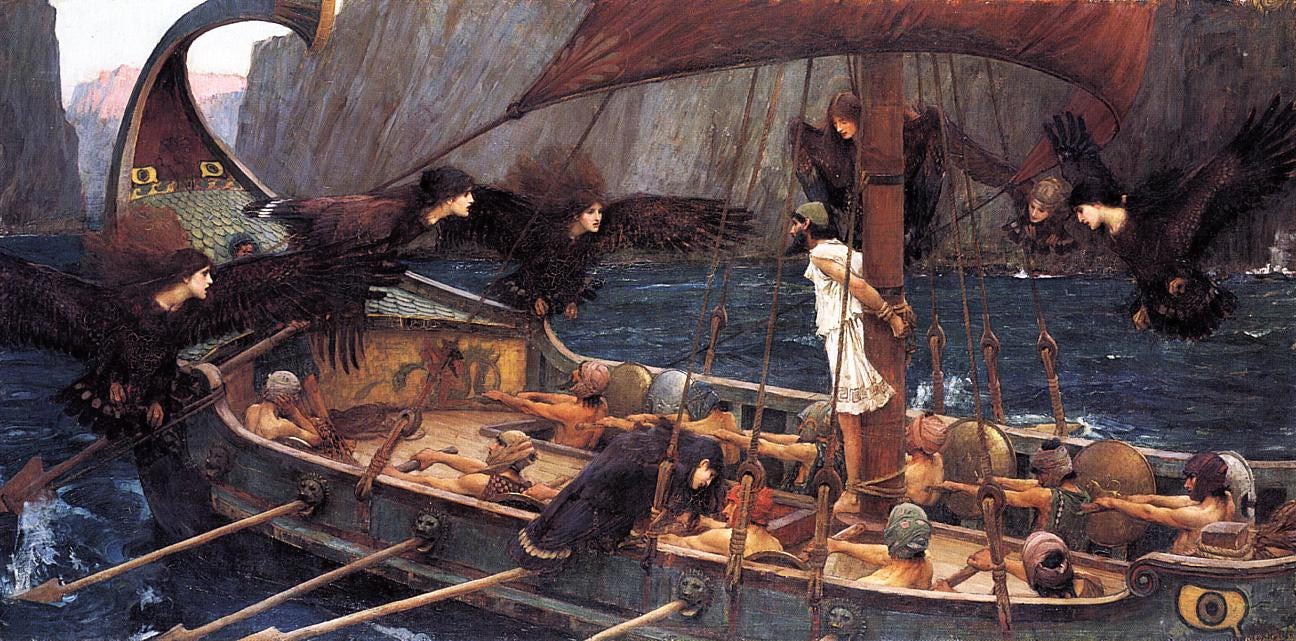
Ulysses and the Sirens by John William Waterhouse, 1891 England
Comments
Nothing yet. Say the first thing.
Sign in to join the conversation.