
My next Berkshire OLLI course (Winter 2027) will be on the Radical Duke.
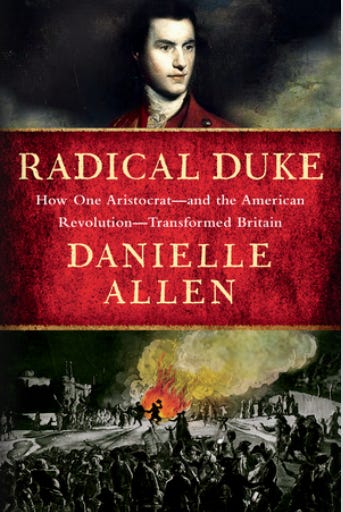
This course will form part of Berkshire OLLI’s 250th Anniversary series, since the action in the book takes place in the years surrounding the signing of the Declaration of Independence. It is also of local interest, since the name of the Duke is familiar to those of us who live in Berkshire County. The area above the Indian Town (which became Stockbridge in 1739) was known as the District of Richmont. Its history is complex and distracts from my immediate desire to focus on the Duke. If interested, see the footnote for entryways to historical rabbitholes.1
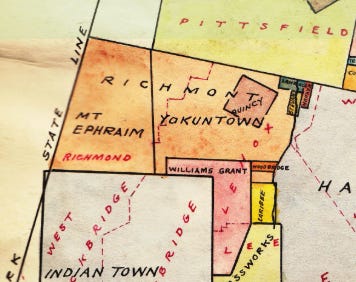
The Town of Lenox was established in 1767. Ironically, one of its original proprietors was Daniel Allen (note the name of the author of the book shown above).
Prior to that happening, Richmont had been split in two. The western part was called Mount Ephraim and the eastern end was called Yokuntown; both parts were named after the Native men who had earlier laid claim to them. Title to those lands was murky. Some colonists bought land from the two named gentlemen, others bought lots from the Massachusetts Bay Colony based in Boston.
In any case, the English residents of these two areas wanted to establish two separate townships because of the hardship of having to go over the mountain ridge between them during the winter months to attend church services. In those days, in order to create a Town, there was a requirement of at least sixteen proprietors (i.e. property owners), a meeting house, and a minister.
Having met these requirements, the two districts applied for township status to Boston and were granted the names of Richmond and Lenox.
What has all of this to do with the Radical Duke? Well, in case you haven’t figured it out already, the Duke celebrated in the book was Charles Lennox, Third Duke of Richmond. (The clerk who submitted the paperwork to Boston misspelled his name.)
During this period, the Duke of Richmond was in charge of the English colonies in America. He was of royal descent and a highly-regarded member of the English aristocracy. He was also a local hero because he was an advocate for letting the colonies have their independence.
What Danielle Allen maintains in her book is that “March” (as he was known in his younger days since he was the Earl of March) was more than just a verbal advocate for colonial independence. The Duke (as he came to be called when his father died in 1750, when March was not quite fifteen years old), among many other things, was a mentor to Thomas Paine (and many other pamphleteers).
Allen claims that her research has provided persuasive evidence that the Duke successfully indoctrinated Paine into the Duke’s views of governance, and then sent him to America (Paine arrived late in 1774) to help foment the Revolution. Paine was a prolific and gifted writer, and there is no suggestion that the Duke aided him in his writing, other than to provide information and philosophy.
Intrigued? Read the book. Sign up for my OLLI course. Not yet, as it is still several months in the future. You can count on receiving reminders.
Ah, yes, remember the title of this post?
In keeping with my prior OLLI course on Reframing the Questions: Moving Beyond Identity Politics (Winter 2025), I would like to remind everyone that, in many real-world contexts, labels don’t matter. For example, in an essay in The New York Review, Michael Greenberg writes
Greenberg goes on to say
Some Democratic stalwarts have publicly fretted that the self-professed socialism of these candidates will hand Republicans a truncheon with which to run wild. They fear that the entire party will be tarred as “anti-American.” This sort of hand-wringing smacks of cowardice and exposes just how badly Democrats have lost their ethical bearings.
A perfectly valid criticism, in my opinion. And, in a final broadside:
Jaime Harrison, the former chair of the Democratic National Committee, recently sent a warning to socialists:
If you hate the Democratic Party, then please don’t run for our nomination. Don’t use our resources. Don’t rely on our volunteers. Don’t use our infrastructure. Focus on building the party you actually support.
Never mind that the DSA supplies its own volunteers—if Harrison were to be heeded, Democrats would run the risk of shrinking into permanent irrelevance. They would do better to welcome socialists into the party and to adopt some of their ideas, which are no more radical than Social Security was during the New Deal. Our two major parties have moved so far to the right since 1980 that common-sense proposals to rebalance the economy are met with terror, as if they will turn the US into a twenty-first-century version of the Soviet Union. But Democrats currently have no path to becoming the majority party without making room for an outspoken and unambiguous left flank.
In presenting this mélange of ideas and labels, I was going to use it to highlight the folly of using such ill-defined terms as the just-given “left flank" or “moved to the right” instead of focusing on actual policy ideas (which Greenberg also does when he mentions “abolish ICE, raise taxes on the rich, oppose US support for Israel’s war crimes in Gaza, and Medicare for All“
But then I happened upon an exchange on Paul Krugman’s Substack that makes my point. To wit:
Paul Krugman: Yeah. What I take a lot from you is that the idea of, “Well, Medicare for All, that’s kind of a left-wing policy, and people will be against it”—it’s not clear that the public even thinks about it as being a left-wing policy, or even that the public has a left-wing versus right-wing conception except sort of as a caricature vision. So...
G. Elliott Morris: Yeah. A public option for healthcare, if you want to say it that way, polls very well. The 60–65% universal healthcare idea and expanding Medicaid polls at 75–80%. People want more of a government role in health insurance. I just saw a lot of the interviews with younger people in Michigan as well. And, you know, anecdotes are anecdotes, but still, most of the accounts from these young people about why they supported Abdul El-Sayed were healthcare-related—that they wanted some guarantee of health insurance.
From the Archives (1991)
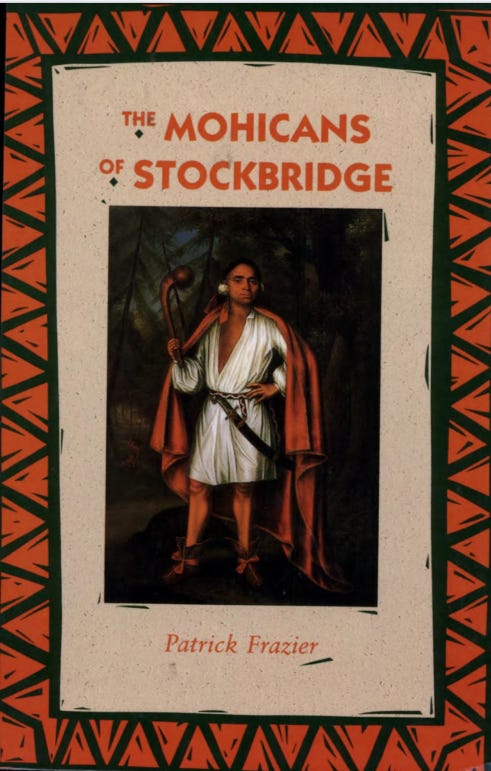
More on the early history of Berkshire County (which was created in 1761 by splitting it off of Hampshire County).
The history on this ^ website differs in some details from the one told by Patrick Frazier. I’d be more inclined to follow his account. I’ll try to go into more detail in a future post (or, even better, take my OLLI course…).
https://hillsdalehistorians.wordpress.com/2018/01/31/in-search-of-nobletown/
This ^ link also mentions my town (Alford):
Alford, MA was established on the land acquired in the Shawenon Purchase [1756]. A map [shown in the post] of Alford suggests that a line extended from the northeast corner of Nobletown [now Hillsdale] would indeed intersect with Stockbridge as it existed in the 1760s.
To repeat the map shown above:
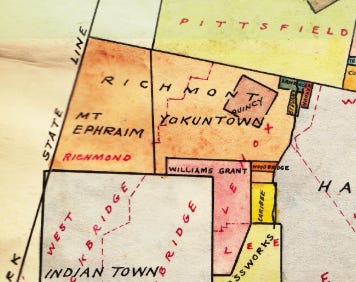
Notice that the “New York State Line” slightly overlaps the northwest corner of the Indian Town. The truth is that, in those days, no one knew exactly where the border was. There were many disputes and even bloodshed associated with disagreements. The small triangle to the left of the Indian Town extended south into what is now Alford. It was called “The Gore” because of the uncertain nature of its statehood. The present New York/Massachusetts border was not finalized until the 1850s.
The Gore
A gore is a small, irregular (typically triangular) piece of land left over between larger, adjoining surveyed properties or administrative boundaries. [see Wikipedia]
Comments
Nothing yet. Say the first thing.
Sign in to join the conversation.