
The March 9, 2026 issue of The New Yorker featured an article on The Man Who Broke Into Jail. In my post The Year With No Autumn Foliage, I wrote about the end of my time in jail. In that post, I gave links to two earlier posts describing what led up to that incarceration, and I promised a couple of posts to come (which have not yet materialized).
So it is perhaps not surprising that The New Yorker article caught my attention. The story is fascinating in and of itself, and as I became mesmerized by the mystery of why a person would do such a thing, I began to be entranced by similarities to what I experienced all those (63) years ago when I was in jail.
As background to the story of how and why Alexander Friedman became “The Man Who Broke Into Jail” here is an account of his first arrest. He was not trying to break into jail, but he ended up there after trying to rob a numismatic shop in Nashville.
[Police Officer] Forrest brought Friedmann to a hospital, where his wounded hand was treated. Eventually, Friedmann identified himself and confessed. “He didn’t have any emotion in his voice,” Forrest recalled. “It just seemed like he was unfazed by the events going on around him.”
Friedmann, who was charged with armed robbery and three counts of attempted murder, was sent to Nashville’s old central jail.
I was struck by the description of his lack of emotional display. Along with several other clues in the article, this led me to believe that Friedman is probably autistic. I recalled a story that my (autistic) friend John Robison told me, and related in one of his books. John was fixing his motorcycle when someone came in to the shop and announced the terrible news that a friend of theirs had just been killed in a motorcycle accident. As John continued to work on his bike, showing no emotion, the bearer of the news said to him, “What’s the matter with you? What are you doing? Aren’t you upset?” John’s expression didn’t change, nor did he say a word. His trauma was real, but he kept it to himself, thinking “Of course I’m upset. How could I not be upset? How could anyone even think I’m not upset? A horrible tragedy has just happened and I can’t do anything about it.”
In my earlier writing I had described a similar incident when I was in jail and my minister came to visit me. “One thing that is troubling me,” he said, “is that you have shown no signs of remorse.” I’m sure my face gave him no sign of emotion, but my insides were in turmoil. I was experiencing a storm of negative emotions, remorse among them. How could he think I was not sorry? My life was in shambles. My dreams of going to college had been shattered. I had hurt people, not the least of whom was my father. How could my minister think that someone in my position was not full of remorse and regret?
It was only many (maybe forty) years later that I learned that neurotypical people expect visible displays of emotion. Autistic people, on the other hand, can read the emotional landscape and don’t feel a need for external reinforcement. I am, I realize, overgeneralizing, but I do it to support my idea that the subject of the article being discussed is autistic. Back in 2013, I wrote about all of this in the context of empathy.
As I think back on the events in my life that happened over six decades ago, my feelings of that time are still very much with me. I vividly remember and re-experience the pain I felt then. My life was in shambles, and instead of guidance all I got was scolding. Except from my parents. My mother never lost faith in me, and I felt nothing but love from my parents.
In that and other respects, my story is nothing like that of Alex Friedman. His parents had abandoned him as a child, and he became a ward of the state. His crime was violent, my robberies were not. I was charged with “Breaking and Entering in the Daytime” and the crimes I committed were done in private, when no one was at home. I can, nonetheless, relate to his flat affect. I have witnessed that in many autistic people, and heard about it from countless others.
to give a flavor of what Friedman was like…
Friedmann went inside [the Nashville jail] on November 30, 1987. He was barely out of boyhood, myopic, five feet seven, and pencil-thin. [he was born in 1969]
Friedmann tried to kill himself again.
Friedmann never brought up the fact that he’d almost killed three people, or that he’d been shot and nearly killed himself. He seemed as unfazed as he’d been when he was arrested.
“He wasn’t manifesting symptoms of mental unwellness, but you thought there must be something going on.”
Some parallels to autism and my own mental state:
A judge ordered a psychiatric evaluation. A psychologist concluded that Friedmann suffered from dysthymia, today known as persistent depressive disorder, and schizoid personality disorder, writing that he showed “indifference to social relationships and a restricted range of emotional experience and expression.” He also had a tendency to “blur fantasy with reality.”
My longtime readers will know of my dislike for the DSM and its insurance-related categories, most of which are called “disorders” so that people with the conditions can qualify for reimbursement for treatment. A condition such as depression can hardly be called a disorder when a large proportion (maybe even a majority) of the population has experienced depression at some point. More than a dozen years ago, I wrote about The Healing Power of Depression.
The bits about “indifference” and “restricted range” are typical of how neurotypical people perceive autistic people. I was nearly sixty years old when I figured out that I’m autistic. Soon after that, I asked one of my childhood classmates about my lack of social connections. I asked her if she realized that I had felt left out “No,” she said, “we just thought you’d rather be alone.” That was the last thing I wanted!
Also, as mentioned above, the flat affect of autistic people often leads others to believe that because we don’t express our emotions in the neurotypical fashion, we are therefore not experiencing them. Again, nothing could be further from the truth. We are often overwhelmed by emotion and need to calm ourselves by being quiet in order to avoid having a complete meltdown.
Friedmann, now twenty-two, robbed a comic-book store and then tried to steal trading cards from a Kroger supermarket.
There is a long description of his capture, including his confession that “When the officer asked Friedmann how he’d stashed the weapons so cunningly, he said that he’d learned to do it while jailed in the Criminal Justice Center.“
When I was in the County Jail, I was given many offers to lead a life of crime once I was released. I was told stories of how easy it was to pass counterfeit twenties, for example.
The judge ordered Friedmann’s psychologist to evaluate him again. He arrived for the interview in a placid mood, carrying two books. This time, he was more candid with her, confiding that his criminal career had started before the attempted robbery at the Coin Purse. He’d been shoplifting since he was a child, he said, and saw himself as a “manipulator” and a “thrillseeker, viewing illegal activity as a challenge.”
Ah! this is the story of my early life.
I was a shoplifter from an early age. I stole things from my parents. I took old coins from my mother’s drawer, so I could buy penny candy. She was saving them, and was very upset when she found them missing. I still feel bad about doing that. On a more humorous note, I stole some condoms from my father so that my friends and I could make water balloons. Later, I stole cigarettes from him so I could join my friends in the woods. One day, my friend Henry Ford brought cigars, stashed in a clever hiding place in his bicycle. I was never so sick — I think I literally turned green. Luckily for me, that turned me off to smoking.
When I was about seven years old, I tried to steal a rubber dog bone from Braman’s drygoods store. I cleverly (so I thought) put my baseball cap over the bone and then picked up the hat with the bone inside it. Anne Braman saw me do this from afar and came over to scold me. I began to cry as she asked me why I was doing it. I told her my dog didn’t have any toys and I did not have any money. She told me she would not tell my parents, but if she ever caught me again, she would turn me in. I continued to cry as I left the store — quite an act, since I was laughing inside. I did not have a dog.
Ironically, a couple of years later, Norman Rockwell asked me to pose for a painting called “Happy Birthday Miss Jones” (also called “The Schoolteacher” by some). I’m the boy in the red shirt with an eraser on my head. When we posed for the photographer, there was no schoolteacher present. Norman had her photographed before he rounded up the children. “Jonesy” was, in real life, Anne Braman.
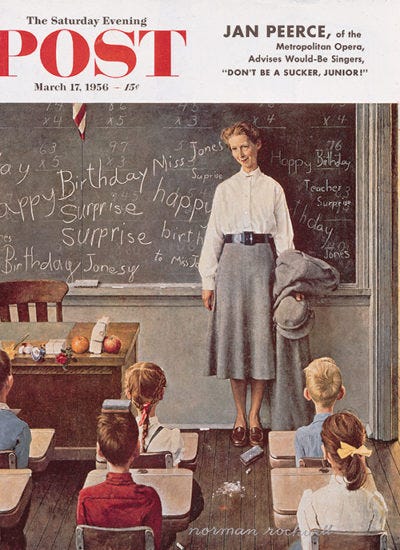
My attempted theft of the bone was only one of many times I tried to steal things (sometime successfully), just to see if I could get away with it. The self-description of Friedman as a “thrillseeker“ is another piece of evidence I offer to support my contention that he is autistic.
Self-stimulation — often called “stimming” — takes many forms, and is a well-known characteristic of autism. Mild stims include such things as spinning objects or hand-flapping. Children might arrange their toys by size or color. Extreme stims include activities that could be called “thrillseeking” such as riding on a roller coaster.
I could give many examples of how I flouted authority in my quest for stimulation. School was too easy for me, so I needed to spice it up. When I saw that Friedman had “been shoplifting since he was a child, he said, and saw himself as … a “thrillseeker“ all of my own memories came rushing to the fore. I now see all of these activities as being symptomatic of my autism and my need for stimulation, but, at the time, the adults in my life wondered how an A-student and Eagle Scout could be so morally deficient.
There are more parallels. “Amid the chaos [of the prison], Friedmann found a pocket of calm.“ In my earlier posts, I have recounted how much I loved the freedom of being in jail. Like Friedman, I attracted protectors, and probably for many of the same reasons.
The excerpts that I have shared all came from the first half of the article. The rest of the piece details his subsequent crimes, arrest, and internment — none of which has any resemblance to my life. But I was struck, as you can see, by the similarities (amidst the differences) of our early lives.
When I was released from jail, one of the conditions of my probation was that I had to undergo counseling. I was seeing a psychiatrist who became frustrated that he didn’t seem to be able to hang Freudian tropes on me. “I don’t know why you steal,” he admitted, “but I do know that if you keep doing it you will completely mess up your life.” That made sense to me. I stopped.
For readers who have followed me this far, I hope you have received something of value from my retelling. As I have already alluded to, revisiting my experiences triggered in me many negative emotional responses.
I am aware that many mental health counselors advise trauma victims not to retell their story of the trauma because of such triggers. I recently had nightmares that clearly grew out of my refreshed memories. Yet, I welcome the chance to rethink my experiences, and learn and understand more about myself.
I have come to appreciate how, through dint of effort and my sheer stubbornness — being unwilling to give up in the face of adversity — I have overcome many of the challenges that plagued me for so long.
I’m not yet perfect. I am still young, however, so give me a bit more time…
Comments
Nothing yet. Say the first thing.
Sign in to join the conversation.