
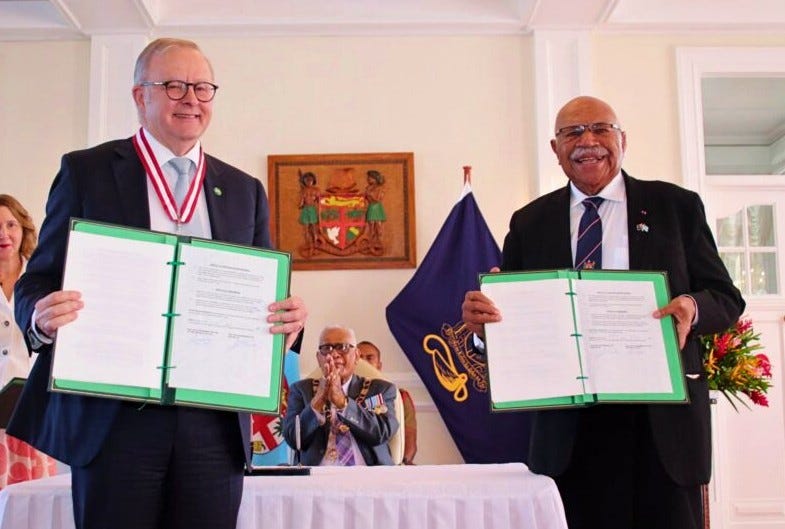
As political and diplomatic theatre goes, events in Suva, Fiji, on July 6, were almost comically over-staged.
Gathered at Government House - with all the overdressed pomp Fiji’s elite can muster - were Australian Prime Minister Anthony Albanese and Fiji leader Sitiveni Rabuka, signing two treaties: one a military pact plainly designed to fend off China in the Pacific, the other carrying a faintly colonial economic flavour.
Just two kilometres away, surprisingly unnoticed by diplomats and media, sat China People Liberation Army Navy spy and tracking ship Yuan Wang 5. At the same time, a Chinese submarine test‑launched a ballistic missile with a dummy warhead that splashed down 1,500 km north of Suva, near Taiwan‑recognising Tuvalu, prompting a wave of carefully worded protest statements. The missile’s flight path also passed near the U.S. Army’s Ronald Reagan Test Range on Kwajalein Atoll in the Taiwan‑recognising Marshall Islands.
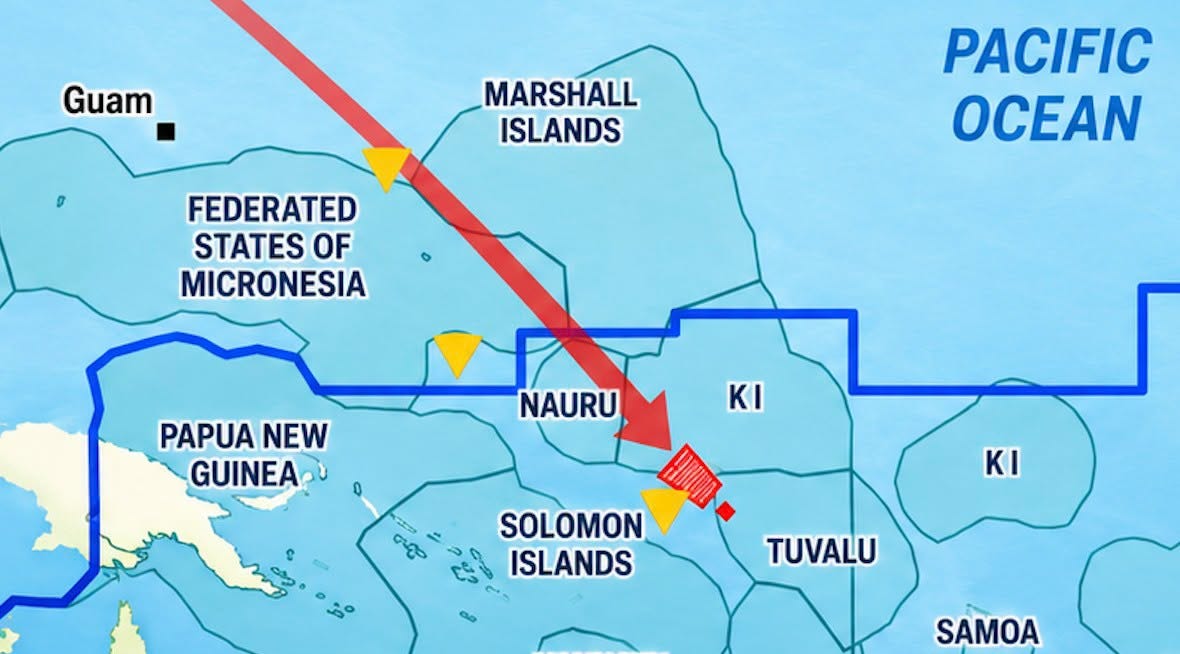
A lot of stuff from many nations splashes down in the South Pacific - so outrage has to be moderated. Just a couple of days before, near Guam, a Royal New Zealand Air Force P-8 Poisidon fired a missile into an old American warship, sinking it. No comparison between a ballistic rocket and an anti-ship missile, but New Zealand did make a bigger mess.
So is was quite a Monday — which brings us back to the Suva signing of the Ocean of Peace Alliance, or Veitacini Mutual Defence Treaty, a military pact between Australia and, for now, Fiji.
End of Tonga’s Democratic Dream
Symbolic of democracy’s erosion is the curious fact that the number of voters who actually elected Fakafānua into the Fale Alea in 2025 is unknown. It appears likely he simply installed himself as a noble representative. Ironically, in a fully democratic system Fakafānua would be politically attractive — even popular. He could have become prime minister without being noble. At the Pacific Islands Forum he aligned himself with good governance and democratic principles.
Veitacini is a Fijian word meaning “to stand together as one family in defence and peace.” In Fijian political language, it carries a specific connotation: mutual protection among kin, not mere cooperation. Fiji is signalling that Australia is family, not a distant partner.

Article 6 captures the core intent:
Comments
Nothing yet. Say the first thing.
Sign in to join the conversation.