

President Donald J. Trump posted the following:
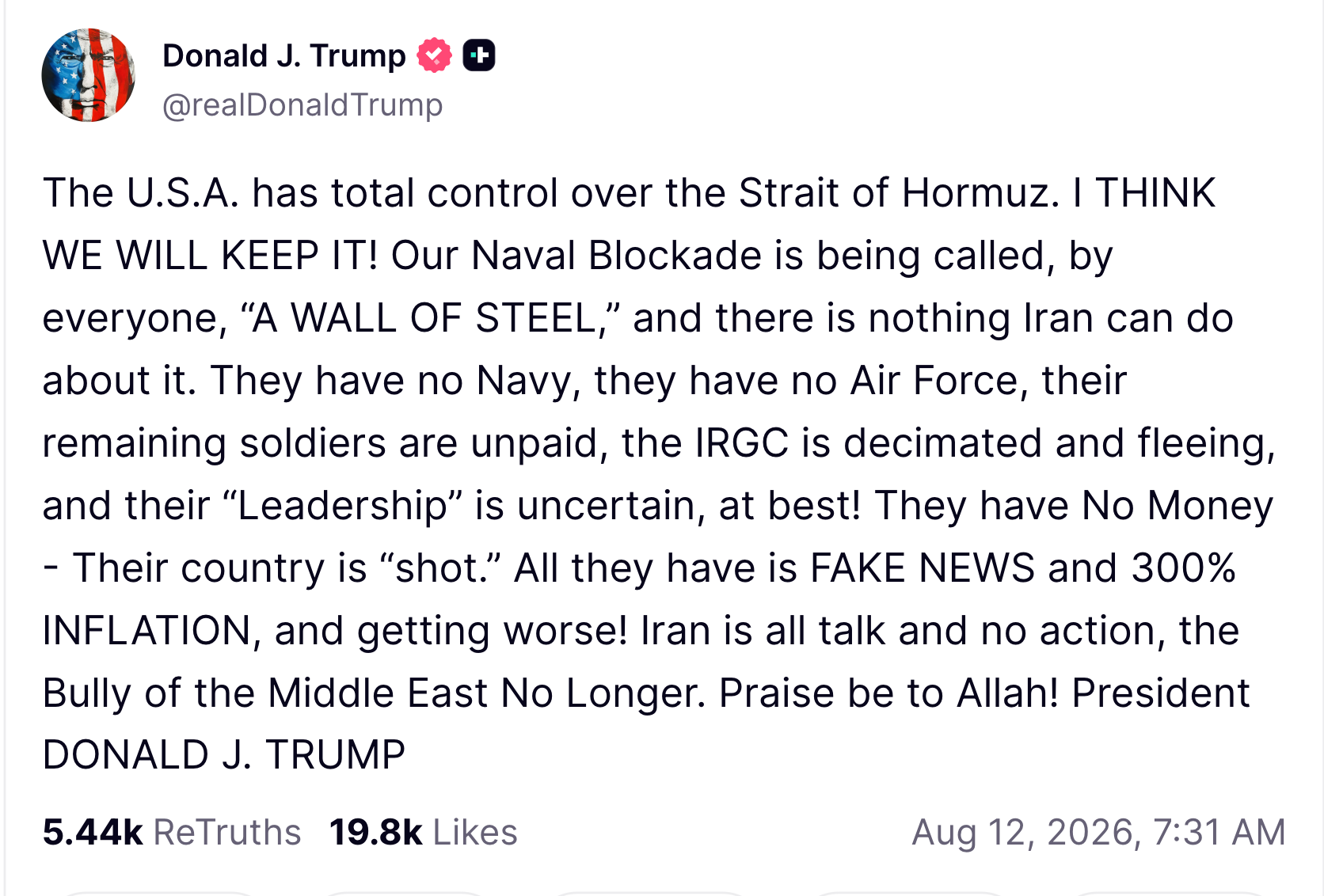
Well, let’s see.
There is independent shipping data we could look at. Why don’t we?
The data come from the same organizations the global shipping industry relies upon every day.
Kpler tracks commercial vessels worldwide using satellite AIS transmissions, radar and other maritime data. It is one of the industry’s leading providers of shipping intelligence.
LSEG (London Stock Exchange Group) also operates a major commercial vessel-tracking platform used throughout the maritime industry.
Lloyd’s List Intelligence, whose roots go back nearly 300 years, combines vessel tracking with reporting from shipping companies, insurers and port operators.
None of these organizations has a political stake in whether President Trump is right or wrong. Their business is simply figuring out where ships are going.
The picture they paint is remarkably consistent.
Today, commercial shipping through Hormuz falls into three broad categories.
Bucket 1: Ships using Iran’s System: Iran has established a de facto clearance regime. Ships approaching the Strait along the Iranian side obtain approval from Iranian authorities. Some passages are arranged through diplomatic agreements between governments. Others reportedly involve payments that Iranian officials describe as security or navigation fees. Reuters reconstructed several voyages through this system. Lloyd’s List documented others, including Chinese, Greek, Indian and Pakistani-linked vessels using the Iranian-controlled corridor.
Bucket 2: Ships Using the American System: The United States has created an alternative transit corridor along the Omani side of the Strait under American escort. This is not the old image of destroyers escorting tankers in convoy. Instead, the U.S. military coordinates movements using aircraft, helicopters, drones, surveillance assets and nearby naval forces. The problem is that coordination has not guaranteed safety. Iran has successfully attacked ships using this southern route, including supertankers, an LNG carrier and a container ship. Many shipping companies have consequently declined to use the American-managed corridor
Bucket Three: Ships That Simply Aren’t Going: These are ships that are stuck; would like to transit; but aren’t going through at all.
Using the Kpler numbers simply as an illustration, the daily picture now looks roughly like this:
Bucket 1 — Iran Corridor: About 6% of all ships wishing to transit are in fact transiting using the Iran arrangements and Iran corridor.
Bucket 2 — US Corridor: About 2% of all ships wishng to transit are in fact transiting using the US escort system.
Bucket 3 — About 92% of all ships wishing to transit are simply not transiting.
So — those are the hard numbers regarding US “Total Control” of the Strait of Hormuz.
I’ll say goodnight. Time to take Zawadi for a walk.
Audio Listeners can stop here.
https://www.reuters.com/world/middle-east/hormuz-shipping-traffic-falls-one-week-low-amid-hostilities-2026-08-12/
https://www.reuters.com/investigations/iran-is-consolidating-control-hormuz-with-island-checkpoints-diplomatic-deals-2026-05-20/
https://www.reuters.com/world/middle-east/some-ships-refusing-us-military-guided-hormuz-transits-after-attacks-sources-say-2026-07-15/
https://www.wsj.com/world/middle-east/trump-says-hormuz-is-under-u-s-control-few-ships-are-listening-485ba60e
https://www.lloydslist.com/LL1156689/Chinese-boxship-pays-Iran-for-Hormuz-passage-as-corridor-traffic-grows
https://www.lloydslist.com/LL1157459/The-Week-in-Charts-Container-spot-rates-still-rising–Analysis-exposes-who-dares-use-Irans-Hormuz-Lanes
https://www.lloydslistintelligence.com/resources/blog/strait-of-hormuz-brief-5-august-2026
Comments
Nothing yet. Say the first thing.
Sign in to join the conversation.