
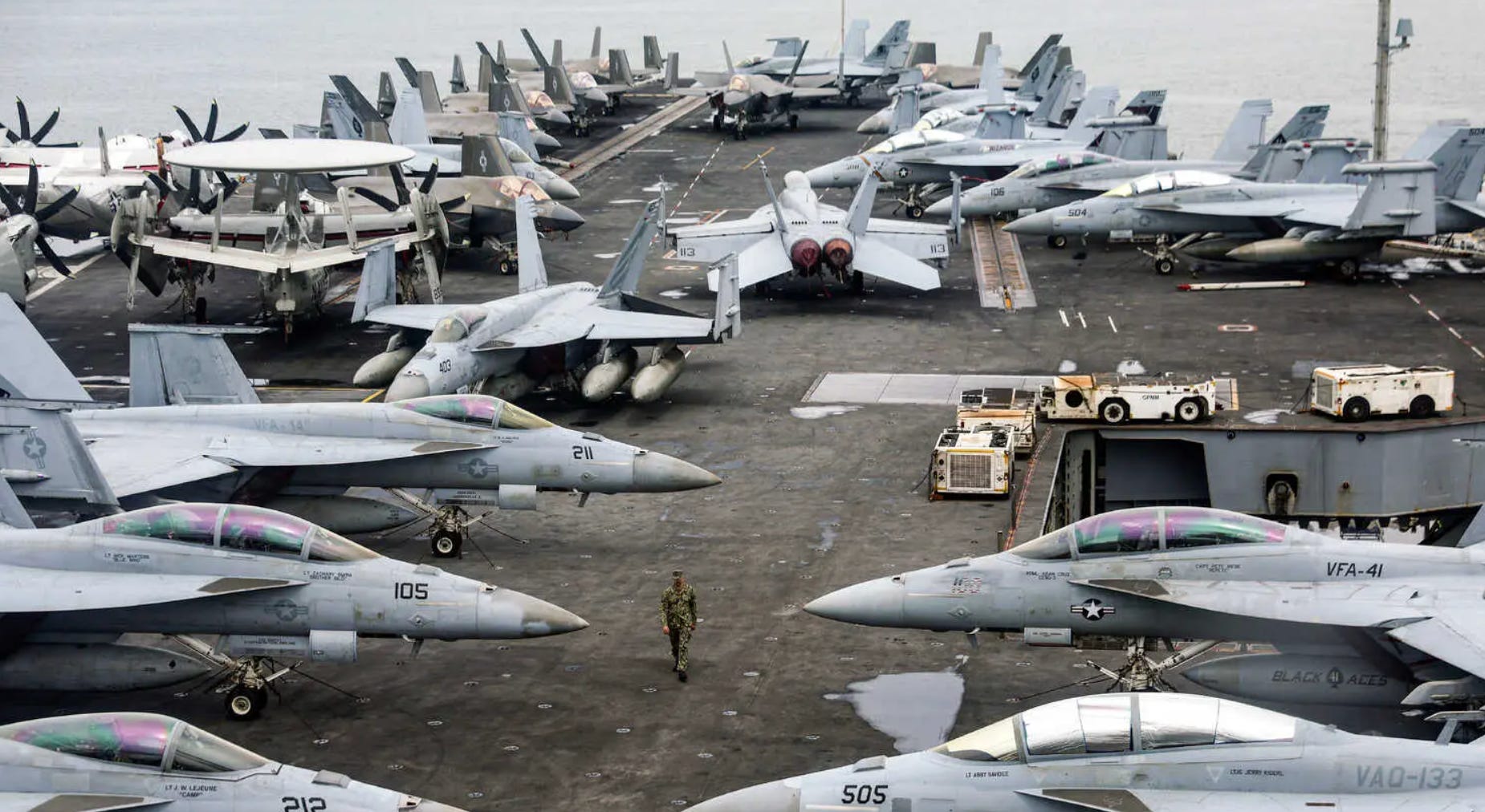
Over the past several days, you’ve probably seen the headlines.
Food shortages. Broken toilets. Mold. Sailors threatening to jump overboard. Families sounding the alarm. Members of Congress demanding answers.
Like many of you, I found myself wondering: What’s really going on aboard the USS Abraham Lincoln*?*
At first I wasn’t sure a deeper dive would reveal much beyond the headlines. Sometimes it doesn’t. But after spending time with the reporting, Navy statements, interviews with sailors’ families, military publications and congressional correspondence, I came away with a much clearer understanding of what appears to be happening.
This isn’t a story about proving the Navy is lying. Nor is it a story about dismissing the complaints as exaggerated.
It’s an attempt to answer a simpler question: what does the evidence actually tell us?
The USS Abraham Lincoln left San Diego in November 2025 on what was expected to be a routine Pacific deployment.
Instead, events intervened.
As tensions with Iran escalated, the carrier was redirected to the Middle East. Then came the war itself. Instead of returning home in the spring as expected, the deployment kept getting extended.
That matters because almost every headline about conditions aboard the ship is really a downstream consequence of that single fact.
Carrier deployments are demanding. Sailors expect long hours, difficult living conditions and months away from family. But they also expect things like periodic port visits, opportunities to get off the ship for a day or two, receive mail, reconnect with home and put their feet on solid ground.
The Lincoln crew has largely been denied that typical rhythm.
By this summer they had spent more than two hundred consecutive days at sea—longer than any modern carrier deployment outside the extraordinary circumstances of the COVID pandemic—and much of that time involved sustained combat operations rather than routine presence missions. There is a big difference between a deployment supporting combat missions and one where the main purpose is simply presence.
That’s the context in which everything else should be understood.
There is now a substantial record of official and unofficial but well documented complaints from spouses, parents and other family members. Roughly 200 family attended an in-person meeting with senior Navy leadership in San Diego on August 6th. Multiple military publications have interviewed and published reports from named family members independently of one another. Members of Congress have demanded explanations from the Navy and have interviewed family members.
Families have described intermittent problems with food quality, shortages of fresh produce, delays in receiving mail, difficulties obtaining hygiene items, broken laundry facilities, plumbing problems, mold in some berthing areas, and periods when hot water or other services were unavailable.
The Navy disputes some of those claims and says many of the earlier problems have since been corrected. It also notes that the carrier remains fully mission capable and continues to conduct flight operations.
Interestingly, those two positions are not necessarily inconsistent.
A warship can remain fully capable of carrying out its military mission while conditions aboard gradually become more difficult for the people living there.
There are viral claims of a mutiny, 7 sailors dead, etc, etc. These do not appear to be true and in fact they seem to have been opportunistically seeded by Iran, seizing upon the reports of deterioriating conditions on board. Centcom has officially and forcefully denied these reports. They are better seen as the opponent in the Iran war taking advantage of the situation to spread disinformation.
Meanwhile, normal military operations continue. The ship continues to launch and recover aircraft, conduct replenishment at sea, and perform the mission assigned to it.
After reading hundreds of source documents, the key takeaway is that almost none of the individual complaints, taken by themselves, seem extraordinary. A broken toilet; a delayed care package; less fresh food than sailors would like; laundry unavailable for several days; long work hours.
Anyone who has served aboard a deployed warship would probably recognize those frustrations. And what military hasn’t complained about the food?
It seems the story isn’t any one of these items.
Rather, it’s the accumulation.
Imagine living inside a steel city with nearly five thousand other people.
You work twelve- to fourteen-hour days.
You don’t know exactly when you’re going home because the deployment keeps getting extended.
Mail stops arriving.
The food becomes less varied.
Minor maintenance problems linger longer than normal because logistics throughout the region have been disrupted by war.
Weeks become months.
Months become more months.
At some point, the individual inconveniences stop being individual inconveniences. They become a single psychological burden.
That, more than anything else, seems to explain the concerns now emerging from the ship.
There’s another aspect of this story that I found fascinating.
For most of naval history, families simply didn’t know much about day-to-day life aboard a deployed carrier.
Today’s Navy is different.
Modern communications allow sailors to text, email and sometimes even video chat with spouses and parents while deployed. The Lincoln was actually one of the first carriers to receive dramatically improved commercial satellite internet capability.
That’s wonderful for morale.
But it also means conditions aboard ship become visible almost immediately.
A sailor who encounters plumbing problems, poor meals or mounting exhaustion can tell his wife that evening. She talks with other spouses. Patterns emerge. Eventually reporters begin receiving calls from multiple families describing similar experiences.
In other words, the Navy has become more transparent—not because it intended to be, but because communications technology has fundamentally changed the relationship between deployed sailors and the families waiting for them at home.
That’s one reason this story has become so much more visible than similar stories might have been twenty years ago.
The good news is that relief finally appears to be coming.
The Navy has begun moving another carrier strike group toward the Middle East, and all indications are that the Lincoln’s extraordinarily long deployment is nearing its end.
That won’t erase what the crew has experienced.
But it may prevent an already exceptional deployment from becoming even longer.
After spending time with this story, I don’t think the right conclusion is that conditions aboard the USS Abraham Lincoln are either much worse—or much better—than the headlines suggest.
I think the real lesson is more interesting.
We’ve become accustomed to thinking of aircraft carriers primarily as extraordinary machines: floating airfields powered by nuclear reactors, capable of projecting American power anywhere on earth.
But they are also homes—temporary, crowded, stressful homes—for nearly five thousand human beings.
The Lincoln appears to have proven that a nuclear-powered carrier can remain on station for an exceptionally long time.
Whether human beings can do so without beginning to fray around the edges is a different question entirely.
And that may be the real story unfolding aboard the USS Abraham Lincoln.
MS: I hope this was helpful but I’m not sure. In choosing what to write about, I’m sometimes guided by my own curiousity and the theory that if I’m curious about something, perhaps readers are too. Here I was curious, and concerned, to try and understand what’s really going on here. After doing the work, I do have a much better feel for it and hopefully those who have invested the time in reading will come away feeing they have a better idea of it. But there’s no big revelation; no single big point that makes it spectacular. Just the work of trying to understand. On to the next one. Happy Friday. And please — support the work if you can. $60 once a year, $6 once a month. You support matters.
Audio listeners can stop here.
Sources
https://www.stripes.com/theaters/us/2026-08-11/abraham-lincoln-middle-east-mental-health-town-hall-meeting-22506344.html
https://www.militarytimes.com/news/your-military/2026/08/11/multiple-uss-abraham-lincoln-sailors-have-tried-to-go-overboard-amid-extended-deployment-families-say/
https://news.usni.org/2026/08/13/uss-george-washington-heading-west-lincoln-deployment-nears-9-months
https://taskandpurpose.com/news/uss-abraham-lincoln-conditions-sailors/
https://www.cbsnews.com/news/uss-abraham-lincoln-democratic-senators-inquiry-demand/
https://www.reuters.com/world/us/hegseth-says-reports-about-poor-conditions-aboard-carrier-are-misrepresented-2026-08-13/
https://www.wsj.com/politics/national-security/u-s-sends-second-aircraft-carrier-toward-middle-east-a258de37
https://apnews.com/
https://www.twz.com/news-features/how-life-aboard-a-navy-aircraft-carrier-changed-when-high-speed-internet-arrived
https://www.thetimes.com/us/american-politics/article/iran-war-us-navy-food-pictures-b79nhm7d3
https://www.navy.mil/
https://www.facebook.com/groups/cvn72frg/
Comments
Nothing yet. Say the first thing.
Sign in to join the conversation.