
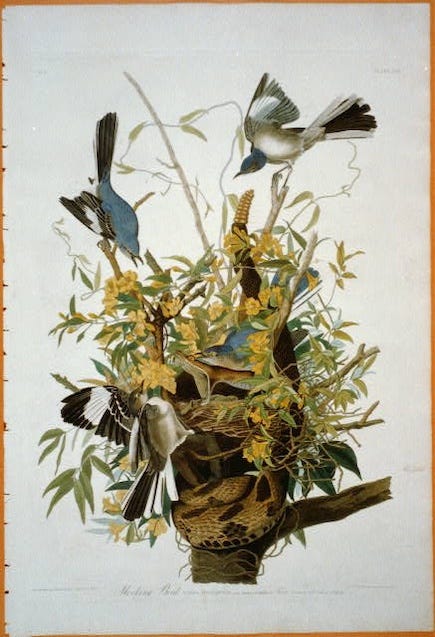
I’ve established that I enjoy the 3:00am hour’s dark solitude. That’s when I do some of my best thinking. It’s damn quiet, too, for about half of the year. Around the beginning of May, the mockingbird starts singing. calling, hoping In May, it’s later than my waking hour. But, as the dawn breaks earlier, the mockingbird adjusts the start of his serenade. Developed over millennia, he repeats his offering in the evening – his internal clock adjusting with the changing dusk. The journey of the monarch butterflies, the great migrations across the plains of Africa, the running of salmon in the rivers of the Northwest United States rivers, hundreds and hundreds of crickets keeping perfect time, and so many other patterns and rhythms of movement prospered for millions and millions of years while the human species was in its infancy. Nature amazes. It just keeps going, finding a way – even through our human species’ intrusions into habitat and soundscape.
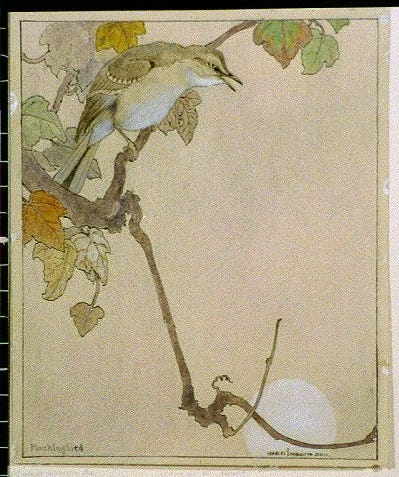
It’s said imitation is the highest form of flattery. To a point, I agree with that sentiment but when does imitation cross or blur the line – to what end should we imitate? We imitate when we learn to speak. Recently, I watched the kitten imitate the older cat. As artists, we start by learning what has come before us, studying it, looking for our place in the continuing, growing artform of calling – words, music, the brush or pencil to canvas or paper, dance, theatre, or name your chosen one. I sat learning every nuance from those Jimmy Reed, Little Walter, and B.B. King records or, trying to imitate, translate the pounding piano rhythms of James Booker and Ray Charles to the guitar. Imitation, reference, and revelation were all part of the process growing and learning process. We’re always growing (hopefully) and changing (a necessity) as we age into our artistry.
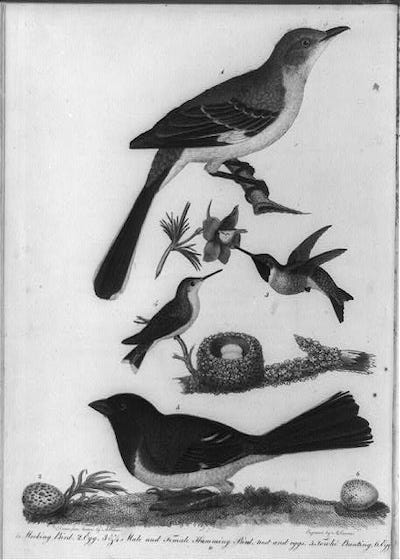
The mockingbird may just be one of nature’s most perfect imitators – even more so than the habitat-absorbing lizards or insects that can make themselves “disappear” in plain sight. In what feels like another lifetime ago, I had a different 3:00am experience with the mockingbird. About a quarter-century ago, my current waking hour was near to my arrival back home or later after a night of playing the bars or clubs. For a span of about eight weeks, in the late summer all those years ago, I kept coming home to the sounds of a reciprocal saw, nail gun, and power drill with the occasional skill saw tossed in for good measure. At first, I was truly baffled. Who would be working at this hour of the day? Were they trying to beat the late-summer heat – but this early? I was at a loss. I do not remember how I eventually stumbled onto it being a mockingbird making those sounds. But, I did and left it at that – aside from marveling at the bird’s unbelievable ability to perfectly emit the sounds he was hearing during the day – all in the effort to attract a mate. It would be a couple of decades before nature, hence recording the mockingbird, would play an integral role and part of my work.
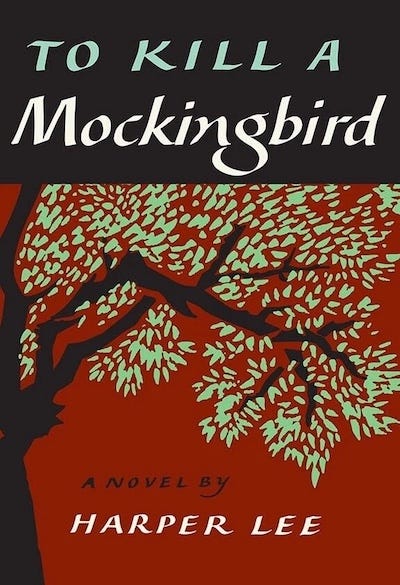
I would be sorely remiss if I didn’t acknowledge one of America’s greatest works of literature, and in some people’s opinion the greatest, Harper Lee’s To Kill a Mockingbird. I was so absolutely engrossed with it, that my first reading took about a day and a half. I first read it when I was beginning to understand that what I had been taught to believe was horribly wrong. It is a shame it has been so vilified by people that want to turn us back to the age of Jim Crow. And, that is the extent of my negativity today. Harper Lee’s writing in To Kill a Mockingbird – the humor, the darkness, the humanity, the honesty –is quite simply reading that should be required. Like all great literature, I find it inspiring, and thought provoking. The movie is a classic. In years past, I often wondered why she chose the mockingbird as opposed to a cardinal, which, to me, has a much more melodious song. As my waking hours changed with my life, I saw a reasoning behind choosing the mockingbird. And, while it may not have been Harper Lee’s exact reason or explanation, I see the tenacity of the mockingbird as a very strong reason.
And so, I will continue to enjoy the mockingbird’s song every morning with the hope, however slim, that he’ll discover power tools – for old time’s sake. Maybe I’ll play him the music that his song will be intertwined with when it’s finished. And, maybe he’ll sing it back.
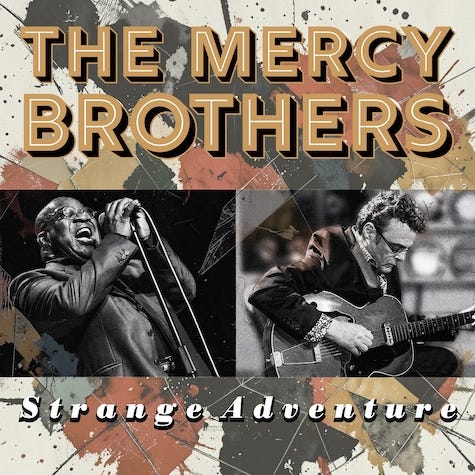
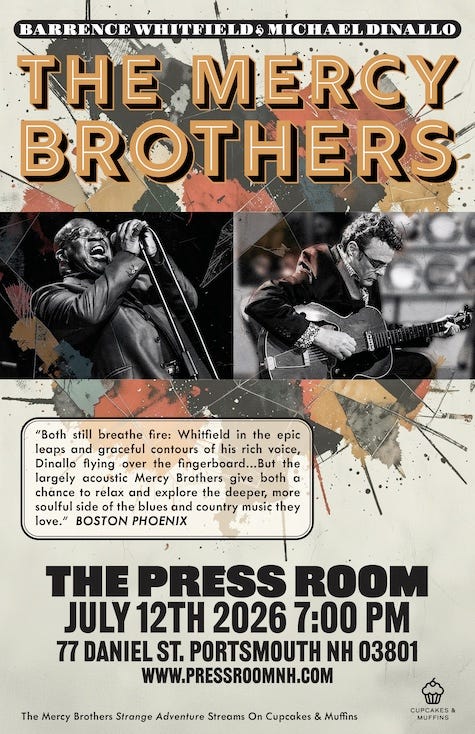
Available July 10, 2026 on Cupcakes & Muffins. Preorder/Pre-save here.
My playlist for Saturday, June 13, 2026 on WICN 90.5fm in Worcester, Massachusetts, and globally at wicn.org:
Frank Stokes “Downtown Blues”
O.V. Wright “Precious, Precious”
Quiet Elegance “You Got My Mind Messed Up”
Otis Clay “Trying to Live My Life Without You”
Ann Peebles “I’m Gonna Tear Your Playhouse Down”
Al Green “Let’s Stay Together”
Eddie Floyd “Knock on Wood”
Otis Redding and Carla Thomas “Knock on Wood”
Mable John “Your Good Thing (Is about to End)”
Sam & Dave “I Take What I Want”
Albert King “Born Under a Bad Sign”
Booker T and the MGs “Hip Hug Her”
James Carr “You Got My Mind Messed Up”
Dusty Springfield “Son of a Preacher Man”
Wilson Pickett “I’m in Love”
Bobby Womack “More Than I Can Stand”
Arthur Conley “Funky Street”
Mark James “Suspicious Minds”
No posts
Comments
Nothing yet. Say the first thing.
Sign in to join the conversation.