
My Unsnared Drum Lab book includes a good bit of information about how to invent solutions to musical problems, and how to mobilize creativity in the practice room to learn music more effectively and perform better. But the text does not spend much time on diagnosing what is wrong in a particular passage, an essential skill for performing musicians.
How do we do that?
Diagnosis is part of musical craft. It is the comparison between what happened and what we expected. These expectations come from our mental models—the sound, feel, timing, and movement we have developed through listening, observation, practice, invention, and performance. And it matters: if we cannot tell whether the problem is rhythm, sticking, inflection, environment, or mental model, we will build the wrong solution. Every minute spent solving the wrong problem is wasted. Better diagnosis means faster learning, better teaching, and more effective rehearsals. It is as much a professional skill as a practice-room skill.
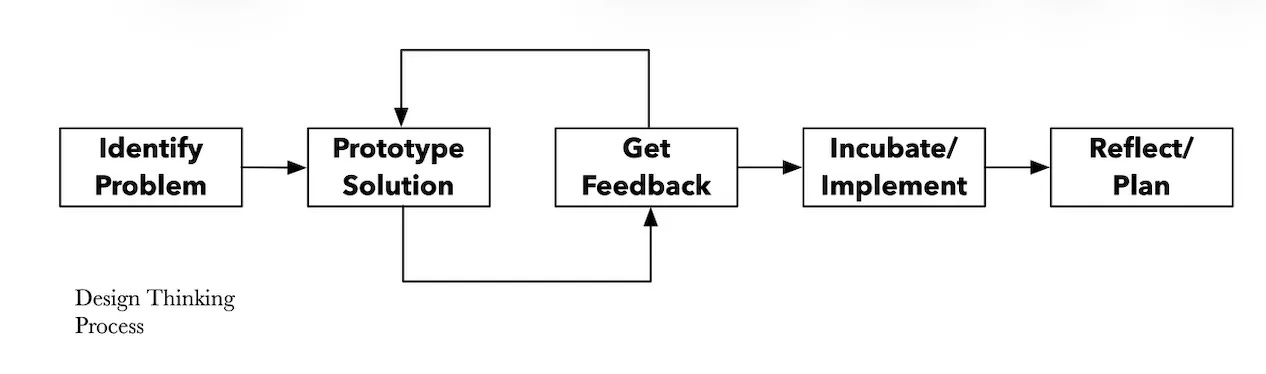
Sometimes, wonderful diagnoses are practical: I remember one lesson with my teacher Robert van Sice in which he solved many of my wrong notes by showing me I wasn’t considering where I stood when I played the marimba, or when he told me that the uneven color between my two hands made it sound like my rhythm stunk. Both of these require immense experience, skill, and intuition. Other times, diagnoses border on the mystical: in the same week, Bob told me that I was missing another note (I missed a lot of notes) because my ears weren’t connected to my hands, which led to a semester-long emphasis on timpani strokes, which led to me eventually getting that note in a concert, and fundamentally unlocked my sound.
Great diagnosis turns mysteries into what I call Infomercial Problems: problems so clearly identified that the narrator could solve them in two sentences.
But the point of diagnosis is not abstract understanding. The point is to choose the right intervention. Playing more slowly is not useful if playing too fast wasn’t the problem! Usually, diagnosis is intuitive and quick. But what do you do when it isn’t, when your problem appears to be a murky mystery?
Diagnosis is very difficult, fraught with cognitive biases. Performers fail at diagnosis in predictable ways:
emotional entanglement: “I suck” instead of “the left hand rushed”
clumping multiple parameters into one vague mistake (”this was bad”)
mistaking noise for signal (”maybe it’s my mallets!”)
ignoring environment (”this never seems to happen in the practice room!”). Some problems only appear under pressure, with others, or in certain rooms. That makes diagnosis not just technical, but contextual.
not checking the mental model (not including visual, aural, and kinetic memory in our assessments
The desire to help isolate and build this diagnostic skill led me to revisit surgeon Atul Gawande’s The Checklist Manifesto, a wonderful read that had me checklist-ing everything I do. Gawande argues that many of the failures experts experience are not failures of knowledge, but of execution. Under pressure, with too much information arriving too quickly, even highly trained professionals skip obvious steps, overlook important details, or jump to conclusions. A well-designed checklist creates a moment of productive friction, slowing us down just enough to avoid predictable mistakes and consistently apply what we already know. And, they include “pause points,” places where the action taker needs to deliberately stop what they are doing and evaluate whether they can or should continue.
Important note: checklists are actually for experts. They create productive friction at the moments where skilled practitioners are most likely to skip important steps. They are not designed for beginners learning new skills.
I’m side-stepping the amazingness of Gawande’s Checklist for Making a Checklist, but here’s my checklist for diagnosing musical problems in the practice room. Its mission is to help make musical mysteries less mysterious and to find the minimum viable problem that can be addressed through creative practice.
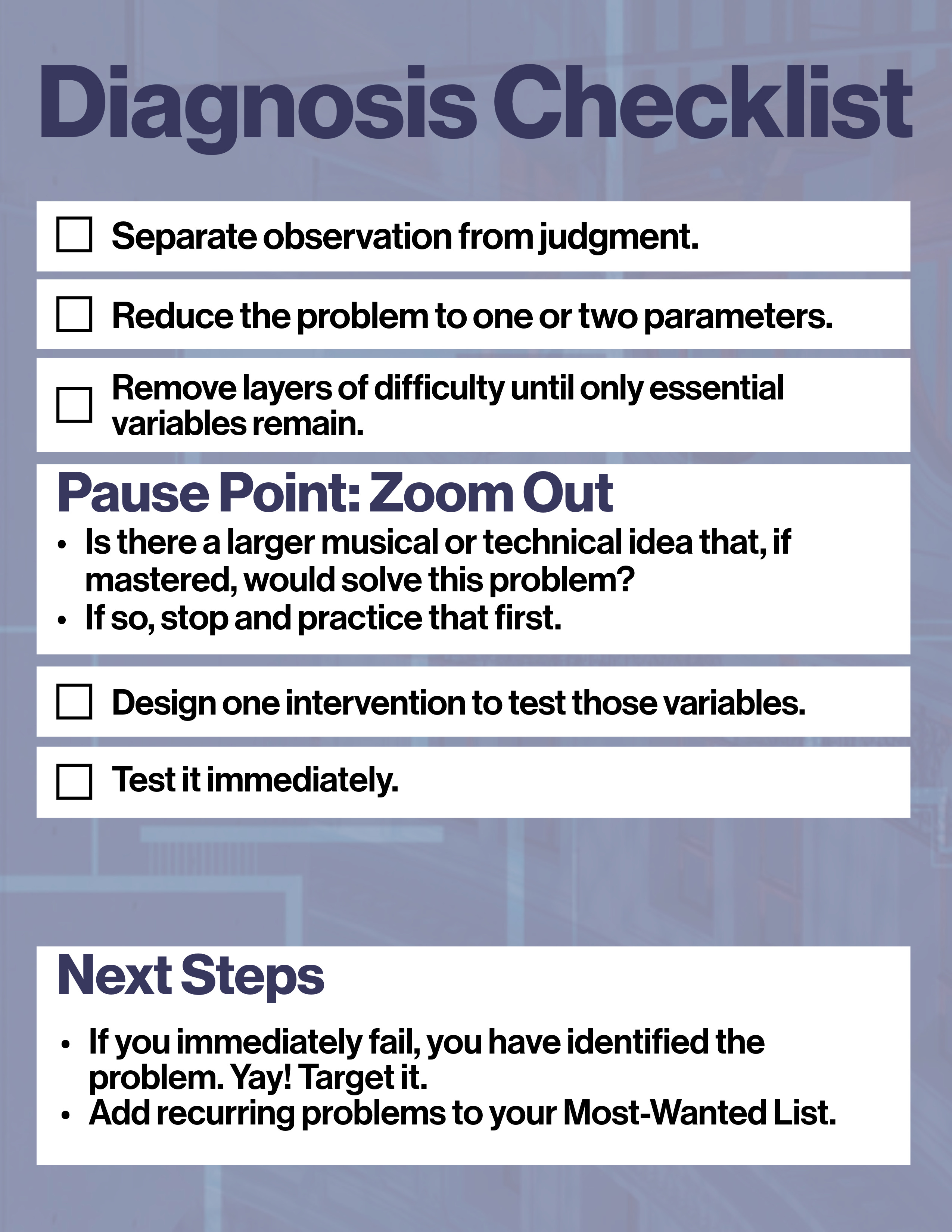
If you’re stuck, address musical parameters one by one. Here are some:
Dynamic
Sticking
rhythmic spacing
Density
Timbre
Articulation
Tempo
Duration
Pitch
Harmony
Structure
Inflection
Horizontal/vertical
Likewise, thinking about the performance environment and incorporating all senses can be useful. Some more parameters to explore:
Aural
Kinetic
Visual
Timing
Emotional
Environmental
What do you think? What’s this missing?
As I mentioned, this checklist is designed for experts: extraneous information is kept to a minimum, and explanations are left off. I reduced a complex process to a few key steps. If I were building diagnostic skills—or teaching someone building those skills—I would target each of these steps, repeating them and getting feedback on the results. It’s best done in a group, where multiple thought processes can be articulated.
This process will be difficult and slow. With time, the design process will become instantaneous and intuitive.
You know what other activities help build these skills? Creativity, play, and tinkering in the practice room. The more we tinker, the more repetitions we get at noticing relationships between movement and sound, cause and effect, and intention and result. That noticing is our diagnostic skill at work. Actually, noticing details in any field seems to hone this skill, so all those trips to the art museum are worth it! Do this enough, and mysteries become rarer, not because problems get easier, but because we get better at separating signal from noise.
Thanks for reading this far! This post is public, so feel free to share it with someone who might like to read it.
No posts
Comments
Nothing yet. Say the first thing.
Sign in to join the conversation.