
Almost a month ago, Trumpanyahoo partnered to launch an impetuous, illegal and devastating air war on Iran, which isn’t going well. Iran, despite having its leadership decapitated, immediately responded with attacks on both Israel and its own Persian Gulf neighbours. This has rapidly disrupted the flow of oil and natural gas through the Hormuz Strait, which carries roughly 20% of world supply, thus threatening the global economy, for which Trumpanyahoo proved unprepared. Also affected are supplies of fertiliser and helium, the latter a key ingredient in various advanced technologies. New cracks are appearing in geopolitical alignments, already strained by Russia’s war in Ukraine, Israel’s genocide in Gaza, and Trumpitup’s America First adventurism in Latin America and elsewhere. The media come up with new euphemisms. Trumpitup calls it an ‘excursion’ (a Freudian slip for the military term ‘incursion’?), while the media speak of a ‘war of choice’, which means unwarranted and unjustifiable under international law. I heard a military historian suggesting that all wars are wars of choice, citing Churchill’s declaration of war against Germany as an example, but this is quite different. Here, Trumpanyahoo are the fascists. Trumpitup, disappointed with the response of Prime Minister Smarmer, complains that he’s no Churchill, but then he himself is no Roosevelt.
Trumpitup is also in trouble at home. The war is not popular in the USA. Four major opinion polls put the rate of disapproval between 53% and 59%, and of approval between 27% and 44%. The New Yorker reports that in Israel “Operation Roaring Lion, as it is known, is extremely popular... Ninety-three per cent of Jewish Israelis support the war, according to a survey by the Israel Democracy Institute.” If so, my first question is, are Jewish Israelis deluding themselves?
A quick web search tells me that the Israel Democracy Institute is a centre-left Jerusalem-based think tank funded by American philanthropists. I email a cousin in Tel-Aviv, whom I haven’t seen for over twenty-five years, to ask if he thinks the figure is true, and he replies, “I don’t think 93% would vote for war if you asked them, but once it started, I think it is safe to say that a firm majority prefers winning the war (whatever that means) over stopping it. (Actually 67% in a TV survey on the screen as I’m writing this, are satisfied with its progress).”
Which figure is more likely? How can one tell? After all, opinion polls are a poor guide to what’s really going down on the streets, nor are foreign journalists or pundits much better, and I haven’t been there for more than twenty-five years. I visited several times in earlier years, and while I was comfortable with family, for some of whom one makes allowances, I became increasingly disenchanted with the country’s tribalism, the strange mix of official theocracy and secular irreligiosity, and the racist caste system (European Jews at the top, above Oriental Jews, who were above Christian Palestinians, below whom came the Muslims). One of the last times I went there was in 1999, when I was invited to serve on the jury at the first edition of the Tel Aviv documentary film festival. One of the films included scenes featuring Netanyahu, who had just been voted out of office after his first term as prime minister, and each time he appeared the sophisticated festival audience cracked up in scornful laughter. Nobody’s laughing at him now.
My cousin, who describes the present situation as “idiotic chaos”, says
“We are in the grip of this Machiavellian sociopath marketing man that managed to harness the whole political sociological situation and whatever else, to his petty narcissistic disturbances, wants and needs, on the way breeding miniature likenesses of himself, that seem to have spread all over. It’s like a Zombie attack.”
In other words, I respond, a fitting buddy to the sociopath in the White House, not to mention the one in the Kremlin and a few others. But there are other questions bothering me.
I live in a country where Israel’s actions in Gaza, tacitly supported by the government, have provoked strong opposition on the streets, with which I deeply sympathise; I have always been suspicious of Zionism. The government responds with an authoritarian ban against Palestine Action, equating them with terrorists for attacking the Israeli-owned arms manufacturer Elbit Systems, and arresting almost 3,000 of the group’s supporters who are now in legal limbo while the government appeals a High Court ruling that the ban isn’t justified. The conflict has invaded parliamentary politics, with the election of independent MPs on a pro-Palestinian platform. It has also provoked violent and sometimes deadly attacks against Jewish targets. It doesn’t help that the media confuse antisemitism and anti-Zionism, but the truth is that Israel can be held responsible for provoking both. Are people aware, I ask my cousin, how much anger is generated around the world by the genocide in Gaza?
“I think,” he replies, “the mainstream cares about the practical implications of this anger (mainly concerning traveling, import-export, tourism, academia, business etc.), but since October 7th regard it essentially as naive or self serving, or hypocritical or ignorant or even understandable, though too distant to be relevant. The country is in survival mode and people feel strongly about these issues. A lot of it is emotional.” There is a growing feeling, he adds, that the outside threats are not as divisive as the dangers that lie within. “The only hope is that given the unique Israeli collective experience, it will all turn out to be a family feud and not a civil war.”
*
Returning to the current situation, I am bothered by a third, but very different question, about the political economy behind Israel’s belligerency. This is not a question for my cousin and I’ve not seen anything about it in the media, either mainstream or independent, with one exception that I’ll come to. My question is this. Israel has a reputation for being in the vanguard of digital surveillance technology, which it uses to track its targets (although prone to tragic errors), but war also consumes huge amounts of physical energy (not to mention the environmental damage it leaves behind). Of the Trumpanyahoo partnership, the USA is energy rich, although this doesn’t make it immune to rising oil prices. But what about Israel? Where does its energy consumption come from? And won’t the rise in oil prices provoked by the war work to its detriment? Time for some internet research, which nowadays includes AI.1
I read somewhere that Israel wants to control Gaza to exploit an undeveloped natural gas field off its shores. What I didn’t know, because this is only covered in the specialist press, and which now initially surprises me, is that it already controls two major offshore natural gas fields further north, Tamar and Leviathan, discovered in 2009 and 2010 respectively. Tamar came online in 2013; Leviathan, one of the biggest deepwater gas discoveries anywhere in the world, in 2019. In other words, while overall Israel’s energy sector is heavily dependent on fossil fuels, natural gas accounts for 71% of the country’s electricity generation, and not only that: it has also turned the country into a gas exporter, with exports going to Egypt and Jordan. Coal is being phased out and renewable energy, mostly solar, remains low, at around 12-13%. There is very little domestic oil extraction, and since Israel is blocked from sourcing the oil it needs, principally for transportation, from its Arab neighbours, it comes from further afield. The core suppliers, Azerbaijan and Kazakhstan, account for around 70%, the remainder comes from Russia, Gabon, possibly Turkey, and the USA, which the AI informs me has maintained a strategic oil reserve stockpile for Israel since 1975.
It turns out that the gas field off the coast of Gaza was discovered as long ago as 2000, and according to international law and agreements made between Israel and the Palestinians, it belongs to the Palestinian Authority – but it cannot be developed without Israeli approval, and negotiations broke down when Israel refused to deal with Hamas. Then the discovery of Tamar in 2009 reduced the incentive.
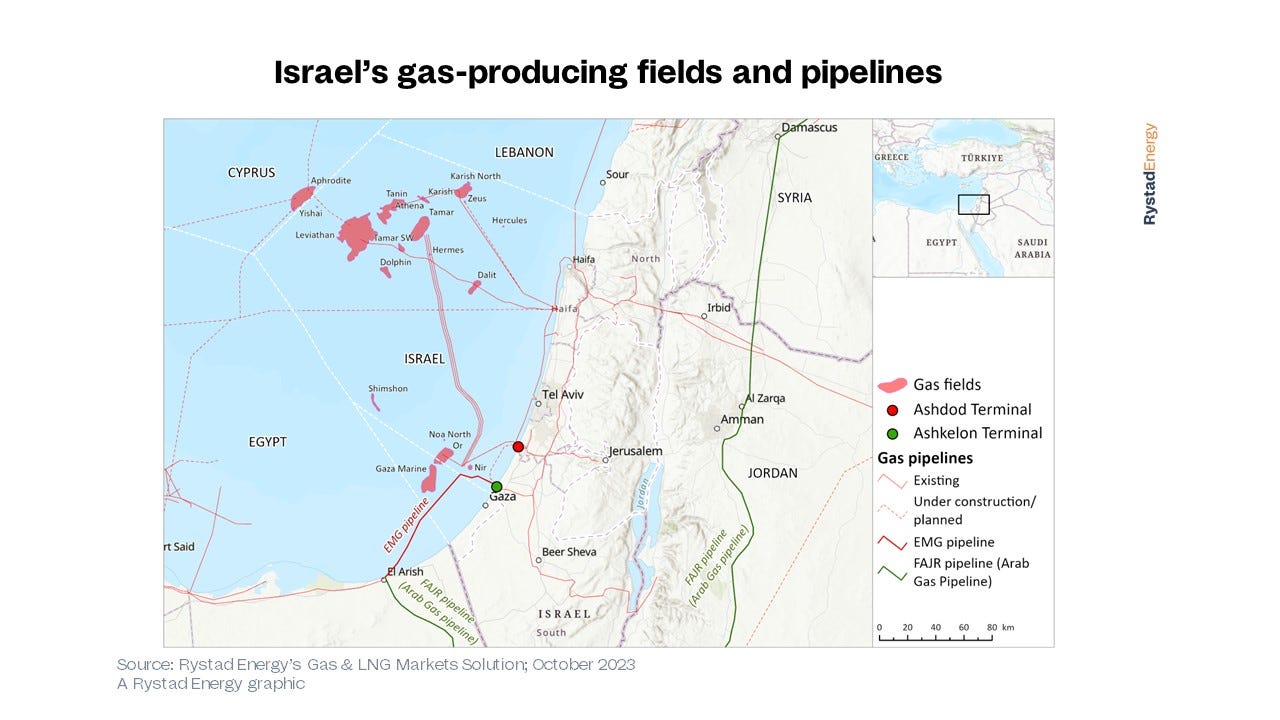
No sooner had I gleaned all this from AI than a report turned up on Al Jazeera headlined ‘Arab states should beware of Israel’s hegemonic energy expansion’. It seems Israel’s offshore gas does more than insulate it from overdependence on imported oil, but gives it a powerful lever over the energy supplies which flow through the pipelines that criss-cross the whole region. Some of the gas Israel exports to Egypt and Jordan goes further afield to Syria and Lebanon. When the Leviathan field was shut down during Israel’s 12-day incursion against Iran in June 2025 and gas flows to Egypt and Jordan were halted, both countries faced an energy crisis. Now it’s happening again as Israel and the USA attack Iran, Cairo and Amman have been forced to suspend onward exports to Syria. This is not just collateral damage, but evidence that “the Zionist settler-colonial project” operates “not only through military aggression but also through economic power and energy networks.” Israel, says the report, has already demonstrated its willingness to weaponise essential infrastructure and utilities. “During the genocide in Gaza, electricity, energy and water – along with the infrastructure that sustains them – were systematically targeted and cut off, deployed as instruments of collective punishment and destruction.”
Israel is not doing this alone, however. The AI informs me that Tamar and Leviathan are operated by a consortium led by Chevron alongside Israeli partners. Chevron, a multinational headquartered in California, is the third largest oil company in the world (after Saudi Aramco and ExxonMobil) and operates across the full energy chain – exploration, production, refining, and retail – in dozens of countries. It was not Chevron who discovered Tamar and Leviathan but a Houston-based company which Chevron acquired in 2020, instantly making it the dominant player in Israel’s offshore gas. Its role today is to manage the export agreements that pipe gas to Egypt and Jordan, and develop a plan for expansion towards Europe via Cyprus and Greece in order to reduce dependence on Russian gas.
Chevron’s activities have not been uncontroversial. The AI reports that their operations in Israel “have attracted criticism from environmental and pro-Palestinian campaigners. After October 7, 2023, there were calls for Chevron to halt production, and the company temporarily reduced output at the Tamar field in the immediate aftermath of the Hamas attacks for security reasons, before resuming. Some activists have framed Chevron’s gas revenues as indirectly financing Israeli military operations, which Chevron and the Israeli government dispute” – but that’s only expectable. Given that Trumpanyahoo’s war is now increasing oil prices and therefore the profits of the oil companies, I leave the answer to my third question – who benefits from this arrangement? – to the reader.
If you enjoyed reading this, please give it a like, or leave a comment and feel free to share.
An afterthought. There is news that an Iranian missile injured scores of people in the town of Dimona, a few kilometres from Israel’s nuclear research centre, built in secret with French assistance and opened in 1958, the heart of its never acknowledged nuclear arms programme. The International Atomic Energy Agency (IAEA) says there’s no indication of damage to the facility, and no abnormal radiation levels, but urged that “maximum military restraint should be observed, in particular in the vicinity of nuclear facilities”. Makes you ask: is it adequately protected against a direct hit? That’s assuming Israel doesn’t nuke Iran first.
My chosen platform, after discarding others, is the free version of Claude.ai. Its advantage over a conventional web search is obvious. Its advantage over other LLM agents like ChatGPT, at any rate in my experience, is that it uses neutral language free of sycophancy. Using it strictly as a research tool, it works best when you know enough about what you’re asking it to question its response. It responds well to interrogation of vague or ambiguous assertions, uses up-to-date web sources, provides useful context and background, and routinely reports on criticisms and counter-arguments. Don’t bother to say please or thank you – it isn’t a person.
Comments
Nothing yet. Say the first thing.
Sign in to join the conversation.