

This small boy is eighty today, a day no different from any other but an age that encourages a little reflection, and I think about the advantages and liabilities of being a so-called baby-boomer. A happy childhood, a good education, the benefits of the welfare state, no conscription, a grant to attend university, eager footsoldier in the rebellion of 1968—for which I make no apology—and the career that followed as a documentary filmmaker and academic.
All the while the world was changing, but at first indistinctly. Recently, when Artemis II took astronauts on a round trip to the moon on the first crewed mission since 1972, my mind went back almost sixty years, to the first moon landing on July 20 1969. I saw it on a small television set in the lounge of the hostel in Switzerland where I was on holiday with my girlfriend, on our way to Italy. Around the same time, I made a short fiction film with an actor friend in Oxford, where we were both postgraduates, which included a scene that we shot in the University Biology Department’s computer laboratory. Sadly, we failed to find the funds to complete it and it got lost, but I well remember it as my first encounter with a mainframe computer with its flashing lights and banks of tapes spooling back and forth. These memories are autobiographical markers. I had no idea that they were also historical signposts, pointing to the transformation of both everyday life and the entire structure of the economy brought about by computers on our desks and satellites and cables enveloping the globe in the virtual world of digital communication. The most palpable form of globalisation.
Some more signposts. I began reading both Marx and Freud in my late teens. When I was making films in Latin America for television, shooting on 16mm, I began using computers for office work and writing. Later, as a professor making films on very small budgets with academic funding, it was video and computer editing that enabled me to do so. I don’t remember when I first became aware of climate change, but after 1997, my vote went to the Greens. By the time I made my last film in 2019, about ecology in Cuba, I was all too aware of the contradiction between the subject matter and the air miles we consumed in making it. I consoled myself with the thought that I didn’t run a car.
Six years ago when I retired, in order to be closer to family I moved out of London to a small town with a castle attached, just the other side of Heathrow Airport. A pleasant place, well endowed with good places to eat on account of the tourist trade, with almost everything one needed within walking distance, I found a flat close to the Long Walk on the edge of the Great Park. Given everything going on in the world, I thought of it as a place of deceptive tranquility, apart from the airplanes.
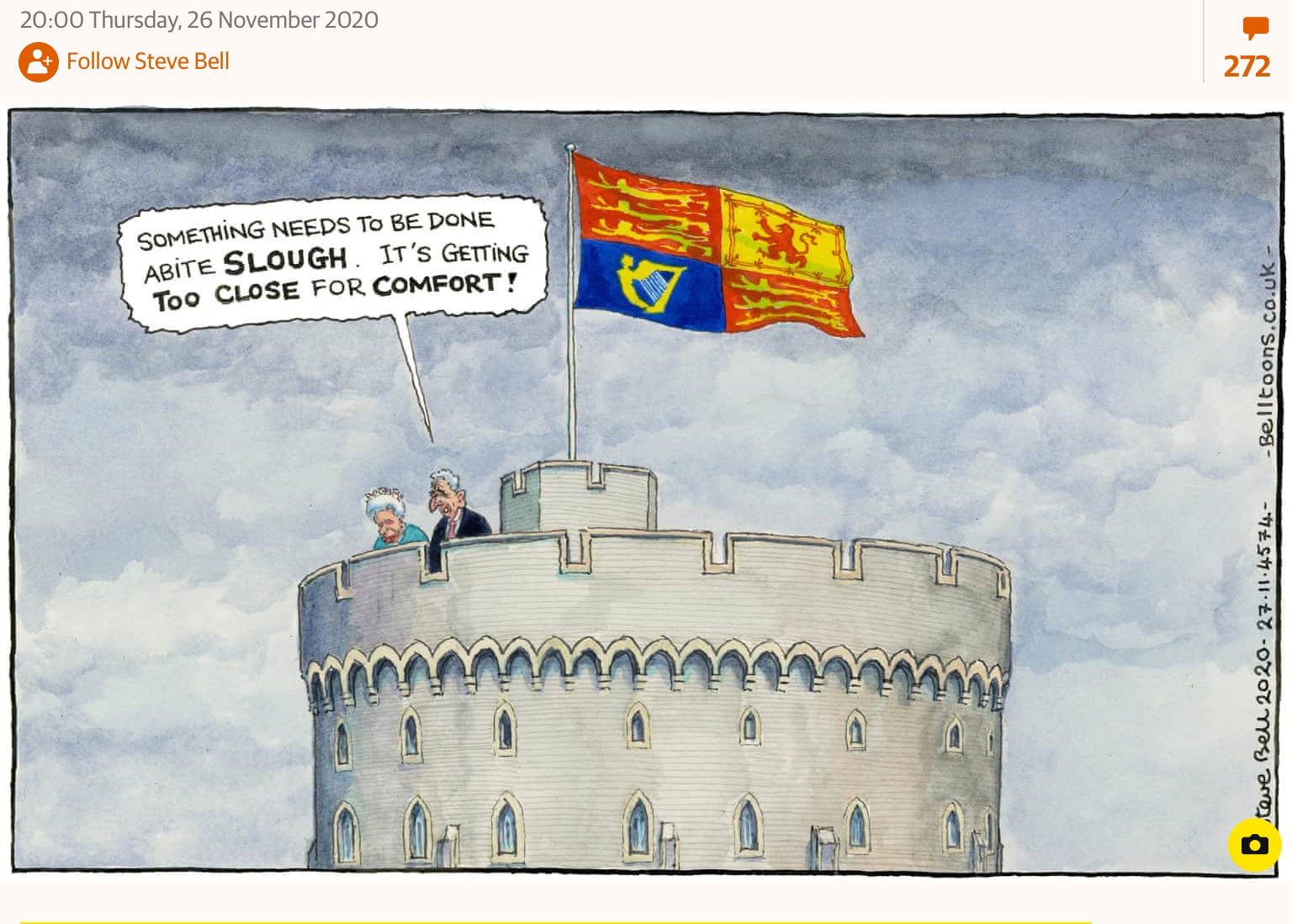
Now I discover that there’s no escape. To my astonishment, I learn that a few miles away on the other side of the river, the industrial town of Slough has been overrun by datacentres. According to reports, it has as many as 40, making it the second largest data hub in the world, behind the US state of Virginia. Owned and maintained by companies with names unknown to the public, like Equinix and Digital Realty, running on hardware made by Nvidia, many of them on a campus in the centre of town, they serve dozens of clients, including the world’s biggest tech companies: Amazon, Google, Oracle and Microsoft.
Data centres are the physical infrastructure that underpin our digital world. No ‘cloud’ but vast arrays of computers consuming vast amount of electricity and water to cool them. Everything—bank transactions, streaming, online trading, emails— is processed through datacentres, whose enormous growth over the last few years is the result of AI, on account of the sheer quantity of data employed to drive their Large Language Models, the intensive business of training them, and the billions of operations carried out each time they’re put to use—800m people use ChatGPT every week. Data centres, to be economically viable, require huge amounts of electricity to keep thousands of computer servers running around the clock. Because renewable energy sources which depend on the weather can at best meet only a fraction of this demand, and nuclear power is currently insufficient, data centres are very largely powered by fossil fuels—contrary to the demands of climate science. They also need powerful cooling systems that require large quantities of water, which can also put pressure on local infrastructure.
Moreover, they also affect their immediate environment. Neighbours say they can hear them humming at night, and they create a heat island, pushing up temperatures in their immediate vicinity by an average of 2°C and sometimes much more. A worker on the industrial park tells a reporter that Slough is consistently hotter than the surrounding areas. “In 2022, when there was the heatwave, the temperature in the car park was 45C. But when you drove towards Windsor it dropped to 39C.”1 Another says “My computer gives off a lot of heat. So does my phone. So I have to imagine that the big data centres do as well.”
Why Slough? James Tyler, UK managing director for Equinix, which runs six sites in the town, calls it one of the most “strategically important” areas on the planet. I paraphrase his explanation: a run-down industrial town with plenty of electricity available and well placed to service London. However, according to another report, the money now being spent on building datacentres represents one of the largest deployments of capital in human history. An energy executive tells the reporter: Datacentres “are perhaps bigger, by an order of magnitude, than anything we’ve connected to the grid before...If you think about the city of Philadelphia, its load is about one gigawatt. Now imagine adding one-gigawatt-sized data centers to the grid, and not just one, but multiples of them.”2
Here in Windsor, the summer’s fifth heatwave has come and gone, the lawn in front of my desk is parched and discoloured, the bushes outside my bedroom window are full of dead leaves. The country is in drought and farmers are losing crops, there are wildfires burning across the country and throughout Europe. All reputable reports agree that this is the accelerating result of anthropogenic climate change, which needs to be reversed. But how, if the demand for fossil fuels (whose cost has increased as a result of the egregious war against Iran) isn’t curbed? We are locked into a system that is unsustainable but won’t let us go. What is the individual to do when one has absolutely no say in the matter? I enter my ninth decade not fearing for myself but wondering about a future which if my luck continues, I might escape.
If you’ve enjoyed reading this, please share, give it a like, or leave a comment.
Comments
Nothing yet. Say the first thing.
Sign in to join the conversation.