
In 1998, a year and half or so before delivering a final draft of The Amazing Adventures of Kavalier & Clay, I drove down from Berkeley in my old Saab convertible to hole up in the Santa Cruz Mountains. I would be gone for three weeks, coming home twice, for a night each time. We had two small children, and I knew I was asking a lot of Ayelet. But I had a big job to do.
I’d just finished rough versions of the final scenes of the book’s fourth part, “The Golden Age,” narrating the tragical, magical events leading up to Joe’s enlistment in the US Navy. It was now, at last, time to go to Antarctica. I would be departing—I had only the vaguest sense of how—from the Laurel Mill Lodge.
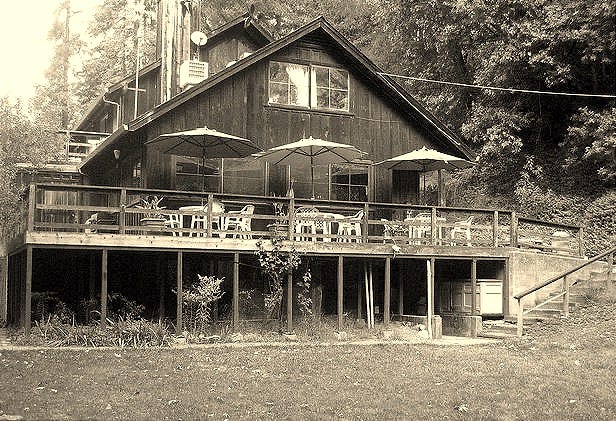
Originally constructed during the war years as a foster home for wayward boys, the Lodge had run through a series of typical twentieth-century Northern California incarnations—children’s camp, religious children’s camp, human-potential retreat, spiritual massage school—before falling into a long desuetude from which it had recently been reclaimed, if not quite redeemed, by a well-intentioned old hippie couple who kindly left me to embark on my invisible expedition.
I have a standard account I give about why I decided to send Joe Kavalier to the Antarctic, which is that by the time I got around to writing about the Second World War, at the tail end of the century, the subject had already been covered from every angle, in every theater of war and on all fronts including the home front, by hundreds of writers before me. Good writers and great writers, many of them endowed with the enviable gift, for the purpose, of having actually fought in, or at least lived through, the war. I claim that I was daunted by all that precedent and history, all that first-hand experience, all those good and great books.
This is, at best, an approximation of the truth. By the time people started to ask me to account for the choice of Antarctica—almost as soon as the book came out—I was already incapable of providing an accurate explanation. It was just one of many determinative, crucial choices that I had made like that (snap of the fingers), without any conscious reason, purely by impulse. Purely because at that instant, when I reached for the setting of Joe’s war, “Antartica” was there, and I grabbed it.
I do know that I wanted to keep Joe out of Europe—that having escaped once, he would not, would never, be going back. But when I looked to the North African and Pacific Theaters, all the settings and situations I could envision were tropes, and all the thoughts I could think about them were cliches—and even so they would demand a ton of work, a ton of research.
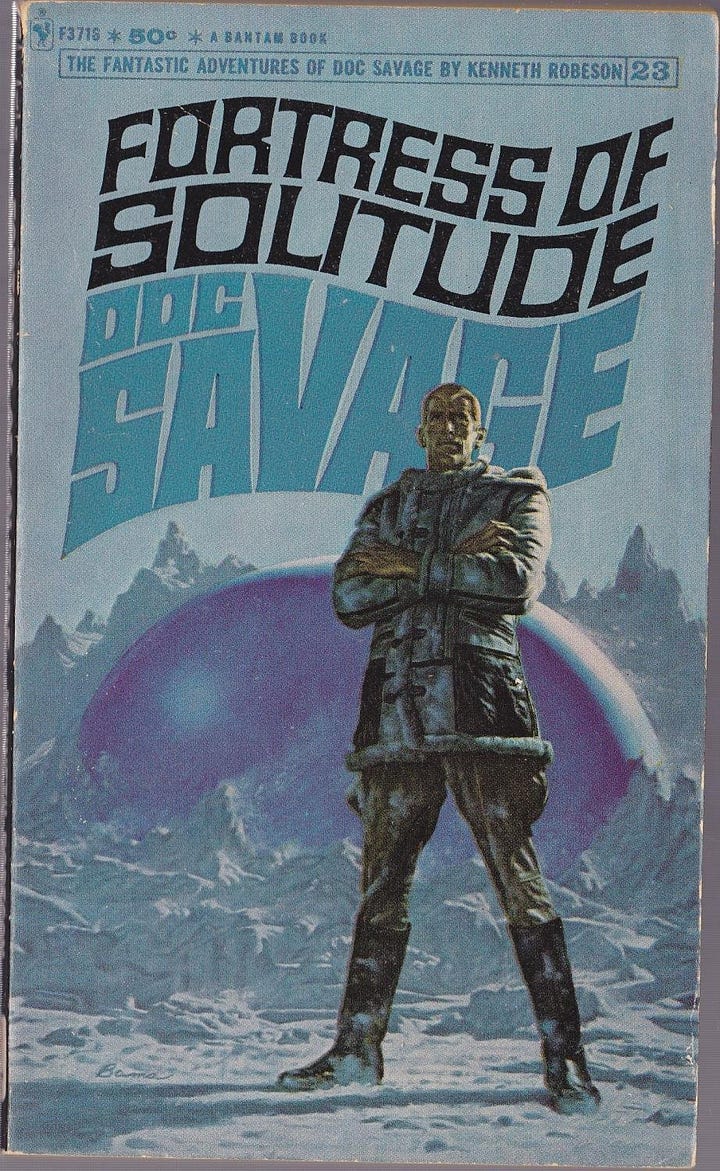
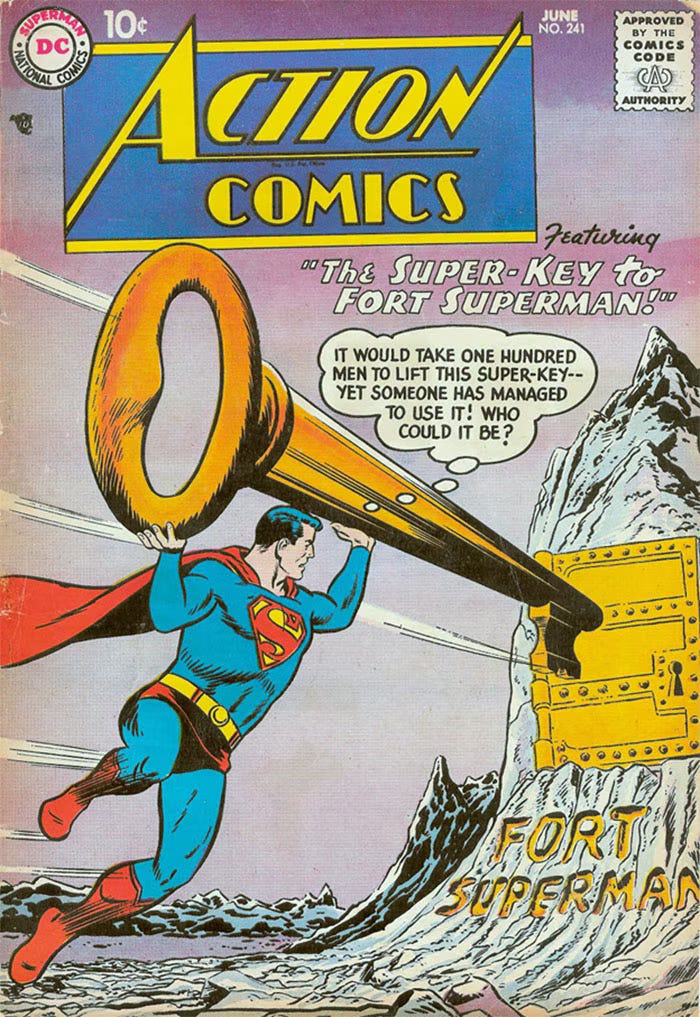
I know, also, that I was fully aware of and alive to the possibilities raised by the two Fortresses of Solitude, one at the North Pole, one at the South, that were the secret impenetrable fastnesses respectively of pulp hero Doc Savage and Superman, both name-checked frequently in the novel.
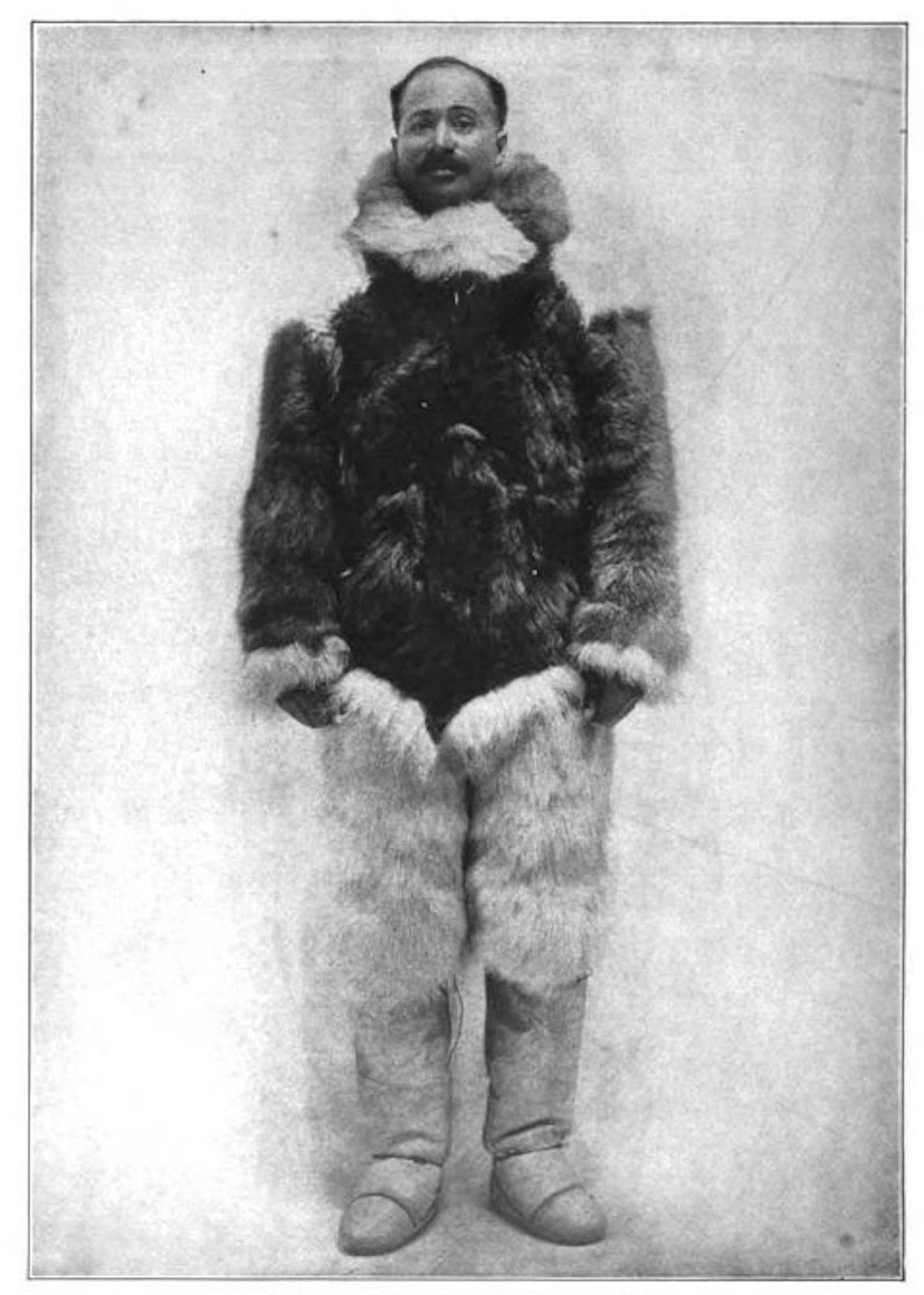
I know that I had always been fascinated by polar explorers and expeditions, from my fellow Marylander Matthew Henson (somewhat encumbered by his employer, Robert Peary) to the doomed Antarctic late-Victorian romances of Shackleton and Scott.
I know that two of my all-time favorite pieces of fiction are Poe’s The Narrative of Arthur Gordon Pym, with its transcendental-uncanny Antarctic climax, and Lovecraft’s At the Mountains of Madness, Pym’s mutant stepchild. And I know that writing about the Golem meant (to me, at least) that I was also, to some degree, writing about Frankenstein—a novel that, like Pym and Madness, is framed as a factual account of polar disaster.
Probably—that’s as confident as I feel, looking back—all of those interests and concerns and narratives were at work, in my unconscious (or whatever you want to call the relevant brain-state), at the instant I decided on the place where the US Navy and I would be sending Radioman (2nd Class) Josef Kavalier: he would be deployed in the Antarctic Theater, a sphere of operations to call my own. If nothing else, I would be guaranteed, as far as competition was concerned, to have the Theater all to myself, since I would be inventing it.
I spent the first few days at the Laurel Mill Lodge polishing those final scenes from Part IV, gathering steam and strength, and reading some pages I’d copied from a book before leaving home—possibly Jack Bursey’s Antarctic Night, which I’d picked up secondhand and read, years before. The chapter concerned the US Navy’s Antarctic Expedition of 1940-41, under the command of Admiral Richard E. Byrd, which was undertaken in response to Nazi Germany’s having recently made territorial claims to a vast Antarctic region it was pleased to call “Neuschwabenland.”
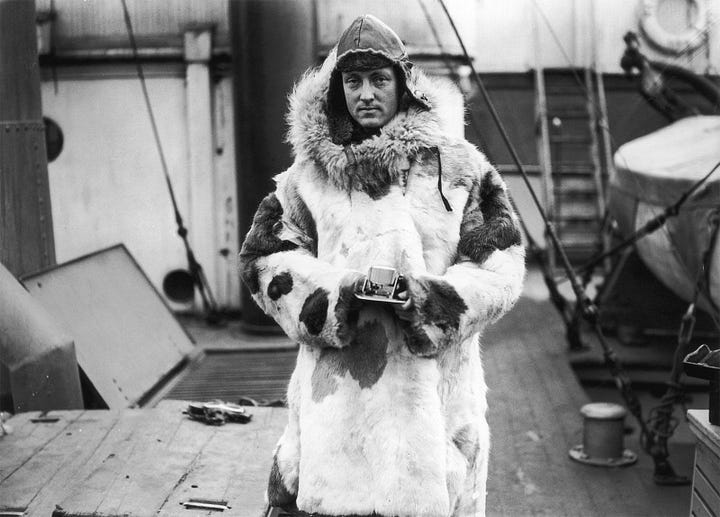
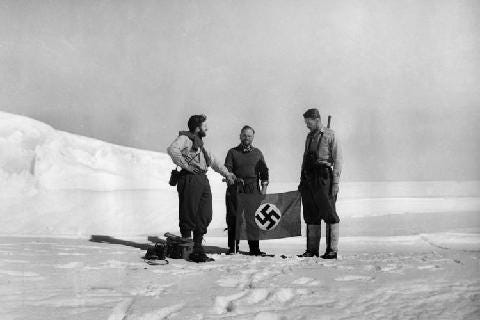
This forgotten episode of polar saber-rattling had become the seed of my proposal, as yet made only to myself, that during the war some kind of conflict or at least strategic maneuvering, afterward classified, might have taken place there. But I knew that if I were going to recruit readers to investing in—believing in—this proposal, I had a lot more research to do.
Strange as it may now sound (it sounds strange to me!), I had no plans to do any of this necessary research on the Web. The Worldwide Web existed (though it was smaller then by a factor 1 x 10⁴ or 105, depending on whether one counts links, or crawls). A then-newish thing called a “search engine” existed; Altavista was the one I favored. And by the latter half of 1998, if that’s when I went to Laurel Mill, there would have been the new kid, Google. But a novelist in need of detailed information about the history, technology, and anthropology of Antarctic exploration would never have turned to, let alone leaned on, the Web. For the kind of research I’d be doing, you went to the library.
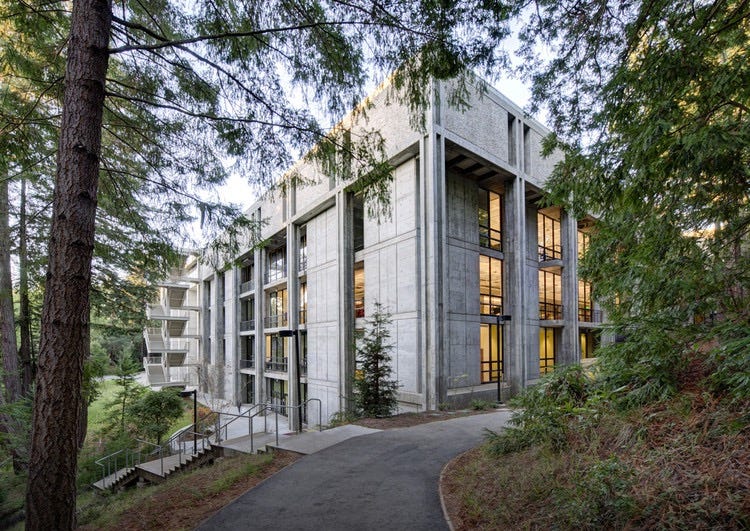
There was a nice big one, not far away: the McHenry, at UC Santa Cruz. Its proximity and the breadth of its holdings had been part of my calculation, to begin with, in selecting the Laurel Mill Lodge. So I wound my way down from Soquel to the university campus, which I’d visited once with my first wife, an alumna. I walked among the redwoods and Doug firs, hit the McHenry, and went to work turning up every book they had about Antarctica and Antarctic exploration. Most had been published since the war, and I set them aside. I didn’t want my own knowledge to exceed what would have been available to Joe, his mates, the US Navy, the German Kriegsmarine, or anyone alive back then. I couldn’t risk a slip that would give Joe premature awareness of data or phenomena gained only after 1945.
As I recall, the books most relevant to my task filled a couple of shelves in what must have been the G-stacks, between 850 and 875. I harvested the prewar titles, and carried two wobbling armloads over to a nearby table. I sat down, and opened my green Mead 7-subject spiral notebook, its divider pouches bulging with souvenir World’s Fair maps, color copies of Golden Age comic book covers, a glamorous headshot of Franchot Tone.
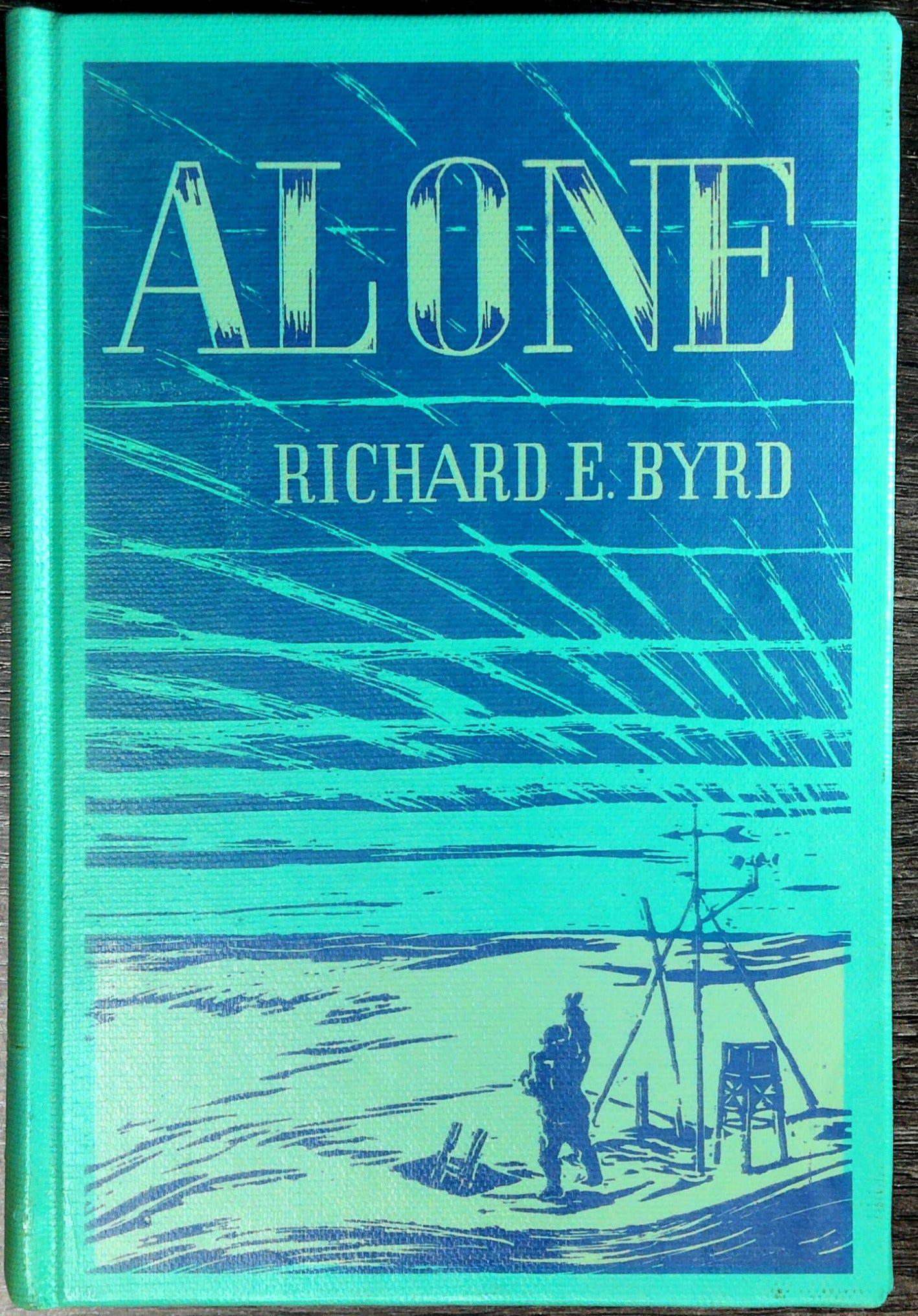
I started with the book that looked most appetizing, and the most haunting, Byrd’s Alone (1938), a firsthand account of the four (out of a projected six) months in 1934 that the explorer and pioneering polar aviator had spent sheltering “on the Ice,” in total solitude, his mind veering wildly from rapturous gloom to somber philosophizing to a dementia induced, as Byrd eventually came to realize, by a nearly-fatal carbon monoxide leak in the flue of his gasoline-fueled stove.
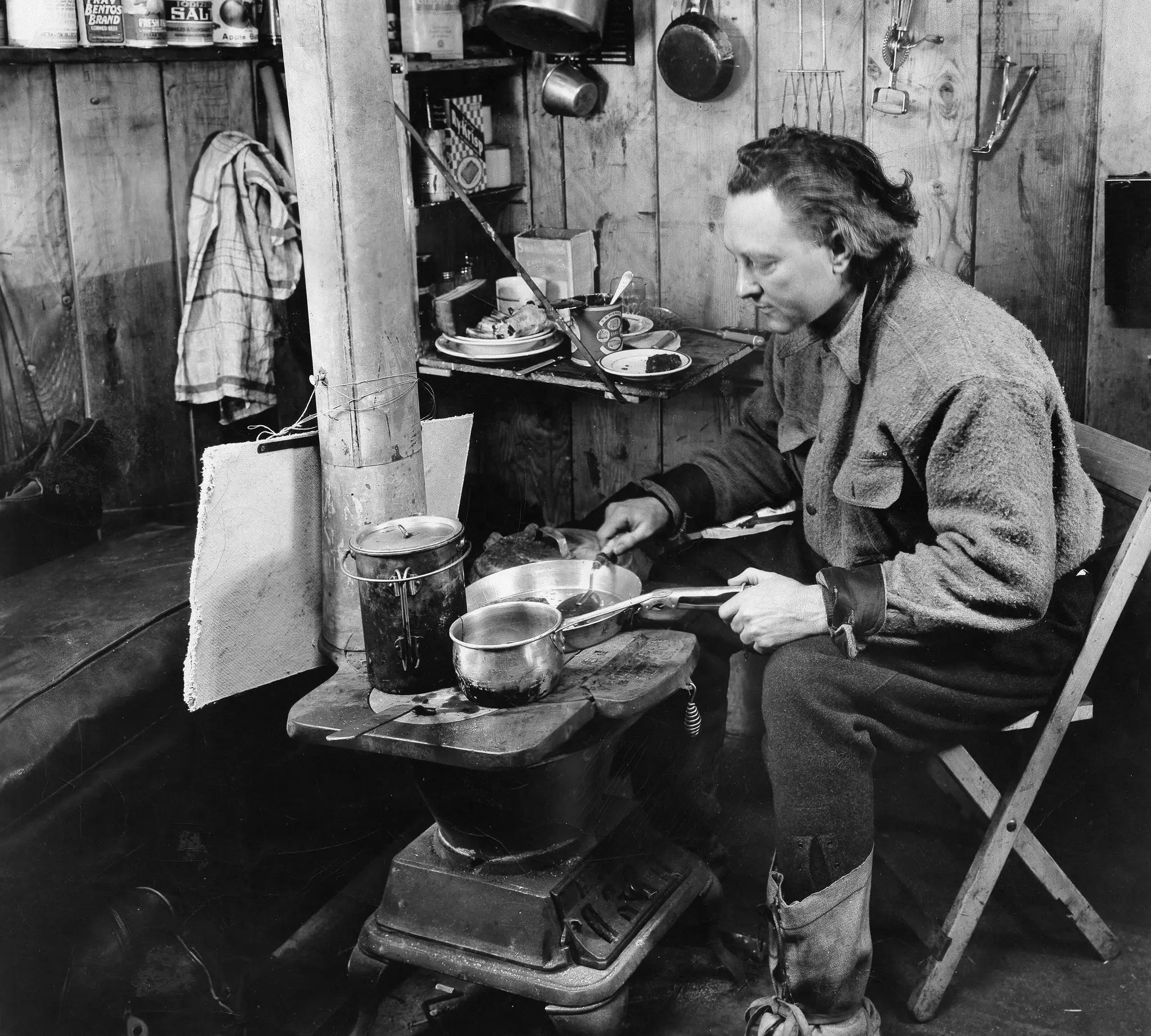
When I finished taking notes on Alone, I reached for the next book on the pile, and then the next. I spent ten hours at the McHenry that day, restored the books I hadn’t gotten to yet to their shelf, and drove a pizza back up to the Lodge. The following day I returned and hoovered up a whole bunch more books, reading for hours, and hours, and hours, until at some point facts and quotations began to repeat themselves, and I reckoned I had absorbed as much as the library had to offer, and more than I would probably need. Then I drove back up into the mountains, to my little A-frame cabin, and started to write, and write, and write.
Two aspects of daily life during the First (1928-30) and Third (1939-41) Byrd Expeditions had made particularly strong impressions on me: the sled dogs, and the men’s relationships with them; and the paramount, almost religious importance of games and pastimes. Shut in by intolerable weather for days on end, Byrd and his men would resort to almost any amusement they had brought with them or could devise, childish or manly, idiotic or sophisticated. In 1934, Byrd had sought refuge—of course—in playing solitaire.
So I started—to get my head into it, to participate imaginatively in the adventure—by devising an idiotic game of my own: it was called Lupe Velez. (I was already up on my Hollywood history of the era.) The first sentence I wrote for Part V emerged complete, in what would remain, word for word, its final form:
The loser at Lupe Velez was obliged to make his bed in the tunnels, out in the pandemonium of Dog-town.
What followed came swiftly, faster than I could type. I had spent the past two days in the library, Alone, imbibing the intoxicant effluents of research, and now I had returned to the solitude of my A-frame fortress, where I spent the next several hours in a remarkable state of flow, of intense, hallucinatory certainty about everything that had happened, that must have happened, to Joe Kavalier, during his sojourn at what his mates and I were already calling “Kelvinator Station.”1
There were eighteen dogs, Alaskan malamutes for the most part, with a few odd Labrador and Greenland huskies and one unreliable skulker that was nearly all wolf. You took a sleeping bag and a blanket and, as often as not, a bottle of Old Grand-Dad, and bedded down in the frozen tunnel where, in spite of the snow floor and snow walls and ceiling of snow, the stench of urine, harness leather, and rancid, seal-greased black husky lip was surprisingly lively. They had started out with twenty-seven dogs, enough for two main teams and a team to spare, but four of them had been torn apart by their fellows out of some complex canine emotion composed of boredom, rivalry, and appalling high spirits; one had fallen into a bottomless hole in the ice; two had come down with something as mysterious as it was swift; one had been shot by the signalman, Gedman, for reasons that remained poorly understood; and Stengel, the true genius among the dogs, had wandered off into the fog one day when no one was looking and never come back. There were twenty-two men. They played poker, Parcheesi, chess, cribbage, hearts, go fish, geography, ghost, Ping-Pong, twenty questions, dime hockey, sock hockey, bottle-cap hockey, contract bridge, checkers, liar’s dice, Monopoly, and Uncle Wiggily for cigarettes (they had as little use for money as for shovels and snow). They played to win exemption from the nasty work of chipping away with an ice chisel at the frozen ziggurat that mounted endlessly in the latrines, a pillar of turdsicles and of diarrhea plumes arrested by the cold into fantastic shapes out of Gaudi. Or they played (at chess in particular) for the treasured prize of reducing one another to little piles of ash and embers. But the winners at Lupe Velez won only the right to sleep in their bunks, warm and dry inside the Antarctic Waldorf, for one more night. It was a stupid, cruel, but at the same time forgiving game, and easy to play. There were always twenty-one winners at Lupe Velez and only one loser, and he had to go lie down with the dogs. Though in theory, given the essentially random and unskilled nature of play, they were all at an equal disadvantage, usually the one bedded down in the chaos and smell of the tunnels at the end of the evening, after a brisk inning of Lupe Velez, was Joe Kavalier. He was in there, tucked right into a crate alongside the dog called Oyster, the night that something went wrong with the Waldorf’s stove.
Apart from the pilot Shannenhouse, there was not a man among them past the age of thirty-five (the first day the thermometer dipped below −20°F had occurred on the thirty-fifth birthday of their captain, Walter “Wahoo” Fleer, who marked the occasion by sprinting fifty yards from the Blubberteria to the Mess Hall, clad only in his mukluks), and three of the Seabees, Po, Mitchell, and Madden, were barely out of their teens, which probably went some way to explaining the essentially boyish stupidity of Lupe Velez. They would all be crammed into the Mess Hall, at once hours and weeks into the night, wasting time or doing something that pretended not to be wasting time or, in sober, intense bursts, being absorbed in some unavoidable and urgent business of repair, analysis, planning, or navy discipline, when somebody—often enough Gedman, though anyone could start a round—would call out the name of the star of Mexican Spitfire and Honolulu Lu. Immediately everyone in the room was obliged, according to the rules, to follow suit. Whoever was judged, by general determination of the players, to have uttered the critical words last (unless it was his turn on watch), spent that night (what they called night; it was all night) in Dog-town. If, through duty or good fortune, you chanced not to be in the room at the time, you were exempted. Play, except in the case of extreme tedium, was limited to one round per day. These were the rules of the game. Its origins were obscure, its conduct passionate. But for whatever reason, Joe could not seem to master it.
At some point I fell into bed, reluctantly, afraid of breaking the spell; but when I woke up the next morning I found myself still in full possession of a true and authentic sense of everything that had transpired Down There, in the course of that awful winter and, even more remarkably, of all the words I needed to tell the tale—and only those words, at the very instant I felt the need of them. I wrote all day, went to bed, woke up, and did it again. Four days later I came to the final sentence, to the last, worst thing that broke Joe’s heart, taking it down like dictation, exactly as it now stands.2
I’d never had an experience like that while writing, and it has never been repeated, at least not over such a prolonged stretch, with the same intensity and clarity and awareness of design.
I miss it.
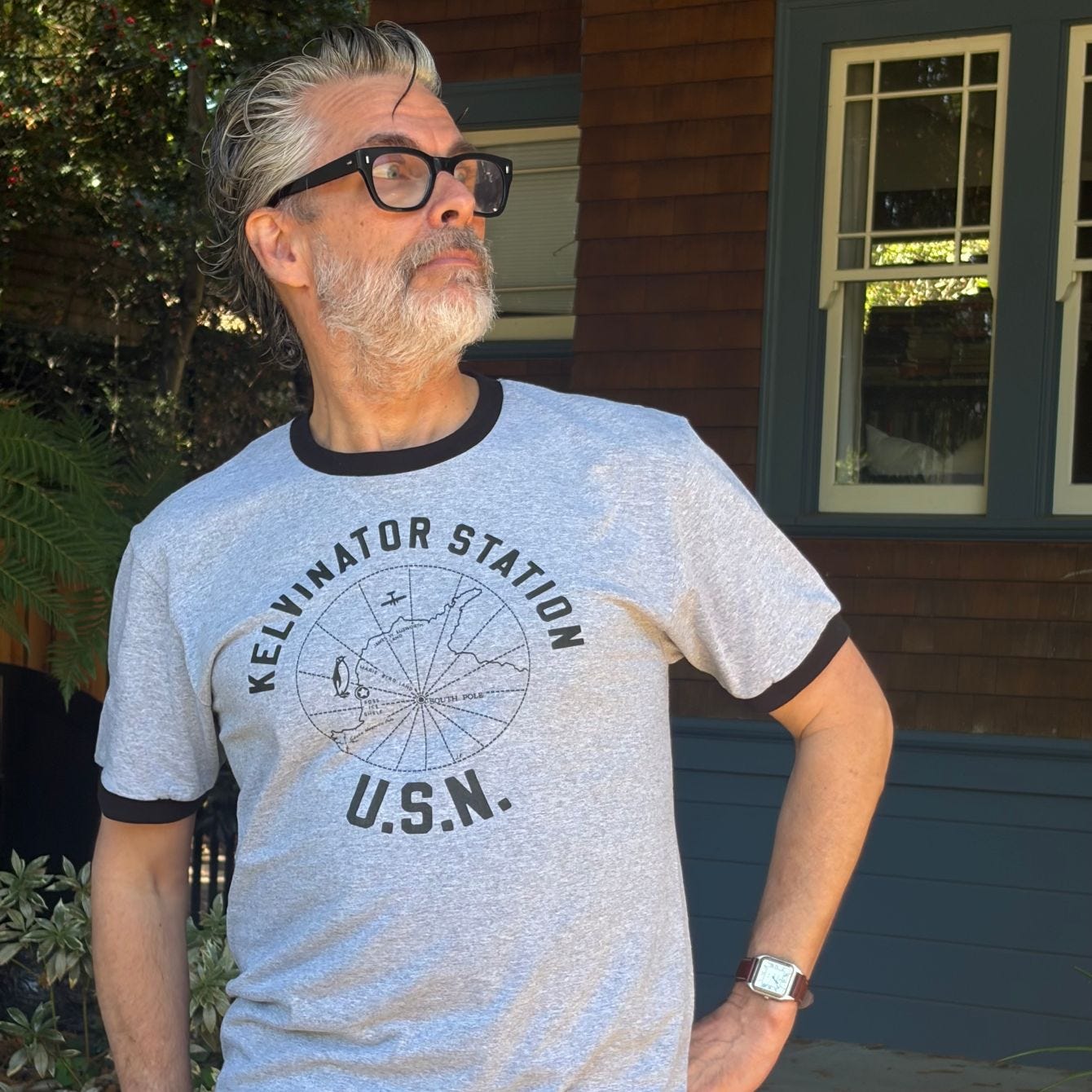
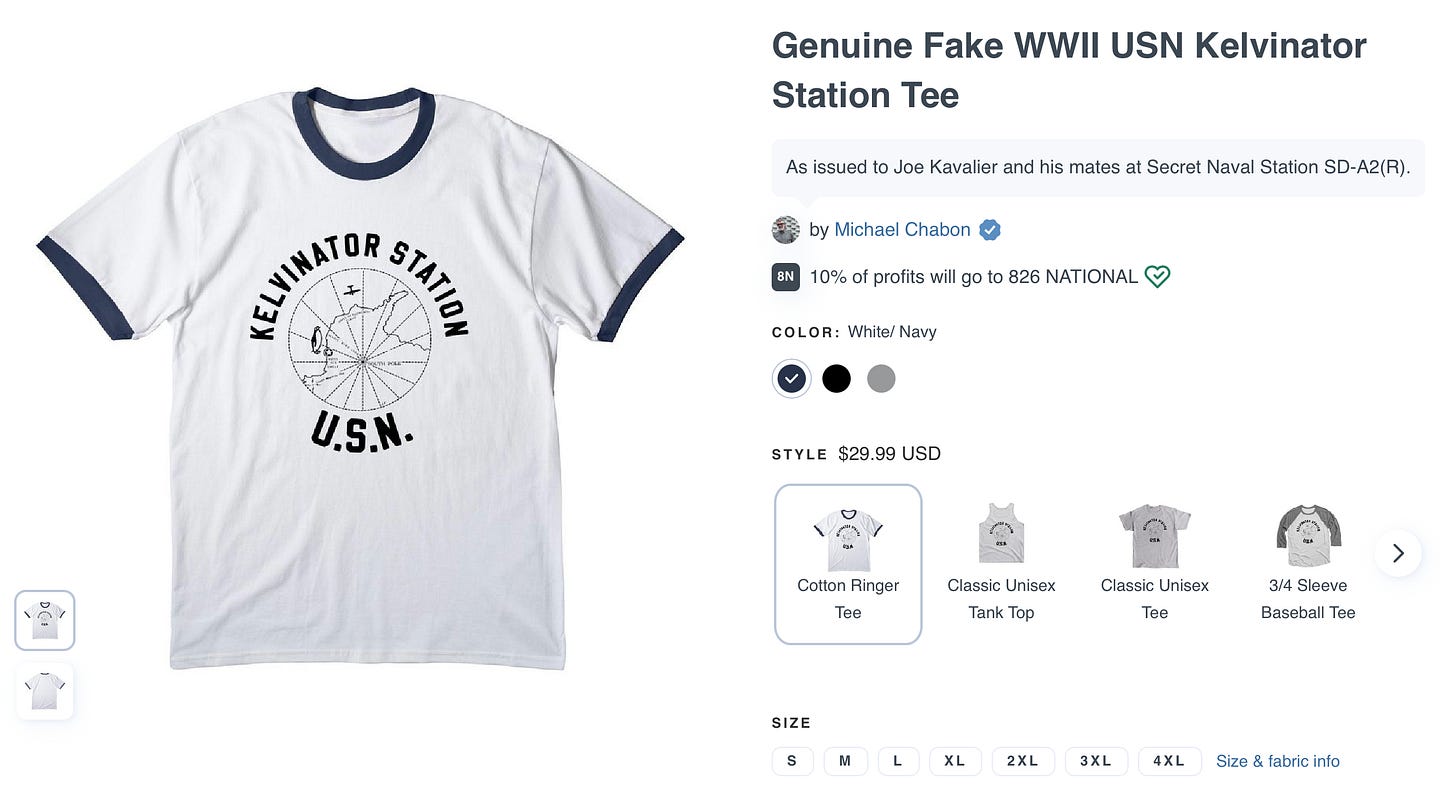
As I contemplated possible subjects for a second “diegetic tee” design—a shirt that might conceivably have been worn by a character in one of my novels, showcasing some tee-worthy element contained therein, I thought right away of doing Kelvinator Station. I thought of Empire Comics, too, and of the Escapist or Luna Moth or some other slightly less obvious Kavalier & Clay creation. I thought of Tannen’s Magic Shop, and wished I had actually invented it.3 Maybe a shirt from the Hofzinser Club (highly unlikely, I believe, to have offered any such plebeian garment), or one that was sold following performances by the Mighty Molecule, World’s Strongest Jew (tempting, but not entirely plausible). The Dali-designed shirt sold at Longman Harkoo’s surrealist art gallery, Les Organes du Facteur (again, period and venue unlikely). I doubted that anyone who liked my books would be caught dead wearing a Genuine Fake Aryan-American League Tee (and sadly you can buy that kind of trash anywhere, nowadays).
I knew, however, that if I designed a classic US Navy “cruise shirt,” exactly replicating the one provided to personnel at Kelvinator Station in 1942, featuring a cool map, and an airplane like Shannenhouse’s Curtiss Condor, and maybe a little penguin in there somewhere, I was guaranteed to sell at least one, because I want a Genuine Fake WWII USN Kelvinator Station Cruise Tee—a trace, like the Time Traveler’s flower from the future, of the most vivid waking dream I’ve ever had, or shared.
Want one too? Here’s your chance. You can find it, along with the Genuine Fake Sitka Tourist Tee, at the usual location, with the usual 10% of profits going to 826 National, in gratitude for the work they do helping to create future writers, readers, and lovers of good writing, and of vividly dreamed dreams.
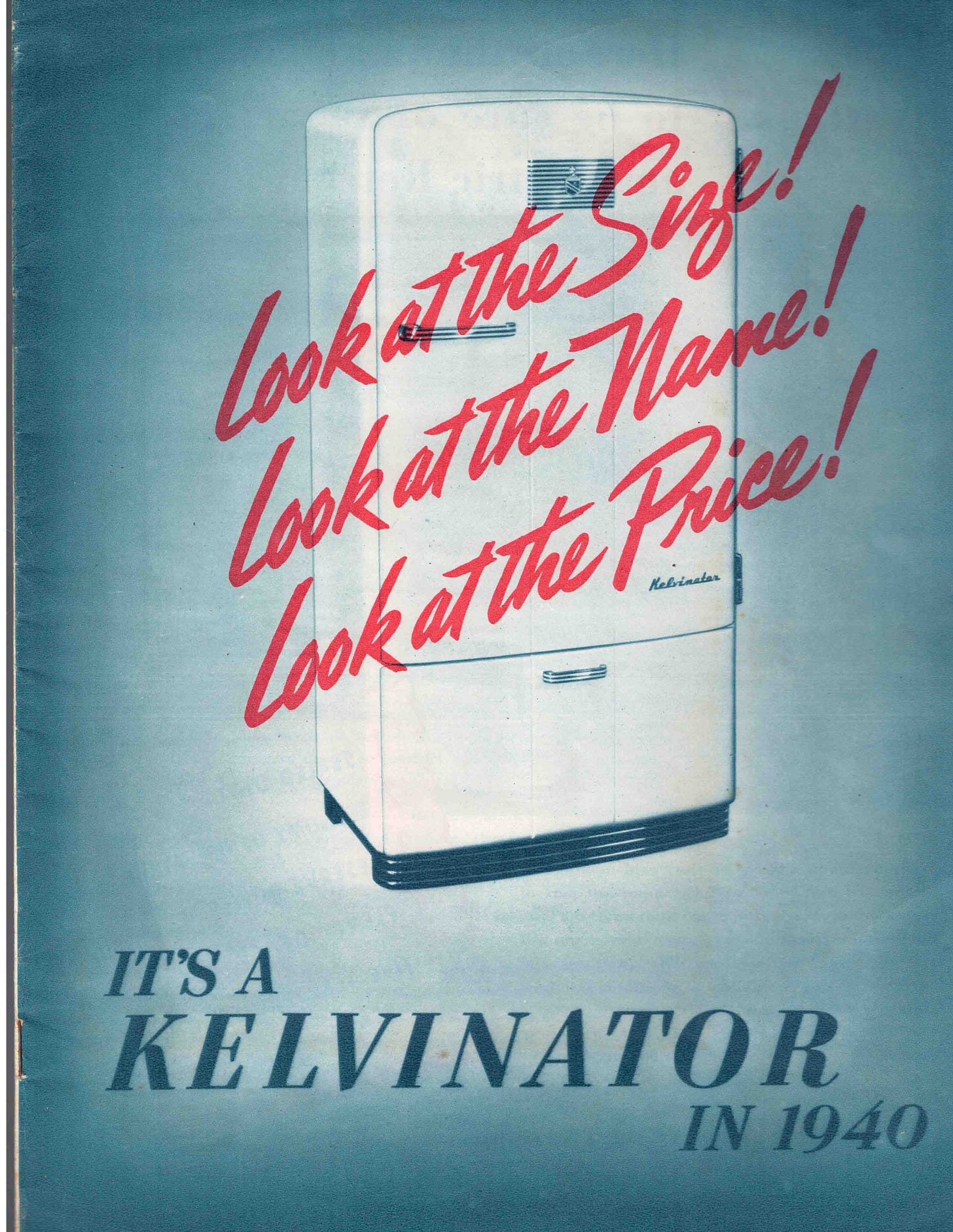
In the late 1930s, Kelvinator was the leading US manufacturer of refrigerators.
I refrain from quoting it, because, spoilers.
Comments
Nothing yet. Say the first thing.
Sign in to join the conversation.