
R.. was a girl in my freshman class at Carnegie-Mellon, an art student. We met sharing a ride home to Maryland over a long October weekend, in the back seat. Two dudes from Bethesda or Chevy Chase were at shotgun and the wheel. She was from Potomac. The trip was nearly five hours (back then on the interstates it was double-nickels all the way), and R. did most of the talking.
The backseat was not spacious and I couldn’t turn to look at her without seeming to deliberately scrutinize her, though mostly what I did when I turned to her was marvel. She was pretty—pale moon face framed by long straight dark hair, dark eyes, long expressive hands, but the marvel was her style of talk. Almost everything she said—assertions, exclamations, observations, recollections—was startling, or unexpected, or rang strange in the everyday ear. No sentence she began ended up where it had appeared to be headed. When she fell silent, there would be an awkward lull during which none of us boys could seem to find anything worth saying.
Her talk relied heavily but without apparent effort on similes that syntactically passed muster but semantically flitted and alighted and flew off again, scattering meaning in golden flecks like pollen.
I won’t pretend to recall any examples from that first day, but here’s one I’ve never forgotten, from later in our brief time together, when R. was trying to account for an unexpectedly lousy grade on an in-class essay: she told me that “the cave” (she was referring to her head, or her mind) “was on fire,” and that her thoughts “flew out of it like burning bats.”
I do remember that I thought about the line in “Happiness Is A Warm Gun” where John Lennon sings about the girl who doesn’t miss much, “well-acquainted with the touch of a velvet hand like a lizard on a windowpane.” In all the times I’d listened to The White Album, I’d never managed to really grasp the intended comparison. I could accept that certain kind of lizard might feel velvety to the touch, but what did the windowpane have to with it? Or were window-affixed lizards, like the observant girl, well-acquainted with the touches of velvet hands? As R. coined similes, one after the other, like an ice cream man dispensing change from a gizmo at his hip, I wondered if this particular observant girl and John Lennon shared some power of wild analogy that I lacked, or if there were more kinds of “likeness” than I had ever imagined.
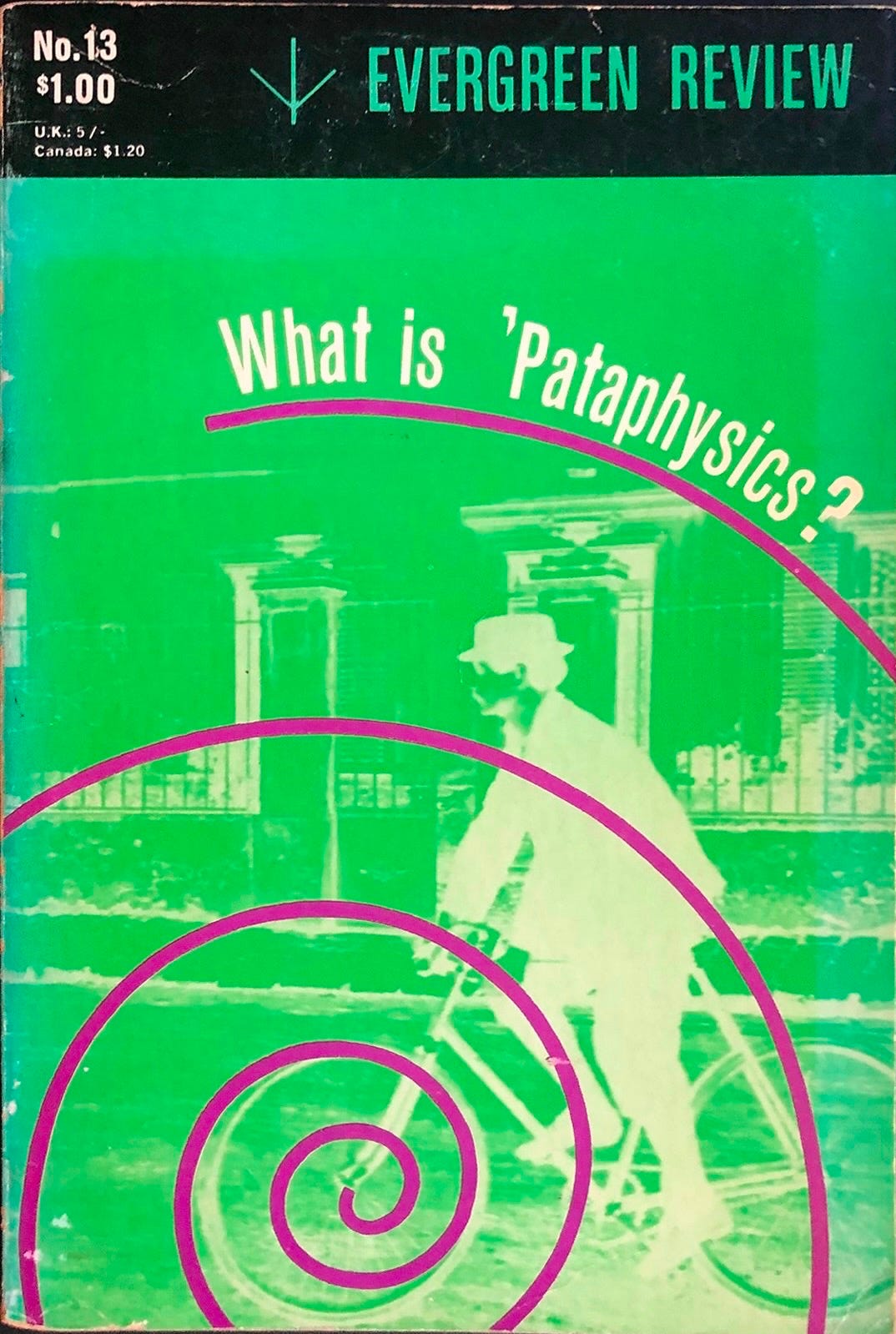
I thought about automatic writing, Andre Bréton quoting Lautreamont’s line “beautiful as the chance encounter of a sewing machine and an umbrella on an operating table.” I thought about the aleatory artistic procedures I’d read about last summer before college, in an old copy of The Evergreen Review dedicated to the art movement or elaborate hoax known as ’Pataphysics.
At some point along the way, maybe Breezewood, we stopped for her to take a bathroom break. When she got out of the car the guy behind the wheel turned to look at me over the front seat.
“What the hell was she talking about?” he said. He was a junior or senior, and we had met only a day or two earlier, when he’d agreed to drive me, and I’d agreed to chip in for gas. “Who the hell is she?”
I didn’t know how to answer either of those questions, really, but I wasn’t going tell him that. I supposed, or maybe it was more like vowed, that I would figure her out eventually, given time. I thought about telling him that, duh, she was obviously a ’Pataphysician. But I hadn’t really understood what ’Pataphysics was all about, either.
“Well,” he said, after a moment, giving up on me. “She’s different.”
R. was “different”: An insult, in 1980, though it often came wrapped as a compliment, presented with an arched eyebrow for a bow.
She was the first person I ever knew who shopped exclusively and willingly at Goodwill, hospital thrift shops, Army-Navy stores, favoring unflattering items that appeared to have been cast off decades ago by Thelma Ritter or Mercedes McCambridge. At times she gave off an almost intolerable smell of mothballs leavened—if that’s the right word—only by Nag Champa incense and the lily-of-the-valley oil she dabbed behind her ears. All her footwear was rat-nosed lace-up Strega Nonna boots or those cheap, flat, black cloth slippers that were sold out of big plastic tubs in the Chinatowns of the day. She had an odd gait, part shuffle, part scuttle, and the sound of her approach was a flat soft flapping like the flit of moth wings.
She lived in a different relationship to animals—birds, mammals, insects. She didn’t presume to communicate with them; not in any direct way, a la Dr. Doolittle. And she did not anthropomorphize them. It was more that she zoomorphized herself. Regarding a tabby cat lounging on a window sill or a praying mantis on a tree her movements were altered, she grew watchful, fell silent. It was as if she could access, or verge on, a level of human consciousness that was interwoven with that of animals, made out of the same stuff, the same vibrating stuff of life.
Everywhere she went she found nests, eggs, dens, hives, cocoons. If they were empty—shells, relics—and pocketable, she put them in her pockets. You found them in the corners of her room. Looking for matches or a joint in her purse I would find the startling blue halves of a robin’s egg, a cicada carapace rattling in an empty pill bottle, and think of Tolkien’s wizard of the animals, Radagast the Brown.
If animals shared the stuff of life with her they also stood for death. Animals died, everywhere, constantly, all around her (no more than around other people, only more remarked upon). A smear of feathers and blood on the window could make her burst into tears and yet she loved animals for their subjection to violence and mortality. Her pockets and the rooms she lived in filled with skulls, bones, teeth, claws. For reasons that as with so much else eluded me, there was something that she needed or some absence that was filled by the presence and her mindfulness of dead things.
At times she seemed to live in a kind of cosmic Pee Wee’s Playhouse in which everything—not just animals and plants but furniture, objects, the sun, moon, sky—was invested with sentience, consciousness, some rough sketch of a soul.
That native panpsychism made it hard for R. to know how to feel about food. She could take a strange delight in unwrapping the foil from a Hostess Ho Ho, in the contrast between what she thought of as the chrome Moderne tubularity of a wrapped Ho Ho and the soft, dark, mystery whorl within. Or, looking at something as benign as a turkey sandwich, see would see only the horrors that must have befallen its ingredients in the journey from the earth, farm, or field to her tongue, throat and belly, themselves just meat for carnivores and worms.
Her ambivalence about it made food a frequent subject of her art and poetry, maybe the most frequent. Sometimes she would totemize it, like Thiebaut with his cake paintings, or indulge in verbal play with her food, an echo of which I caught right away, the first time I heard the chorus of the Prince song quoted above. And even when food inspired her with revulsion, horror, pity or remorse, there was also—as with the animals she felt she understood—a kind of involuntary disinclination to look away. And that was her painter’s gaze.
She left flowers in vases till the stems bent and heads hung and the standing water stank, and then she painted them. She taped dead flowers and fish scales and scattered feathers to the pages of letters and journals and the blank books she used for writing down her dreams.
The membrane between her dreams and waking was sometimes thin. She talked about their incidents and surprises as if you might have also have witnessed them and perhaps noticed something she might have missed. Her dreams supplied her with subject matter for paintings and lines for poems. She collected them in albums and journals. They had staying power. A nightmare could ruin half a waking day. A loving grandmother encountered in a dream could speak comforting words that made no sense in daylight, even to R., but whose consolation could endure for days.
She spent a lot of her waking in life in bed. She often felt ill, prone to cramps, headaches, nausea, bouts of inertia and bleak outlook that I realized only afterward had been the down-cycles of depression. But her bed was also the place where she could lie for hours in the lingering tangles of her dreams, floating on their gentle ebb. It was the place where without quite dreaming she could sit alone for hours, staring out the window at the white Pittsburgh winter sky, and saying nothing. In her bed, alone, the girl who had filled a carful of strangers with skyrockets and fanfares of chatter fell into deep dark soothing silent reveries that she kept to herself, as if they were were more private, more precious, than her dreams.
Her father was an immigrant Russian Jew, a doctor, and an old tyrant—much older than her mother, an insufficiently lapsed Irish Catholic who fretted over inconceivable things like her daughter’s soul and hardly seemed young, or ever to have been young, herself. R.’s Jewishness was a phantom history of phantoms, her Catholicism a lurid jumble of beautiful martyrs and a demonology that been discredited without being wholly renounced.
As a child, in her house and in her head, she’d heard and seen things that she thought were the work, and spoke with the voices, of demons. She alluded to dark incidents when she was growing up but, after almost forty-five years, I’ve lost any detail, which I suppose is just as well and, really, none of my business. I remember a general impression of anger and shame.
In addition to the painting and drawing that she had come to CMU to study, R. wrote and, as importantly, read poetry. She turned me on to the work of Seamus Heaney, Emily Dickinson, Arthur Rimbaud, Gerald Stern, Gary Snyder, Rumi. I was born with a good ear for language and a mind for wordplay, word histories, for grammar as a pastime and spelling as a craft, but R. obliged me to consider the tension and caesuras of a poetic line, the way poems were striped with meaning and silence, like the shadows of louvered blinds on a white wall, like the interlineated strands of human and animal minds.
She played the acoustic guitar, and wrote and sang her own songs. They were like her dreams and her conversation and her paintings: they verged, lingeringly, on making sense.
Her musical knowledge easily encompassed my own, and her taste ranged widely: in the pile of jackets, sleeves and scratched-up discs scattered atop the scratched lucite lid of her all-in-one stereo set you might on any given day find Gary Numan & Tubeway Army’s Replicas, Cat Stevens’ Tea for the Tillerman, Elvis Costello’s My Aim Is True, a Captain Beefheart, one of the Caedmon Dylan Thomas recordings, Syd Barrett’s The Madcap Laughs, and at least one of guitarist and Genesis co-founder Anthony Phillips’s solo albums, especially Wise After the Event.
She was the first Serious Beatle Fan I ever knew—she could draw you the line from “I’m Looking Through You” to “A World Without Love,” and knew what Dr. Robert had prescribed, and who the Fool were, and why everybody put them down. And she revered Joni Mitchell—then only a name and a voice, to me, only “Help Me” and “Both Sides Now” and “The Circle Game”—for her songs and her singing but even more for her writing, for her scene-setting and portraiture (see “Carey” inter alia), for her use of arresting imagery and language swinging easily from poetry to everyday speech and back. To this day as a maker of sentences I turn to Hejira, as R. taught me to do, the way I turn to Ondaatje or Woolf or Elmore Leonard: to remind myself how the pros do it.
R.’s problem—so defined—was that none of these ways of viewing and being in the world was voluntary. None could be controlled. Her ingenuity in neologism, her wildly analogical perceptivity, her ability to spot a fallen bird’s nest or the carcass of a bird where other’s saw neither or were not even looking, her capacity to spend half a day wrapped in the tattered amnion of a dream, grieving or delighting—none of these were tools she deployed, or paths she chose to walk. They could not be turned off, or avoided by a timely detour.
She couldn’t prevent herself, for example, every time she heard David Bowie’s “Ashes to Ashes,” from devising on the spot an entire set of mad lyrics that rhymed at every line ending with the originals; nor from singing them, out loud, wherever she happened to be or whomever she happened to be with:
Do you remember a sky that’s green/Like such an old sarong?
People, not least my father, said she was crazy. This was a characterization I resisted, and not only because I had fallen in love with her but because like many young men at that age I had begun to see my father’s disapproval and the things that earned it as inherently valuable, even cool. I resisted it because it told you exactly nothing about her, beyond the fact that she made many people, again including my father, uncomfortable.
She made my kid brother uncomfortable, though I think he thought of her less as crazy than something more akin to surprising or, at times, alarming. “Your head,” she informed him, the first time they met, “would look good on a fence.”1 He was around twelve, then, and she was comparing his expressive boy-man face to one of those carved heads on a medieval corbel (I believe), but to him (understandably) there was an unnerving allusion to the fate of medieval insurrectionists and criminals.
It would be many years before I noticed that my father, a trained physician who ought to have known better, tended to refer more often to women as “crazy” than men, in particular when they openly disagreed with him, challenged his authority, thwarted his designs, or were too free in their demonstrations of emotion.
That’s why in this life-annotated playlist I have left her and her behaviors, or my memory of them, undiagnosed. Feel free, if you’re into that sort of thing.
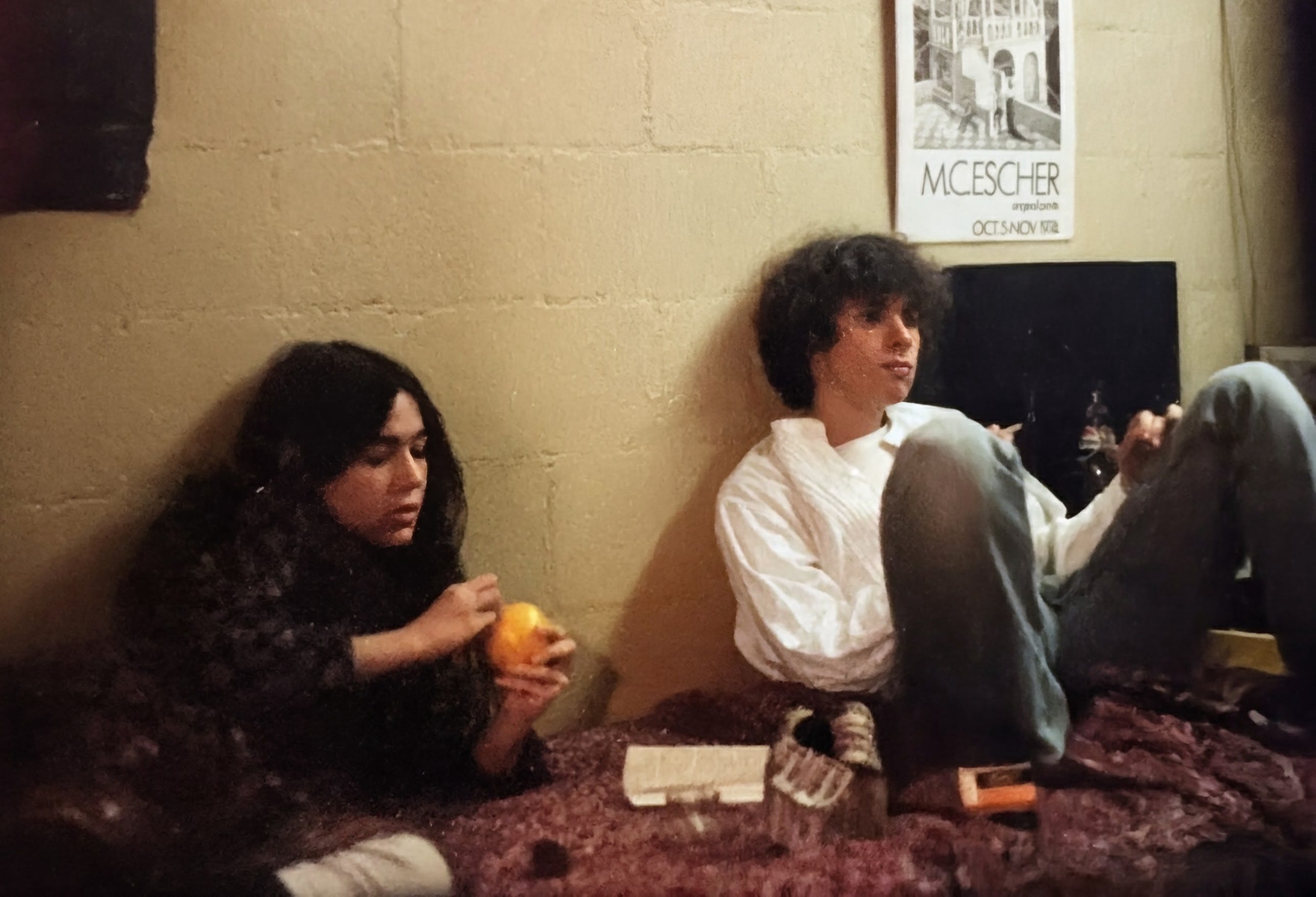
She was only a significant part of my life for a few years; long enough for me to observe that no one who had met her ever seemed to forget her, and that for every person put off by her strangeness there was another who welcomed the lamp that was lighted in life’s dull rooms by her entrance, the windows that were thrown open to catch a hitherto unsuspected breeze.
I certainly never forgot her; the last time I saw her was probably forty-two years ago, and I lost track of her completely. But she has stuck around in my work ever since, with fictionalized versions of her—nearly as many as there are songs on this playlist—cropping up in my short stories and novels, most recently—more by way of her atmosphere than any of her attributes—in the character of the narrator’s grandmother in Moonglow.
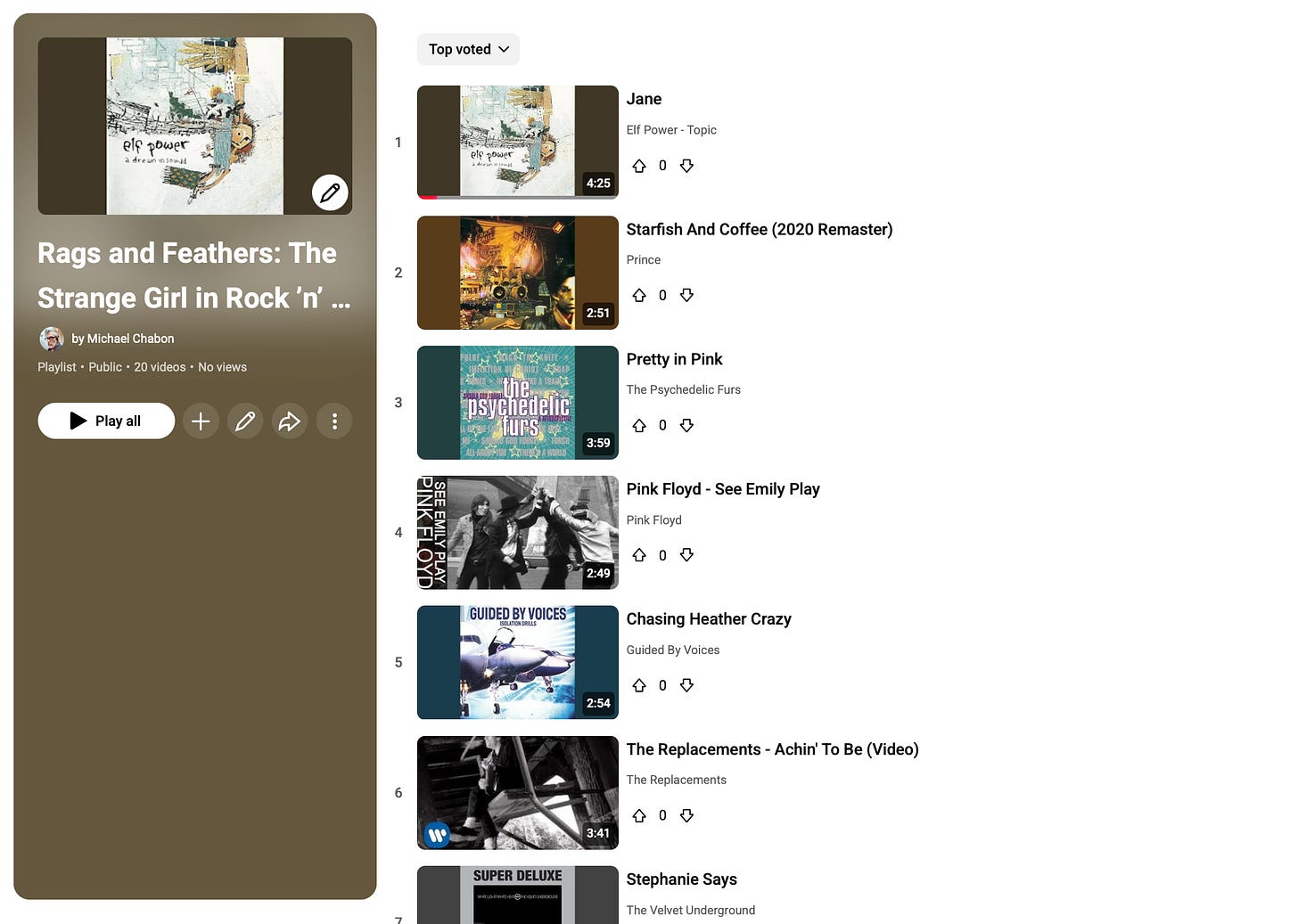
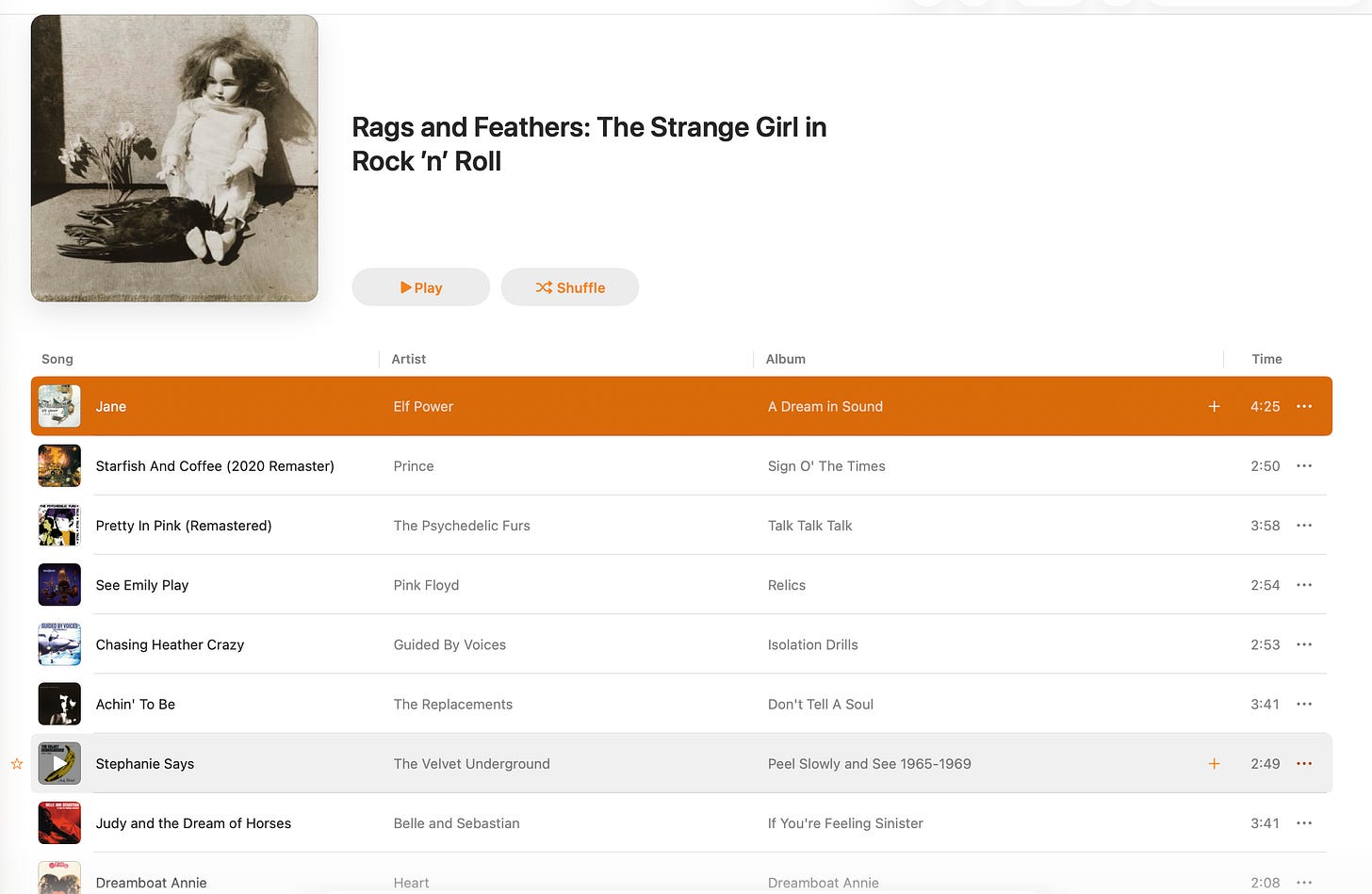
This playlist, a mere twenty songs, an hour and a quarter’s worth of music, has taken forty years to accrue and assemble itself, in my mind and in my memory. It features all of the songs I’ve ever fallen in love with—a few before I knew R., most only afterward—that have seemed to reflect the various songwriters’ own encounters with girls like R. the first girl I ever fell in love with.
In spirit this playlist began the first time I heard Leonard Cohen’s “Suzanne,” in the late Ed Ochester’s poetry class, at the University of Pittsburgh (I had transferred to Pitt from CMU at the end of my freshman year). At that time R. and I were still very much in each other’s lives, though no longer together as a couple. I thought of her right away; so many of the details, right down to the tea and oranges, rhymed. The song I encountered most recently (long after its original 1999 release) is the one that, when I heard it, inspired me to finally start assembling a long-contemplated playlist of songs about Strange Girls: the irresistible, celebratory “Jane,” by Elephant 6 stalwarts Elf Power.
Many of the tracks here, including “Dreamboat Annie,” “See Emily Play,” and “Little Wing,” are songs that I knew and loved before ever meeting R., but that I came over time to associate with her. The balance found their way to me over the years since our breakup, obliging me each time to ponder the surprising truth that in forty-plus years of listening, it’s only in the lyrics of these twenty songs—and certainly not in the life I’ve lived—that I’ve ever again encountered anyone quite like her.
A line subsequently shared out to the grandmother in Moonglow.
Comments
Nothing yet. Say the first thing.
Sign in to join the conversation.