
“Not often has it been given to archaeologists, as it was given to Schliemann at Tiryns and Mycenae, or to Stein in the deserts of Turkestan, to light upon the remains of a long forgotten civilization”
John Marshall, announcing the discovery, 1924
“The past is a foreign country: they do things differently there.”
L. P. Hartley
In 1856, two brothers named John and William Brunton were building a railway across the Punjab for the East Indian Railway Company, and they had a problem.
Track needs ballast, crushed hard material to hold the sleepers in place, and the alluvial plain of the Indus offers almost no stone. Then, local workers told them about the brick mounds.
Ancient ruined cities, shrouded in mystery, sat near the line, unimaginably old, and their bricks were hard-fired, uniform, and free. The Bruntons quarried them by the ton. Around a hundred miles of track between Multan and Lahore ended up resting on these enigmatic ancient bricks.
But where were they from?
The bricks were four and a half thousand years old. They came from Harappa, one of the two great cities of a civilization nobody then knew had existed, and for about seventy years, trains ran over it.
It took until the 1920s, when Daya Ram Sahni cut trenches into what was left of Harappa and R. D. Banerji did the same at a mound called Mohenjo-daro four hundred miles south, for anyone to work out what the railway had been grinding under its wheels. A civilization contemporary with Egypt and Sumer that had left no text, no legend, nothing. No folk memory anywhere on earth had preserved even a rumour it was there.
This is stranger than it first sounds. Egypt never fully disappeared. The pyramids stood there being asked about for four thousand years. Mesopotamia at least survived in the Bible, as Babylon, as Nineveh. Rome, Greece, Persia all lasted in some form. But the Indus survived nowhere. A civilization covering a million square kilometres, larger than Egypt and Mesopotamia put together, and roughly twice the size of France, fell so completely out of the human story that its rediscovery started as a search for gravel.
That is the first strange thing about the Indus Valley Civilization. It’s nowhere near the strangest.
Let me start with what we’ve actually dug up because, by the standard tests, this is a civilization scoring full marks.
Mohenjo-daro at its height held somewhere around forty thousand people, which made it one of the largest settlements on earth around 2500 BC.
And it was planned.
The streets cross at right angles. House walls run flush to the street line. Under the streets ran covered brick drains, fitted with inspection openings so they could be cleared, and nearly every excavated house connects to them, many with a private bathing platform and some with what are, by any honest description, toilets. This is the earliest known sanitation system built at the scale of a whole city. Rome managed something comparable two thousand years later.
The grandest building in the city is a swimming pool. The Great Bath, twelve metres by seven, sits at the highest point of the citadel mound, and the honest answer to ‘what was it for’ is that it looks like ritual bathing but nobody actually knows.
And that’s the honest answer to a surprising number of questions about this place. Where that keeps leading is the whole point of this essay.
But first, a harder puzzle than the drains. Drains only need engineers. The rest of what we’ve found needs something I find much harder to explain away.
Bricks across the entire territory, in cities a thousand miles apart, hold to the same proportions. Four to two to one, length to width to height. Every one of them.
And in the rubble of Mohenjo-daro, Ernest Mackay’s teams kept turning up small cubes of banded chert, polished, unmarked, and when you weigh them they climb in a disciplined sequence, doubling from a base unit of about 0.86 grams. One, two, four, eight, sixteen, thirty-two, sixty-four, before switching to decimal multiples for the heavy trade weights. Somebody enforced that system across an area twice the size of France, for centuries.
Now, we have the weights, but we have no idea who was doing the enforcing.
Because this is where the checklist starts returning nonsense. Every other early civilization announces its rulers. Egypt is practically one long royal advertisement. Mesopotamia hands us palaces, king lists, victory steles carved with who conquered whom. But the Indus gives us no palaces anyone can identify, no royal tombs, no statues of rulers at scale, no victory monuments, and next to no depictions of warfare at all. Mortimer Wheeler labelled one large structure the Great Granary, and the name stuck in a thousand textbooks, despite the small detail that excavation never recovered a single grain from it.
So. A society organised enough to standardise its weights and drain its cities. With no visible king.
Whatever held it together was arranged along lines the evidence just won’t let us reconstruct, and every label we reach for: a priesthood, some merchant guild, an early stab at collective governance, an assembly of elders, is a guess wearing the costume of an answer.
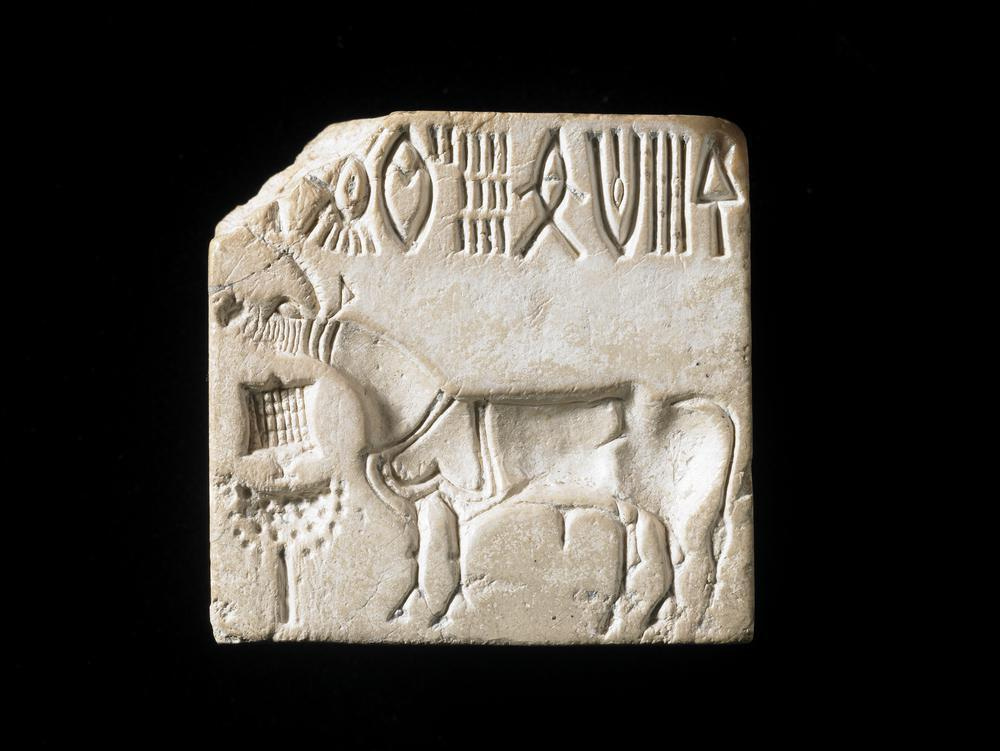
They had a script. Roughly four hundred distinct signs, cut with real precision into small steatite seals, usually above the figure of an animal, most often a unicorn-like beast shown in profile. Thousands of these survive.
Almost all of them are tiny. The average inscription runs about five signs. The longest known runs twenty-six, spread across three faces of one object. There’s no Indus Rosetta stone, no bilingual text, no long document of any kind, and after a century of trying, including claimed decipherments arriving at a rate of several a decade (every one of which has failed to convince anyone outside its author’s circle), the script stays unread. We hold the complete written output of a major civilization and can’t pull one sentence out of it.
Here’s where it gets worse, and this is the one live dispute I want to name precisely for you, because it matters. In 2004 Steve Farmer, Richard Sproat and Michael Witzel published a paper arguing that the Indus signs are too short and too statistically odd to be encoding language at all. That they might be closer to heraldry, or religious emblems. That the ‘script’ has never been deciphered because there’s nothing linguistic in there to decipher. But in 2009, Rajesh Rao’s team answered in Science with an entropy analysis suggesting the sign sequences behave like language after all. The argument still hasn’t settled. Which means the disagreement among serious people is no longer only what does it say. It now includes is it saying anything?
And here’s what gets me: either answer is unsettling! If it’s writing, a literate civilization of a million square kilometres is mute. If it’s heraldry, then one of the largest societies of the ancient world ran cities, standardised its trade and coordinated across enormous distances with no writing whatsoever, and every strange thing on that checklist gets stranger.
Thirty-seven skeletons.
That’s the entire physical basis for one of the most repeated stories in twentieth-century archaeology. Wheeler, digging in the 1940s, fresh from a career as a brigadier, found human remains lying unburied in the upper levels of Mohenjo-daro and read them as the victims of a final slaughter. The city put to the sword by Indo-Aryan invaders sweeping down from the northwest. He even named the culprit from the Rigveda, writing that Indra, the Vedic storm god who breaks cities, “stands accused.” The invasion theory then became fact by sheer repetition. Generations were taught it. Some of you reading this were probably taught it.
It fell apart under a man named George Dales, whose 1964 paper carried the title “The Mythical Massacre at Mohenjo-daro” and laid the problem out flat. The thirty-seven bodies come from different centuries and different strata. Some show signs of ordinary burial disturbance rather than violence. None were in the final occupation layer. The city shows no destruction horizon, no burn layer, no weapon caches, none of the signatures a sacked city reliably leaves behind.
There was no massacre. A soldier looked at a silence and heard a battle.
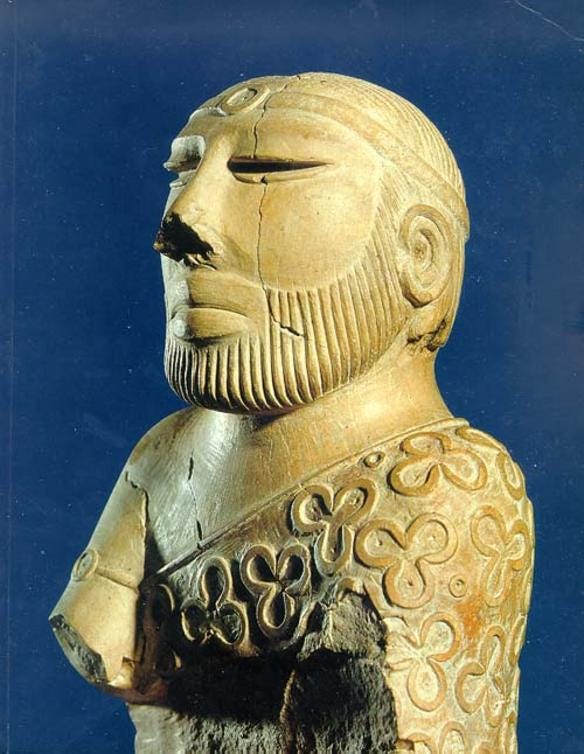
And he was in good company, which is the part that sits uneasily with me, because everyone who has looked hard at this civilization has furnished its silence with their own world. Marshall’s generation found a fine male statuette with a trefoil-patterned robe and hooded eyes and named it the Priest-King, a title it still carries in every museum caption, though there’s no evidence the man was a priest, a king, or either. Wheeler’s granary held no grain. These were the most capable archaeologists of their age, the very best, and the record shows them, one after another, digging up their own assumptions and mistaking them for finds.
The Indus is the cleanest laboratory we have for this, and the reason is exactly its muteness. Egypt can talk back. Invent a story about Egypt and some text eventually embarrasses you. But a civilization with no readable words has no way to correct you. So the observer pours straight in, unopposed, and every era gets the Indus it came expecting.
Around 1900 BC the cities begin to empty, and I think the way they empty is its own lesson.
Nobody burned them. Over roughly two centuries the drains stop being maintained. The standard weights fade from use. The seals stop being cut. The writing, whatever it was, stops. Pottery gets plainer, more local. And the people (here’s the part the word ‘collapse’ quietly hides) mostly do not die. Settlement maps show them dispersing eastward and into smaller villages, toward the Ganges basin and the better-watered land, while the great urban centres shrink into squatter occupation and then into mounds.
The strongest suspect is water, moving on a timescale no resident could ever have perceived. Around 2200 BC the summer monsoon weakened across the whole region, part of a drying event that shows up in climate records everywhere from Greenland ice cores to caves in India, and the river system the eastern cities leaned on, the Ghaggar-Hakra, was gradually starved until it failed. A civilization built on predictable floods met floods that stopped being predictable, and its response, stretched over six or seven generations, was to quietly stop being urban.
When I think of the word collapse I imagine endings with fire and destruction in them. But most endings have no fire. Most endings are boring: like a drain nobody got round to fixing.
And this is the bit I keep turning over. Every single person who lived through the end of the Indus experienced it as ordinary life. A grandfather going on about how busy the lower town used to be. A merchant’s son who moved east because east was where the work had gone. The civilization did not fall in any sense its own people would have recognised. Remember this point, because later in this arc we’re going to meet the other kind of ending, and the gap between the two is one of the most useful things the ancient world has to teach.
The Bruntons looked at Harappa and saw ballast. Wheeler looked at thirty-seven skeletons and saw an invasion, because he’d spent his life around armies. Marshall’s contemporaries looked at a statuette and saw a priest-king, because they came from an empire run by exactly that, a governing class fused with an established church. Nothing in the ground forced any of those readings. The gap forced them. A gap in the record is unbearable to us humans, and whatever the observer is carrying rushes in to fill it, invisibly, wearing the clothes of evidence.
The moment a civilization loses its own voice, someone else starts speaking for it.
Now run that lesson forward instead of backwards. Every institution, every family, every country carries stretches of its own past that left no usable record, and those stretches haven’t stayed empty either. They’ve been filled, by whoever needed them filled, with stories that feel like memory and are actually furniture. The confident narrative built over a silence is one of the most common objects in human life, and once you’ve seen the Indus you start seeing its shape everywhere: full marks for coherence, and when you go looking for the thirty-seven skeletons underneath it, they turn out to be from different centuries.
Which is why I can’t leave this one in the past tense. Somewhere in your own inherited story there’s a silence like this, a stretch with no real record, and it has not stayed blank. Someone filled it. And if you sit with it for a minute, you probably already half-know who, and what they needed it to say.
The Indus was a trading power. Its seals and beads turn up in the cities of Mesopotamia, and the Mesopotamians wrote about the trade openly. Sargon of Akkad had it recorded that ships from a land called Meluhha, which most scholars take to be the Indus, docked at his capital’s quay. There’s even a cylinder seal belonging to one Shu-ilishu, whose inscription names him as an interpreter of the Meluhhan language. A specific man, with a name, whose whole job was carrying meaning between these two worlds.
We can read every Mesopotamian word about Meluhha. We cannot read one word Meluhha wrote about anyone. The correspondence survives with one side of every exchange left blank, and Shu-ilishu, whoever he was, understood things about this civilization that no living person now knows.
He also stood inside something bigger than either of his two worlds. A web of ships, tin, copper, grain and interpreters that tied the Indus to Sumer to Dilmun and onward, the first version of a pattern this planet has been running ever since. About seven centuries after the Indus cities emptied, that kind of web, grown denser and richer than ever in the eastern Mediterranean, failed. And where the Indus ending took two hundred years and left no ash, that one took a single generation and left cities full of it.
That’s what I’m going to talk about in essay seven.
No posts
Comments
Nothing yet. Say the first thing.
Sign in to join the conversation.