
I invest in UK companies for a living, so the state of British venture isn't an abstract question for me — it's my day job. When Tech Nation published its 2026 report, The Next Wave of UK AI, I read it cover to cover. Credit to Tech Nation for putting in the work - it’s a genuinely excellent report. What follows is a deep dive of this report covering the most interesting takeaways.
For the last few years, the story of UK venture has been one of reversion. After the 2021 peak, funding fell for three straight years, the IPO window shut, and the familiar hand-wringing about Britain’s inability to build and keep large technology companies grew more apparent. Tech Nation’s 2026 report, The Next Wave of UK AI, documents a UK tech ecosystem that has not only recovered but is, on several measures, in the strongest position it has ever been. The sector is now worth $1.6 trillion. UK AI startups raised more in the first half of 2026 than in any full year before it. And Britain is, by a clear margin, the number one AI ecosystem in Europe.
But the more interesting finding isn't that venture is back. It's why. AI didn't merely lead the recovery — it is the recovery. Three in four venture dollars in the UK now flow to AI companies, and AI accounts for a third of the entire ecosystem's value. Strip it out, and the picture is far more ordinary. That is the source of both the opportunity and the tension this report captures. The opportunity is a genuine, revenue-backed boom in the technology that will define the next decade. The tension is that Britain increasingly builds the companies while the capital — and, too often, the eventual ownership — sits elsewhere.
I’ve structured this piece around the report’s key themes: investment, the growth of UK AI, the top sectors, the platform shift the report calls “the OpenAI Effect,” the unicorn pipeline, and where the UK can win. As always, the aim is to dissect the key themes and offer my own perspective throughout.
I have included a link to the full report below:
The first thing to establish is simply that the money is back — and back at a scale that reframes the last three years as a dip rather than a decline. After the 2021 peak, UK venture funding fell every year through 2024 as the zero-interest-rate era unwound and capital retreated to safety. The recovery that began in 2025 has now, on the H1 2026 numbers, turned into something that looks less like a bounce and more like a new cycle.
Two features define this rebound, and both matter for what follows. The first is that it is driven overwhelmingly by the return of large, late-stage rounds — the mega-rounds that vanished after 2021 are back. The second is that it is a distinctly British phenomenon: while the UK has rebounded, most of its European peers have flatlined, widening a lead that was already substantial.
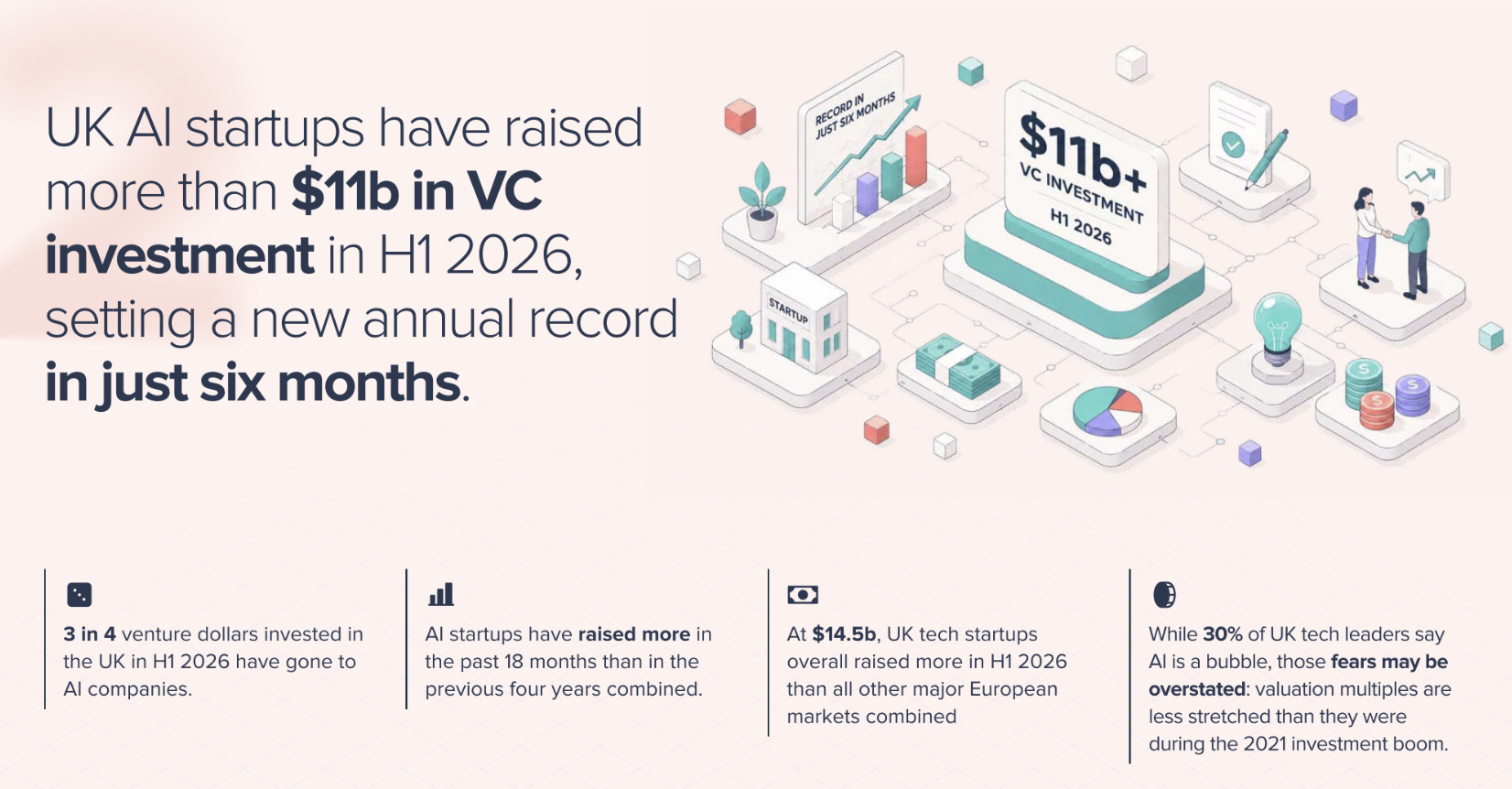
A few headline numbers illustrate this. UK AI startups raised more than $11 billion in the first half of 2026 alone — a new annual record set in six months. Three in four venture dollars invested in the UK went to AI companies. And at $14.5 billion, UK tech startups raised more in H1 2026 than all other major European markets combined.
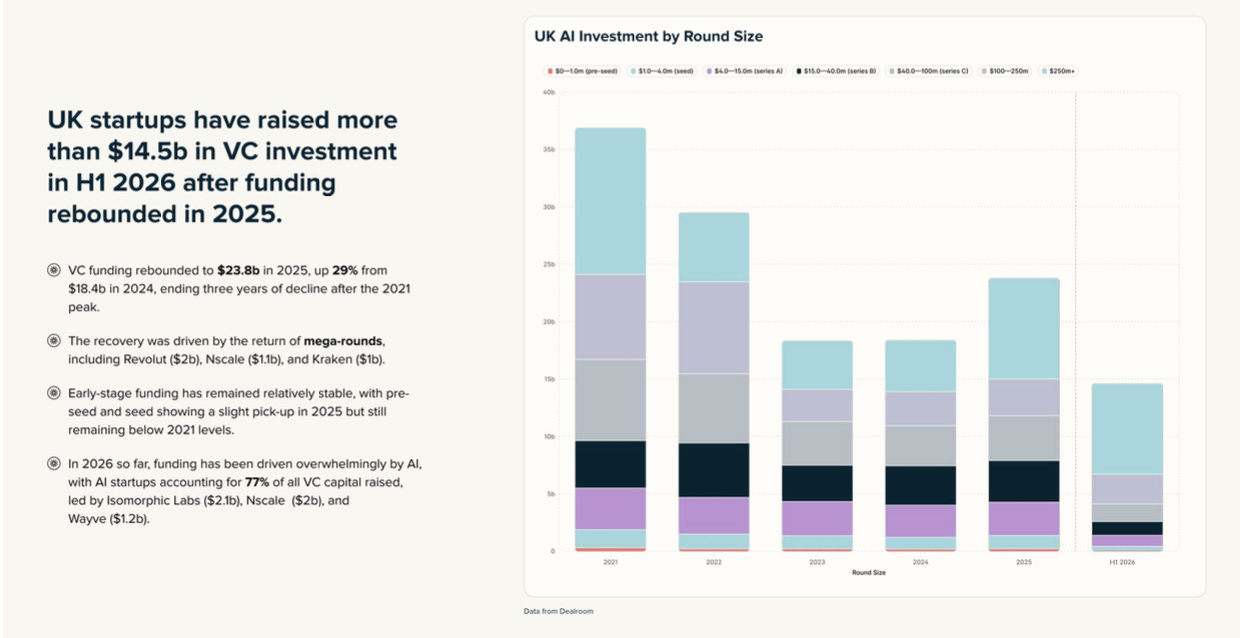
The clearest picture of the rebound is the composition of funding by round size. VC funding rebounded to $23.8 billion in 2025 — up 29% on 2024, and the first year of growth after three years of decline. The recovery was led by the return of mega-rounds: Revolut ($2b), Nscale ($1.1b) and Kraken ($1b) among them.
Read the stages carefully, though, and a more nuanced story emerges — one that matters for where the real opportunity sits. The headline recovery is being driven from the top: late-stage and mega-rounds ($100m+) are doing most of the heavy lifting on the totals. Early-stage — pre-seed and seed — tells a steadier story. It never ran up the way growth-stage valuations did in 2021, so it had far less to give back; it corrected only modestly, held firm through the downturn, and picked up again in 2025. The earliest rounds are where valuations stayed semi-rational, where discipline held through the cycle, and — for those of us who invest at this stage — where the entry points still remain attractive on a relative basis.
Move up the stages and the picture stays healthy. Series A and B are the best-capitalised part of the market right now — the mid-stage funds raised through the boom years are sitting on substantial dry powder, capital committed and waiting to be deployed. And late-stage is booming outright, driven by the mega-rounds. So this isn’t a market with an obvious funding gap at any single stage. Read across the whole value chain, capital is abundant almost everywhere you look.
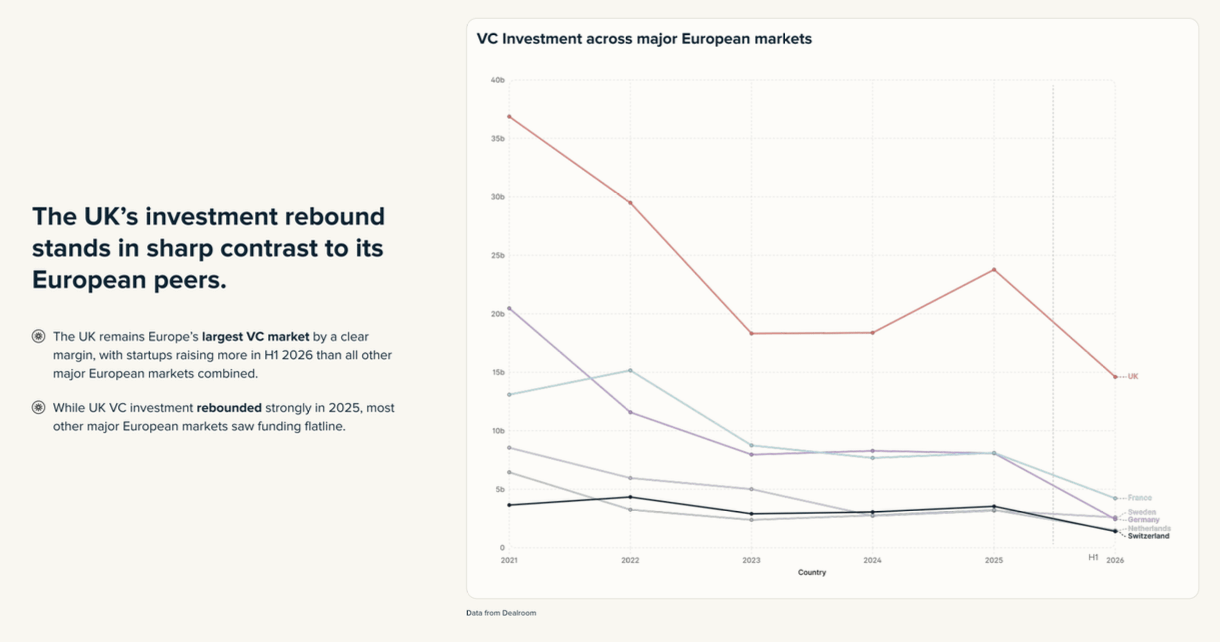
The rebound looks even more striking in a European context. The UK remains Europe’s largest VC market by a clear margin, raising more in H1 2026 than all other major European markets combined. And while UK investment rebounded strongly in 2025, most of its European peers saw funding flatline — France, Germany, Sweden, the Netherlands and Switzerland have all drifted sideways or down while the UK has climbed. The gap between Britain and the rest of European venture is not closing; it’s widening.
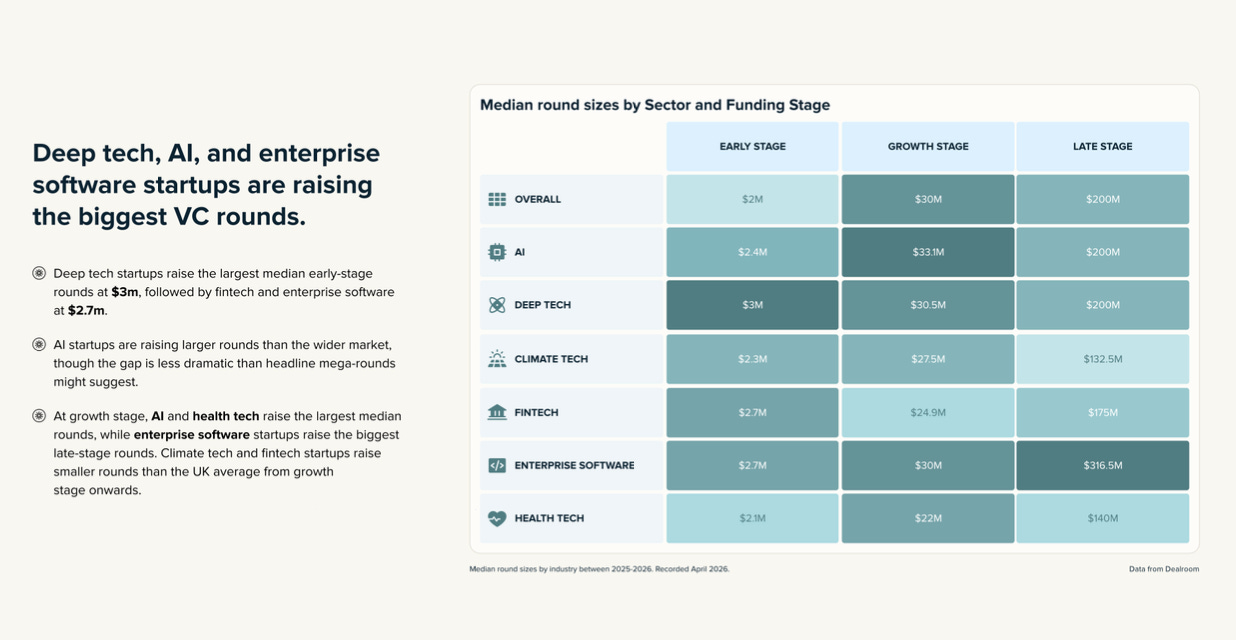
Strip out the billion-dollar headline raises and look instead at the median round in each sector, and a far more accurate picture appears. The AI-adjacent sectors do command the largest cheques — deep tech leads early-stage at a $3m median, and AI and health tech raise the biggest rounds at growth stage. But the premium is much more measured than the Isomorphics and Wayves imply: at the median, a typical AI round is larger than the wider market, yet not dramatically so. The ‘froth’ is concentrated at the very top — in a handful of enormous raises — while the broad market is still pricing AI with broad consistency. That's a premium, not a mania — and it's the first piece of evidence we'll come back to when we reach the question everyone is really asking about this boom: whether it's a bubble.
Three things are now clear, and together they reframe how to think about UK venture in 2026.
First, the rebound is real and structural, not a statistical blip. UK venture funding has ended three straight years of decline, rebounding to $23.8 billion in 2025 and running at $14.5 billion in the first half of 2026 alone. This isn’t a dead-cat bounce off a low base — it’s a second consecutive period of growth, with the trajectory pointing upward.
Second, Britain’s position relative to Europe has strengthened, not weakened, through the downturn. The UK is not merely Europe’s largest venture market; it now raises more than all its major European rivals combined, and it did so while those rivals flatlined. Whatever the challenges facing Britain — and there are real ones — losing ground to the rest of Europe is not among them. If anything, the gap is widening.
Third, and most importantly, the shape of the recovery matters as much as its size. The headline is top-heavy: the mega-rounds that vanished after 2021 have come roaring back, and they drive most of the totals — strip them out and the picture is far steadier. But a top-heavy headline isn't the same as a starved market. Capital availability is broad: seed has held firm and stayed disciplined, the mid-stage funds raised in the boom years are sitting on ample dry powder, and late-stage is booming outright. Money is not Britain's problem at any point on the value chain. Which is why the questions worth asking about this recovery aren't whether the capital is there — it obviously is — but what it's concentrated in, and whose capital it increasingly is. Those are the threads the rest of this piece pulls. For funds, though, one thing is unchanged: the real asymmetry — the chance to back a winner before the mega-rounds arrive and reprice it — sits at the early stage, which is exactly where a disproportionate share of the long-term return has always been made.
Underlying all of it is a difference in character from the last cycle that’s easy to miss but matters enormously. The 2021 peak was a cheap-money phenomenon: capital chasing growth at any price in a zero-rate world, largely indiscriminate about what it funded. This recovery is the opposite — narrower, more disciplined, and built on a genuine technology step-change rather than a liquidity wave. The capital returning to UK venture is not returning to everything. It is returning, overwhelmingly, to AI.
Section 1 established that the capital is back — and that it’s flowing, overwhelmingly, towards AI. This section is about the growth of AI, the fact it now dominates British venture, and what it means to have staked an entire ecosystem’s recovery on a single technology.
AI is no longer merely the largest theme in UK tech; it’s the organising factor of it — remove it, and most of the recovery of the past two years goes with it. Three-quarters of all venture funding. A third of the entire ecosystem’s value. This is a single, enormous, national wager on getting one call right. And a wager that size makes one question unavoidable, the one every reader is already forming: is this substance, or is it a bubble? It’s the right question — and the aim here is to answer it honestly, without reaching for either the reassuring version or the alarmist one. The scale first, because you can’t weigh the bet without seeing how big it is.
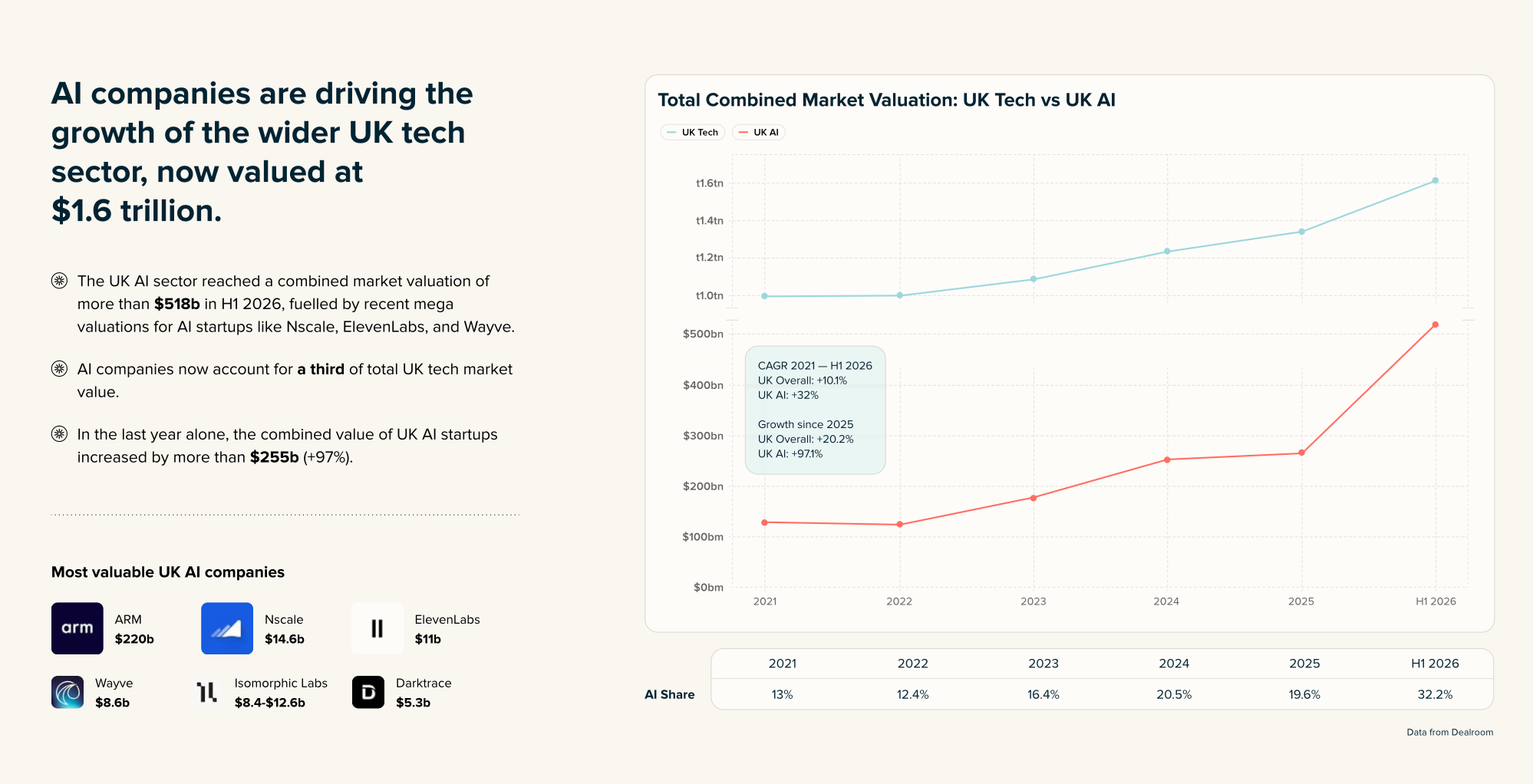
The clearest measure of AI’s rise is its share of total UK tech value. The UK AI sector reached a combined market valuation of more than $518 billion in H1 2026 — roughly a third of the entire $1.6 trillion UK tech ecosystem. Five years ago that share was 13%. It is now 32%, and climbing.
UK AI is compounding at a 32% CAGR since 2021, against just 10% for UK tech overall. In the last year alone, the combined value of UK AI startups rose by more than $255 billion — a 97% increase. AI isn’t growing faster at the margin; it’s growing at more than three times the rate of everything else, and dragging the ecosystem’s headline number up with it. ARM ($220b), Nscale ($14.6b), ElevenLabs ($11b) and Wayve ($8.6b) sit at the top of that value.
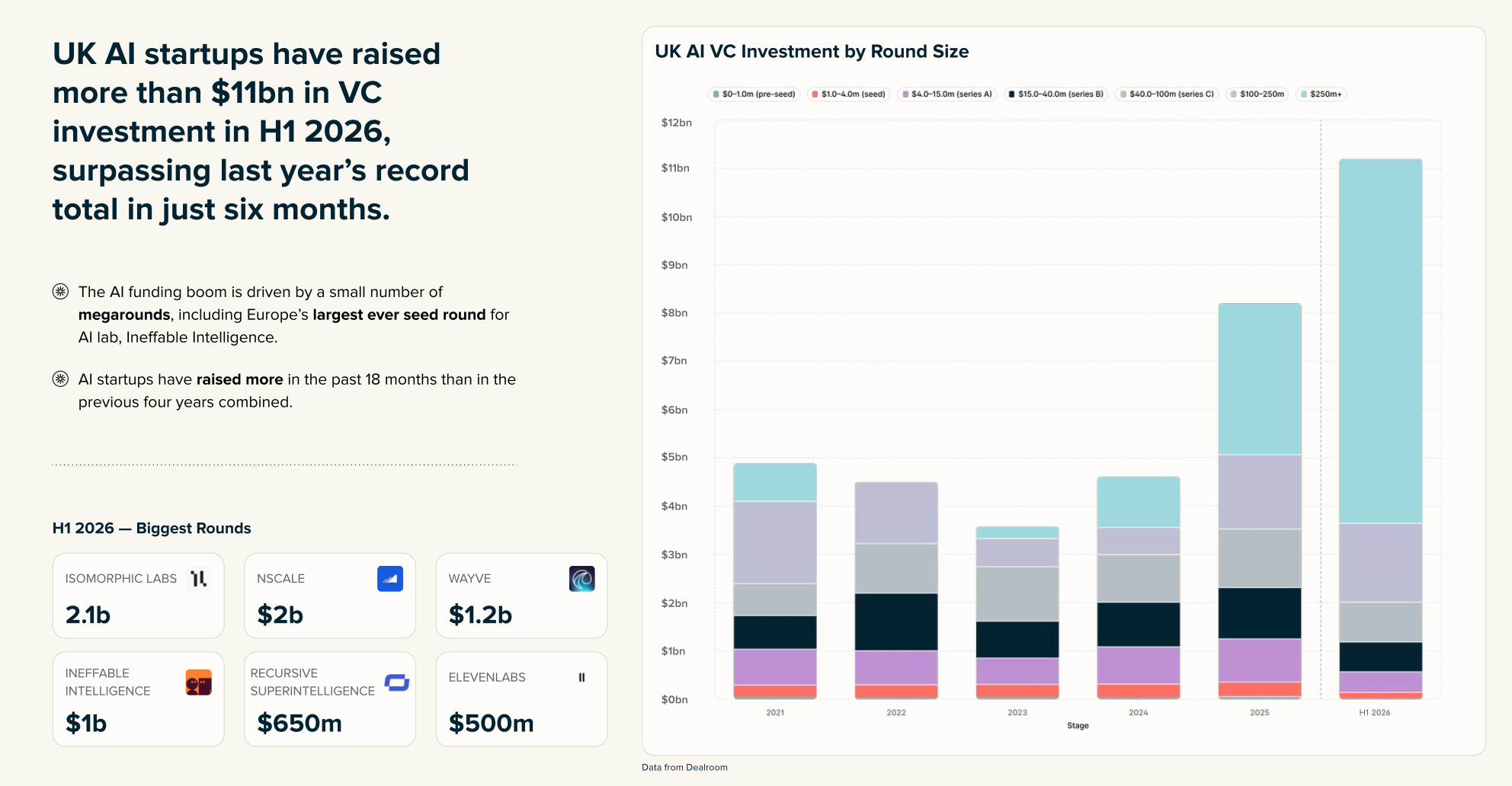
The investment figures tell the same story as the valuations. UK AI startups raised more than $11 billion in the first half of 2026 alone — surpassing the previous full-year record in six months, and exceeding the previous four years combined. A step-change of that magnitude is not what gradual, rational reallocation looks like — it’s what a genuine platform shift, or a genuine mania, looks like. Which of the two is the question that frames ‘are we in a bubble’.
The mega-rounds behind the total complicate the easy “mania” read. Look at where the biggest cheques went: Isomorphic Labs ($2.1b), applying AI to drug discovery; Nscale ($2b), building AI compute infrastructure; Wayve ($1.2b), in autonomous driving; and the AI lab Ineffable Intelligence, which raised what the report flags as Europe’s largest-ever seed round, north of a billion dollars. This isn’t a wall of money chasing one narrow application — it’s capital deployed across the entire AI stack: a model lab, the infrastructure beneath it, and world-class applications in biology and autonomy sitting on top. Britain isn’t betting on one AI use case. It’s funding the whole AI stack.
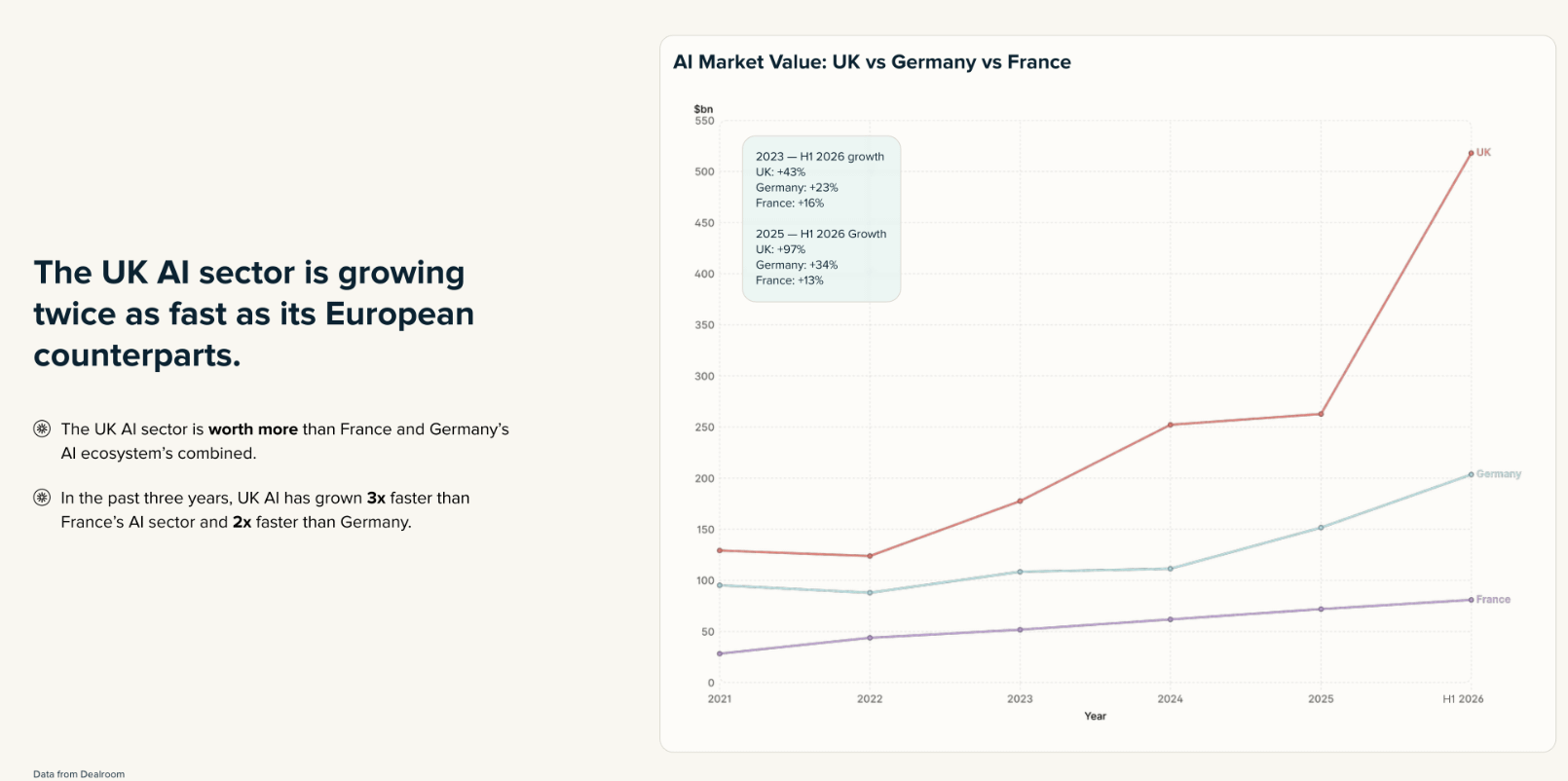
The UK’s lead over Europe, which Section 1 established at the whole-market level, is even wider in AI specifically. The UK AI sector is now worth more than the French and German AI ecosystems combined, and over the past three years it has grown roughly 3x faster than France and 2x faster than Germany. Britain’s advantage in European tech is, increasingly, an advantage in AI — which cuts both ways. It’s a genuine strength, but it also means the UK’s fortunes are now unusually tied to a single technology wave.
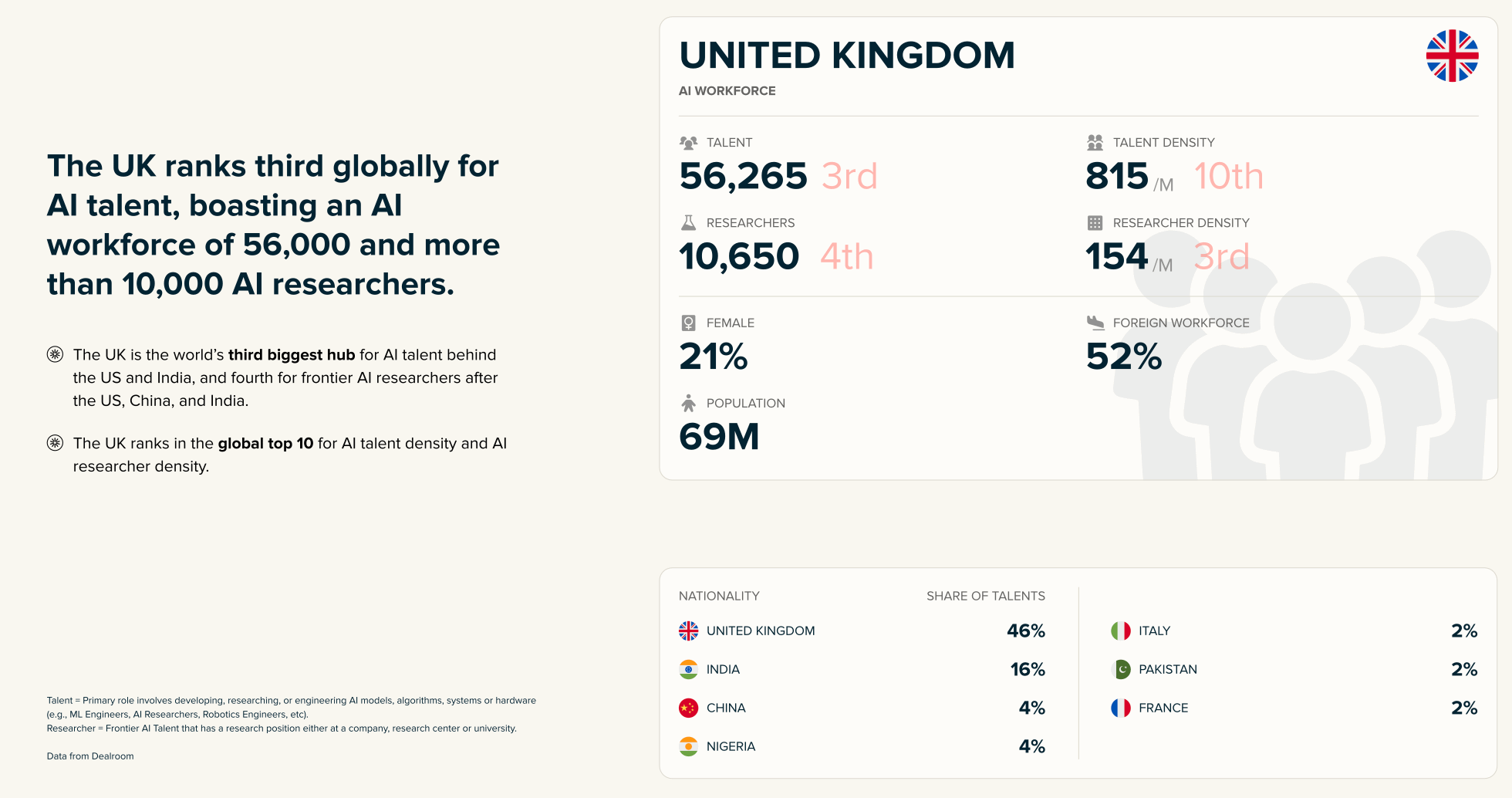
One reason to take the boom seriously rather than dismiss it as hype is that it rests on genuine capability, not just capital. The UK ranks third globally for AI talent, behind only the US and India, with a workforce of more than 56,000 and over 10,650 researchers — fourth in the world for frontier AI researchers — and it sits in the global top 10 for both talent and researcher density. This matters, because ecosystems built on capital alone are fragile, while ecosystems built on talent and research compound. The UK’s boom is drawing on world-class universities and a deep research base — assets that don’t evaporate when sentiment turns. Whilst many millionaires are leaving the UK, we’re attracting some of the smartest minds in AI, who are moving to the UK with a purpose and mission.
Which brings us to the question the scale demands. When any technology grows this fast and this concentrated, the word “bubble” is never far behind. The report addresses it directly, and the answer is more measured than the headlines suggest.
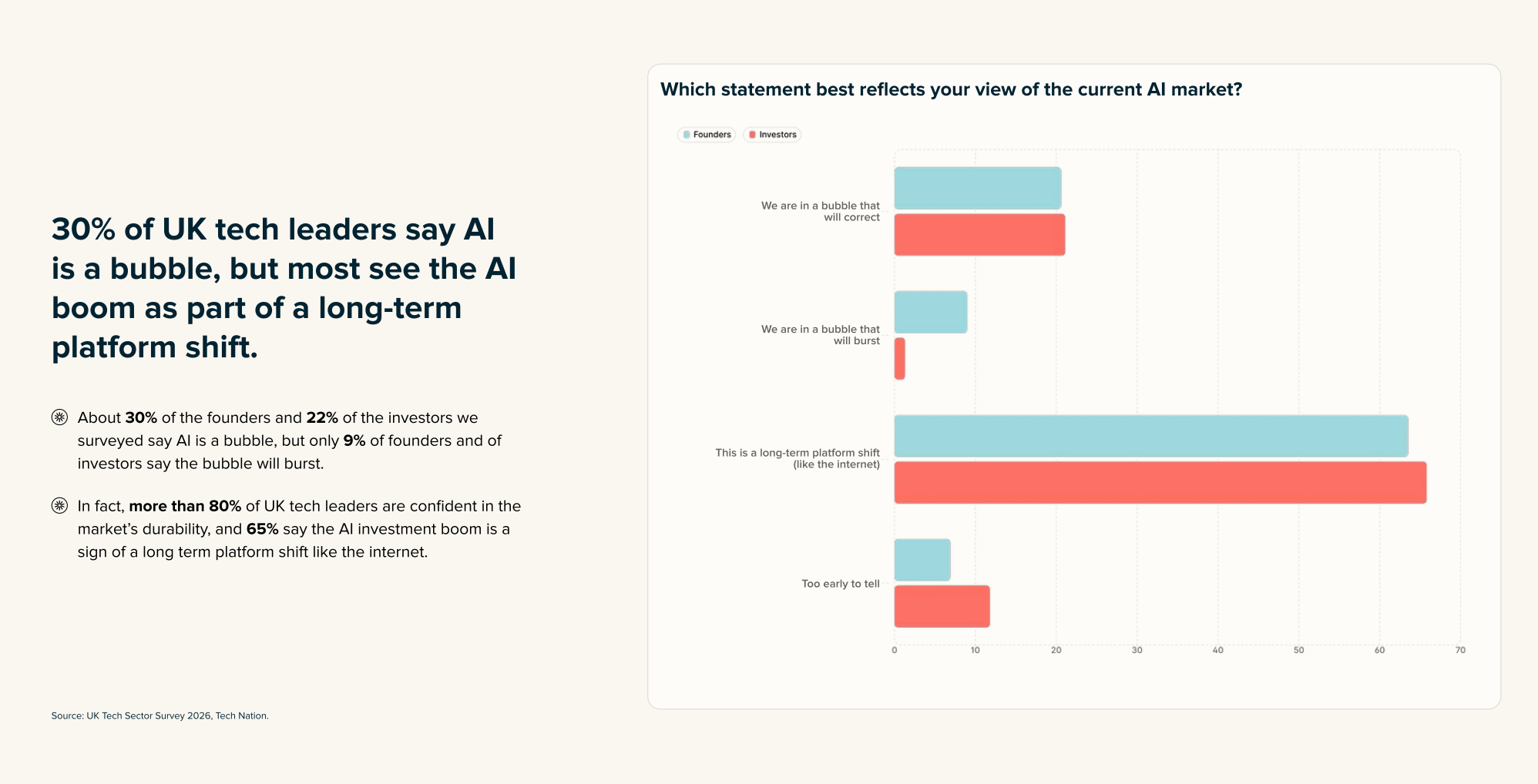
Start with what the market itself believes. Around 30% of founders and 22% of investors say AI is a bubble — a meaningful minority. But the crucial detail is what kind of bubble. Only 9% think it will actually burst. The dominant view, by a wide margin, is that this is a long-term platform shift on the scale of the internet, and more than 80% of UK tech leaders are confident in the market’s durability. The concern isn’t that the boom is fake; it’s that some froth may need to correct along the way. That is a very different proposition from 2000.
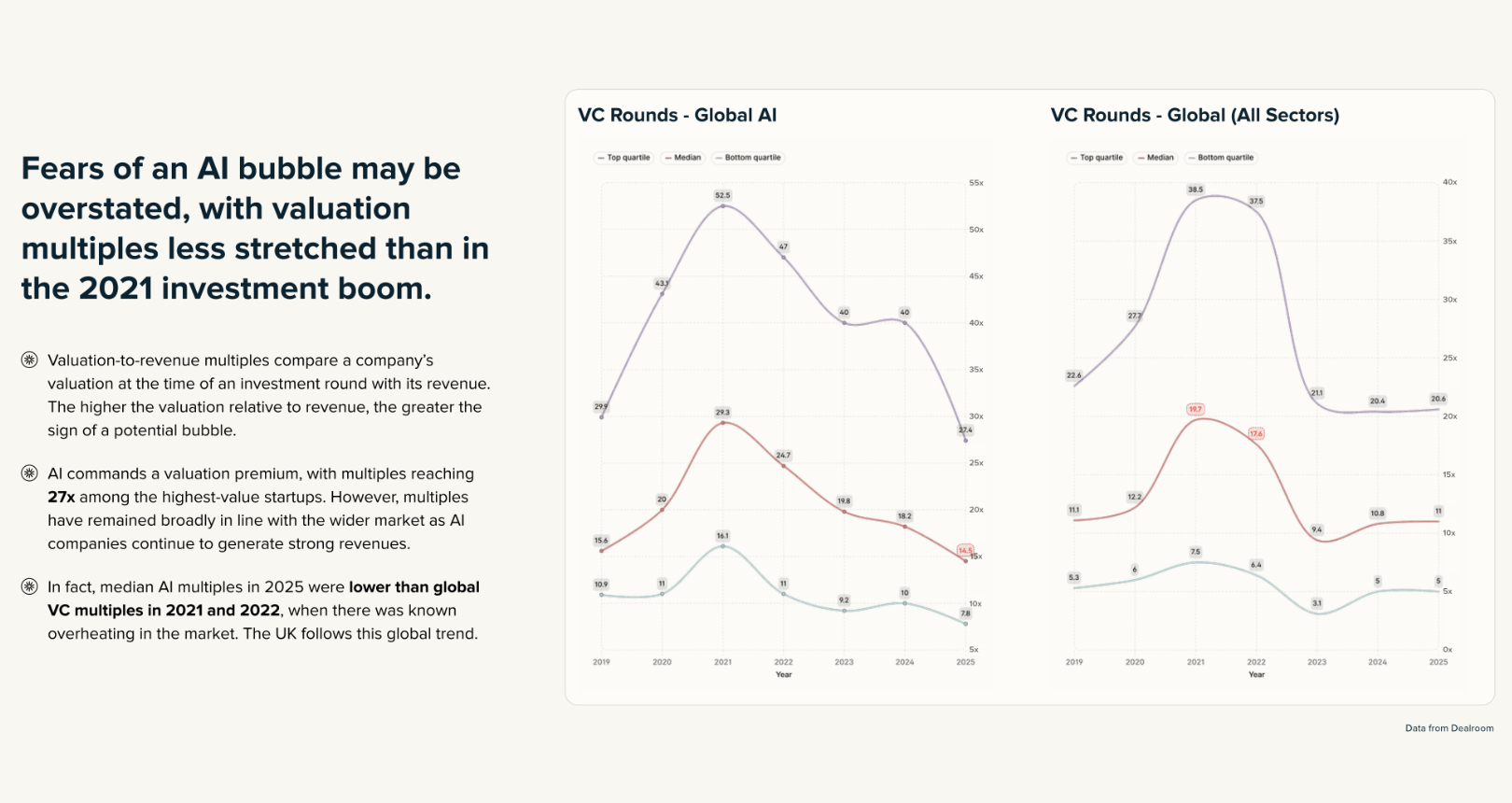
The valuation data supports that reading. AI does command a premium — median valuation-to-revenue multiples reach 27x among the highest-value startups. But set against history, the multiples are strikingly restrained. Median AI multiples in 2025 sat below the multiples the entire global VC market carried in 2021 and 2022, when the market was visibly overheating. In other words, today’s AI valuations — the supposed epicentre of the bubble — are less stretched than the whole market was at the last peak. The premium is real, but it’s being underwritten by real revenue growth and technological advancements, not pure speculation.
This is where I’d add a frame I’ve written about before. There’s a meaningful difference between a mean-reversion bubble — asset prices detached from fundamentals, destined to snap back — and an inflection bubble, where capital floods in to build the infrastructure for a genuine new paradigm. The two look similar from the outside; both involve euphoria and over-investment. But they resolve completely differently. The evidence here — real revenue, grounded multiples, a deep talent base, and a market that overwhelmingly sees a platform shift rather than a mania — points firmly toward the latter. That doesn’t mean there won’t be corrections, failed companies, and pockets of excess. It means the underlying technology is real.
Two facts define UK venture in 2026, and this section establishes both.
The first is dominance. AI is not a sector within the UK ecosystem — it is the ecosystem’s centre of gravity. A third of all value, three-quarters of all funding, and effectively all of the net growth now sits in AI. Britain’s much-celebrated lead over Europe turns out to be an AI lead: strip AI out and the UK looks like a far more ordinary large European market. This is the single most important thing to understand about the state of British venture — it is, increasingly, a concentrated bet on one technology.
The second is that the dominance is real. The reflex when something grows this fast is to reach for “bubble,” and the report meets that reflex head-on. The verdict is evidence-based, and it cuts against the alarmist reading in three specific ways. The revenue is real: this isn’t the revenueless dot-com pattern. The multiples are grounded: today’s AI valuations are less stretched than the entire market was at the 2021 peak. And the capability is deep: a top-three global talent base and a research foundation that compounds rather than evaporates. The market itself agrees — only 9% of founders and investors think this bursts. It’s the distinction I keep returning to: a mean-reversion bubble snaps back to fundamentals, while an inflection bubble builds the infrastructure for a genuinely new paradigm. On this evidence, Britain is living through the second, not the first.
But establishing that the boom is real is not the same as establishing that it’s safe — and this is where the section’s optimism has to be qualified. Concentration is itself a risk, independent of valuation. An ecosystem that has tied a third of its value and three-quarters of its capital to a single technology wave has, by definition, thinned its margin of safety. If the AI thesis is right, Britain is superbly positioned. If progress stalls, or the value migrates in ways the UK fails to capture, the same concentration powering the boom becomes the thing that amplifies the fall. Framed properly, the bubble question isn’t “will it pop?” It’s “what happens to a country that has bet this heavily on getting one call right?”
That is exactly the question the rest of this article attempts to answer. Knowing AI dominates isn’t enough; what matters is where the money is actually going, what it’s building, and — above all — who ends up owning the result.
Section 2 established that AI dominates UK venture. This section asks a more specific question: within that dominance, where exactly is the capital going? Because “AI” isn’t a monolith — it’s a stack, and it’s also cutting across every existing sector — and where the money flows tells you what kind of AI economy Britain is building.
I’ll do this in two sections. First the macro view — which sectors are rising, which are falling, and where AI capital concentrates. Then a closer look at the two sectors that matter most to this story and, full disclosure, to my own fund: enterprise software and fintech. They’re the two clearest expressions this report maps to — AI eating the application layer, converging with labour budgets, and AI rebuilding a mature, incumbent-heavy industry from the inside.
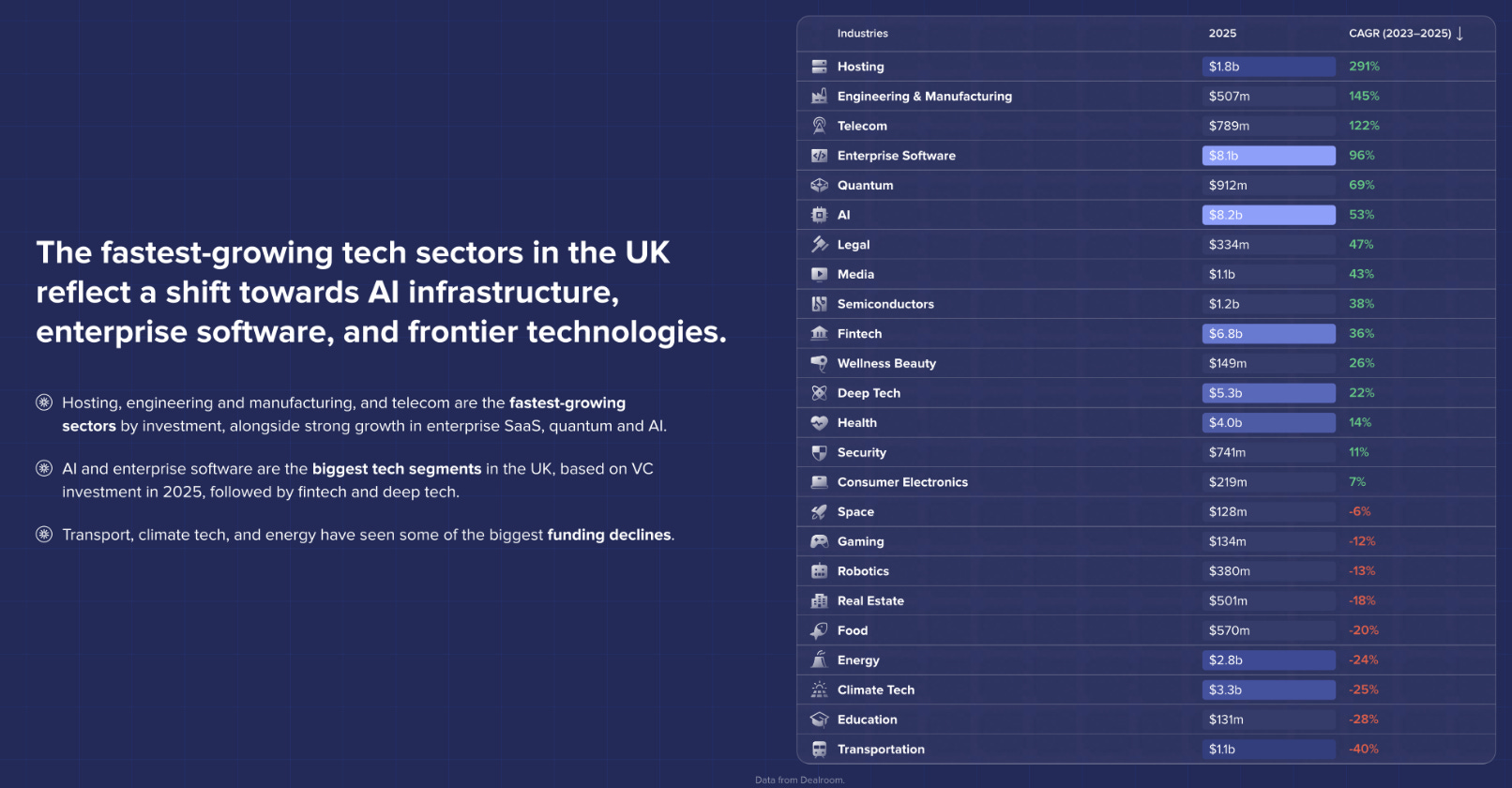
This sector-growth table is an interesting one, because it shows venture capital doing what it always does in a platform shift: reallocating, not just expanding. The fastest-growing sectors are unmistakably the AI-adjacent ones. Hosting leads at a remarkable +291% CAGR — the data-centre and compute layer AI runs on. Engineering & manufacturing (+145%) and telecom (+122%) follow, alongside enterprise software (+96%), quantum (+69%), AI itself (+53%) and semiconductors (+38%).
The bottom of the table is just as telling. The steepest declines are in the darlings of the last cycle: transportation (−40%), education (−28%), climate tech (−25%), energy (−24%) and food (−20%). This is the part the AI-boom narrative usually misses. Venture capital isn’t a bottomless pool that simply grows; it’s a finite resource being reallocated. Every dollar flowing into AI infrastructure is, to some degree, a dollar no longer flowing into climate or consumer or mobility. The boom isn’t only additive — it’s also cannibalising the funding that used to go elsewhere.
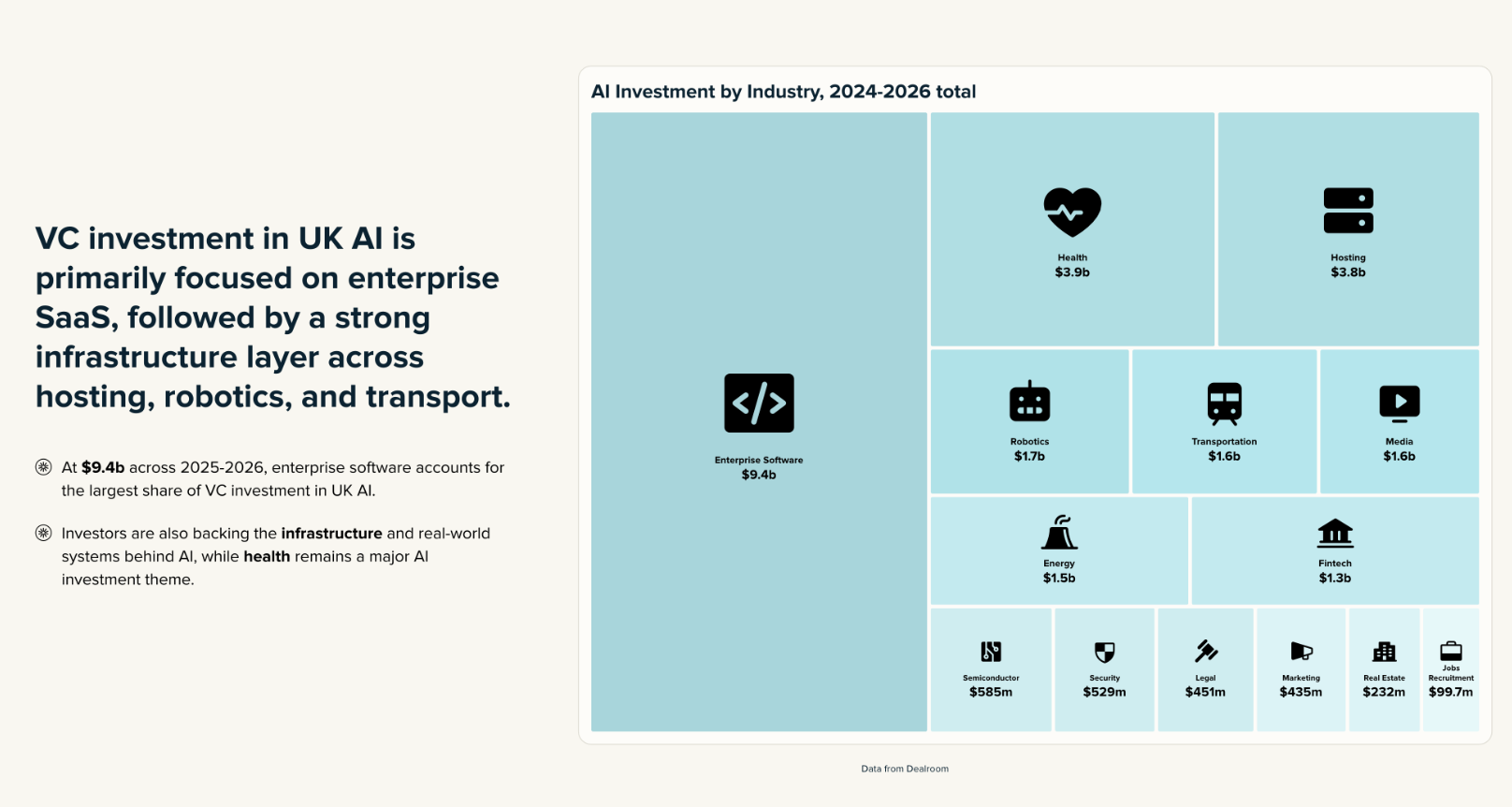
Zoom in on AI investment specifically, and the concentration becomes more apparent. Enterprise software is, by a wide margin, the single largest destination for UK AI capital — $9.4 billion across 2024–2026, more than double the next sector. Behind it sits a strong infrastructure and real-world-systems layer: health ($3.9b), hosting ($3.8b), robotics ($1.7b), transportation ($1.6b) and media ($1.6b), with energy ($1.5b) and fintech ($1.3b) close behind.
Read structurally, this maps almost perfectly onto the AI stack — the application layer (enterprise software) at the top, the compute infrastructure (hosting, semiconductors) beneath it, and the real-world systems (robotics, transport, health) around it. British AI money is concentrated at the two ends of the stack where durable value has historically accrued rather than been competed away. I think you all know my view on the importance of the AI application layer by now, so I won’t repeat it here…
That macro view sets up the two sectors worth looking at more closely — and they tell two quite different stories. One is a sector being remade by AI from the outside; the other is a mature industry rebuilding itself from within.
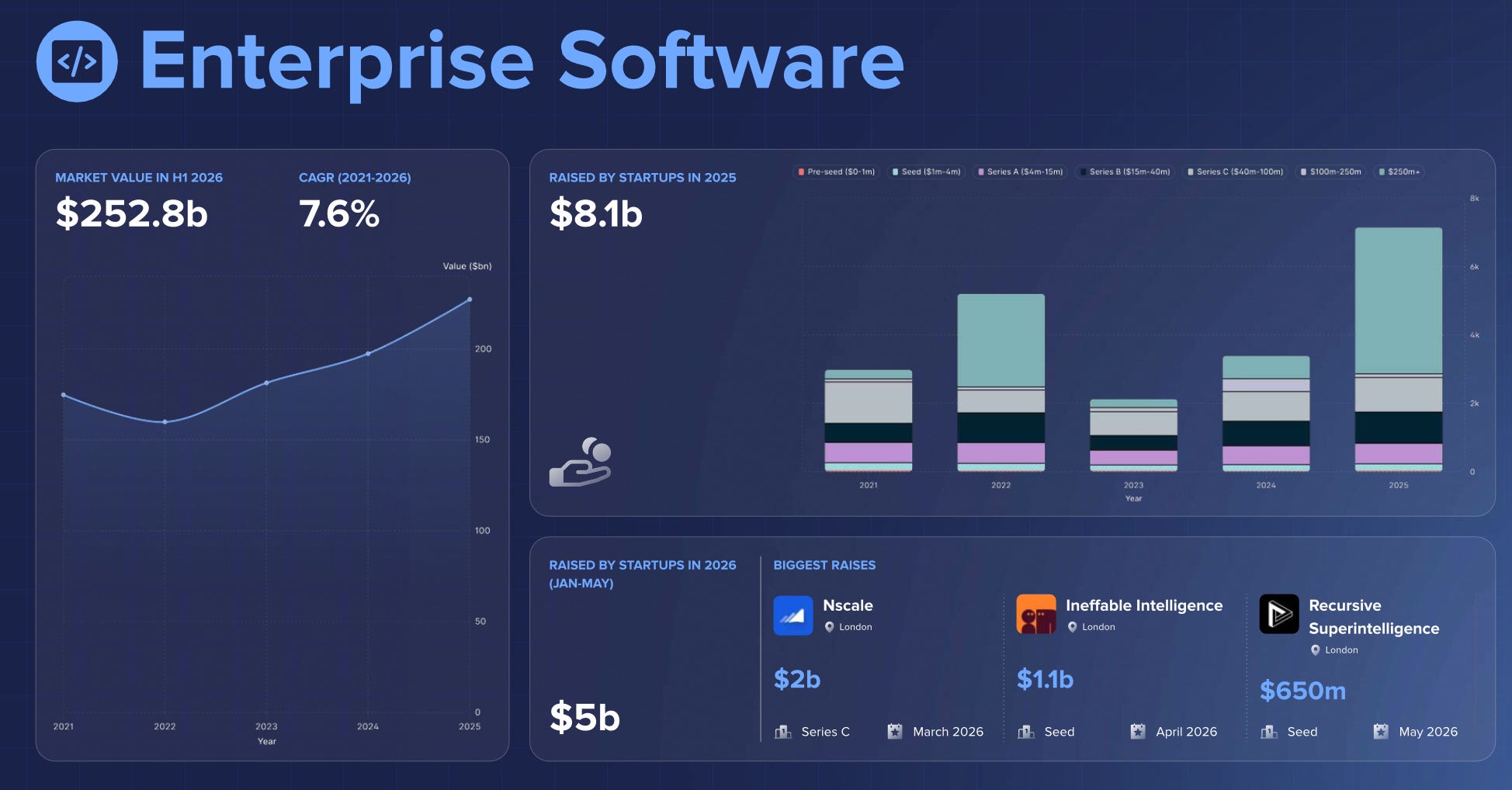
Enterprise software is the beating heart of the UK AI story. The sector is worth $252.8 billion, but the more telling number is the acceleration: UK enterprise software startups raised $8.1 billion in 2025, and an extraordinary $5 billion in the first five months of 2026 alone. The biggest raises tell you why — Nscale ($2b), Ineffable Intelligence ($1.1b) and Recursive Superintelligence ($650m). These aren’t traditional SaaS companies; they’re AI labs and infrastructure businesses the data classifies under enterprise software — which is exactly the point. The line between “enterprise software” and “AI” has effectively dissolved.
This is the application layer being remade in real time — the layer where, as I’ve argued before, the durable value in the AI economy ultimately accrues. Software is no longer competing for the IT budget; it’s competing for the far larger pools of labour and services spend, by delivering outcomes rather than tools. It’s the sector where I spend most of my own time as an investor, precisely because it’s where the shift from selling software to selling work is playing out most directly.
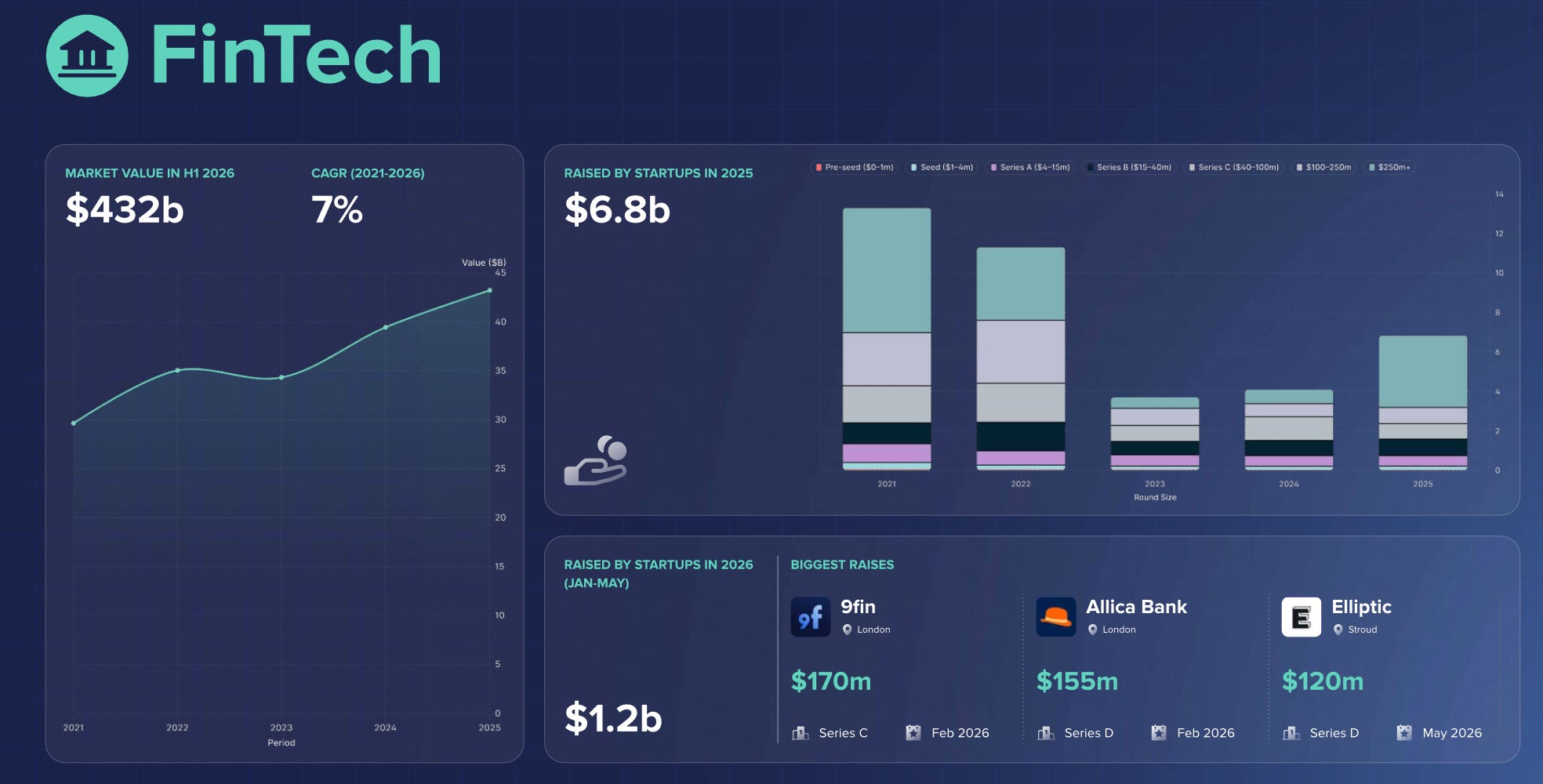
Fintech tells a different, and in some ways more mature, story. At $432 billion, it’s actually a larger market than enterprise software by value — Britain’s deepest and most established tech vertical, built over a decade of Revolut, Wise, Monzo and the rest. But its growth profile is more measured: $6.8 billion raised in 2025, $1.2 billion in the first five months of 2026, at a 7% CAGR. The biggest recent raises — 9fin ($170m), Allica Bank ($155m), Elliptic ($120m) — are substantial, but a world away from the billion-dollar AI-lab rounds landing in enterprise software.
What makes fintech interesting in an AI context isn’t explosive growth; it’s transformation from within. This is a large, incumbent-heavy, regulated industry being rebuilt from the inside by AI — underwriting, agentic finance, regtech, embedded finance, fraud and compliance (Elliptic’s world). The opportunity isn’t a greenfield land-grab; it’s the patient re-plumbing of an enormous existing industry, which is why it rewards depth of domain expertise over sheer speed. It’s the other part of my fund’s thesis — ‘Fintech 2.0’, the convergence of AI, payment infrastructure and blockchain technology, making the ‘new’ fintech era look a lot more exponential.
The two sectors together capture two of the ways AI creates value: by building the new, and by rewiring the old.
Three things stand out once you look past the headline that “AI is winning.”
The first is that this is a reallocation, not just an expansion — and reallocation has losers. The capital flooding into hosting, enterprise software and semiconductors is, in large part, capital that has drained out of climate, transport, energy and consumer. Venture funding isn’t a rising tide lifting all boats; it’s a finite pool being redirected toward a single opportunity. That’s rational for any individual investor chasing the highest-return theme of the era — but at the level of the whole ecosystem it concentrates Britain’s bets and defunds sectors the country will still need. The AI boom casts a shadow, and the shadow is a capital drought everywhere else.
The second is that AI value is being created in two distinct modes, and the UK is genuinely strong at both. Enterprise software is AI building the new — the application layer remade from scratch, software mutating from a tool you buy into work you outsource. Fintech is AI rewiring the old — a mature, regulated, incumbent-heavy industry rebuilt from the inside. These aren’t the same opportunity, and they don’t reward the same thing: one rewards speed and the willingness to reinvent a category, the other rewards domain depth and the patience to re-plumb an existing one. Britain has both in abundance — a large part of why its AI ecosystem is deeper than any other in Europe, and, not coincidentally, where my own fund concentrates.
The third is the one that should give pause. The money is flowing to exactly the right layers — the application layer and the infrastructure beneath it, the two places where value has always been captured rather than competed away. On paper, Britain is investing precisely where a serious AI economy should. But where value accrues and who captures it are different questions, and Section 3 can only answer the first. The infrastructure these companies run on is largely American. A growing share of the capital funding them is American. And the more successful they become, the more that ownership question matters.
So the sectors are right, and the UK’s strengths are real. But building the right companies in the right sectors is only half the equation. The other half — who ends up owning the value once it’s built — is what the next two sections unpack.
The report’s most conceptually interesting section is the one it calls “The OpenAI Effect” — its term for the way the major AI platforms are reshaping the UK startup ecosystem. Just as the internet created a new layer for startups to build on in the 2000s, and the cloud providers did the same in the 2010s, the frontier AI labs — OpenAI, Anthropic, the Big Tech AI divisions — are now a new infrastructure layer beneath the entire ecosystem. They’re reshaping what founders build, how they build it, who’s doing the building, and, increasingly, who owns the result.
This section works through that shift in four movements — how central AI has become to what founders build, the opportunities it’s opening, the talent flywheel it’s spinning — and then the flip side: the dependence that comes with building on someone else’s platform.
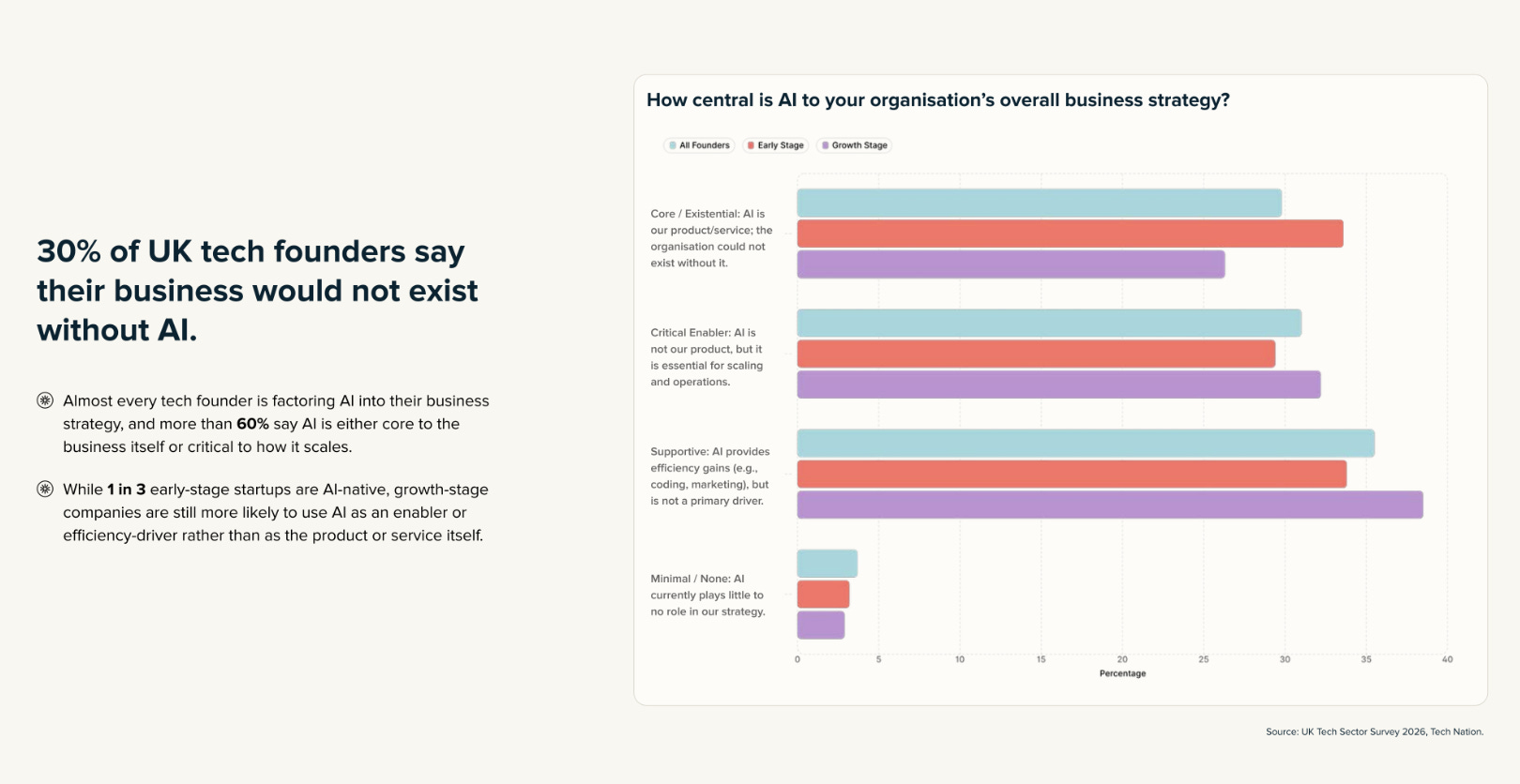
The first measure of the platform shift is how deeply AI is now embedded in how companies are even conceived. 30% of UK tech founders say their business would not exist without AI — it is the product, not a feature. Add the founders who call AI a “critical enabler” of scaling and operations, and more than 60% say AI is either core to the business or essential to how it runs. The stage split is revealing: one in three early-stage startups is now AI-native — conceived around AI from day one — while growth-stage companies are more likely to use AI as an enabler layered onto an existing business. The newest companies aren’t adopting AI; they’re born from it.
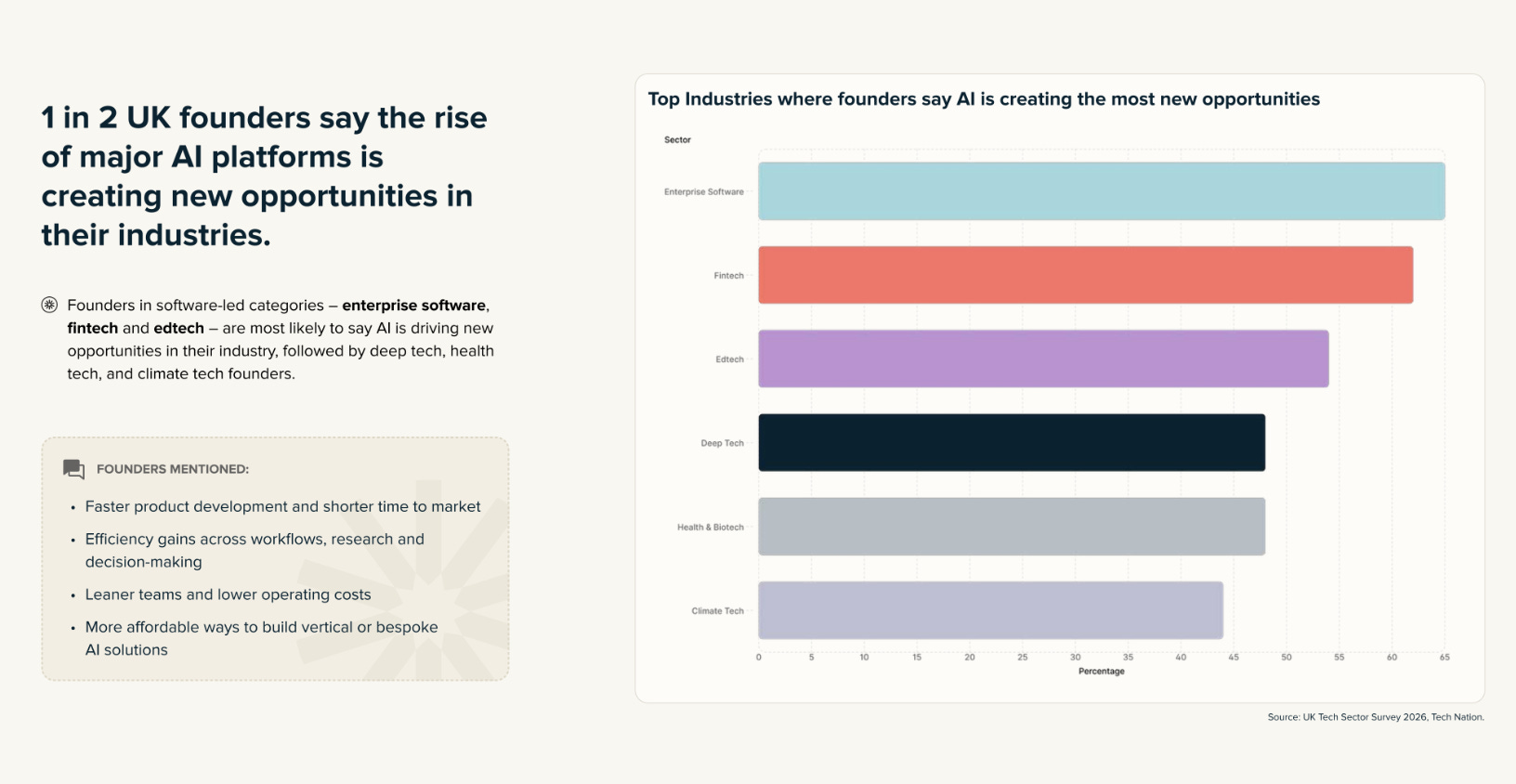
Crucially, founders experience the rise of the major platforms as an expansion of the opportunity, not a threat to it. One in two UK founders say the platforms are creating new opportunities in their industry — most strongly in the sectors from Section 3, enterprise software and fintech at the top, followed by edtech, deep tech, health and climate. What founders cite is telling: faster product development, efficiency gains across workflows, leaner teams, and — the crucial one — far cheaper ways to build vertical or bespoke AI solutions. The platforms have collapsed the cost of building intelligent software, and founders are pouring into that space to capitalise.
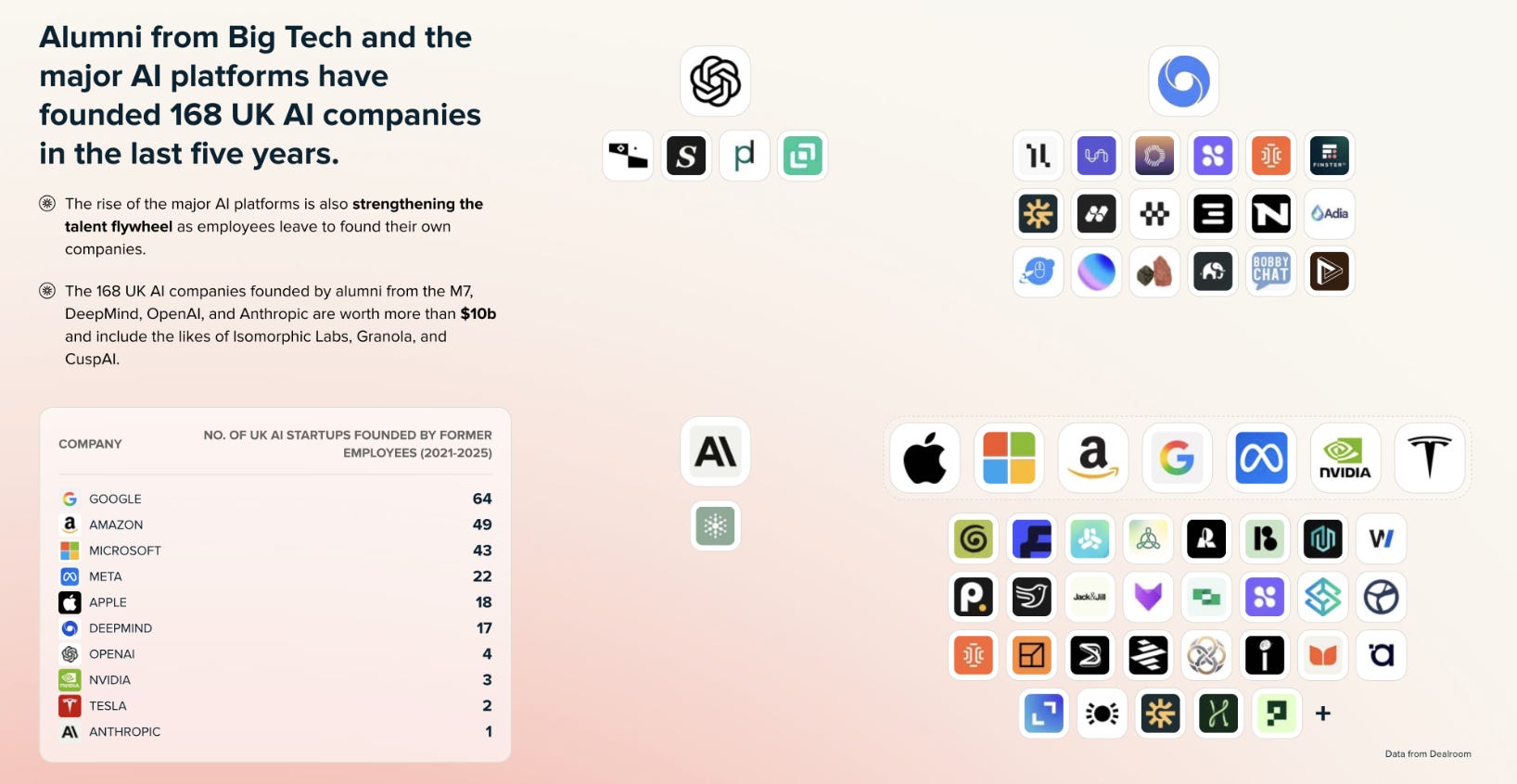
Perhaps the most important long-term dynamic is the talent flywheel. Alumni of Big Tech and the major AI labs have founded 168 UK AI companies in the last five years — worth more than $10 billion combined, and including names like Isomorphic Labs, Granola and CuspAI. The breakdown is striking: Google alumni founded 64, Amazon 49, Microsoft 43, then Meta, Apple and DeepMind. This is how great ecosystems compound — talent joins the frontier firms, learns at the edge of the field, then leaves to build, seeding the next generation. And the presence of OpenAI and Anthropic in London (the report notes they’ve leased more than a million square feet of office space since the start of 2025) will only accelerate it. Every engineer they hire in Britain is a potential future founder.
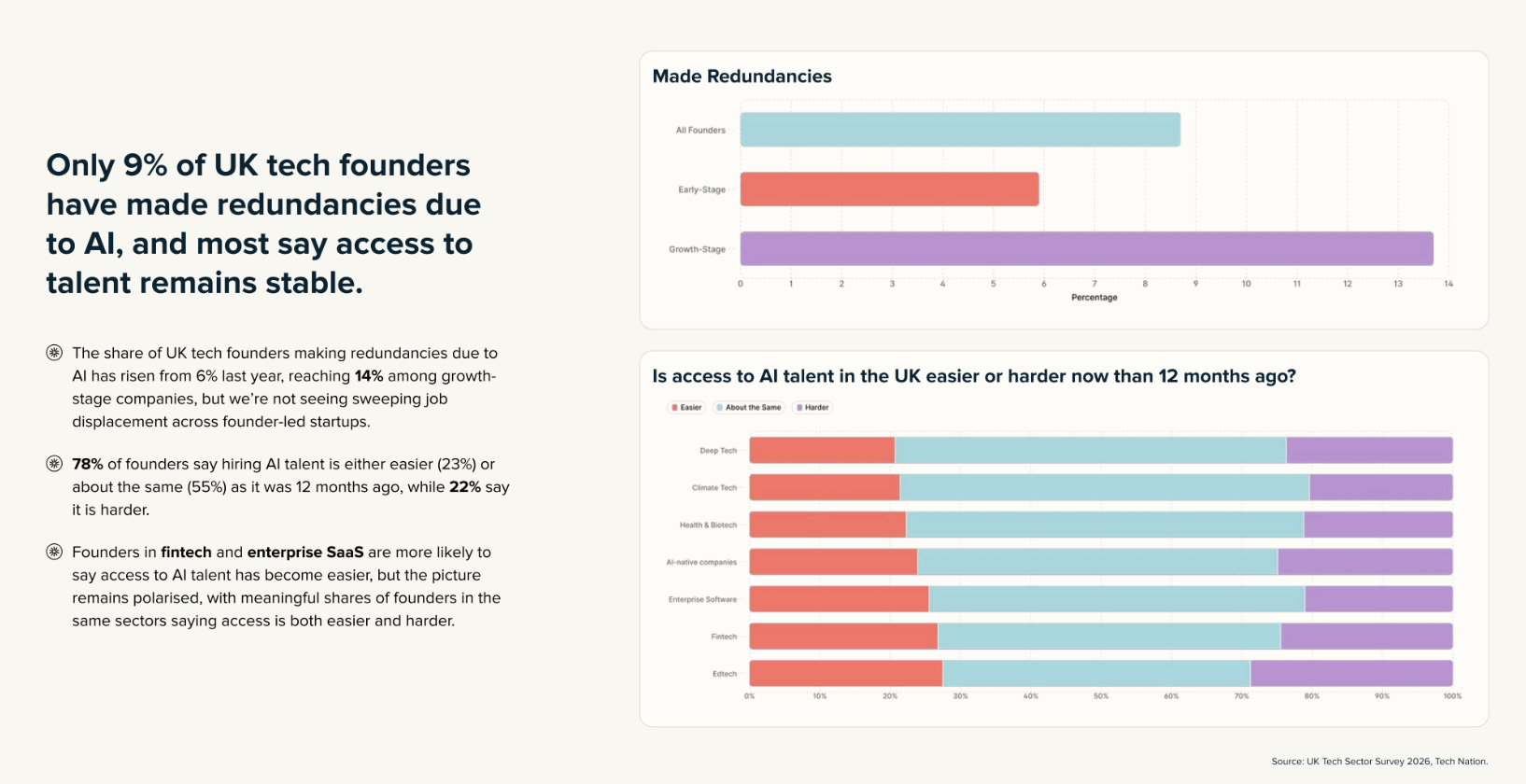
For all the anxiety about AI and employment, the founder data offers a measured picture. Only 9% of UK tech founders have made redundancies due to AI — up from 6% last year, and higher (14%) among growth-stage companies, but hardly the sweeping displacement the headlines imply. And access to talent looks stable: 78% of founders say hiring AI talent is either easier or about the same as a year ago. The honest reading is that, so far, AI is being used to build and to scale leaner rather than to cut — an enabler more than a replacement. Whether that holds as the technology matures is a genuine open question, but the current evidence doesn’t support the mass-displacement narrative.
David Sacks, the White House's AI czar, has made the point repeatedly: the fear of AI-driven job displacement is overblown. In most cases, he argues, the technology will prove a productivity multiplier and a net creator of jobs — not the wholesale displacer the headlines assume. I broadly share that view — with one caveat. Certain jobs, and certain whole categories of them, will almost certainly be displaced. Net job creation and individual displacement aren't contradictory: the aggregate can be positive while specific roles disappear along the way.
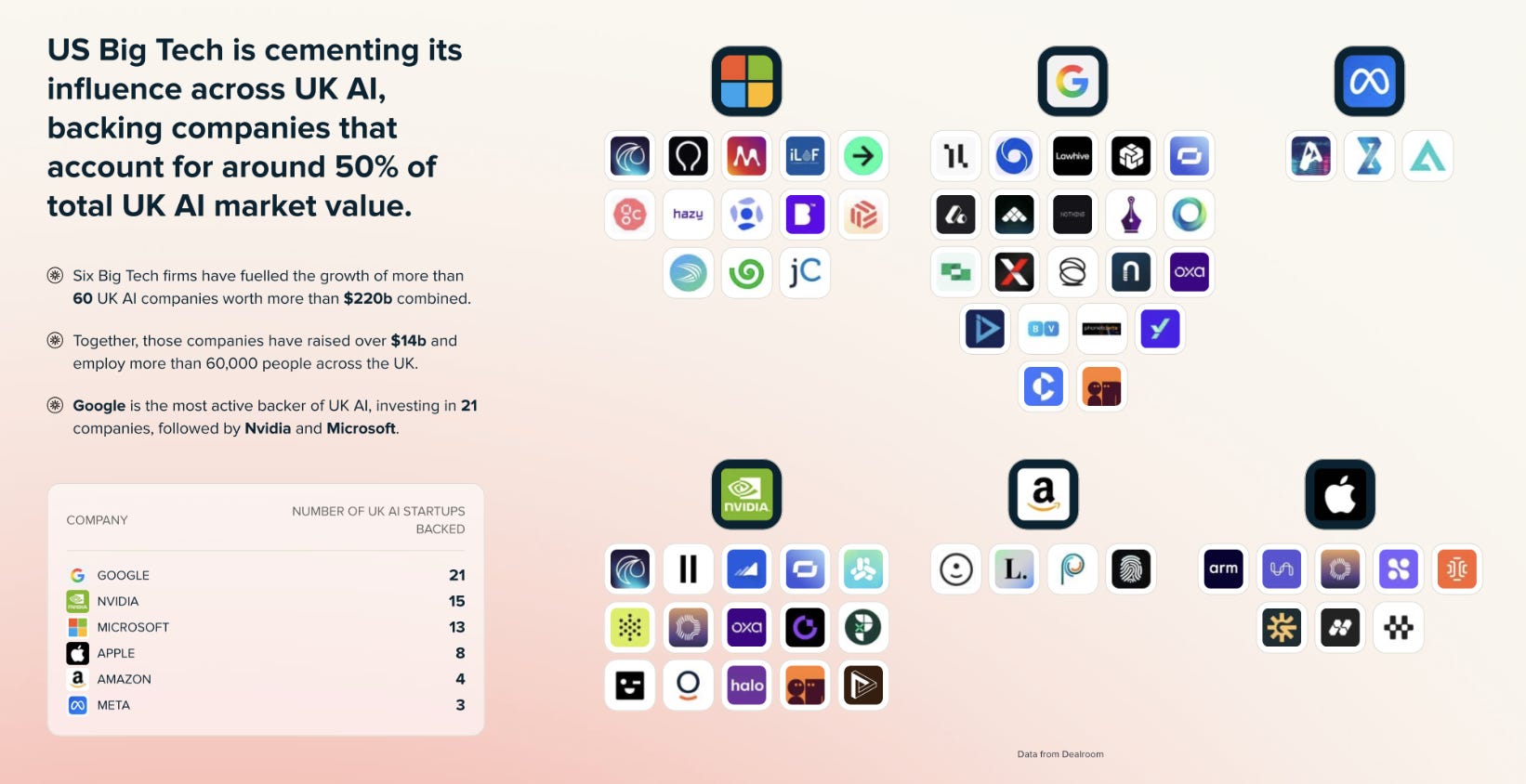
Here’s where the OpenAI Effect turns double-edged. The same platforms that enable British founders are, overwhelmingly, American — and US Big Tech is using that position to buy its way deep into the ecosystem. Six US Big Tech firms have backed more than 60 UK AI companies worth over $220 billion combined, accounting for around half of total UK AI market value. Google is the most active, backing 21 UK AI companies, followed by Nvidia and Microsoft. This is the part of the platform shift that should give British policymakers and investors pause. Building on OpenAI’s or Anthropic’s models is enormously enabling — but it also means the most important supplier, and increasingly the most important shareholder, sits in California. The platform that lifts you can also own you.
It's also where much of the debate has converged on open-source models as the future — a single answer to two problems at once: preserving sovereignty while delivering capability at far lower cost. If the frontier labs are the dependence, open-weight models are the most credible hedge against it — a way to build on near-frontier capability that Britain can run, inspect and control for itself, rather than rent from a lab across the Atlantic.
Section 4 establishes that the OpenAI Effect cuts both ways. By almost any measure, it is the most enabling force in British tech today. It is also the clearest mechanism through which British innovation is being drawn into American ownership.
Start with the enabling side. The platform shift has lowered the cost of building intelligent software so far that a third of new British companies could not exist without it. It has opened new opportunity in precisely the sectors the UK is strongest in. It has set a talent flywheel spinning — 168 companies in five years — that will compound for a decade. And it has done all this without the mass job displacement the headlines promised. Strip away the caveats, and this is, straightforwardly, the best environment to start an AI company that Britain has ever had.
However, dependence is a real thing. The same handful of American labs supply the models these companies are built on. American Big Tech supplies a growing share of the capital they’re funded with. And American firms are the most likely eventual acquirers. Model, money and exit all trace back to the same place. That isn’t a platform relationship; it’s a three-way lock-in, and it tightens with every round of success. The internet and the cloud were American too — but you could build a durable, independent European business on AWS. It is not yet clear you can build one on a frontier model you don’t control, funded by the incumbent, in a market where the natural exit is a sale to that same incumbent.
Which reframes the real question — and it’s a more structural than “is this a bubble” or “will AI take the jobs.” Dependence, on its own, isn’t fatal. Britain doesn’t need to own the frontier models to win, any more than it needed to own the operating system to build a software industry. What it needs is to capture enough value at the layers it does control — the application layer, the data, the customer relationships, the vertical depth — to make the dependence a fair trade rather than a slow handover. Whether it’s doing that is the question the next part of this piece aims to answer: not whether Britain can build world-class AI companies — it can — but whether it gets to keep them.
Venture capital is, at its core, a business of outcomes. You can raise the funds, back the right sectors and build on the best platforms, and none of it counts for anything until companies actually break through — because in this asset class a small number of enormous winners define everything. The returns, the reputations, the recycled capital, the next generation of founders: all of it flows from the tail, from the handful of companies that make it the whole way. So the real test of an ecosystem isn’t how much money goes in, or how busy it looks. It’s how many genuine winners come out the other end — and, just as importantly, what becomes of them once they do.
Everything so far has been about process — the capital, the sectors, the platform shift. Now we look at the product: the unicorns Britain has already built, the next wave climbing up behind them, and the exits where all of it finally resolves into who owns what. It’s also where the ownership question that’s been shadowing this piece stops being a matter of argument and becomes a matter of arithmetic. And the arithmetic splits in two — one set of numbers that makes Britain look like a superpower, and one that makes it look like something closer to a supplier.
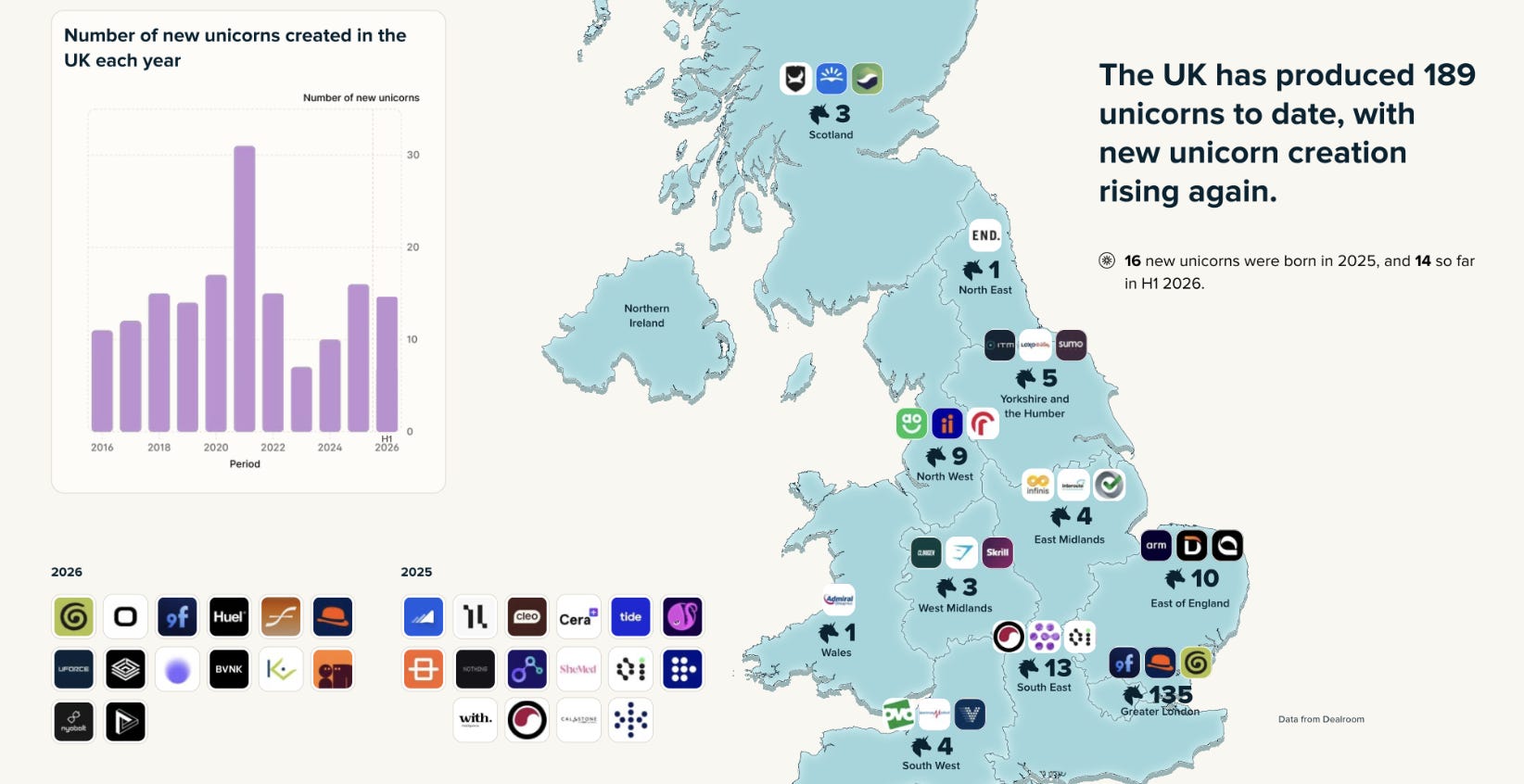
Start with the headline outcome. The UK is now home to 189 unicorns — private companies worth over $1 billion — and the number is still climbing. That places Britain third in the world, behind only the US and China, and comfortably ahead of every other European nation. This is not a country that struggles to produce winners. Whatever else is true about the funding gaps and the exit problems, the top of the funnel is working: the UK manufactures billion-dollar companies at a rate almost no one else can match. The power law of venture — where a handful of enormous outcomes define an entire ecosystem — is operating firmly in Britain’s favour on the creation side.
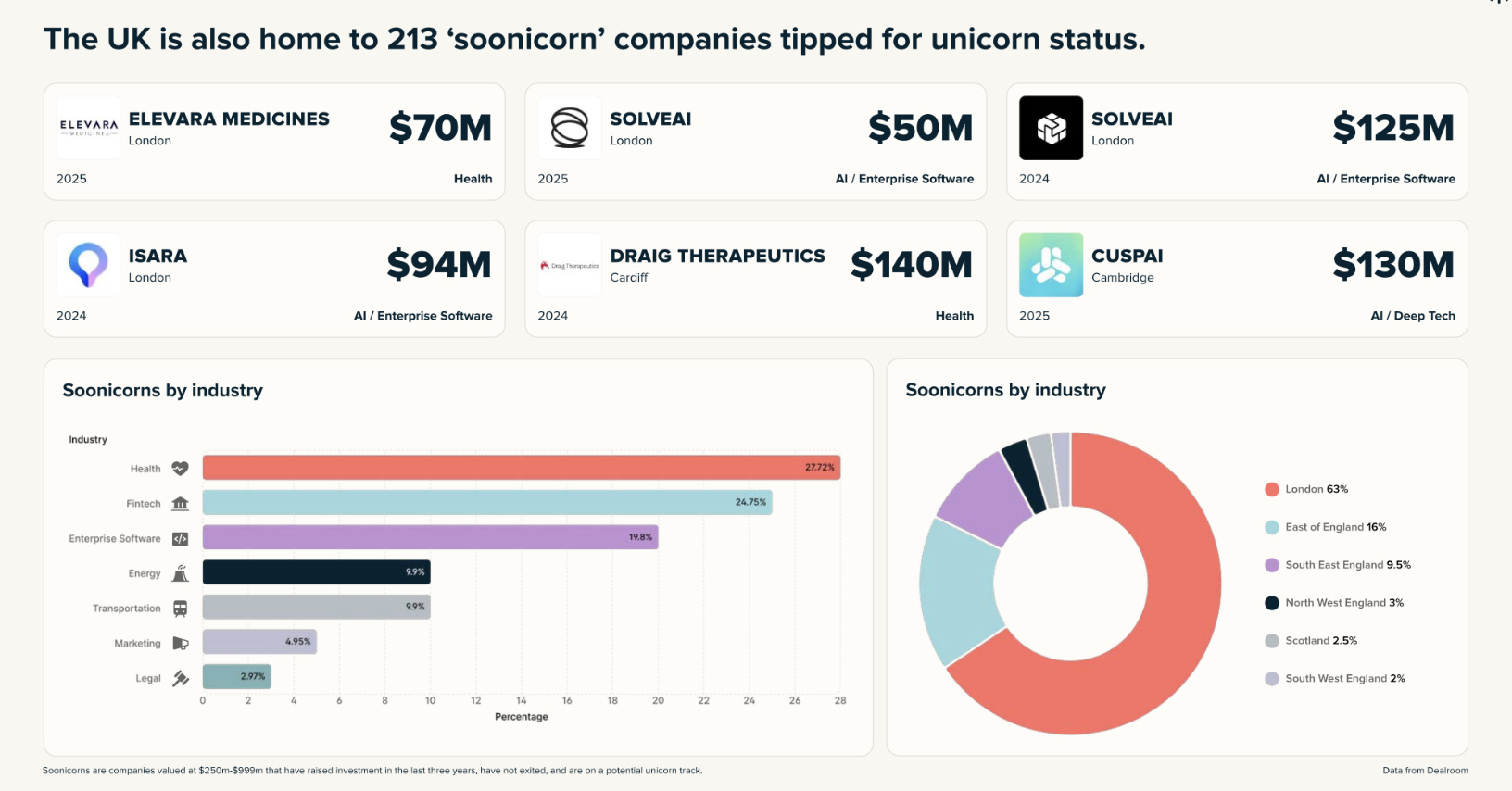
More consequential than the unicorns is what sits directly behind them. The UK now has 213 “soonicorns” — companies valued between $250 million and $1 billion, on a credible path to unicorn status. There are more soonicorns than unicorns, which tells you the factory isn’t slowing; it’s accelerating. The pipeline of tomorrow’s billion-dollar companies is deeper than the stock of today’s. The concentration is stark, though — 63% of these soonicorns are in London, a reminder that for all the talk of levelling up, Britain’s outcomes remain overwhelmingly a London story. But on the central question of whether the UK can keep producing companies of consequence, the answer here is unambiguous: yes, and more of them.
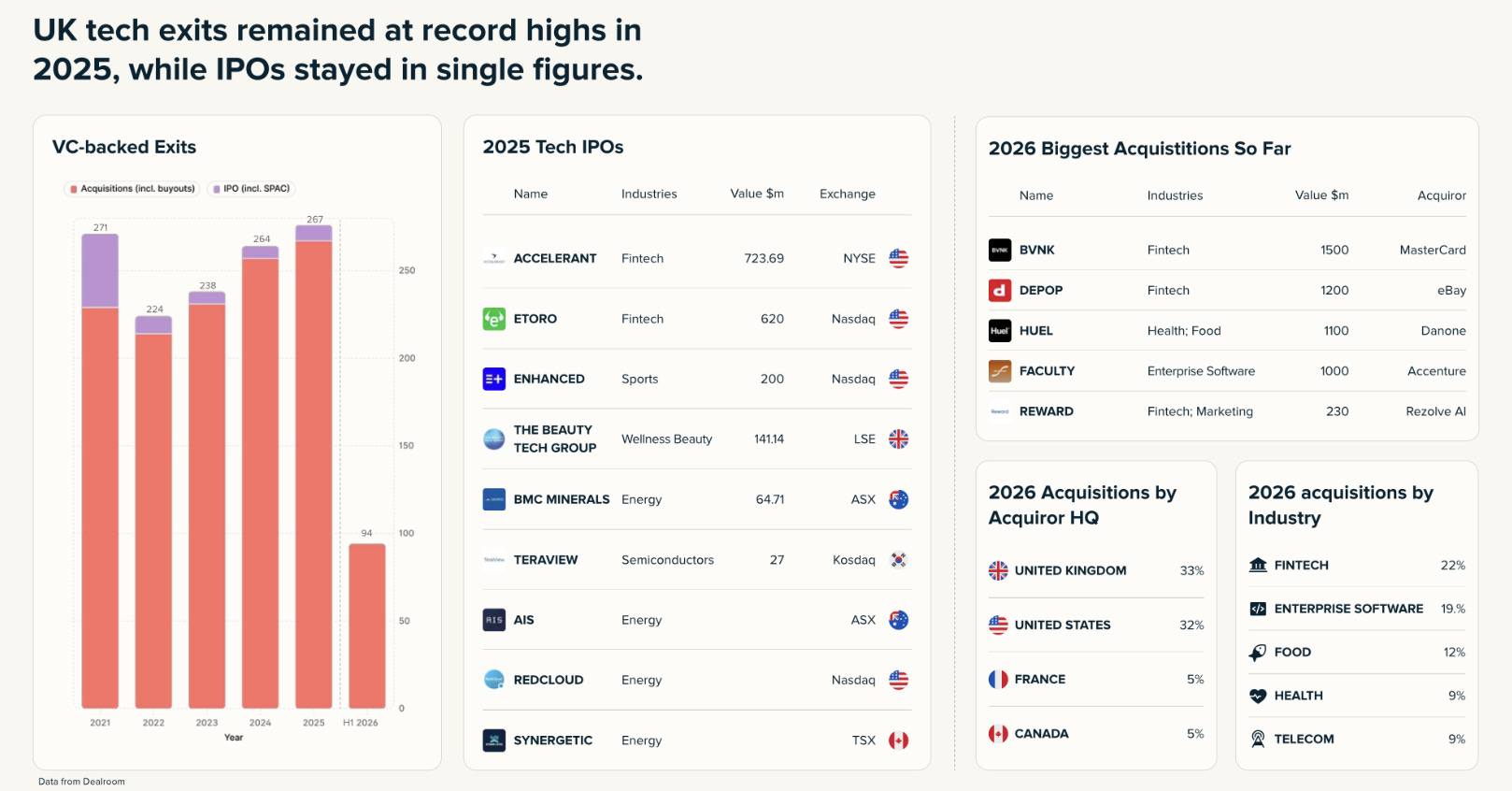
However, Britain has a clear problem in retaining value within it’s ecosystem - which is linked to a couple of key fundamental gaps.
The first is that the public markets have all but closed as an exit. The number of UK tech companies going public each year is now in single figures — barely a trickle. The mechanism that should turn a great private company into a great public one — a listing, and the chance to scale on as an independent business — has effectively stopped working for British tech. That leaves acquisition as the only exit that really matters or is attainable. Of the British companies that are acquired, roughly a third are bought by domestic acquirers and very nearly a third by American ones — 33% against 32%. A successful British company is now almost exactly as likely to be sold to a US owner as to a UK one.
The prognosis is as follows: the models are American; the late-stage capital is increasingly American; and now the exits, too, split evenly between London and the United States. The creation engine works — there is nothing wrong with the companies Britain builds. What breaks is what happens to them at the finish line, the moment a growing share of the value they’ve created passes into foreign hands.
Sections 3 and 4 argued that the UK risks not owning what it builds; this section counts it. And the count reveals a genuine asymmetry at the centre of British venture: the country has all but mastered the part everyone assumed was hardest, and has only just begun on the part that matters most for what comes next.
The mastered part is creation. 189 unicorns and 213 soonicorns is not luck, and it isn’t a bubble artefact — it’s a factory, third in the world, pulling away from the rest of Europe, with a next wave deeper than the current one. This is the hard-won foundation, and it is genuinely world-class.
The unfinished part is retention. But be clear about who actually has this problem, because it isn't the investors. If a company backed at seed goes on to raise its big rounds in San Francisco, or sells to a US acquirer at a strong multiple, that is usually a strong outcome for early stage investors. The returns are there either way; UK early-stage is world-class whoever ends up owning the company two rounds later. So when I say Britain has to keep more of what it builds, I'm not talking about investment returns. I'm talking about the economy: the jobs, the tax, the headquarters, the decades of compounding growth a company throws off as it scales. Those either happen here, or they happen somewhere else.
And the national stakes are high because retention diffuses into the economy. Keep a great company at home and it doesn’t just add its own value; it becomes an anchor — the acquirer of the next generation, the employer that trains the next wave of founders, the listing that deepens the market, the capital that recycles back in. That flywheel is exactly how Silicon Valley became Silicon Valley: not one great company, but great companies that stayed and seeded the next. Keep even a fraction of these businesses and the same compounding that built Britain’s creation engine starts working one level up — on ownership, on the tax base, on the whole economy around it.
Britain has, in effect, already run this experiment — and not to good effect. DeepMind, the most important AI lab the country has ever produced, has belonged to Google since 2014; its breakthroughs are British in origin and American in ownership. ARM, the Cambridge designer whose chips sit in nearly every smartphone on earth, was sold to SoftBank in 2016 and, when it finally returned to the public markets in 2023, listed in New York rather than London — the retention problem and the IPO problem embodied in a single company. Graphcore, once Britain's great AI-chip hope, went the same way, to SoftBank, in 2024. Each genuinely had trillion dollar potential; but each now compounds for someone else's economy.
Britain has already done the difficult thing. What’s left is the more tractable one — building the exits, the growth capital and the anchor companies that let those world-class businesses scale and stay. That isn’t a flaw in the founders or the science; those are the hardest inputs of all to manufacture, and Britain has them in abundance. It’s a gap in the financial plumbing. If and how Britain fixes this is the trillion dollar question.
The UK tech sector is worth $1.6 trillion; AI is a third of it and compounding three times faster than the rest; Britain is the third AI power on earth, behind only the United States and China. On the question that has dogged British technology for two decades — can this country actually build companies of global consequence? — the report is emphatic. Yes, at scale, and faster than anyone else in Europe.
But building and keeping are not the same thing, and the report contains one number that draws the distinction. For every pound of value a British company creates and realises at exit, 57 pence leaves the country — flowing back across the Atlantic to the American investors who increasingly own it. Britain has built a superb machine for creating value and a poor one for holding on to it.
That single fact separates the two futures available to this country. In one, Britain is a great technology nation — it builds the companies, and it keeps enough of them to compound the winnings into the next generation of jobs, taxes and founders. In the other, it is the world’s most sophisticated incubator: a place that reliably produces brilliant companies for other countries to own. The distance between those futures has nothing to do with the founders, the science or the talent, all of which are already world-class. It has everything to do with ownership — and ownership is a solvable problem.
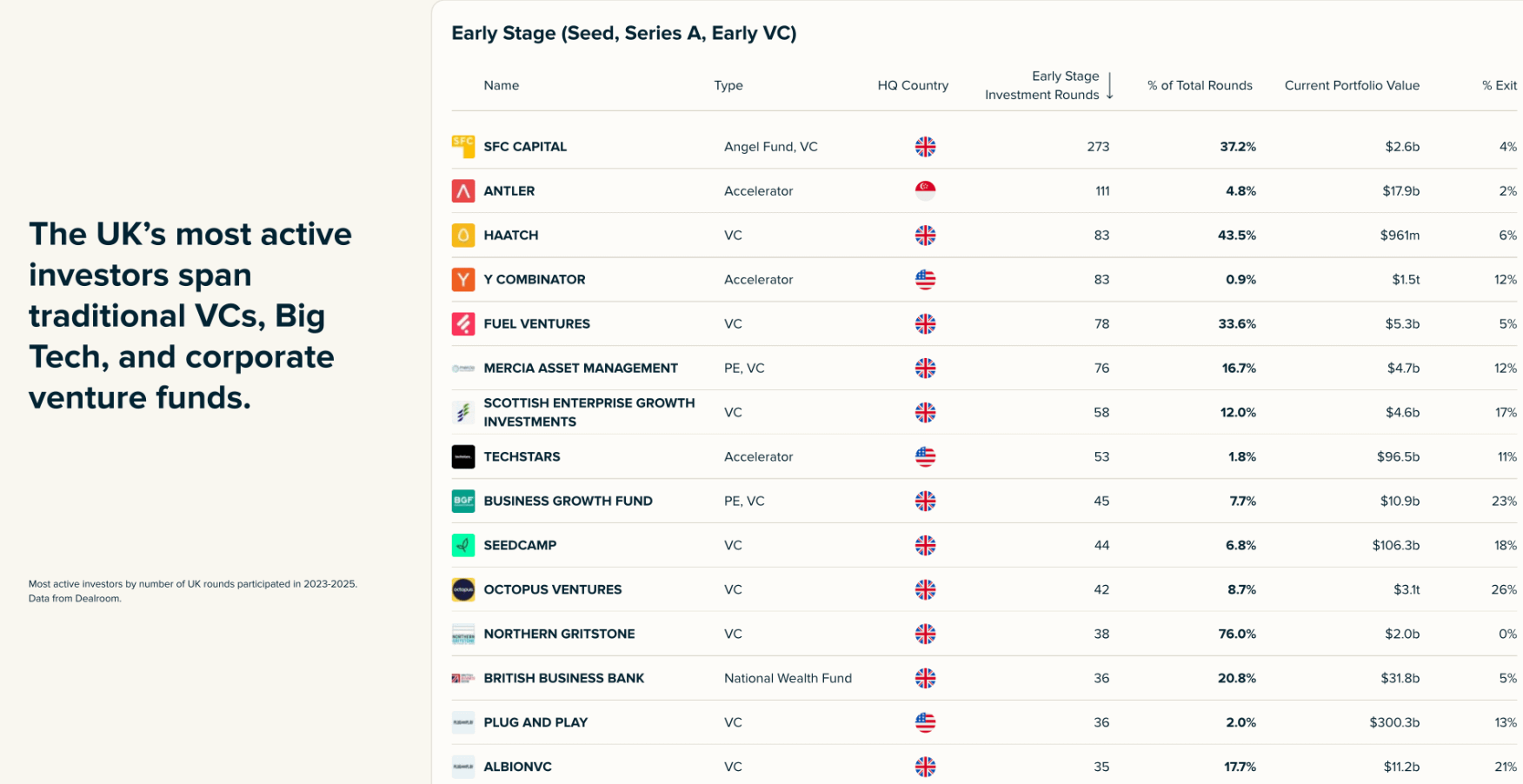
But look at where that capital actually comes from, and the more important point is a structural one: Britain has built genuine depth across the whole funnel, not just the front of it, spanning from pre-seed to Series A. At the early stage, the numbers are impressive. Eleven of the fifteen most active are UK-headquartered. The composition is as telling as the volume. The field spans every category of capital — specialist angel funds and seed VCs, international accelerators, and a substantial layer of public and regional institutions, from the British Business Bank to Scottish Enterprise Growth Investments and Northern Gritstone, deploying into Scotland and the North rather than London alone. Private risk capital sitting alongside catalytic public capital, spread across the country: that is what a mature early-stage market looks like, and none in Europe is this pronounced. On this evidence, it is the single strongest structural asset UK technology has.
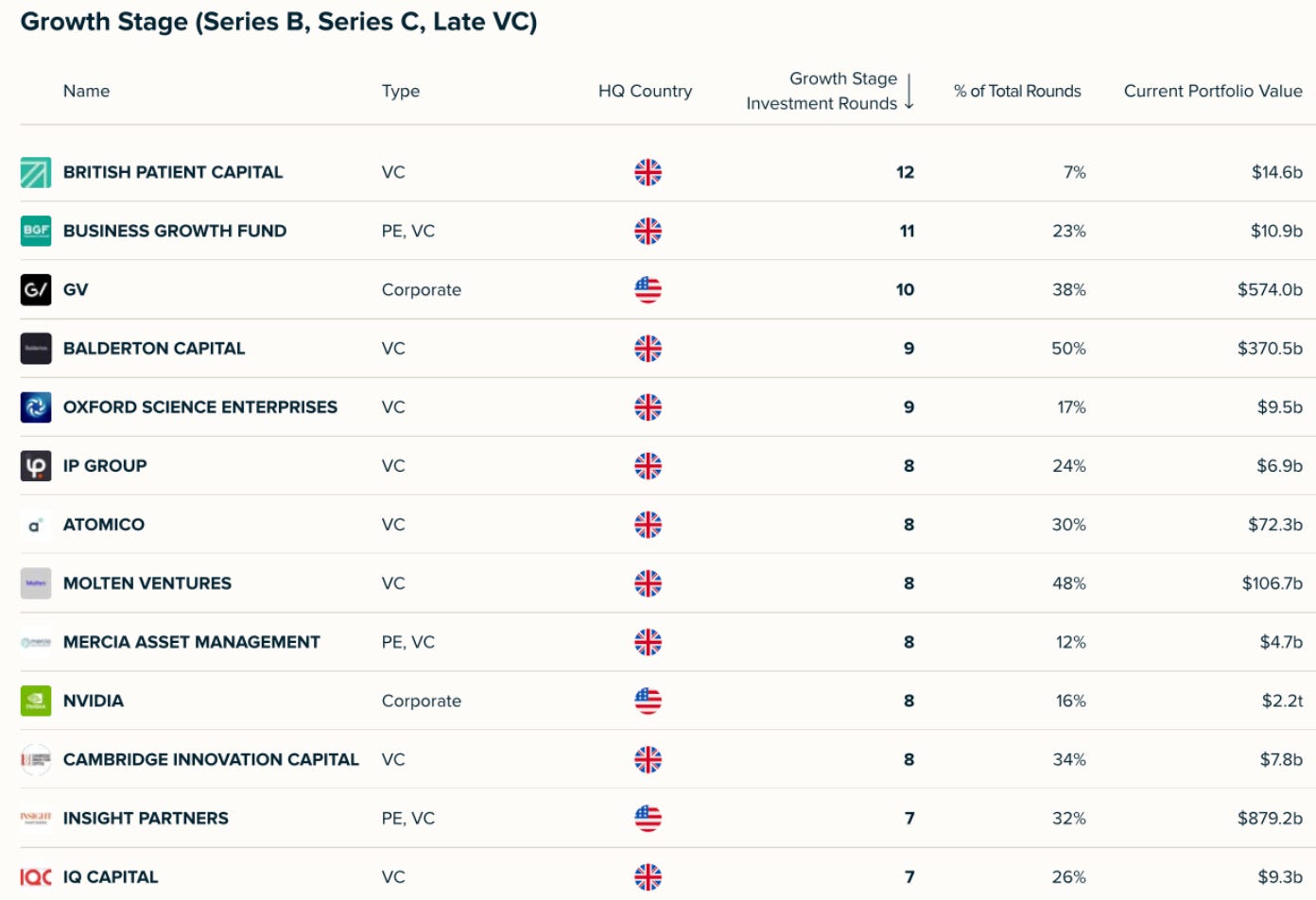
And the follow-on capital is there too. Move up to the growth stage and a genuine, largely domestic cohort actively invests in Series B+ rounds: Balderton, Atomico, Molten Ventures, Oxford Science Enterprises, IP Group, British Patient Capital. This is not an ecosystem that can only get companies started — it can fund them as they grow. The gap is one of depth. The domestic capital availability starts the fade as you progress through the value chain, especially at the largest rounds and at exit, is where American capital (GV, Nvidia, Insight Partners) starts to feature. Our task needs to focus on deepening the later-stage and patient capital — the pension money, above all — and far more of the value Britain creates would stay home the whole way through.
The solution is not to try to become America. Britain will not, and should not, spend its way to a domestic rival to OpenAI; the frontier is a capital race for those who own the compute, and on that layer Britain is a consumer, not a producer. The opportunity is narrower, and far more winnable. It is to own the layers where value actually accrues — the application layer and the verticals built on the models, where Britain is already strong; AI safety, the one part of the stack it leads outright; and the energy to power all of it. And it is to build what the country clearly lacks: the domestic growth capital and the public markets that would let a great company scale and stay, rather than sell.
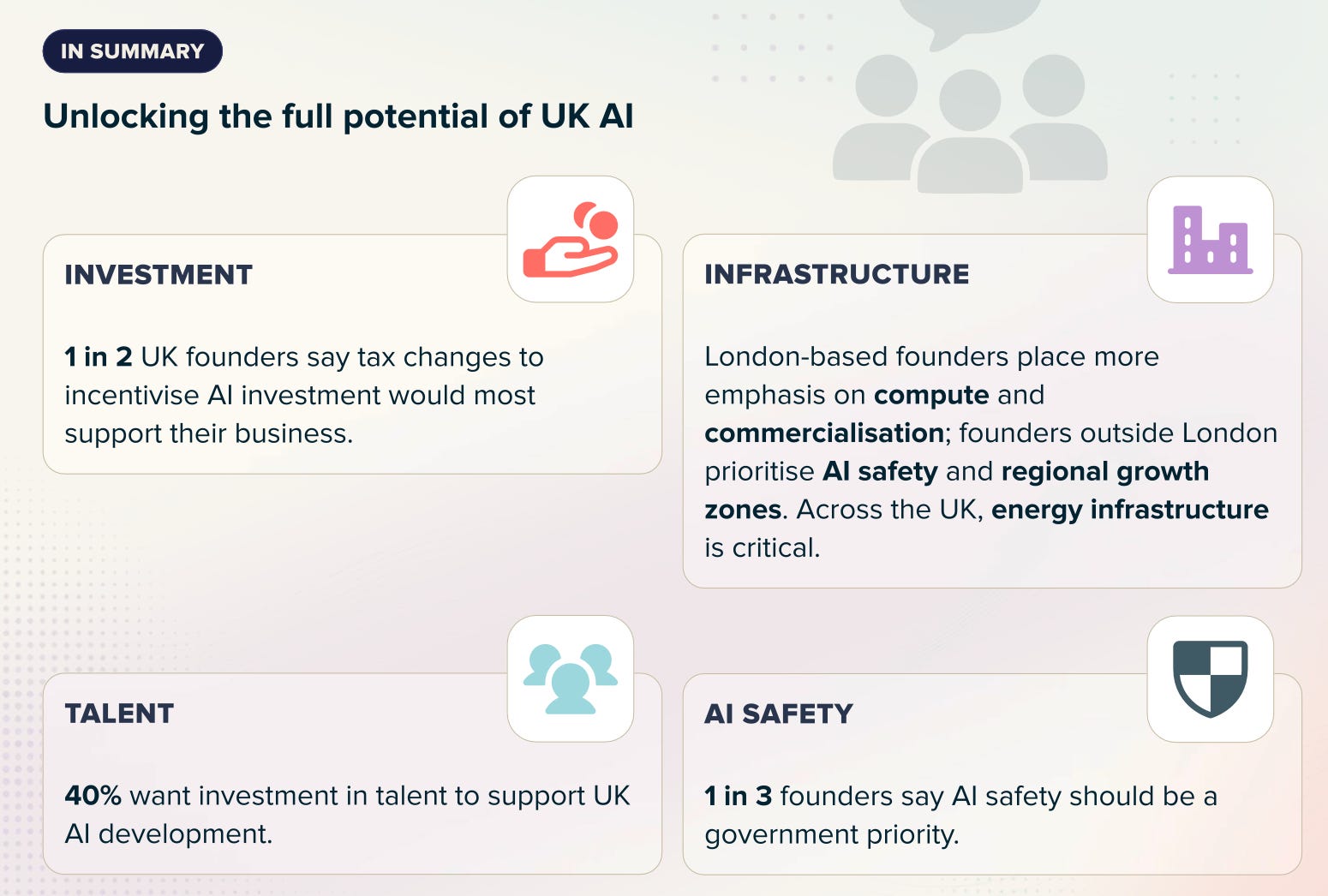
The report concludes on the founders' own prescription, and it comes down to four things: investment, infrastructure, talent and safety. Each targets a different part of the same problem. One in two founders say the most useful move the government could make is to reform the tax treatment of AI investment — strengthening the very incentives that already pull private capital into the earliest and riskiest bets. On infrastructure the message is unanimous: energy is the binding constraint, and it matters right across the country, even as London leans towards compute and commercialisation and the regions towards safety and growth zones. Forty per cent want the state to invest directly in talent — the researchers and engineers who are already Britain's clearest edge. And a third want AI safety treated as a national priority, which is an uncommon thing for the people building the technology to ask of their own field.
I will end on something no chart in this report can capture. I have spent the last few years meeting these founders, week after week, in exactly the sectors the report covers — and the honest truth is that it is the most exciting moment I have known in a decade of investing. A real dynamism, and a real ambition, have come back to the UK tech ecosystem. Founders and investors alike genuinely believe that this is now one of the best places in the world to build, back and grow the AI companies of the future. The founders building now are the best I have encountered: more technical, more commercial, more experienced, and far more determined to build world leading companies.
The ambition behind it is the part that gives me most hope — because it is precisely what Silicon Valley understood long before the rest of us. The companies that change the world are almost never built on realistic ambition. They are built on an ambition that looks, at the outset, faintly delusional. Every truly great company has that streak of delusion running through it. Britain, for most of its history, has been too sensible for that — too quick to temper ambition with realism, to build for a respectable exit rather than for outright dominance. What I am seeing now, for the first time, is a generation of founders who have shed that caution, and the last thing the country should do is talk them out of it. Ambition is the lifeblood of global dominance, and it is exactly what the UK must continue to embrace.
For all the UK’s wider economic difficulties, early-stage technology and innovation is the country’s single brightest light — the one arena where Britain is competing at the frontier. The lesson running through this entire report is that we should lean into it, and hard: treat it not as a corner of the economy but as one of the most powerful levers we have to get the UK back to an era of prosperity and growth.
No posts
Comments
Nothing yet. Say the first thing.
Sign in to join the conversation.