
A deep read on the most-watched young investor in AI — his thesis, his portfolio, and what his positioning tells us about where the cycle goes next.
Leopold Aschenbrenner is someone I have been following for a while now — I have read his Situational Awareness memo twice over, genuinely one of the most thought provoking pieces ever written on AI. For anyone who does not yet know him, I thought it would be worth pulling together who he is, what he believes, and why his portfolio has become one of the most watched in the market.
Start with a comparison that should not be possible. Bill Ackman’s Pershing Square, one of the most recognisable hedge funds in the world, runs around $20 billion. Ackman has been investing professionally for roughly three decades, built and nearly lost his first fund, survived the Herbalife years, and earned every grey hair in the process. Situational Awareness LP also runs around $20 billion. Its founder is twenty-four years old, started the fund eighteen months ago, and had no professional investing track record of any kind before he did. By assets under management, a person who could not legally have managed outside capital for most of the last decade is now operating at the same scale as one of the most storied investors of his generation.
The person is Leopold Aschenbrenner. He graduated as valedictorian of Columbia at nineteen, joined OpenAI’s Superalignment team, and was dismissed in the spring of 2024 in the turbulence that followed the departure of several safety researchers. Within months he had done two things. He published a 165-page essay laying out an aggressive, specific, dated thesis about where artificial intelligence was heading. And he launched a fund to back that thesis with capital — an initial raise of roughly $200 million, supported by a roster of backers that reportedly included Patrick and John Collison, Daniel Gross, and Nat Friedman. The LP’s matter because they are the people closest to the actual frontier of the technology, and they were willing to hand a first-time manager their money on the strength of a worldview.
That worldview has compounded at a rate few funds in history have matched. The most recent public filing shows roughly $13.7 billion in disclosed equity positions. Add the privately held stake in Anthropic that has been widely reported, and the total runs closer to $20 billion. The fund has, by various accounts, roughly doubled in scale quarter over quarter — a trajectory that belongs to a fast-growing startup rather than a hedge fund. In under two years, Leopold has gone from fired researcher to one of the more consequential allocators of capital in the entire AI cycle.
Most coverage of Leopold focuses on the essay, and rightly so. Situational Awareness is one of the most consequential pieces of public writing on AI to appear in the last several years. It made specific, dated, falsifiable predictions about the trajectory of a technology cycle that most people consider the largest in modern economic history, and those predictions have, so far, broadly tracked the cycle as it has unfolded. It is rare for a single document to be that influential, and rarer still for its author to then put hundreds of millions of dollars behind it.
That last point is what makes Leopold genuinely worth studying. Most people who write a thesis this aggressive never have to back it. The essay can be debated in the abstract, praised or dismissed, and its author faces no consequence either way. Leopold did the opposite. He wrote the thesis, then built a fund whose every position is, in effect, a wager that the thesis is correct. The essay and the portfolio are not two separate things. They are the same argument expressed in two forms — one in prose, one in capital.
This article is an aim to walk through the thesis, examine the public positions, analyse his framework, unpack the rotation underneath the surface, and arrive at a clear view on where his positioning sits in the wider debate. The structure follows Leopold’s own logic: start with the worldview laid out in Situational Awareness, then trace how that worldview has been translated into capital, layer by layer, position by position.
I’ve also included a link below to the Situational Awareness article which I would highly recommend reading:
Every position in the fund traces back to this document, so it is where the analysis has to begin. Situational Awareness was published in June 2024 — roughly 165 pages, five essays, released openly online and dedicated to Ilya Sutskever. The title is a term borrowed from military and intelligence settings, and it means seeing the board as it actually is while everyone around you is still playing the previous move. That is the entire posture of the document. Leopold’s claim is not that he is smarter than the market. It is that he is looking at the same data as everyone else and simply refusing to round it down.
The organising principle of the entire essay is the OOM — the order of magnitude, a single factor of ten. Rather than tracking AI progress through model names or benchmark scores, Leopold tracks it through orders of magnitude of what he calls “effective compute.” The leap from GPT-2 to GPT-4, he shows, was somewhere around four to five OOMs of effective compute — and in capability terms, that was the difference between a preschooler barely stringing words together and a smart high-schooler who can write working code and pass demanding exams. Four years. Four or five factors of ten. One enormous jump in what the systems could actually do.
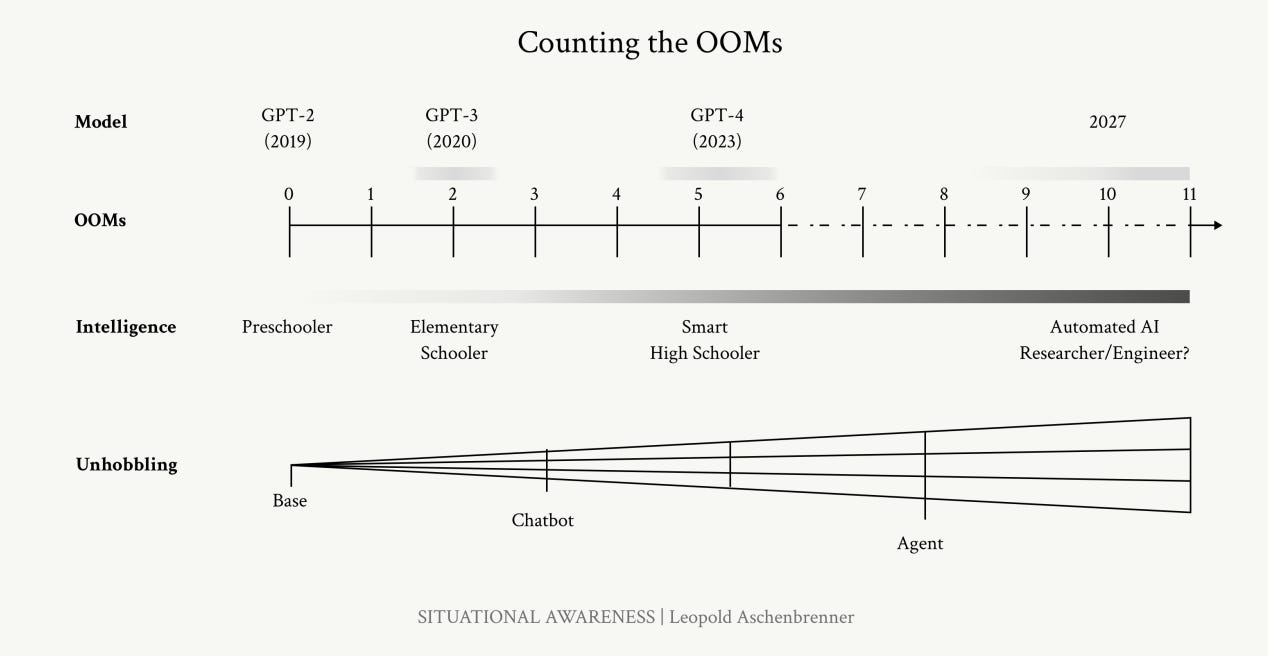
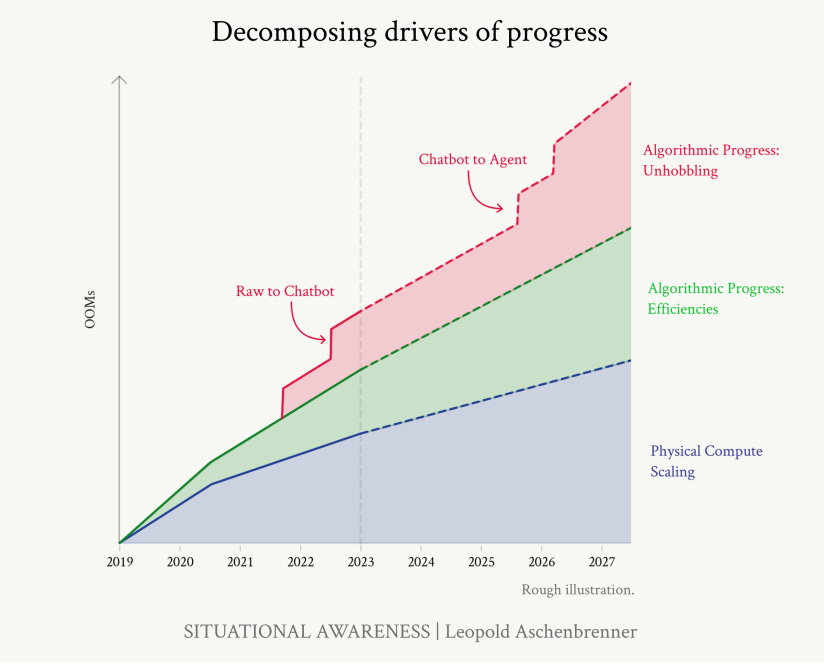
As a framework to his OOM mental model, he counts three drivers, each contributing independently and each likely to continue. The first is raw compute scaleup — the physical chips, clusters, and capital, growing at roughly half an order of magnitude a year. The second is algorithmic efficiency — the same capability extracted from less compute as training techniques improve, contributing a comparable amount on top. The third is what he terms “unhobbling” — the unlocking of latent capability that the models already possess but cannot yet express, through tools, memory, longer context windows, and agentic scaffolding.
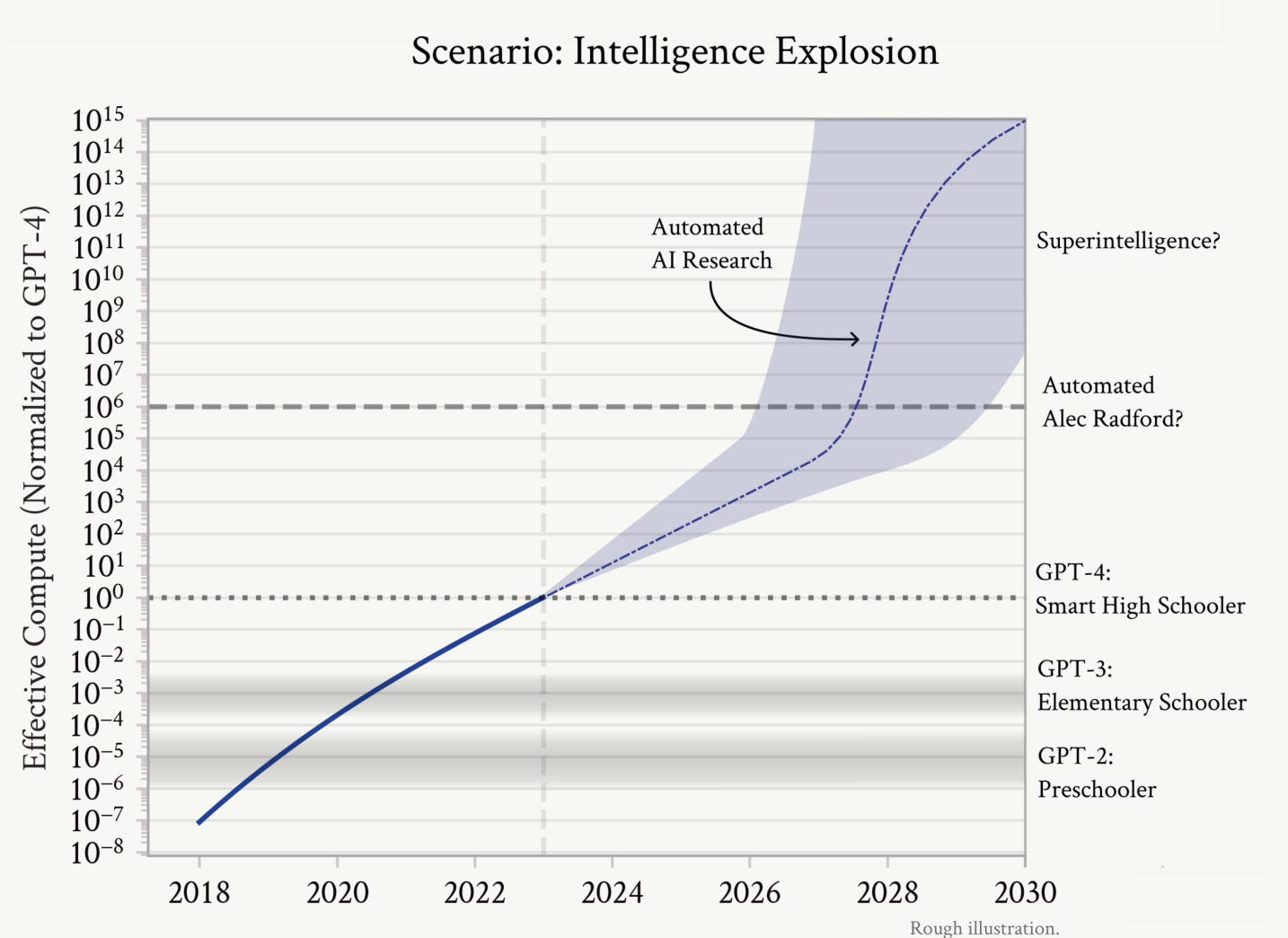
Stack the three drivers together and they compound into a steady, predictable climb — and this is where the paper's most famous image does its work. Leopold's chart, "Base Scaleup of Effective Compute," plots that climb on a log scale: GPT-2 to GPT-3 to GPT-4, each model a few orders of magnitude of effective compute above the last, the capability labels running from preschooler to elementary schooler to smart high-schooler. A solid line runs through those points to 2023. Then Leopold does the unconventional and extends the line. The dashed line carries the same slope four more years and lands, around 2027, on a single label: "Automated AI Researcher/Engineer." The case for AGI this decade, in other words, does not rest on a breakthrough, a new architecture, or a leap of faith. It rests only on that line — compute, plus algorithms, plus unhobbling — holding the slope it has kept for the better part of a decade.
From there the argument compounds — literally. Once a system can do the work of an AI researcher, you point it at building the next system, and run hundreds of thousands of copies in parallel. Leopold calls this the intelligence explosion: a decade of progress compressed into a year, because the researchers no longer sleep. The jump from AGI to superintelligence is not a separate event needing separate assumptions. It is the same line continuing — only now the AI is the one drawing it.
And if superintelligence is arriving before 2030, the consequences stop being technical and turn industrial: trillion-dollar compute clusters, training runs drawing tens of gigawatts, a mobilisation of power and silicon Leopold likens to wartime production. He wraps it in a national-security thesis — the US against China, the labs as strategic assets, an eventual government takeover he calls “The Project.” The politics may or may not play out. The economics underneath reduce to one prediction: an unprecedented wave of capital is about to hit the physical substrate of intelligence.
But the prediction that built the fund was more specific than “money floods into AI.” Leopold called the order it arrives in. Compute first — the chips everyone could see. Then the constraints compute exposes: power, grid, memory, cooling, networking. Then the hard physical layer beneath it — data centre shells, permits, the raw capacity to build. By correctly predicting the oscillation between layers is what separates Situational Awareness from every other bull case of 2024: the others named a destination, Leopold drew a route.
What is striking, reading the document eighteen months on, is how little of it needs revising. The compute buildout arrived on the scale he described. Power became the constraint everyone is now scrambling to solve, exactly when he said it would. The trillion-dollar capex figures that read as science fiction in mid-2024 are now line items in hyperscaler earnings calls. Anyone who had simply read the memo as a roadmap and positioned against it — long the compute layer, then long power and the grid, then long the physical build-out as each bottleneck came into view — would have captured one of the great returns of the cycle. The document was not just a profitable trade. It was an accurate forecast of the present.
A 13F is a confession the market forces on you. Any institutional manager running over $100 million in US equities has to disclose their positions every quarter, with a forty-five-day lag, whether they want to or not. For most funds this is a formality. For Situational Awareness, it is the closest thing the public has to a window into how Leopold has translated 165 pages of thesis into actual capital — and the filing rewards close reading, because the positions line up against the essay almost paragraph by paragraph.
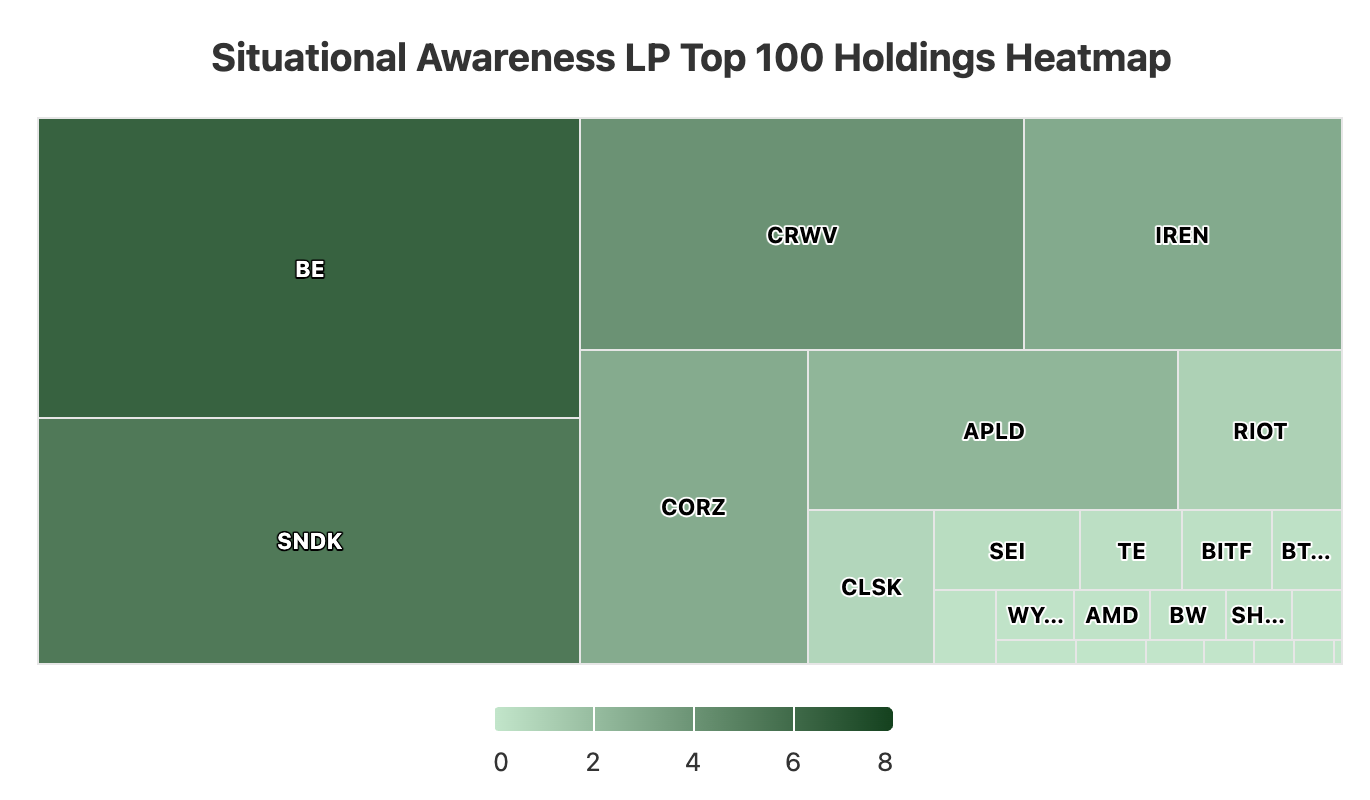
Start with the long positions that built the fund. Leopold’s longest-held holdings are in the neoclouds — CoreWeave and IREN, the companies that own GPU capacity and rent it to AI labs that cannot build fast enough themselves. These are not chip designers. They are the landlords of compute, and they monetise the single scarcest resource in the cycle: working GPUs, racked, powered, cooled, and available now. He has held them since close to the fund’s inception, concentrated rather than diversified, and they have driven a meaningful share of the returns. The logic is symmetrical to Situational Awareness: if compute is the binding constraint, own the people who control access to it.
From there the filing climbs down the stack into the constraints that compute exposes. Power is the heaviest theme — the largest single name on the long side is Bloom Energy, the fuel-cell and on-site generation company, sitting in the layer Leopold flagged in the essay as the second bottleneck, the one that binds the moment you have enough chips. The portfolio reaches into memory and storage too, through call positions in Micron and Sandisk — the high-bandwidth memory that every training cluster consumes in volume, where supply is tight and pricing has structural support. Each layer maps to a constraint the essay said would bind in sequence.
What is equally telling is what the filing does not contain. There is little direct exposure to the application-layer giants most investors reach for when they want “AI exposure” — the Microsofts, Googles, and Metas that dominate the public AI narrative. Leopold is not playing the companies that use the compute. He is playing the ones that supply it, power it, and store its working memory. His long positions are, in effect, a single wager on the physical substrate of intelligence, expressed through whichever layer is the tightest constraint.
It connects to something I have written about before: the enduring value in a compute cycle rarely stays with the suppliers; it migrates to the consumers — the telecom build-out gave way to the internet giants, the cloud build-out to the software layer above it. Suppliers capture the early margin; consumers capture the lasting franchise. Leopold’s portfolio is all supplier — the right place to be while compute is the binding constraint, but not where the durable value finally lands.
Positions are also concentrated and geared. His position in Core Scientific, for instance, functions as a leveraged bet on CoreWeave, by owning the data-centre infrastructure CoreWeave runs on top of. This is not a diversified index of AI infrastructure. It is a small number of high-conviction positions, sized aggressively, in the layers he believed the market had underpriced. It is the canonical installation-phase portfolio — Carlota Perez’s term for the early period of a technological revolution, when capital floods into the physical substrate of a new paradigm and the returns accrue to whoever supplies it. This is the portfolio that took the fund from $200 million to its current scale.
But the most recent filing complicates that existing picture. This is not a portfolio standing still and compounding. In the latest quarter, Leopold is trimming nearly all of it — paring back CoreWeave, IREN, Core Scientific, Applied Digital, even Bloom Energy, and exiting smaller positions outright. The longs that built the fund are being reduced, not added to. And what he is buying instead is not more infrastructure. It’s a structural repositioning of the book.
The most aggressive position in the filing is a bet against the very trade that made him. One caveat first: a 13F is a lagged snapshot, filed forty-five days after the quarter closes, so these are his positions as of the most recent disclosure — not necessarily where the portfolio sits today. Leopold’s single largest position change in the quarter — bigger than any long he holds — is a put on the VanEck Semiconductor ETF, the index that tracks the entire chip sector. Beside it sit puts on NVIDIA, Broadcom, AMD, Taiwan Semiconductor, ASML and Oracle: more than $8 billion of notional short exposure, layered across the semiconductor complex as a whole. The man who built his fund on the AI build-out has, this quarter, placed his biggest single bet against the companies that supply its silicon.
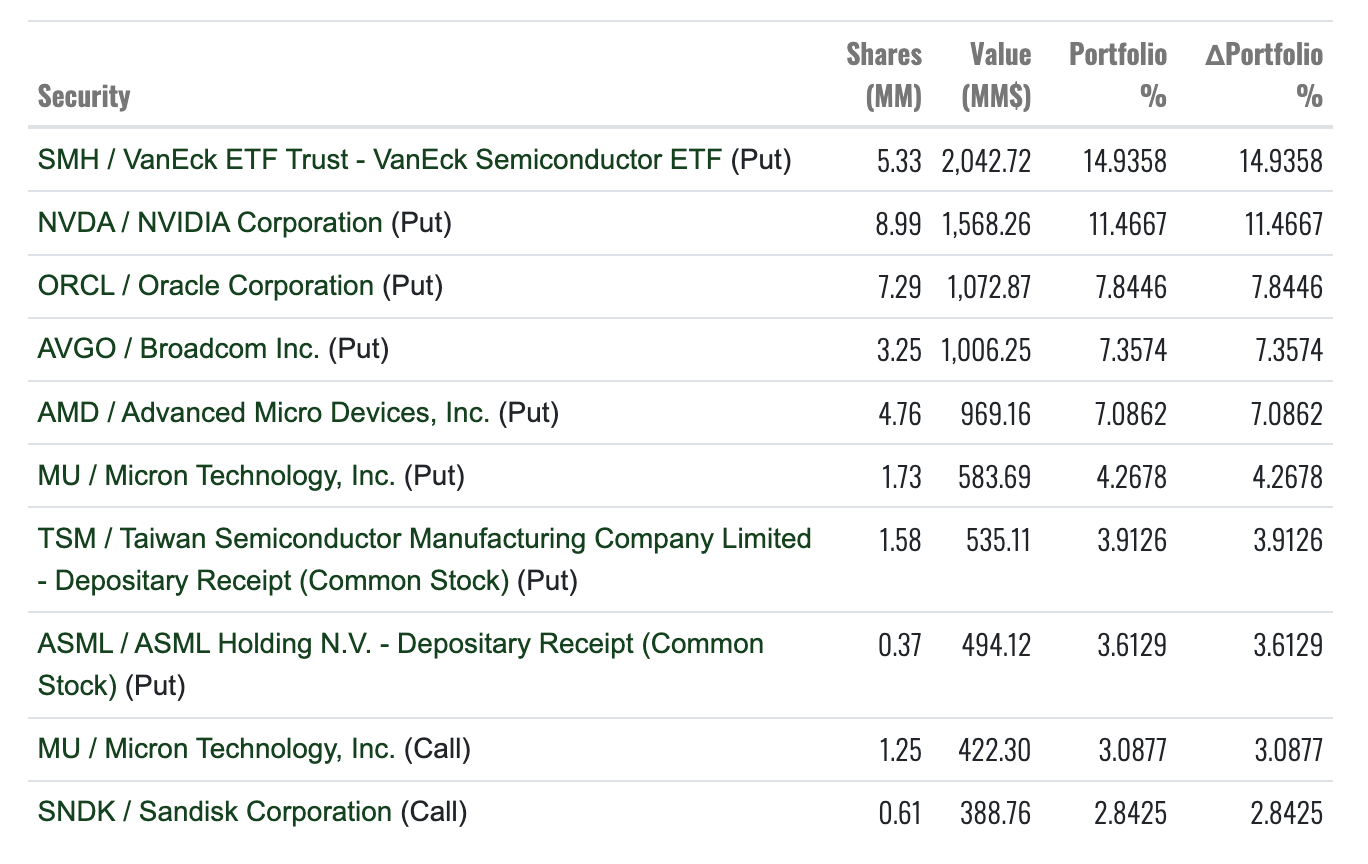
This looks like the counter-narrative to his whole thesis, but it is not — and what he is not shorting tells you why. He remains long the neoclouds that rent compute, long Bloom Energy and the power layer, and, tellingly, long memory and storage, through calls on Micron and Sandisk even as he shorts the broader chip index. That distinction got real-time validation on Wednesday night: Micron reported blowout earnings, driven by exactly the high-bandwidth memory demand the AI build-out is generating — the one corner of the chip complex where the fundamentals are still accelerating, and the corner Leopold kept long.
The layer he is shorting is the opposite kind: the chipmakers and equipment names that have become the most crowded, most consensus trade in global markets. Every generalist fund owns NVIDIA. Every thematic ETF is built around the semiconductor complex. When a trade gets that crowded, the marginal buyer has already bought, and the alpha starts to decay. The deeper logic is about where the margin goes from here: as the build-out matures and chip supply catches up with demand, pricing power tends to drift from the companies that manufacture the silicon to the ones that deploy it. Set against the way he has repositioned the portfolio, the message is consistent. Leopold is not calling the top of AI. He is calling the top of the chip trade.
And then there is one more position, the largest of all, that no 13F can show — because it is private. According to reporting from the Wall Street Journal and others, roughly 20% of the fund sits in a stake in Anthropic, entered in March 2025 at a valuation near $60 billion and marked up close to fifteen-fold since: a holding worth somewhere near $7 billion, and the bridge between the $13.7 billion of disclosed positions and the roughly $20 billion the fund actually runs.
It is also neither infrastructure nor a short. Anthropic is a frontier lab — a producer of intelligence, not a business that consumes it. This is not a bet on the deployment layer, where I have argued the durable value eventually settles; it is a concentrated bet that as the model layer consolidates, it consolidates around a handful of winners, and that Anthropic is one of them. Set beside the semiconductor short, it completes a coherent picture: short the part of the supply chain that has run too far, hold the constraints that still bind, and place the single biggest chip on owning the most valuable node of the production layer outright.
That is the shape of the portfolio today — not the static, long-only conviction of the fund that got here, but something in motion: trimming the infrastructure that drove the returns, shorting the chipmakers the crowd still loves, and concentrated, above all, in one private bet the public cannot follow. A $200 million fund became a $20 billion one on the first version of this thesis. The latest filing is Leopold starting to play the next.
Once you read the full paper, you realise there is far more to it than the OOMs. The scaling argument — the chart, the orders of magnitude, AGI by 2027 — is the part that circulated, because it is the part you can trade. But it is only two of the five essays. A big part of Leopold's focus is national security, and it stems directly from where he came from: before he was a fund manager, he was a safety researcher at OpenAI, on the Superalignment team. The other three essays turn to something the market has no clean way to price — the security of the labs, the race with China, and what happens when governments finally grasp what is being built.
The first of these themes is the security of the labs themselves. Leopold argues that the leading AI labs are catastrophically unprotected — that their model weights and algorithmic secrets are among the most valuable national security assets in the world, and that they are being guarded like consumer software rather than nuclear secrets. His contention is that state actors, China in particular, will simply steal the frontier rather than race to build it, and that the labs are doing far too little to stop them. This was not an abstract argument for him: by his own account, the memo he circulated internally on lab security was part of what got him dismissed from OpenAI. You can now watch the theme play out in real time — in the export controls on advanced chips, in the chip-smuggling cases, in the debate over open-weight models that put frontier capability into anyone’s hands, and in the steadily tightening security posture across the major labs. The argument that seemed alarmist in mid-2024 has become a mainstream policy concern.
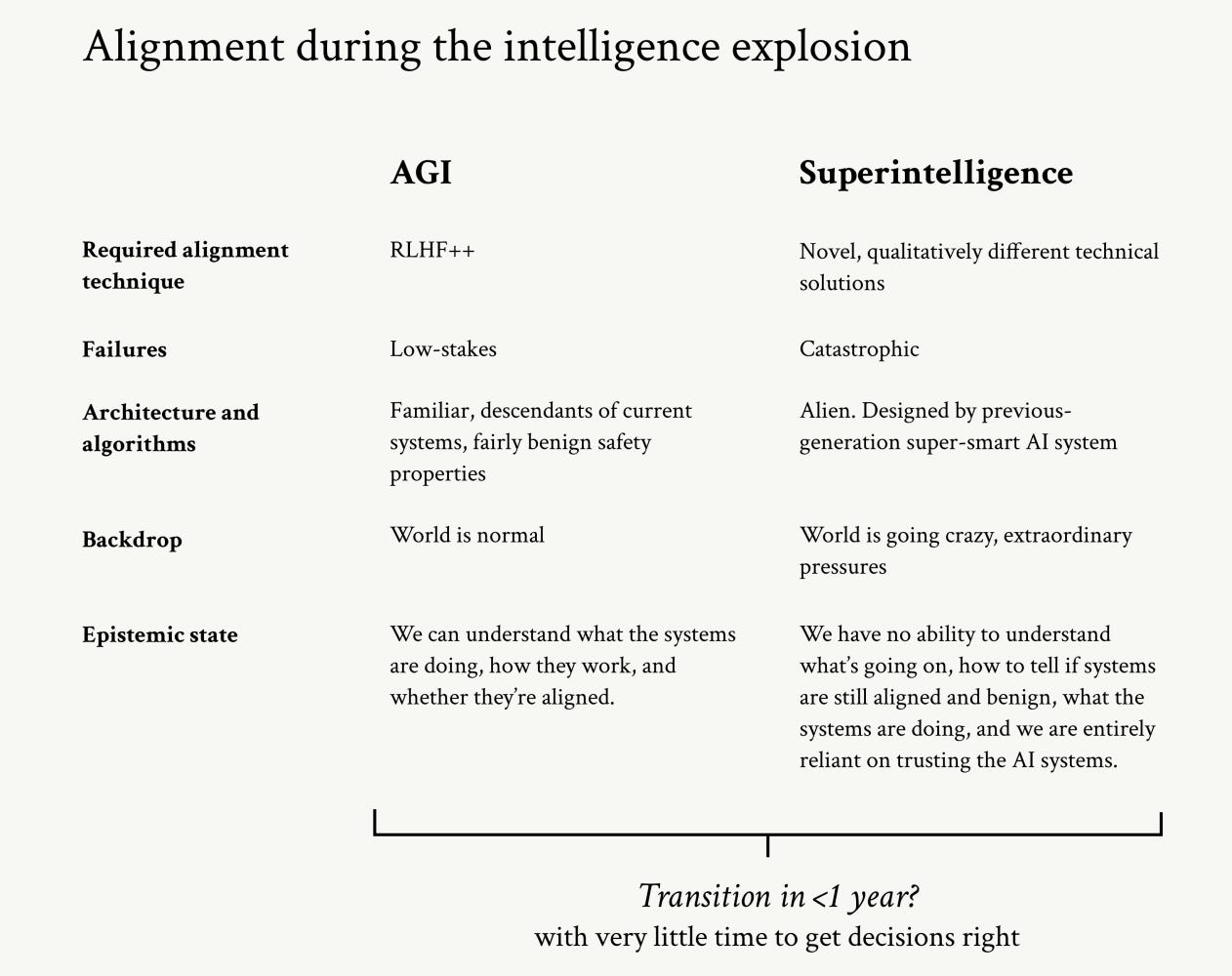
The second theme is superalignment — the technical problem of controlling systems more capable than their creators. This is the work Leopold actually did at OpenAI, on the team that was dissolved not long before he left. His position is that aligning a superintelligence is a genuinely unsolved problem, that the intelligence explosion leaves very little time to solve it, and that the competitive race makes it more likely the problem gets skipped than solved. The uncomfortable subtext, given everything else in the memo, is that he is describing a danger he also expects to arrive on a specific timeline. The departures from safety teams across the industry since, and the persistent tension between the people racing to build capability and the people trying to make it controllable, are the live version of the concern he laid out.
The third theme is the geopolitical, ‘the free world must prevail’. Leopold frames AGI not as a product but as the decisive strategic technology of the century — a lead in superintelligence translating into a decisive military and economic advantage, the way the atomic bomb did in 1945. From that premise, the conclusion follows that the United States and its allies cannot afford to lose the race to an authoritarian China, and that treating AI as a normal commercial technology badly understates the stakes. The language of AI as national infrastructure, of compute as a strategic resource, of a US–China race with civilisational stakes, is now standard in Washington in a way it was not when Leopold wrote it down.
The fourth theme is a prediction that’s still ahead of us: The Project. Leopold argues that as AGI comes into view, the US government will stop treating it as a private-sector matter and move to consolidate development into a secretive, state-led programme — a Manhattan Project for intelligence — because no government will allow superintelligence to be wielded by a handful of private companies answerable to nobody. He puts a rough date on it, around 2027 or 2028. It has not yet happened. But the early shape of it is visible: the national security memoranda on AI, the deepening web of government contracts with the frontier labs, the banning of Anthropic’s recent model ‘Fable’, the defence and intelligence deals, the increasing comfort of the state with treating compute and models as instruments of national power.
What stands out, two halves and eighteen months on, is that both are being proven out. The scaling half was validated by the market: the build-out arrived on the scale he described, and his portfolio is the beneficiary. The security half is now being validated by policy. Export controls have tightened around advanced chips. The labs have hardened their security. Governments have begun treating compute and models as strategic assets and signing the contracts to match. The part the markets ignored has become the part shaping decisions in Washington and a central theme over the years to come.
I wrote this because Leopold is someone worth knowing about, and outside the AI and investing worlds he still largely flies under the radar. A twenty-four-year-old running $20 billion off the back of a paper he published online ought to be more widely understood than he is.
What I take from him, above any single position, is a way of thinking. He did the thing almost nobody does: he looked at the same data as everyone else, refused to round it down, wrote the conclusion out in full, put a date on it, and then backed it with everything he had. He reasoned in layers and sequences rather than headlines — not “is AI big,” but “which constraint binds next, and who owns it.” He carried one coherent worldview across capability, capital, and geopolitics, and let it drive real decisions with real money behind them. The definition of thinking in first principles.
This is a slightly different piece from the ones I usually write — less a thesis of my own than a close read of someone else's. But that is deliberate. Leopold's framework is another substrate for thinking about AI, approached through a different lens than the one I tend to bring: not where the value lands or how the cycle turns, but how to reason about the whole thing from the ground up and then stake real capital on the answer. Working through it has sharpened my own mental model of where this is all heading more than almost anything I have read this year, and I hope it will do the same for you.
No posts
Comments
Nothing yet. Say the first thing.
Sign in to join the conversation.