
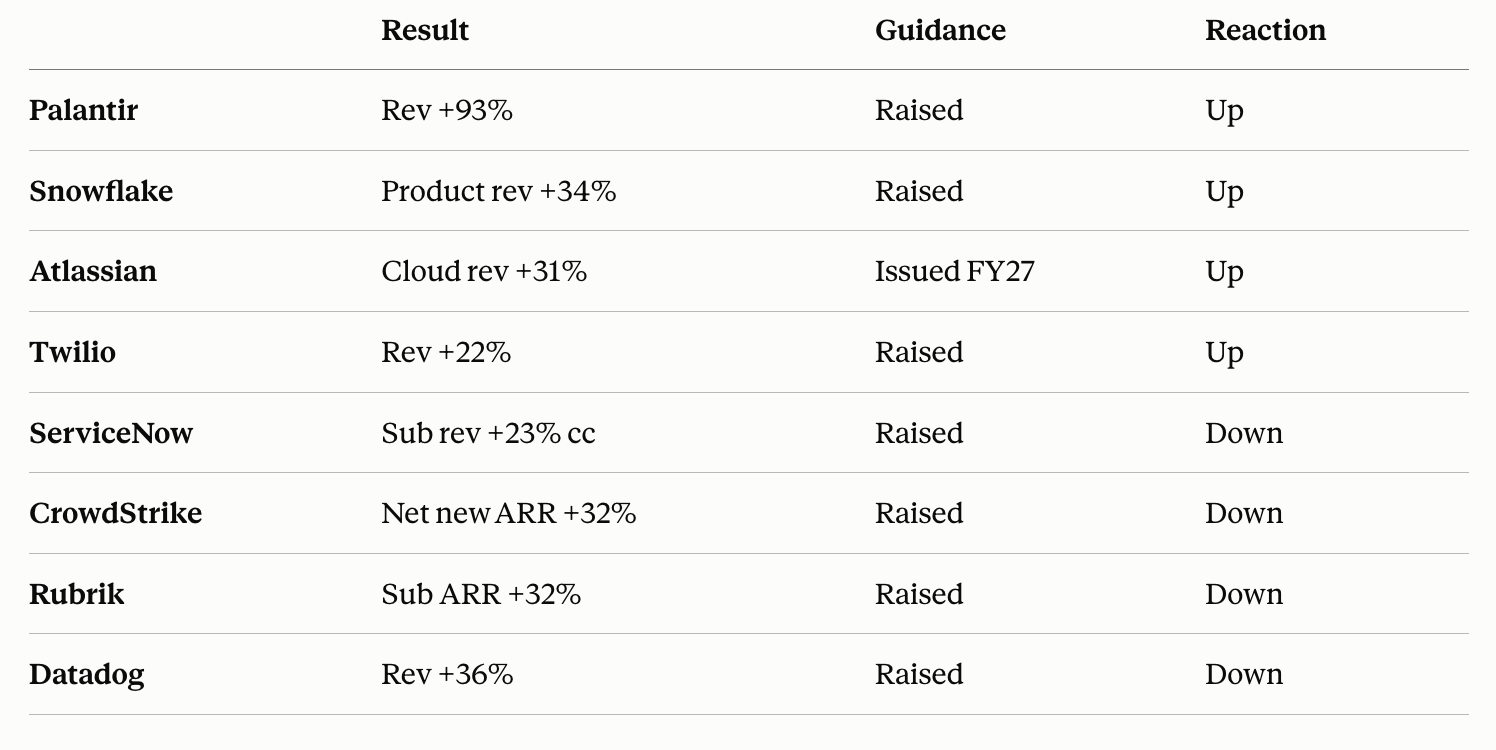
Q2 software earnings are out. Between 27 May and 6 August, eight of the companies I follow most closely reported. All eight beat on revenue and earnings. Seven raised full-year guidance, and the eighth issued a new one at its fiscal year end. Four of the stocks rose between 12% and 36%. Four fell, one of them by 19% in a single session.
In May I wrote that the Q1 2026 numbers had answered the February panic. The argument was that AI was landing inside the high-quality software stack rather than routing around it, that the marginal AI dollar was showing up as ARR at the companies with the deepest deployment surface, and that Software-mageddon had been a narrative repricing rather than a diagnosis. Article below in case you missed it.
In this article, I unpack the eight Q2 earnings reports, dissecting key trends, takeaways and learnings. Three of them put a hard number on AI monetisation: ServiceNow crossed $1 billion in AI ACV, Atlassian disclosed Rovo users growing ARR at twice the rate of non-adopters, Datadog reported over 750 AI customers. Two of those three were sold. The market sorted the eight into two piles of four, with roughly fifty points of dispersion between the best and worst outcome inside a ten-week window.
The variable that separated them is what each company charges for. The winners bill for work done. The losers bill for a person doing it, and outside this group of eight that distinction has cost Accenture roughly half its market value in twelve months. I want to work through how that split shows up in the numbers, what it does to margins on the way through, and what it changes about how I underwrite a software business.
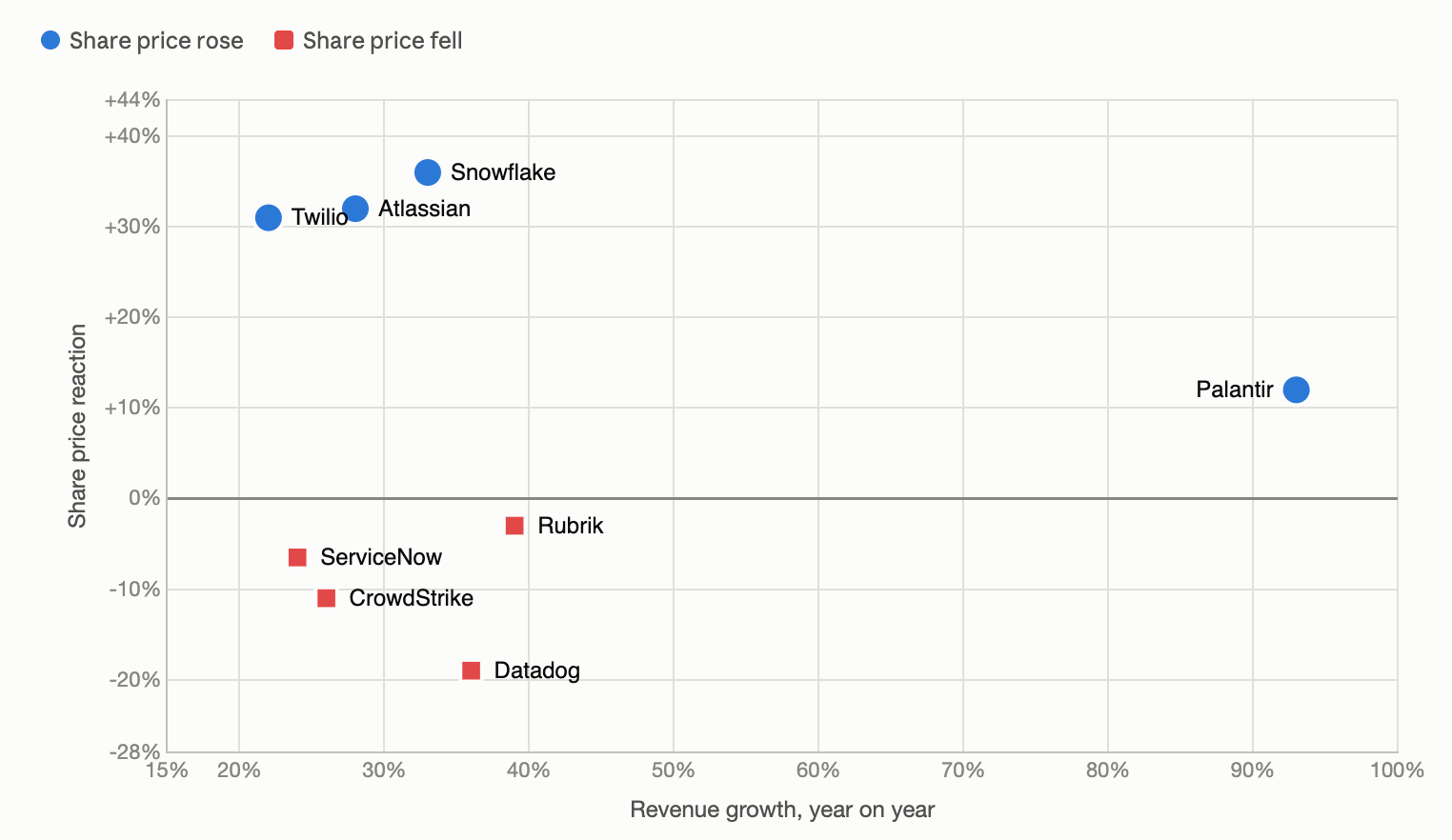
Eight companies, three fiscal calendars, ten weeks. Growth, guidance direction, share price reaction.
Palantir grew US commercial revenue 149% while running a 62% adjusted operating margin, and raised full-year guidance to $8.15 billion, an 82% growth rate and the largest raise in the company’s history. A sceptic will say the margin owes more to government contract structure than to software leverage, and the government book did grow 90%. The commercial line is the harder number to counter.
Snowflake’s product revenue reaccelerated to 34% from 30% against a hard comparison, with remaining performance obligations up 38% to $9.21 billion. Consumption is difficult to manufacture inside a single quarter, because the number is generated by workloads that were actually executed rather than contracts that were signed. Impressive quarter with strong directional signals.
Atlassian closed FY2026 with cloud revenue of $1.2 billion accelerating to 31% and RPO up 44% to $4.8 billion. It then guided FY2027 to 13% total revenue growth, down from 26% delivered, and absorbed a 300 basis point margin hit from moving employee compensation out of equity and into cash. The stock rose 32%.
Twilio’s voice channel has now accelerated for seven consecutive quarters, with dollar-based net expansion at 116%, and full-year reported growth guidance moved from 14-15% to 18-18.5%. The stock closed at an all-time high. One of the best examples of a software company naturally well positioned to benefit from the AI trend.
ServiceNow reaccelerated subscription revenue to 23% in constant currency from 19%, beat its own margin guidance by three points, and put a dollar figure on AI revenue: $1 billion of AI ACV, with net new AI ACV up more than 40% sequentially and agentic deployments up ninefold in nine months. Almost nobody else in the group quantified AI that precisely. The stock fell 6.5% and stayed roughly 37% below its 52-week high. Note, AI ACV being coined as a new metric, and logic would tell me we’re in store for a lot more self manufactured metrics in the quarters ahead!
CrowdStrike delivered record net new ARR of $256 million, up 32%, record free cash flow of $468 million, and raised full-year net new ARR growth guidance by 520 basis points into an outright acceleration over the prior year. It announced a four-for-one split in the same release. The stock fell.
Rubrik reached $1.57 billion of subscription ARR, up 32%, expanded subscription ARR contribution margin from 8% to 13.2%, more than doubled free cash flow to $74 million, and raised the full year across revenue, ARR and EPS. It beat every guided metric. The stock fell.
Datadog grew revenue 36% above the top of its own guidance, added customers over $100,000 ARR at 23% to around 4,720, and generated $279 million of free cash flow at a 25% margin. The non-AI cohort, the part of the book February said would be cannibalised first, accelerated to the high 20s from the mid 20s. The stock closed down 19.03%. It had roughly doubled year to date going in.
Growth did not sort these. Datadog grew faster than Snowflake and Atlassian and was the only one of the three to fall. Profitability did not sort them either, since CrowdStrike and Rubrik both printed record cash flow and were sold while Atlassian guided its margin down and was bought. Nor did AI disclosure, because the company that quantified AI revenue most precisely lost ground on the day. And guidance direction cannot explain a spread running from up 36% to down 19% when seven of the eight raised.
What separates them is what they charge for, and what was already in the price.
Neither variable appears anywhere in the piece I wrote in May. That argued AI was landing inside the software stack rather than routing around it, and the eight prints above confirm it. Datadog’s non-AI cohort, the part February said would be cannibalised first, accelerated to the high 20s. What the argument could not do is explain why four of those eight fell. It was a framework for judging businesses, applied to a question about prices, and Datadog delivered everything it predicted while losing a fifth of its value in a session.
What a company charges for runs well beyond these eight, and it is why Accenture is down about 45% this year while Twilio trades at a record. What was already in the price is a valuation question, and section four of this article comes back to it.
Accenture reported on 18 June. Revenue of $18.72 billion, up 6% in dollars and 3% in local currency respectively. Consulting revenue up 1%. Total new bookings down about 2%. Managed Services bookings down 15%. Full-year revenue growth guidance cut to 3-4% from 5%. The stock fell around 17% intraday, the worst single day in the company’s history, taking it back to roughly 2017 price levels and roughly halving it over twelve months. It sits down about 45% for the year, alongside Cognizant, which was removed from the Nasdaq-100.
Twilio’s voice revenue and Accenture’s Managed Services bookings are the same dollar.
The enterprise function underneath both is customer operations: contact centres, service desks, the managed back office. Twilio’s voice minutes are growing because the human at the far end of the call is being taken out. Accenture’s bookings are falling for the same reason. One company bills for the workload and one bills for the person doing it, and the transfer between them lands as revenue in one income statement and a bookings decline in the other, in the same quarter.
One company bills for the workload and one bills for the person doing it.
The arithmetic in IT services has one lever. Revenue = headcount x utilisation x bill rate. A productivity gain the client can measure is a price cut you have to absorb, and there is no product line where the saved cost returns as margin. The corroboration is on the record from operators rather than analysts. A Microsoft executive said publicly that Accenture does not need 750,000 employees and TCS does not need 600,000. Arvind Krishna has conceded that roughly 30% of IBM’s back-office headcount will not be needed within a few years.
Take a mid-size financial services firm running 500 outsourced service agents. These are my numbers rather than either company’s, but the shape holds at any scale.
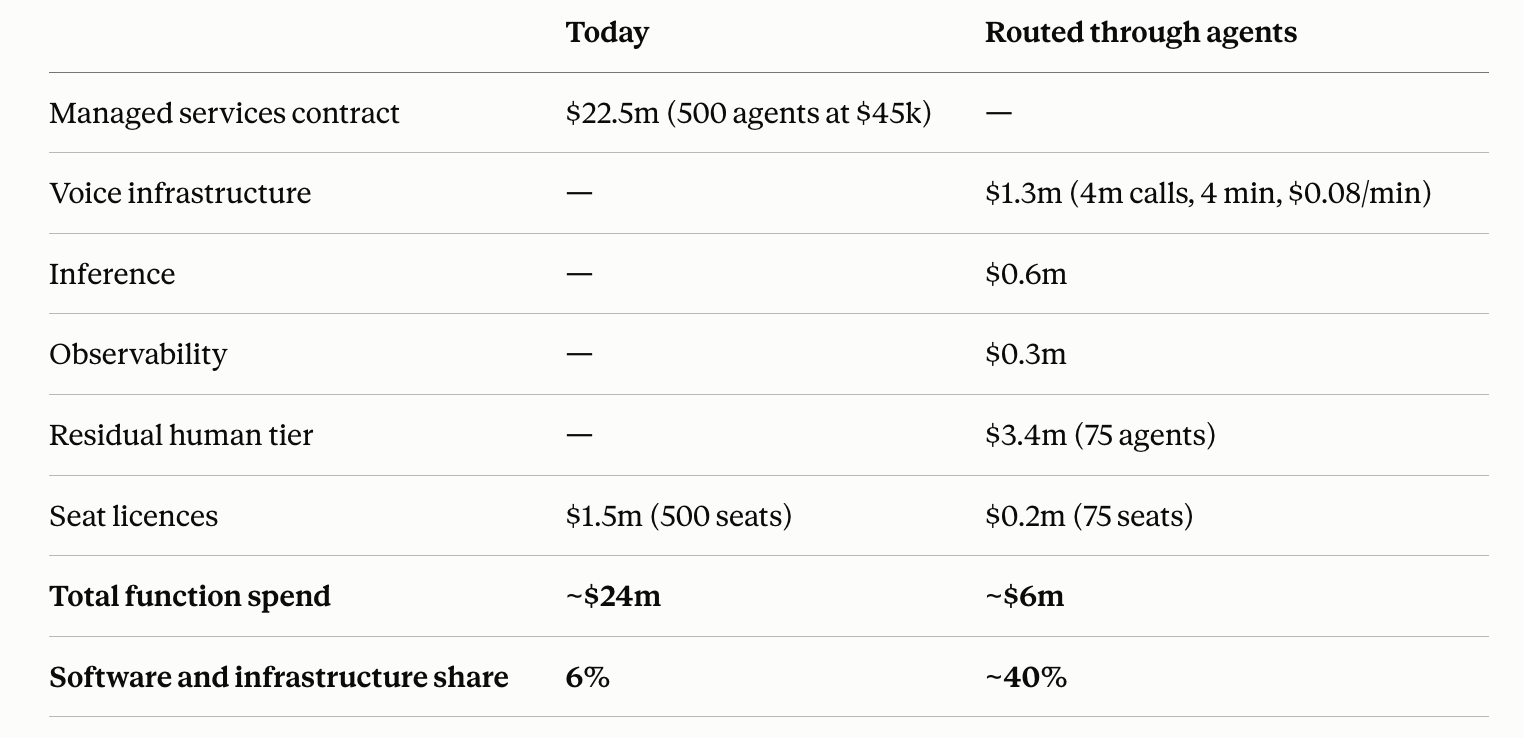
Enterprise spend on the function falls by roughly 75%. Headcount falls by 85%. And the share of what remains flowing to software and infrastructure goes from 6% to something near 40%. The integrator’s revenue in this function does not compress, it largely disappears, while Twilio grows into the gap, Datadog grows, and the model provider grows. The pool shrinks and the software share of it expands by enough that the vendors metering the workload grow through a contraction in total spend.
AI is not draining the software sector, and it is not lifting all of it either. It is moving the billing unit off the person and onto the workload, and the 2026 dispersion is largely a function of which side of that transfer a company sits on.
The winners in section one all meter a workload. Twilio charges per interaction. Datadog charges per host, span and log volume. Snowflake charges per credit consumed, which is why product revenue reaccelerated to 34% while its customers’ headcount went nowhere. Palantir charges for a deployment. Atlassian began 2026 selling seats and spent the year grafting metered AI credits onto the seat without breaking it, which is why the Teamwork Collection bundle became the primary on-ramp.
The vendor side has moved fast. Subscription plus usage is now the most common commercial model in B2B software at 37%, up from 25% a year earlier. ServiceNow says half its net-new business is no longer sold by seat. Salesforce has put a price on a single agent resolution. Adobe moved to generative credits. Atlassian introduced Flex, which lets large customers commit a fixed budget and move spend between seats, applications and AI usage.
Buyer behaviour has not kept pace. Usage-based pricing is still only 4 to 6% of actual enterprise software spend. Vendors have rebuilt the meter and budgets have not migrated onto it, which means the repricing visible in 2026 is anticipatory. The market is trading the destination rather than the current mix. That gap is where the next two years of dispersion comes from, and it is also why a company can post an excellent quarter under the old billing unit and still lose a fifth of its value in a session.
Which raises the question of what happens to margin once the meter is running.
The most useful question asked on any call this quarter came from a UBS analyst on Atlassian’s, and it was not about revenue. He opened by noting that a number of software stocks had been hit that week on weaker than expected margin performance as their AI usage and AI mix went up.
Q1 was about whether AI takes revenue away. Q2 was about what it costs to deliver.
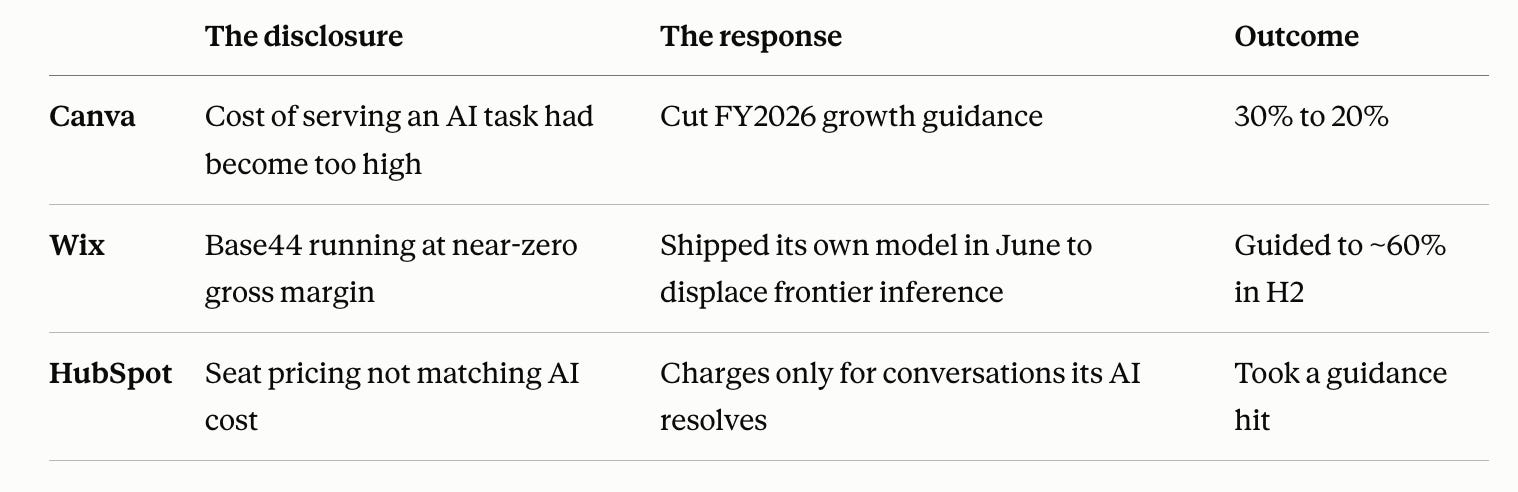
Same physics, three outcomes. One let its AI costs run until they took eight points off its growth rate, one repriced and paid for the transition, one built its own model and took the margin back.
This is not a new pattern. When perpetual-licence vendors moved to hosted delivery in the late 2000s, gross margins fell fifteen to twenty points on the way through, and the market spent years arguing about whether software had structurally worse economics than it used to. It did not. The cost base changed shape and the vendors that reached scale first got the margin back. Inference is the same transition with a harder floor, because the input is bought from a supplier with pricing power rather than from a datacentre you eventually own.
Traditional SaaS carried gross margins in the high 70s to mid 80s because the marginal cost of one more user was close to nothing. Inference scales with usage, and it lands in cost of revenue rather than R&D, which is the line investors use to decide whether a business is software at all. Sell per seat, deliver AI to defend the seat, and you have converted a fixed-cost product into a variable-cost one without changing what you collect.
The incumbents are managing the same pressure with more room. Datadog’s gross margin came in at 79.6%, down from 80.2% the prior quarter and 80.9% a year earlier, while operating margin expanded from 20% to 23%. ServiceNow told investors that hyperscaler consumption is pressuring margin near term.
Atlassian has built rather than absorbed, and put figures on it. The Teamwork Graph delivers a 44% improvement in task efficiency and a 48% reduction in token usage for a given task, MCP calls grew 400% with minimal infrastructure impact, and Rovo-assisted actions grew 50% quarter-on-quarter.
My read is that this is a capability rather than a pricing decision, and it is the durable version of the two. Price defence works until a competitor with better cost to serve undercuts it. Atlassian is guiding FY2027 to a 25% non-GAAP operating margin while absorbing a 300 basis point compensation shift and rising AI volume, which is the specific thing Canva could not do. If inference prices fall as fast as the last two years suggest, the advantage narrows. If they hold, it widens every quarter.
Cost to serve per unit of delivered work is the metric I expect to become standard disclosure within four quarters. Revenue per seat says what a customer pays. Cost per resolved ticket, per generated document, per completed workflow says whether the business survives on product superiority.
Cost explains why margin diverged. It does not explain why four companies with expanding margins were still sold.
Intuit reported fiscal Q3 on 20 May. Revenue of $8.56 billion, up 10%, non-GAAP EPS of $12.80, and a full-year guidance raise to roughly $21.34 billion with EPS lifted about 18% to $23.80-23.85. On the same call it trimmed TurboTax full-year revenue by around $30 million at the midpoint, taking that line’s growth to about 7% from a prior 8-10%, and announced a 17% workforce reduction with a $300-340 million restructuring charge.
The stock fell about 18% that week to a five-year low, and trades in the mid-teens on forward earnings against a historical range of 30 to 40x.
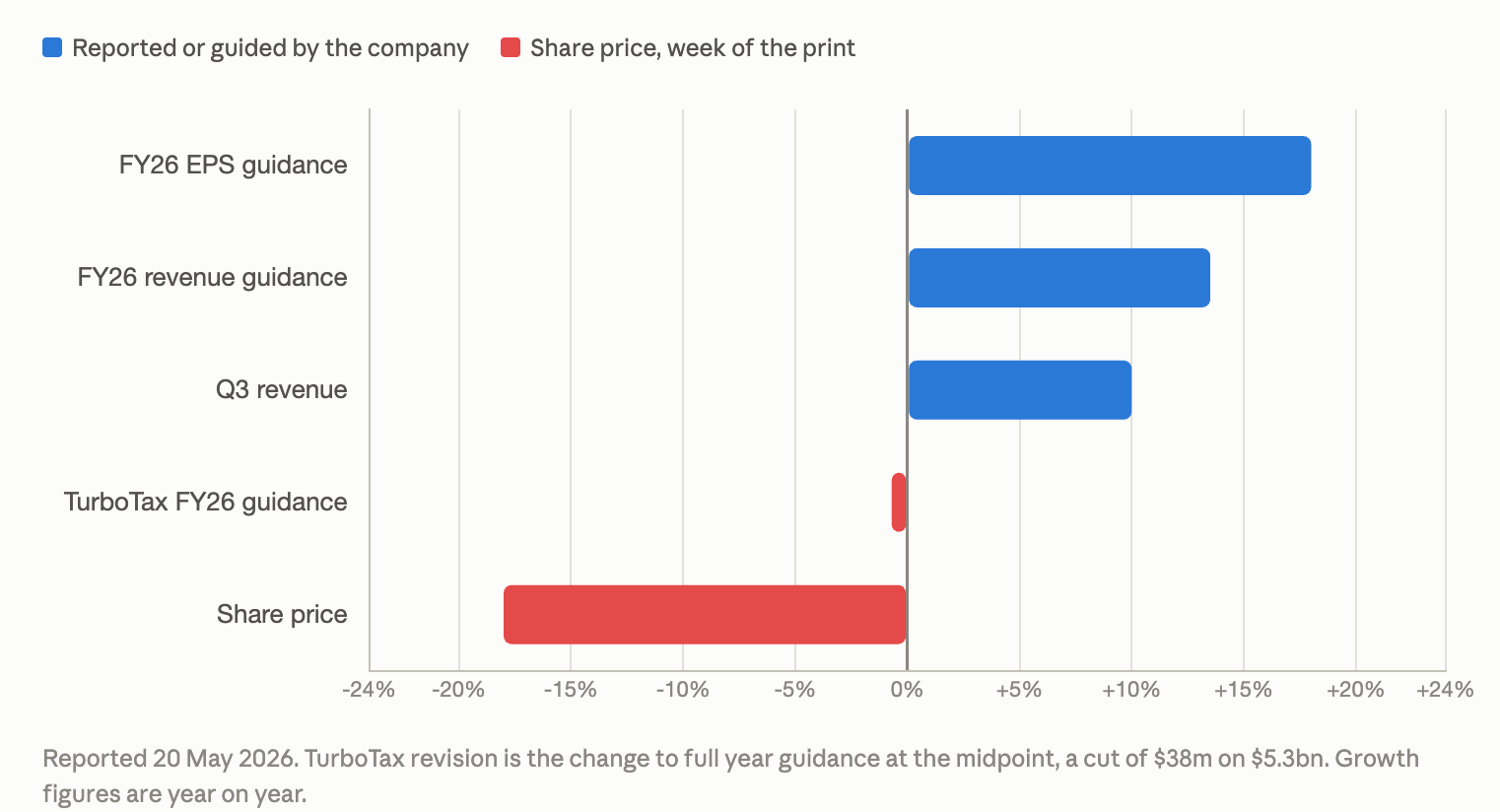
A $30 million trim inside a $21 billion business is a rounding error, and the company raised the year around it. The move was not about fiscal 2026.
Work backwards from the multiple instead. A business compounding EPS at 18% and priced at 16x is being valued as though that compounding has a short life. Hold the multiple flat and Intuit returns roughly 18% a year from earnings growth alone, which is not a price the market sets for a company it believes will keep growing at 18%. The gap between the delivered growth rate and the multiple is the market’s estimate of how many years of that growth remain. On these numbers it is pricing a handful, not a decade.
Gartner is another version of the same judgement, because there the deterioration has already arrived. Global contract value grew under 1% and full-year 2026 revenue guidance was cut below $6.41 billion against $6.5 billion in 2025, a guide to outright decline in a business that compounded for decades. Intuit is being priced for a future Gartner is already reporting.
Goodarzi’s framing on the call was that customers buy confidence, not code. The bear reading is that confidence in an unfamiliar domain is precisely the good a competent model now supplies at close to zero marginal cost, while the workflow, compliance logic and integrations remain hard. TurboTax priced the explanation layer. That layer is the one under pressure.
My view is that this is half right, and that the market has picked the wrong horizon for it. The explanation layer is genuinely commoditising, and anyone modelling TurboTax on the old pricing power will be wrong. But Intuit is not defending it. TurboTax Live is expected to grow about 36% this year to roughly 53% of TurboTax revenue, which moves the company from selling software confidence toward selling human confidence with software attached. The bear case reads that as a retreat into a lower-margin, headcount-priced business. The alternative reading is that assisted filing is where the pricing power was always going to end up, and Intuit is getting there before anyone else.
My instinct is that the multiple is pricing the first reading with almost no weight on the second, and that asymmetry is more interesting than the direction of travel. What would settle it is the unit economics of TurboTax Live, specifically the cost per assisted return and whether it falls as models improve. Intuit does not disclose that number. Until it does, the argument cannot be resolved from outside, and a market that cannot resolve an argument defaults to the pessimistic branch. That is a disclosure failure rather than a mispricing.
The two arguments in this piece run in opposite directions and both hold. AI lands as revenue in businesses that charge for work done, which the eight prints in section one demonstrate in detail. AI is marked as a terminal-value problem in businesses whose price depended on a task a model now performs, which is what a mid-teens multiple on 18% EPS growth tells you.
The second effect is currently doing more to set share prices than the first, including inside the winners. Datadog was not repriced on this year’s growth. It was repriced on one sentence about one customer’s future usage. ServiceNow beat every guided metric and stayed 37% below its high, because nothing in a good quarter answers a question about the next decade.
The four that rose have an easier answer to that question. Snowflake and Twilio both charge for consumption, so their revenue grows with the workload rather than with the customer’s headcount, and neither has a task inside its product that a model performs for free. Palantir sells a deployment. Atlassian holds the record of how the work was done, which is the input every agent needs and the one thing that does not get cheaper. None of that guarantees the next decade, but it does mean there’s more assurity in terminal value vs the structurally weaker companies.
That is a hard environment to invest into and an unusually good one to build into. A public company defending a terminal value cannot easily change what it charges for without taking the guidance hit HubSpot took for repricing to AI-resolved conversations. A private company choosing its pricing model today carries no such constraint. This is counter-positioning in the sense I have written about before, and it is one of the most powerful positions a start-up can occupy right now: adopting a business model the incumbent cannot copy without damaging its existing one.
In my previous article I also covered hyper-scaler capex. Roughly $575 billion committed across three companies, Pichai telling analysts Google was compute constrained, contracted multi-year backlogs at Microsoft and Amazon. I called it the floor of the buildout rather than the ceiling.
The return on that capital has started to arrive, and it is not marginal. In the last week of July all three clouds accelerated at once. Azure grew 43%, up from 40%. AWS grew 37% to a $169 billion run rate, its fastest in eighteen quarters and the sixth consecutive quarter of acceleration, with segment operating margin expanding from 32.9% to 39.4%. Google Cloud grew 82% to $24.8 billion, up from 63% the prior quarter, with operating income tripling and margin moving from 20.7% to 35.6%. Microsoft’s commercial remaining performance obligation rose 84% to $678 billion. Alphabet’s cloud backlog reached $514 billion, over half of it expected as revenue inside 24 months. Alphabet fell about 7% the next day.
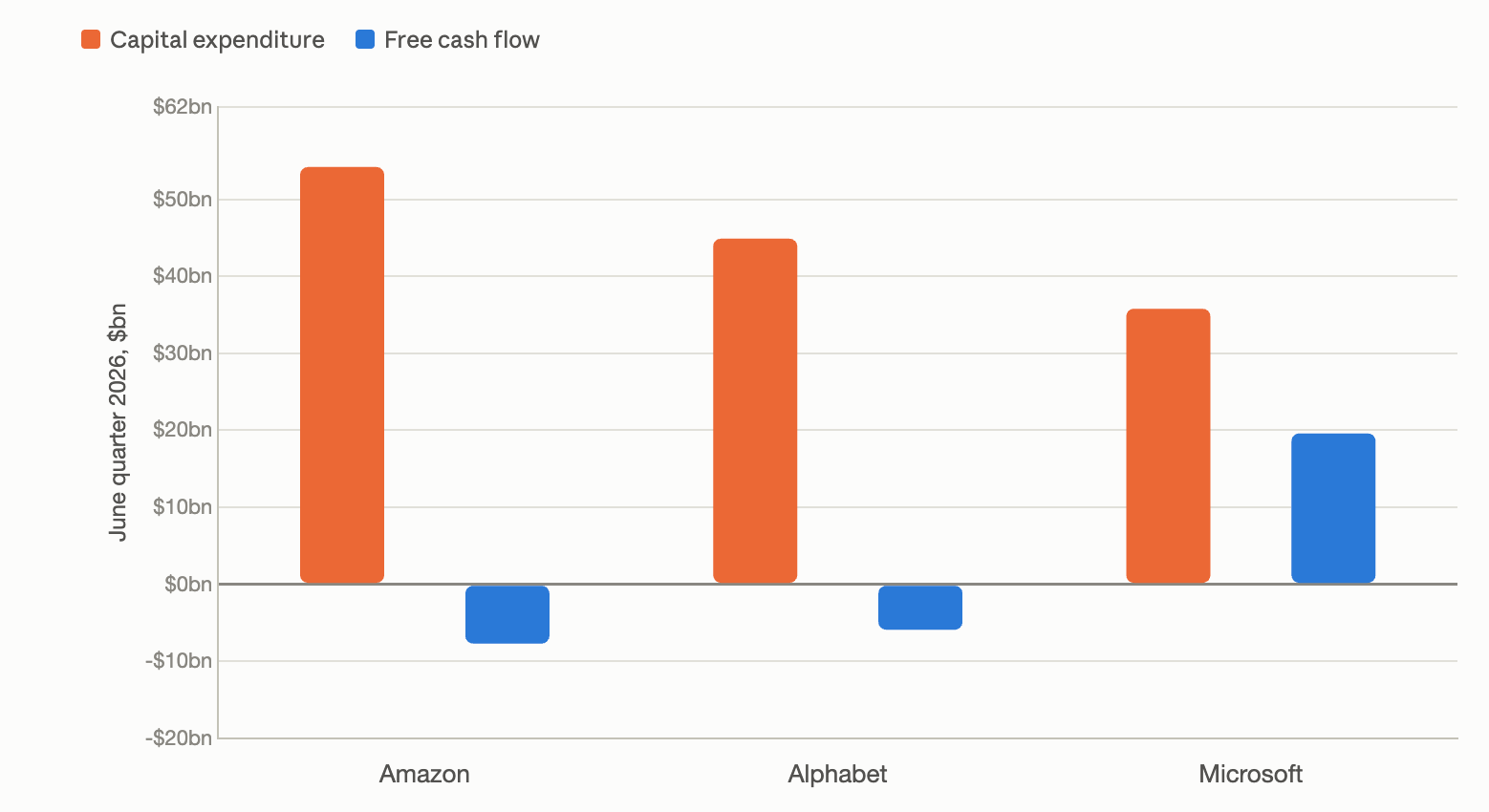
The number that moved is not capex. It is where the money comes from, and the group has split.
Alphabet’s quarterly free cash flow went to negative $5.9 billion, the first time in the company’s history, on capex of $44.9 billion. Buybacks are suspended and long-term debt has roughly doubled. Amazon’s trailing twelve-month free cash flow is negative $7.6 billion, against positive $18.2 billion a year ago, and long-term debt went from $65.6 billion to $128.9 billion in six months. Microsoft, on the same buildout, generated roughly $67 billion of free cash flow and reduced long-term debt.
Capex funded from operating cash is evidence about demand. Capex funded from capital markets is a duration bet, priced against rates and confidence rather than backlog. Two of the three have crossed that line and one has not.
Debt-funded infrastructure buildouts have a poor record. Telecoms borrowed against a demand curve that was directionally right and arrived years late, and the fibre was still there when the balance sheets were not. The demand here is arriving faster than that, and the backlogs are contracted rather than projected. What is not yet tested is what happens to the borrower if inference prices fall while the depreciation schedule does not.
Meta is the tell at the extreme. No cloud business, no external revenue to defray the spend, capex guided to $125-145 billion after two raises, and now looking to sell compute to third parties. A company builds capacity for its own products. It starts selling that capacity when the capital structure needs the asset to pay for itself sooner than the products will.
There is one more thing worth reading carefully. $53.4 billion of Amazon’s $62.6 billion of net income is a non-operating gain, primarily from its Anthropic stake. Alphabet’s GAAP EPS included roughly $99 billion of unrealised gains on SpaceX and Anthropic, while adjusted EPS of $2.85 missed consensus. Microsoft strips OpenAI out of its non-GAAP entirely and took a $3.2 billion Anthropic gain in the quarter. The reported earnings of the companies financing the buildout are being flattered by mark-ups on the private companies consuming it. None of which changes the operating picture. Cloud revenue, segment margins and backlog are all accelerating, and there is no sign in any of the three prints of demand slowing. Remarkable revenue growth for companies of this scale.
Nadella framed the quarter as advancing the frontier on the cost-to-outcome curve, ensuring customers can turn tokens into business results. That is the same variable as section three, named by the largest supplier in the market.
My view is that the financing pressure resolves as pricing pressure on the layer above. The capital is committed and cannot be uncommitted. What can move is the price of compute, inference and managed services charged to the companies building on top, which is the cost line the application layer cannot easily pass through. Alphabet has already flagged Q3 cloud margin pressure from renting third-party capacity as a bridge. ServiceNow has already flagged hyperscaler consumption pressuring its own margin.
Every cost to serve argument in this piece has a supplier with pricing power behind it, and that supplier now carries a depreciation charge that arrives whether the revenue does or not. Amazon’s trailing depreciation is $75.2 billion, up from $58.6 billion a year ago. Revenue is outrunning it comfortably today. AWS expanded operating margin to 39.4% with depreciation already in the cost base, and Google Cloud went from 20.7% to 35.6%. The charge is contracted and rising, and the price of what it produces is falling.
That is the risk I underpriced previously. The buildout does not stop. The return on it gets collected from the application layer rather than from the end customer.
Two things settle it. If inference prices keep falling at the rate of the last two years, volume absorbs the pressure and the application layer never feels it. If they flatten while capex compounds, gross margin becomes the only line in software that matters. I would watch the second more closely, because the capex is contracted and the price is not.
Four things have run through this piece: what a company charges for, what that costs to deliver, how much of the revenue can be turned down, and what happens when the models improve. They are the questions I now ask of any software business at any stage.
What is the unit being charged for. Accenture charges for a person, and this year that cost it Managed Services bookings down 15%, a guidance cut, and the worst single day in the company’s history. This is a pricing architecture question, it is answerable on a first call, and it is close to unfixable by Series B. I ask what the invoice counts before I ask what the product does. If the answer is seats, the follow-up is what happens to the customer’s headcount in that function over three years, and the founder should already have run that number.
What does it cost to deliver one unit of it. Canva cut full-year growth guidance from 30% to 20% because the cost of serving an AI task got away from it. Wix took Base44 from near-zero gross margin to a guided 60% by shipping its own model. Same problem, six months apart, opposite outcomes, and the difference was that one company tracked AI cost as a line with its own drivers while the other found it inside COGS after it had moved guidance. Ask for cost per resolved ticket, per generated document, per completed workflow. A founder who cannot produce it has a control gap rather than a modelling gap, and the number only gets harder to retrofit as volume grows.
How much of the revenue can be reduced without anyone cancelling. Datadog has over $4 billion of ARR and lost a fifth of its value on one sentence about one account renewing and cutting usage. AI-native logos are the fastest revenue available and the lowest quality: few counterparties, consumption-priced so they shrink without a churn event, and under their own pressure to cut inference spend. That revenue deserves a discount - it’s more likely to be transitory revenue, especially for companies with low switching costs.
What breaks when the models get materially better. What breaks is the company whose product is the model’s output. What survives is the company whose product is everything around it: the deployment, the context, the controls, the record of how the work was done. Palantir grew US commercial revenue 149% at a 62% adjusted operating margin, which is public evidence that delivery-heavy can still be software rather than consultancy. Amazon put $1 billion into AWS Forward Deployed Engineering this quarter, embedding engineers directly with customers. When the largest infrastructure provider in the world buys the delivery layer instead of assuming the platform is sufficient, that is a read on where the defensible work sits, and it is the argument I made about the control layer (harness) and models being the commodity.
The first question was whether AI destroys software. The second was whether AI shows up in revenue. Both are settled, and settling them explained almost nothing about the eight prints in section one. All eight beat. Seven raised. Four rose and four fell, and no operating metric in any of those releases separates the two groups. What separates them is whether the company charges for people or for work done, what that work costs to deliver, how much of the revenue can be reduced without anyone cancelling, and how much of the next decade the share price already accounted for.
The vendors have moved fast. Subscription plus usage is now the most common commercial model in B2B software at 37%, up from 25% a year ago, and ServiceNow says half its net-new business is no longer sold by seat. Buyers have barely started. Usage-based pricing remains 4 to 6% of enterprise software spend. The market is pricing a destination procurement has not yet left for, which is why an excellent quarter under the old pricing model can still cost a company a fifth of its value in a session.
Underneath it, roughly $725 billion of capex is being committed this year against clouds growing 37%, 43% and 82%, funded increasingly from capital markets rather than from operating cash flow. The revenue is arriving. Whether it arrives fast enough, and whether the margin on it survives, comes down to who can raise prices on whom. That is the argument worth having about software from here.
I will continue tracking quarterly software earnings closely as a proxy to developing my wider mental model as to how AI unfolds and where durable value sits. I hope the analysis and takeaways are useful.
No posts
Comments
Nothing yet. Say the first thing.
Sign in to join the conversation.