
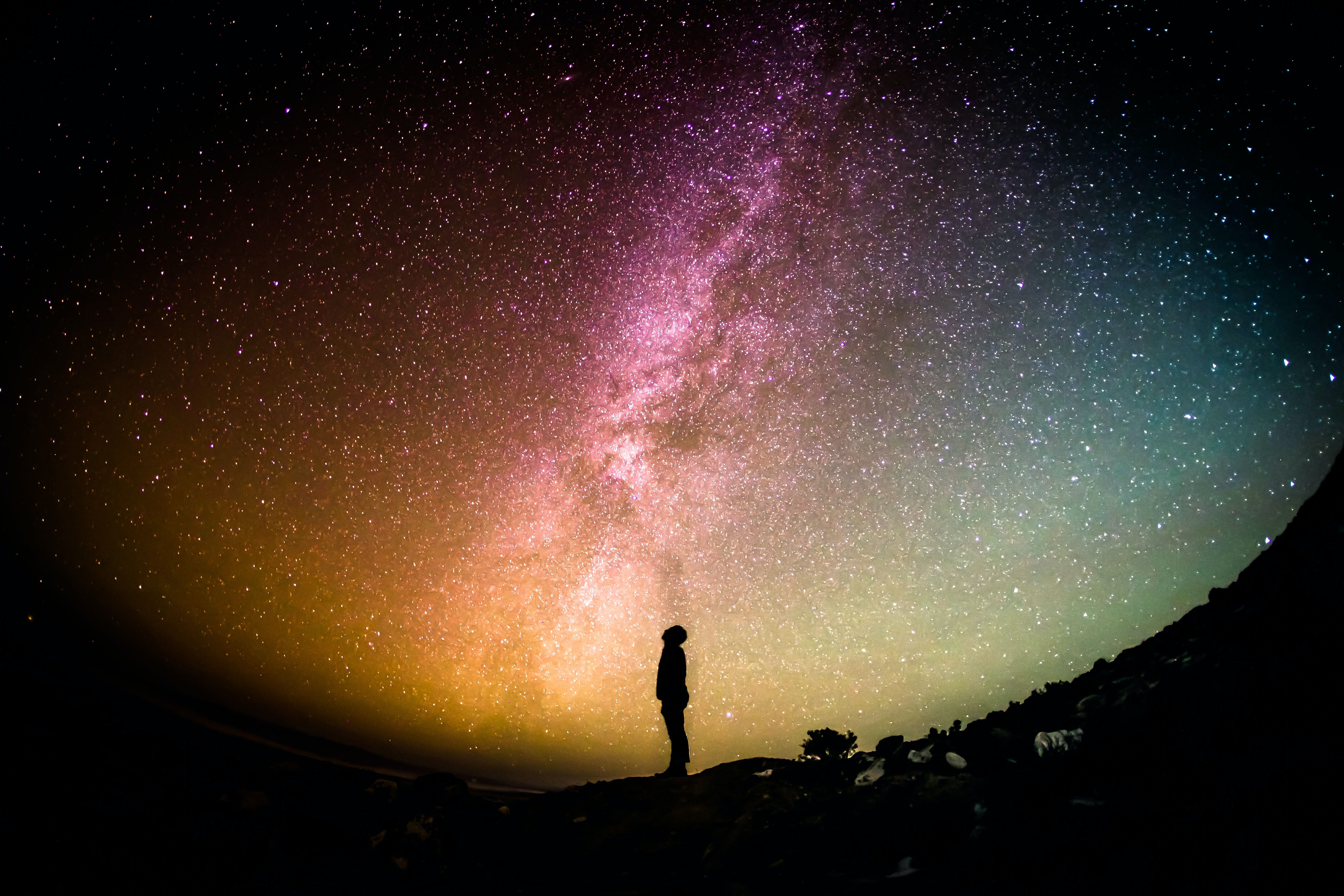
“Things can only get better!” That was the story I was told growing up as a young boy in Glasgow, Scotland.
It was also the anthem of the Labour Party’s general election campaign of 1997. A feel-good pop hit by the band D:REAM exuding an optimism characteristic of the time. I was 11 years old, but I can still remember the sense of naive jubilation as Tony Blair’s New Labour arrived promising a brighter future. “I love Tony” my aunties used to say.

This optimism wasn’t just due to a change in government in the UK, of course. Cultural and civilizational confidence were part of the story of life. As the song proclaimed, things were getting better! Poverty was falling around the world, democracy was spreading, quality and length of life were increasing. Yes there were problems, but we humans were ingenious, we’d solve them. Look at the hole in the ozone layer - it was beginning to heal. And for those marginalised groups that weren’t experiencing the benefits? Don’t worry, just be patient, they’ll eventually reap the rewards of this progress too. In fact, it was our moral duty - so the story went - to make sure the achievements of the West spread across the world, so everyone could benefit.
Today, as poll after poll demonstrates (see “economic pessimism”, “Americans take a dim view of the future”, “Almost half of young people in England feel there are now fewer opportunities” and “75% of adults in UK worry about climate change”), many of us are not so upbeat about the coming decades. Whether it’s the threat of exponential AI, increasingly extreme weather events resulting from climate change, the deterioration of democracy, ever-increasing wealth inequality, the cost of living, the tragic loss of biodiversity, the destruction of ecosystems, or the psycho-spiritual crisis of meaninglessness, addiction, loneliness, and depression, the reasons for gloom are numerous. If the Labour Party used a song like “Things Can Only Get Better” now, it would seem like cruel satire. Instead, in 2023 Labour speaks of “tough choices” which, to me at least, sounds like a euphemism for “we’re stuffed, and we’ve no idea what to do”. By contrast, the song that’s captured the social, economic and political mood of the moment is Anthony Oliver’s Rich Men North of Richmond, decrying the powerlessness of the majority and the corruption of the elite.

Socrates believed the most important question one could ask, is “How do I live well?” As the story of civilizational progress has begun to falter, the conventional answers to this question don’t work as well as they used to. What’s more, there’s an increasing need for us to reckon with this question, not just as individuals, but together as a global society. What I am sharing here is my own story - my (often misguided) attempts to answer the question, “how do I live well?” I share it to better make sense of my own journey and what follows from it. But it’s also a thread in a larger weave. The story of the world and each of the stories of our lives are intimately entangled. Maybe you’ll feel resonance or see parallels to your own experience. Ultimately, of course, it may be a time for new stories altogether, or as Ben Okri titled one of his books, “A time for new dreams”.
At a young age I was obsessed with two things: football and soul music. Listening to the likes of Etta James, Otis Redding, and Little Richard would send me into fits of ecstasy. I can still remember listening to Smokey Robinson’s Going To A Go-Go and feeling chills at the climax of the chorus when the piano dances over the thumping unison of the bass, drums and horns, and Smokey screams “Yeaaahhh… one more tiiiime”. As an adult I would learn this kind of music was evocative of sex, but at the time I just knew it felt good.
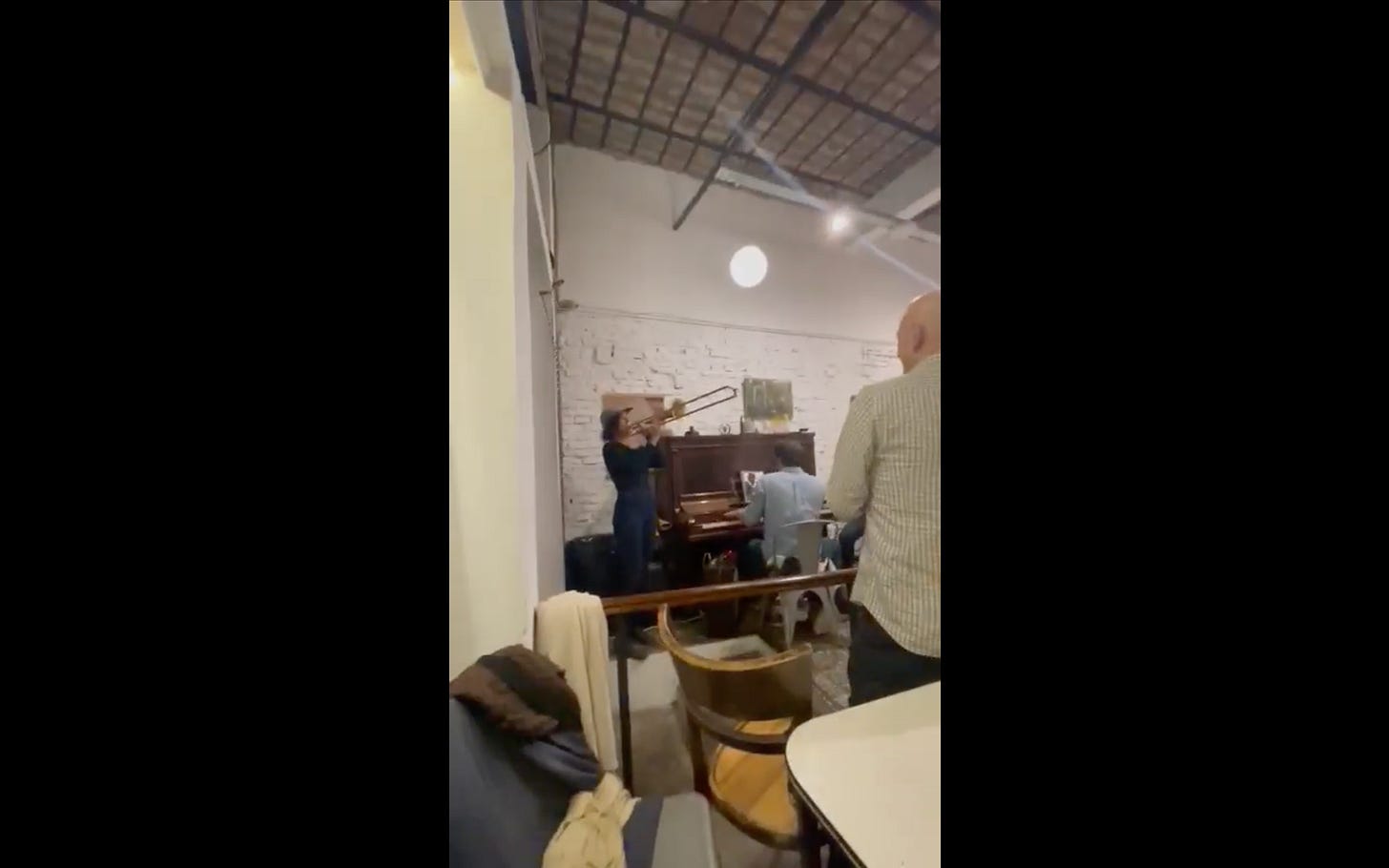
I started showing an interest in playing the piano and so at the age of 6 my Dad taught me what he called the blues scale - I later learned everyone else calls it the minor pentatonic. It was probably about the same time that I started playing football and realising that the team I was to support was Celtic - because all my family supported them, and all my friends in school as well. I ended up becoming quite good at the piano, and in my 20s played semi-professionally to support myself while I started a charity (see below a clip of an impromptu jam in Buenos Aires earlier this year). Sadly, the same cannot be said of my footballing abilities.
As I grew older, my interest in the world managed to expand beyond music and Glasgow’s sporting tribalism. With an appetite for big ideas, and a desire to lend my hand to the long arc of historical progress, I decided to study International Relations at the University of St. Andrews. As it happened, the first book I read was Francis Fukayama’s The End of History and the Last Man. Published in 1992, in the aftermath of the Cold War, it’s the emblematic affirmation of confidence in the achievements of the West, declaring democracy and free markets the ideological endpoint of humankind.
During my time at St. Andrew’s I took a particular interest in Africa’s political and economic history. I thought I might pursue a career in international development, but the more I learned about Africa’s history - from colonialism, through to the arrival of the IMF and World Bank’s structural adjustment programmes, and then the wave of NGOs distorting the relationship of political accountability between the people and their governments - the more I came to the view that another “well-intentioned” European wasn’t what was needed. I also became disillusioned with the wider field of International Relations. At its root it operated on an extremely simple model of reality: human-beings were selfish, rational and motivated by power. There was no interest in the depth or complexity of the interior world. This - along with the existential crisis of a young broken heart - drove me to become interested in psychology and spirituality, particularly Buddhism and the humanistic psychologists of the mid-20th Century like Carl Rogers, Abraham Maslow and Erich Fromm.
I would eventually go on to spend a year on retreat practising in various meditation centres in India and Nepal, before arriving at Thich Nhat Hanh’s Zen centre in France, Plum Village. Although I was only able to stay at Plum Village for a month, it had a profound impact on me. I felt like I had travelled 400 years into the future - to a time where human beings had finally learned to live in harmony with each other and the planet. The monks and nuns at Plum Village were more at ease than anyone I had ever come across. Their practice was simple but profound: to be deeply present, deeply embodied, in every moment - while walking, while eating, while doing the dishes. And through this way of attending, this deep connection to life, joy became a living reality.
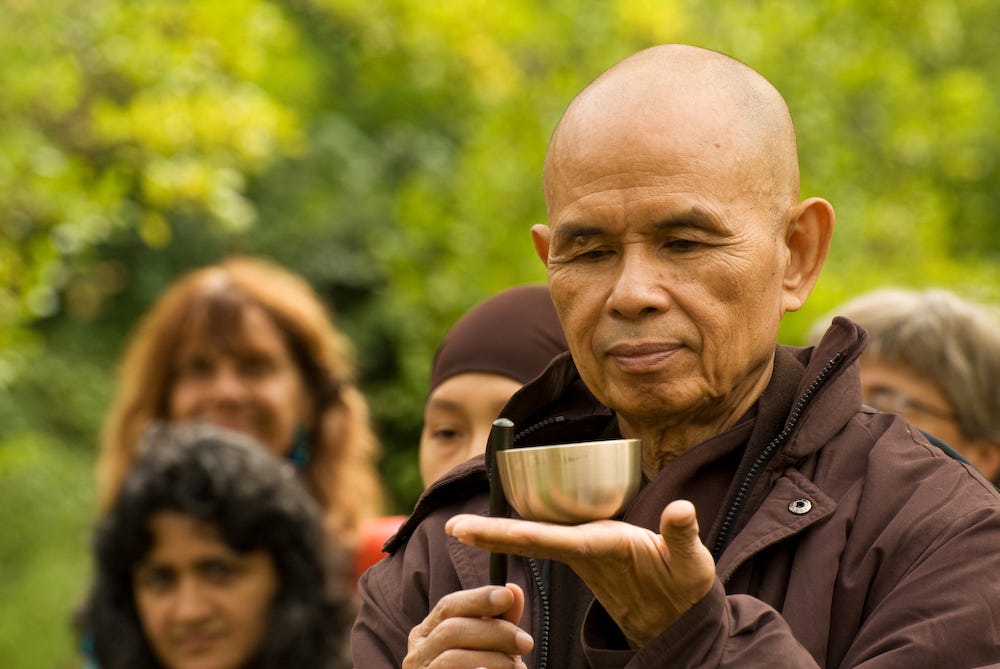
You could say I fell in love with Plum Village and, as is always the case when we fall in love, my perceptions were rose-tinted. I’ve since seen that Plum Village has its flaws like every human being and every human endeavour, but this has not diminished by appreciation for the place. If anything it deepens my respect for the resilience of the community.
Buoyed by this experience, and passionate to share the benefits of mindfulness with the world, I studied for a Masters in Positive Psychology at the University of Pennsylvania. By that time - 2010 - the world was becoming increasingly excited about “wellbeing” and the new “science of happiness”. Many studies were showing that past a certain point, increased wealth (whether at the personal or national level) didn’t lead to commensurate gains in human happiness. What we needed was a shift from a focus on GDP (gross domestic product) to GNH (gross national happiness). The story of the West’s progress was still alive and well, it just needed a tweak.
When I returned to Scotland, I started a charity called Youth Mindfulness with the intention of developing mindfulness-based wellbeing programmes for children, teenagers and at-risk youth. In the last 12 years I’ve worked with 1,000s of young people in schools, prisons and community contexts, and trained 1,000s of educators to deliver the programmes we’ve developed in more than 50 countries around the world. We estimate that hundreds of thousands of young people have learned mindfulness through our programmes. I’m proud of the work and I’ve seen first-hand the transformative potential of opening young people’s hearts and minds to their positive inner qualities - to enable them to become familiar with, and cultivate their capacities for, compassion, kindness, awareness, gratitude and joy. At one level, the purpose of our programmes is to enhance young peoples’ wellbeing, but at a deeper level, it’s about enabling a transformed relationship with oneself and reality - a falling in love with life itself.

In 2010 I was passionate about enhancing wellbeing, but today I have a more complex relationship with the concept. On first glance it appears that “wellbeing” is evidently a good thing, and has resultantly become a fixture of public discourse - e.g. the “wellbeing economy”, but I have serious misgivings about making it the summum bonum of society. Every ancient wisdom tradition advises that placing the self at the centre of one’s preoccupations is antithetical to what we are called to as human beings. Indeed, the good life is often marked by forgetting the self - letting go of concern for one’s own wellbeing, as one devotes oneself in service to that which is other: the Divine, the Tao, the Great Spirit, Life itself. Placing wellbeing at the top of our value pyramid risks a collective narcissism, no matter how complexified and nuanced we make the term. It makes our human experience of ultimate importance, privileging us with a special status in the grand order of things. As such, it’s a continuation of the cultural code - “the ascent of man” - we’ve been running for thousands of years, and it may be that this view of separation from the rest of the cosmos is one of the deepest roots of our current malaise.
You might ask the question, what value or values should we orient to as a society if not wellbeing? A full answer is beyond the scope of this post, but suffice to say, truth, goodness, beauty and the sacredness of life would be a good start. This does not negate the functional importance of wellbeing to the realisation of truth, goodness, and beauty - in fact I believe it’s very important - but it’s to put it in its proper place: in service of something more fundamental, something ineffable.
The dominance of the term wellbeing, is just one example of how the transformative potential of mindfulness is limited by the West’s collective spiritual and civilisational confusion. I’ve also seen how the deep stories we tell about the nature of reality and the nature of human beings - i.e. reductionist materialism - and all the trappings of the worldview that says humanity is adrift in a dead, mechanistic and meaningless universe - disenchants reality and leaves young people nihilistic and lost. I’ve seen how the logic of late capitalism infiltrates almost every aspect of educational life so that young people ultimately become numbers in a spreadsheet and time is treated as a finite resource to be used as efficiently as possible, leaving little space for human relationships, healing, or spontaneous creativity and play. I’ve seen how young people are less and less convinced of the mythos that they’re being asked to live - that the way to succeed is to make as much money as possible in the very same economy that is destroying the planet. And I’ve seen how mindfulness - a practice that can enable a sacred relationship to reality - has been watered down to be a sticking plaster for young people’s mental health problems and a means of shoring up a sclerotic education system. Let me be clear, I still deeply believe in the value of mindfulness within education. It’s just that now I see it as necessary but not sufficient to bring about the changes we need.
While my experience over the last 12 years is particular to the field of education, the larger point I’m seeking to make is about how our collective relationship to reality is askew, and that this expresses itself in different ways in different contexts, undermining localised efforts to realise positive change. The deep operating system of our civilization is proving itself inadequate to bring about a flourishing humanity in harmony with a flourishing planet and is therefore in need of radical transformation.
Indeed, the many crises we now face - the mental health crisis, the climate crisis, the meaning crisis, the obesity crisis, the economic crisis, the political crisis - may in fact have a common source, and be aptly named the metacrisis. Jonathan Rowson in his recent essay Pre-fixing the World argues as follows:
The metacrisis is the crisis within and between all the world’s major crises, a root cause that is at once singular and plural, a multi-faceted delusion arising from the spiritual and material exhaustion of modernity that permeates the world’s interrelated challenges and manifests institutionally and culturally to the detriment of life on earth.
If modernity is indeed spiritually and materially exhausted, then the world we’ve known, and the deep stories we’ve been living in, are dying, bringing with it feelings of loss, grief, denial, anger, bewilderment, confusion and of course pessimism. John Vervaeke’s concept of the “agent-arena relationship” is helpful in making sense of why this “time between worlds”, is so challenging and disorientating.
The agent-arena relationship is what organises our cognition and gives meaning to our actions and behaviour. To use the sporting example Vervaeke uses in his lecture series, the football player is the agent and the arena is the football field. The arena of the football field affords the opportunity for the football player to enact their agency as a football player. They have a clear goal to achieve, there are clear rules that both constrain and enable action, and there is a mythos that motivates the football player - to become the winner, the champion. If the football player finds themself on a tennis court, they can’t be a football player. The whole thing becomes absurd. As such, there is an important coupling between the agent and the arena, and this frames the meaning-making of the football player. As Vervaeke states, “If you do not have the agent/arena relationship, then none of your particular actions have meaning.” To return to this historical moment, how do we find agency - what are we to do - when the contours of the arena are dissolving, when the world as we’ve known it is unravelling?
This is the question I find myself asking today and it’s led me to another avenue of exploration - to turn attention to the arena itself, to explore what a reconfigured understanding of reality and our relationship to it might look like. Zak Stein articulates beautifully the spirit of this exploration in an essay for Perspectiva called Education must make History Again:
During times between worlds there emerge certain ideas and thinkers that are, properly speaking, without a world. Their work is about creating a new world, by necessity. Let us call their workspace the liminal. Not within the old world or the world to come, the liminal is exactly that which is the bridge and fulcrum between worlds. The focus of work in the liminal is on foundations, metaphysics, religion, and the deeper codes and sources of culture.
In recent years I have found myself wondering what are the foundations, the deep stories about the nature of reality and the nature of ourselves that we need to realise? What do we need to change at the deep levels of our collective consciousness and culture that can enable a transformed relationship to life? And how do we make such changes?
What seems important at the moment is not grasping after final answers, but instead adopting a radical openness, to be willing to let go of the known and the conventional, and open to what might be ready to emerge. I believe intimations of a new worldview are beginning to take shape - one that restores a sacred view of life. There are many brush strokes in this new picture, and it is not yet possible to see the whole that is yet to come into view, but some aspects include the fundamental relationality of reality - that everything (from the level of quantum particles, up to biological systems, to human beings, and the Earth as a whole) arises in and is sustained through relationship; that intelligence may permeate many more levels of the universe than previously thought; and that value - truth, goodness, and beauty - may be a deep part of the fabric of existence.
To discover such a new worldview will likely require honouring multiple ways of knowing. For instance, we are told that the universe is just dead matter, mechanistic and ultimately meaningless. But how do we know this? What if this isn’t true? What if every living thing, plant, insect, soil, has some quality of interiority, some quality of subjective experience. What if the things that you feel matter, do actually matter? What if singing, dancing, the making real of beauty in the present moment is actually deeply important - not just to you, but to the wider cosmos? What if we stopped denying the knowing that comes from the heart and the body - our aesthetic and moral sensibilities - and started honouring them as the deepest form of wisdom?
The next few decades will likely be profoundly challenging, and how we dispose ourselves to what is unfolding, will be of utmost importance. To deny what is happening, or believe that we’ll simply find some technological fix to resolve the metacrisis is to not fully reckon with what is unfolding. Zak Stein and others, call this naive sensibility pre-tragic. It’s exemplified in the song I mentioned earlier “Things Can Only Get Better”. Another possibility is to lose ourselves in despair and depression. This is the tragic sensibility. Arguably there is greater value in this, because at least we are then in touch with the truth of the pain of our time, but the danger here is that we drown in it and it narrows our perception so that all we see is darkness. There are shades of this sensibility in Oliver Anthony’s Rich Men North of Richmond, although the beauty and power of that song, as well as Anthony’s performance, means it also shares elements of the next sensibility - the one we need today - the post-tragic. To be of a post-tragic sensibility is to honour the pain and suffering that is unfolding, but not be bound by it, and instead allow it to bring a transformation to our relationship to reality. Thich Nhat Hanh often used the image of the mud and the lotus to explain how we can make good use of our suffering to produce love, compassion and happiness. He was fond of saying that a lotus can not grow on marble. So as a musician, the question arises for me, what song reflects this sensibility?
I’m tempted to provide an entire playlist, but that wouldn’t be fair to you the reader, so while there are many contenders, my choice is Aretha Franklin’s version of “Bridge Over Troubled Water”. There’s many lines in the song, written by Simon and Garfunkel, that find resonance in this time - not least the title. But the musical journey of the song is what touches me most. The opening minute and a half consists of a gentle soulful interplay between the electric piano and organ which is both warm and humanising. Next comes Aretha’s soaring vocals evoking pain, grief and compassion supported by the sensitive and powerful tones of her backing singers. But the song doesn’t remain a balladic expression of tragedy, as it progresses towards its conclusion it moves into a funk-infused gospel vamp (my favourite part), with emotional qualities of resoluteness, determination, ecstasy and hope. At one point the song proclaims “All your dreams are on their way, see how they shine”. I’m not sure if that’s true, but I’m willing to find out.

Today, as well as continuing to run Youth Mindfulness, I am now excited to be working with Perspectiva as Associate Director of Community. Perspectiva is a rare organisation. Grounded in a spirit of deep care for the world, it is at once intellectually rigorous but also daring and with enough epistemic agility to seek new possibilities. A community of scholars, artists, writers, activists, futurists and seekers, it is attuned to the entangled nature of our global predicament, addressing the deep questions of our time. To work in “the liminal” we need each other - and my role at Perspectiva is to support the emergence of such a community. My intuition tells me that what we are seeking will not be realised by one person. In fact, it’s likely bigger than one person can hold. What's emerging is something that we are not presently able to grasp or see. Ultimately it may be more that we feel it than conceptualise it. So what’s necessary is a collective quest - to understand, to envision, to follow the intuitive and imaginal call to realise what is seeking to be born.
I hope to see you on the journey.
No posts
Comments
Nothing yet. Say the first thing.
Sign in to join the conversation.