
Is college still worth it? That’s the question a lot of families are asking.
My answer? Yes on average, but not always.
This was the backdrop to my conversation with Brad Baldridge, whom I joined on his podcast, “Taming the High Cost of College.”
Here are some of the points I made in the episode titled “Rethinking College Value and Fit”:
The biggest risk is not simply paying too much. It is paying a lot for a program you are unlikely to complete.
Students should also widen the aperture. For some, college is the right next step. For others, a gap year, apprenticeship, or career and technical pathway may be a better choice—especially if it creates more clarity about what they want to do next.
On price: families should think like consumers. The sticker price is rarely the actual price. Compare aid offers carefully, ask whether scholarships last all four years, model how costs may rise, and do not be afraid to negotiate once you are admitted.
And college visits matter, but not because students need to find a mythical “perfect fit.” As I argued last week on Substack here, when students lack clarity, visits can be most useful when they help students identify clear deal breakers and learn what kinds of environments they do and do not thrive in.
On that note, a huge thank you to those of you who wrote me with suggestions on how to improve the college planning tool I introduced last week. Based on those suggestions, I’ve updated the free prototype. Check it out.
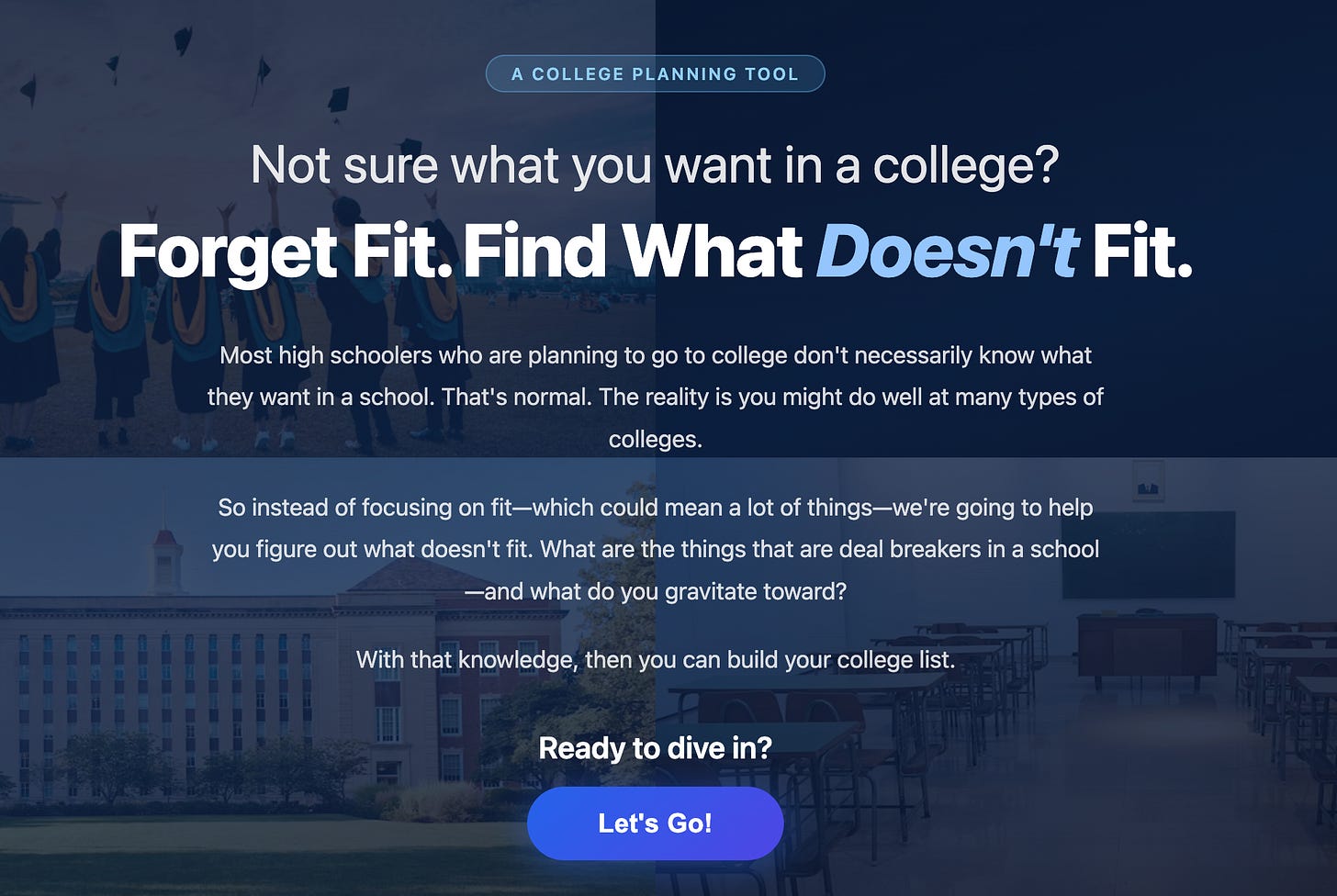
Check out this free college planning tool today.
Could AI, combined with changes in education policy, create more favorable conditions for genuinely disruptive new models of schooling?
That was the question that Vocareum’s founder and CEO Sanjay Srivastava asked me on his podcast, The Learning Curve.
It’s one strand of a much broader conversation, but it took me back nearly two decades to Disrupting Class.
When our book Disrupting Class came out in 2008, online learning was emerging as a potentially disruptive force in K–12 (and higher education). But it didn’t produce the transformation we hoped it would.
In too many cases, we took a new technology and crammed it into the old model of school. The modality changed. The underlying architecture of learning often didn’t.
Part of the challenge was structural. Disruptive innovations typically take root in areas of nonconsumption, but virtually every child already had access to a school. New technologies therefore had little choice but to enter through the existing system—and conform to many of its structures and incentives.
This time, the conditions are different in many states.
AI offers a powerful new disruptive technology. At the same time, education savings accounts are giving more families public dollars they can use across schools, tutoring, microschools, and other educational experiences.
Put those developments together, and there is an intriguing possibility: rather than simply layering AI onto the schools we already have, educators and entrepreneurs have more latitude to build fundamentally different models around what the technology makes possible—and families may increasingly have the resources to choose them.
That doesn’t mean disruption is inevitable. But compared with the first digital-learning wave, there may finally be more fertile ground for new models to take root and grow.
Check out our conversation here:
On a somewhat related note, I weighed in on the debate around a cell phone ban in Massachusetts schools in our local paper, the Lexington Observer.
The district is reportedly concerned about the cost of a ban—particularly when it’s already taken its own measures. I agree—but for a whole host of other reasons that I laid out.
You can read my piece, “Let school districts make the decision on cell phone bans”, here.
Related to this topic, I also highly recommend this piece by Bruno Manno, a senior advisor at the Progressive Policy Institute and a former United States Assistant Secretary of Education for Policy, titled “The Nuance in the Social Media Debate That K-12 Leaders Can’t Afford to Miss.”
If you like this newsletter, my books, and podcasts and want to support me, there are a few ways you can:
Buy or gift a copy of Job Moves for the job seeker in your life or the manager seeking to retain employees. Or buy or gift a copy of From Reopen to Reinvent for a parent or educator seeking something better for K–12 students.
Leave a short review about Job Moves on Amazon or Goodreads—it helps!
Ask me to speak to your school, company, organization, or conference (either in person or virtual).
As always, thank you for reading, writing, and listening.
Comments
Nothing yet. Say the first thing.
Sign in to join the conversation.