
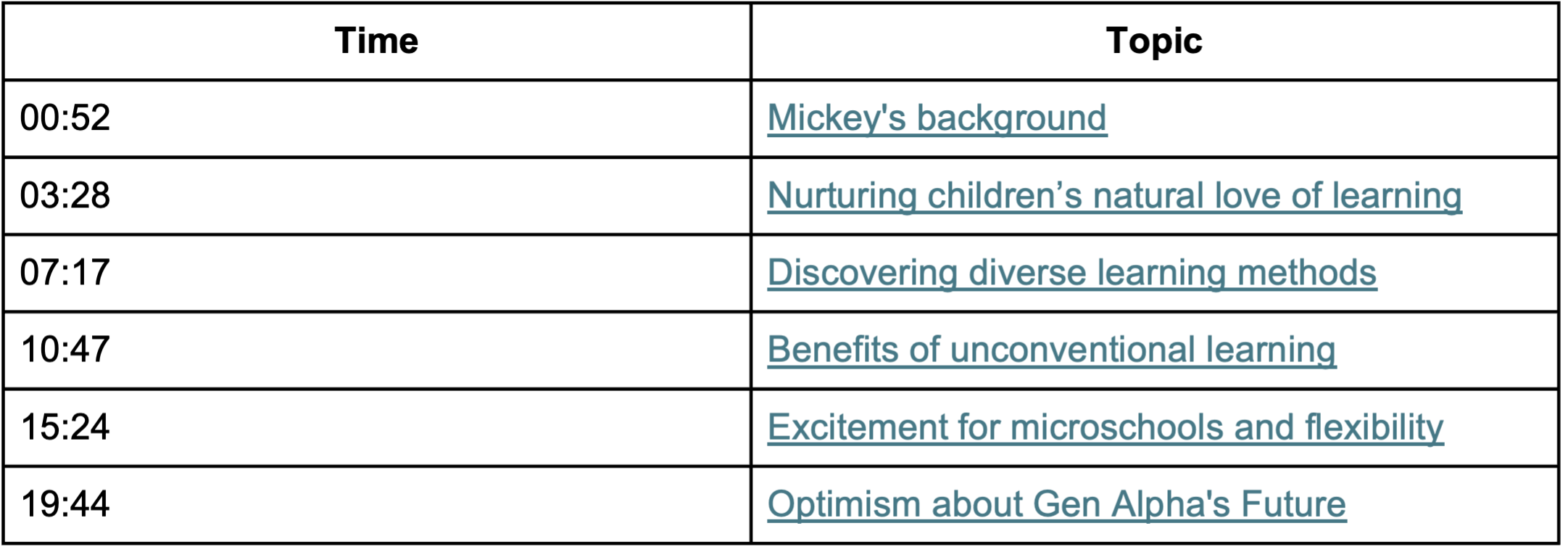
Mickey Revenaugh, co-founder of Connections Academy, is out with her debut book titled School’s Out: Why Families Are Choosing Unconventional Education. She joined me—and a surprise cohost, my daughter Kayla!—to talk about what she learned from reporting and writing the book. Together we explored the rise of innovative schooling models and their impact on student learning and traditional education systems, from unschooling models to project-based learning and more. Mickey shared insights on why families are embracing these diverse educational pathways, discussed the challenges and opportunities with assessment and public funding, and expressed optimism that Gen Alpha’s passion for learning and adaptability will mean a brighter world in the years ahead.
Michael Horn
Welcome to The Future of Education. I’m Michael Horn. You’re joining the show where we’re dedicated to building a world in which all individuals can build their passion, fulfill their potential, and live lives of purpose. And to help us think through how to do that today, I’m delighted we have a repeat guest, a friend of mine who, from my very first days in the education world, was there ushering me in, none other than Mickey Revenaugh. We had her on the podcast in 2023 when she was, quote unquote, retiring.
Michael Horn
Many folks, Mickey, know you as one of the founders of Connections, of course. But more recently, you were the author of this terrific new book, and congratulations, called School’s Out: Why Families Are Choosing Unconventional Education. I’ve got another copy right behind me. We’re delighted to— Everyone get this book. I will say that upfront. I’m delighted to have you again and talk to you about the book.
It’s good to see you.
Mickey Revenaugh
Thank you. It’s a pleasure to be here. It’s always fun to talk with you, and I can’t believe it’s been 3 years. And I also appreciate your wise guidance as an author because this first time out for me and whoo, has it been a learning experience.
Michael Horn
I can only imagine, but we’re gonna come back to that in a minute. Before I get started with my questions, I’m gonna out myself. This is the second time this has happened to me in the last couple years where a friend of mine in the education world writes a book, and then before I can even crack it, my daughter literally reads the entire thing spine to spine before I even open the book. And in this case, she actually drafted a bunch of questions for you, and I wondered, could she join us and actually do the interview with me? What do you think?
Mickey Revenaugh
It would be my pleasure. I’m a little tiny bit intimidated because, you know, kids ask really good questions, but I would love it.
Michael Horn
They do. They do. And I won’t prep you, but I will bring in Kayla, this is my daughter.
Mickey Revenaugh :
Hi, Kayla. Nice to meet you.
Michael Horn
And Kayla’s gonna be in 6th grade, she’s at a Montessori school, and, like I said, she’s poured through this book. And so I’m going to ask the first question and then I’ll turn it over to you to ask a bunch of yours. But Mickey, maybe let’s start here, which is, as we talked about when I had you on the podcast the first time, before starting Connections with that team, that incredible team, you were a writer. You wrote a lot about — you were a journalist. You wrote a lot about education. You wrote a lot about technology in education. You started observing all these things.
You quote unquote retire. I’m going to keep saying quote unquote. And then you start investing in writing again. My recollection is you took some classes, you start writing at 5:00 AM. And I guess my big question is, why this book? Why did you decide to go out, report, as Kayla constantly keeps telling me, interview a lot of people, see a lot of different schooling arrangements, Why did you write this book?
Mickey Revenaugh
Well, part of it actually was inspired by the Kayla in my life, who’s my great-niece, Gemma, who went to Forest School for her preschool years. And I had not heard of Forest School. I mean, I was really hip to virtual school and charter schools and all kinds of other things, but Forest School in the Pacific Northwest where it’s just like mud, mud, mud all the time. And I thought, all right, well, I’m really curious about this. Why would her mom choose that? Why would she love it? And so that kind of started me down the path of trying to understand from a family’s point of view, what is the draw of these unconventional forms, which were also at the same time multiplying. As soon as the pandemic lifted a little bit, people were reaching for things that were really different from the normal school that we were all ready to go back to once the pandemic lifted. So my curiosity got the best of me.
And I really wanted to kind of follow the questions I had about what would motivate a family to go this direction. And I found out an awful lot of stuff, all of which makes me really optimistic and excited about the future.
Michael Horn
That’s great.
Kayla Horn
When you think about the people who will read your book, how do you hope it will impact them in their lives?
Mickey Revenaugh
That’s such a great question, Kayla. I actually had the experience of being at a little conference of Black homeschoolers over the weekend. And I had multiple moms who were doing homeschooling come up and say, I need this book for my mother-in-law. I need this book for my cousin, because they’re already starting to do the things that are described in the book, but the people in their world just don’t understand it at all. They’re really either confused and befuddled or dead set against it.
So what I’m hoping that the book will do is really provide some permission for people to explore and talk about things that they might not have felt comfortable talking about before in terms of how could education be different for their kids.
Michael Horn
So it occurs to me, we’re going to have to get one for my parents to explain your Forest Schooling, Jewish religious school, Waldorf, homeschool pod, Montessori. I think I’ve got them all. Yeah. We’ll have to explain that. Well, go ahead. Yeah.
Kayla Horn
So in your book, you describe a lot of different philosophies of schooling. So could you tell us some of what you saw and what surprised you? What excited you?
Mickey Revenaugh
So one of the things that tied everything together for me was this idea that kids love to learn by their very nature and that school as we have constructed it often stamps that right out of them as they go through the grades. And so almost everything that I covered in the book started with the idea that we should nurture, protect, and support kids’ love of learning and that that might look a little bit different for every kid that we encounter. One size does not fit all. I think that, and that wasn’t a surprise to me, but what surprised me was how many different ways that people found to interpret that. So everything from Forest School in the mud to these road schoolers that traveled around in their RVs all the time, to unschoolers who, one of the people I admire most in the unschooling world, was not an active reader until she was about in 4th grade.
Michael Horn
Oh wow.
Mickey Revenaugh
And it took a lot of courage for her and her mom to say, it’s going to be okay. And now she has a master’s degree in social work and she’s working in the mental health field. So it didn’t hold her back. But that was kind of what it came down to, is that every kid’s different, every kid deserves to learn the way that they learn best, and that we as adults need to figure out better ways to accommodate that.
Kayla Horn
So you started some of your own schools. What are some of your own philosophies of what a school should look like and how have they changed from seeing all the different schools in your book?
Mickey Revenaugh
So I will confess that I was one of those goody-two-shoes kids in my own schooling. I did everything absolutely right. I sat at the front of the class. I raised my hand to answer every question. The teachers loved me. So it had never occurred to me that there was a different way to learn other than the way that most people learned in my generation. So the 2 things that the schools that I worked with getting started really revealed to me, one is that there’s something really magical in the relationship between a teacher and a student, and that sometimes that teacher is a professional teacher with a degree and certificate. Sometimes it’s a parent, sometimes it’s another kid, but that there’s that social aspect of learning that is human to human.
It might be mediated by technology, so we might be learning from each other via the internet like this, but there is something really incredibly powerful and magical about that. And the other is that almost everyone does better when their schooling is tailored to how they learn best.
Some of us have taught ourselves through the years to accommodate whatever’s out there, and we do our best to play school, right? But everybody learns better if the learning environment is set up for the way they learn the best. And so the virtual schools that I worked on, I worked on some blended schools that I was really excited about where they were macro-microschools, I guess. They were schools of like 150 kids. The micro schools of today are more like 15 kids, but the same idea of like really personalized, really surrounded by love and individualized in terms of how the kids learned.
Kayla Horn
So you also wrote about virtual schools in your book. What do you think are some of the biggest problems with virtual schools today and how would you fix them so that they can expand?
Mickey Revenaugh
So I think what we’re seeing is that a lot of virtual schools were the only unconventional option available to an awful lot of people. So if you lived in, let’s say, rural Ohio and your kid wasn’t loving traditional school and you didn’t want to send them to the Catholic school down the street, a virtual school might’ve been your only other choice. That might not have been the best learning environment for that student, but you didn’t really have an option to go someplace else. And so I think virtual schools ended up serving a bunch of kids that, if there were other options available, might not have picked that one.
And at the same time, virtual education, when I got started with it, and a little bit like when your dad got started, was about as sophisticated as a rock and a stick. It’s like we just didn’t have a lot of the tools that we have now. And so we did our best to be engaging and make the curriculum interesting and make it fun to work in. It’s still a work in progress. And I think everybody’s experience during the pandemic when we were doing Zoom school or emergency remote instruction was the lowest common denominator virtual education. And unfortunately, that’s what an awful lot of people see as online learning. And that’s where I think a lot of the not so great results are coming from as well.
Michael Horn
Super interesting.
Kayla Horn
So in your book, you also wrote about unschooling and project-based learning. How do you think they’re important and helpful for kids later in life? And how do you think those skills, upsides, and even trade-offs will compare to kids who learn everything by being told or by a textbook?
Mickey Revenaugh
Well, my personal theory is that kids who learn through really anything that’s about something they’re passionate about. So where project-based learning is, projects that they define themselves or unschooling where their whole school experience is defined by them are going to be so much better off in the future that we’re heading into than kids who have been traditionally taught. And there’s really 3 reasons for that. The first is that they hopefully still love to learn by the time they get out of school. They love to learn and they know how to learn and they want to keep learning. That is a skill that there’s no way that anyone will thrive or survive in the future without that skill. Secondly, they’re self-motivated, so they don’t need somebody standing over them to say, do this next, do this next, do this next. They kind of do it because they want to and because they’re eager to learn the next new thing.
And the third thing is that they’re very resilient and flexible. So if you’re working on a project and that papier-mâché thing that you’re building to house your volcano or whatever it might be, is it working? If you’re a project-based learner, you’ll figure out a different way to do it, and that’s a really important part of the learning process. So I personally think that kids in unconventional education are going to be much better off than kids who are traditionally educated in this very fast-approaching future.
Michael Horn
I’m curious on that, Mickey. You have a whole chapter about education savings accounts and the publicly financing of these arrays, this explosion of models. And toward the end of that chapter, you have this section on measurement, testing outcomes comparison. I guess my question is twofold. Like, first, maybe give folks a summary of where that debate stands today. You do a good job in the book, I think, of outlining the different streams of thought, if you will, around that question. But I’m curious, like, I’ve started to develop my own more nuanced take, I think, about how this should evolve. But you’re such a keen observer of this space.
Like, what’s your own take, around where assessment and measurement should play when public dollars are footing the bill for this explosion of schooling types?
Mickey Revenaugh
Well, I think the public funding through ESAs and the new tax credit scholarship program that’s forthcoming, that’s not public dollars but kind of public dollars, is really going to bring to a head what we’ve always kind of known about standardized testing, which is it’s a really— talk about a rock and a stick. It’s a rock and a stick when it comes to figuring out what kids know. It’s been the only tool that we’ve had, especially in looking at mass assessment.
And so I admire and appreciate those, and especially in the microschool movement that are sort of figuring out a way to do NWEA testing and other things to give parents some comfort that their kids are on track and learning. What I’m really excited about though is I think finally this will bring to fruition something that I’ve been excited about since the ‘90s, which is portfolio assessment.
It’s actually having a set of things that kids create that can be evaluated against a rubric and judged based on their output, not on their ability to memorize an answer, I think is going to become more and more important as these forms exist. And by the way, AI gives us the tools to actually evaluate those things that we didn’t before. So people who were working on portfolio assessment in the ‘90s were like, staying up all night sweating bullets, trying to measure things against a rubric. And now I think there’s a possibility that true authentic assessment that we’ve always been really fixated on and never been able to do will arise as the way that we can measure quality and outcomes, especially in a world where Carnegie units and seat time are not going to be any more useful than they ever have been and probably even less so.
Michael Horn
Makes sense.
Kayla Horn
So in your book, you wrote about a lot of different school models. Which of them do you think will be the most successful in the future?
Mickey Revenaugh
Ooh, you’re asking me to pick which one of my children I love the best. Well, I’m excited about all of them. And really what excites me the most is how they connect up with each other, really. So in a lot of states, kids who go to microschools are actually counted as homeschoolers. Because the state doesn’t have a way to figure out what a microschool is. In the state where I live, if you go to a virtual school, you’re a homeschooler, even though you’re in a virtual school. So the categories end up being a little blurry, and I think that’s fine. I think that’s just great.
Mickey Revenaugh
The newer forms like microschools, I’m really excited about the energy around them, and really because so many of them are being started by teachers. So imagine your favorite teacher, going off to start her own school based on what she really loves about teaching. That’s a fantastic thing. So that part of the ecosystem really excites me a lot, but I think the other parts of it are gonna be equally powerful because the other thing that we’re seeing is that families are doing a lot of switching and mixing, right? One of the researchers that I talked to said it’s starting to become very common for a family to say, I’m homeschooling Kayla, one year, and then next year she’s going to Montessori, and the year after that she’s going to a charter school, and then she’s going to the regular public school, and then she’s going to come back and homeschool again. And by the way, while she’s homeschooling, we’re going to do some online courses and some community experiences, and we’re going to buy some curriculum. We’re going to mix. So switching and mixing is becoming the norm. So I think it’s all going to blend together in a way that we probably can’t even predict right now.
How’s that for avoiding the question?
Michael Horn
Well, it’s interesting before you ask your next question around what the impact will be, maybe more broadly from that, Kayla. Like, it’s also interesting thinking about your answer on measurement right around that, Mickey, because like the other assumption of standardized tests was it told you about school quality.
Mickey Revenaugh
Right.
Michael Horn
If you’ve gone to— you just named 5 different experiences over 5 years, but like, let’s go even deeper. You also said if I’m homeschooling, I might have 10 different providers. To what do we attribute any of those results? Maybe it’s more empowering these measurements of students and parents against their goals of what are you trying to move toward, as opposed to the public sort of looking over your shoulder, it seems. I’m curious your thoughts. Yeah.
Mickey Revenaugh
And I think it’s really critical. I know that there’s some people that are getting really anxious about how do we know whether it was the Khan Academy lesson that helped this kid master this math concept versus the thing that they did out in the backyard with leaves.
I’m not sure I care that much, to be honest with you, as long as it looks like they actually have mastered a concept and we have a way of showing that. And then the portability of that is going to end up being really important. If you really do end up going from setting to setting to setting, your standardized test score becomes less and less relevant every time you make that switch, whereas your portfolio of work becomes more and more relevant. So I mean, I haven’t gone all the way over to where some people are, which is it’s all about the market, right? Parents will tell us what’s good based on what they’re willing to spend their time and money on.
I think they will, but I’m not sure that’s completely sufficient. I really would love something that’s portable to the kid that they can then take with them through their life that’s a little bit objective and also speaks to the kind of skills we know they’re going to need.
Kayla Horn
So with all these new models popping up, do you think the traditional school model will last and do you hope it will?
Mickey Revenaugh
I’ve been thinking about this an awful lot. I actually believe that all of these unconventional models are going to be the best thing that ever happened to traditional school systems because it’s going to force them to adapt to what families and kids really want. And also, pivot and be resilient in the same way that we’re asking kids to be when they come out of school. We’re asking the system to now figure out a way to adapt to the changing desires of families and frankly, the changing demographics that they’re facing. So, most traditional school systems, their enrollment is going down because people are having fewer kids. Immigration is almost at a standstill. There’s fewer kindergartners showing up to say, I want to go to kindergarten here. So if a school system’s going to survive is going to need to figure out how to bring families in, that might’ve chosen something different.
And the only way that they can do that is by adopting some of these forms and figuring out how to make it part of what they offer, as opposed to something that happens over there and they don’t want to have anything to do with it. They’re not going to like it, but I think it’ll turn out to be the best thing that ever happened to them.
Kayla Horn
So with all these clever ways to learn, do you feel that when Gen Alpha are the society’s leaders, that our world will be in good hands
Mickey Revenaugh
I have so much faith in Gen Alpha. I really do. And it’s partly because your generation, which is Gen Alpha, has grown up with this incredible set of tools for learning about anything in the world. And it’s made you really super curious about everything around in the world. And I don’t know a single young person who... We get mad at them sometimes for spending so much time online, but what they’re doing is trying to find out more about stuff they care about. And that makes me really, really, really optimistic about how they’ll approach the problems of the world because they won’t assume they know everything already and they won’t assume that there’s one fix. They’ll know that there’s lots of ways to approach a problem and they’ll be happy to collaborate on it and come up with a good answer. So I hope I live long enough to see Gen Alpha be the leaders of the world.
Michael Horn
I’m confident you live young. I’m gonna, I’m confident, I’m confident you will.
Mickey Revenaugh
Yeah, thanks to Red Bull and caffeine, man.
Michael Horn
Hey, whatever, whatever it takes in your 5:00 AM writing habit. I’ll just say, Mickey, I, you know, just congrats again,, first book, no, you know, big deal. Everyone. Yep. Check it out.
Mickey Revenaugh
Kayla enjoyed it, then I feel like that’s the highest praise I could possibly ask for. If you liked it too, that’d be great, Michael.
Michael Horn
But I feel like I’m part of the space, and yet I learned a lot in terms of the texture and the characters and the motivations for a lot of these things that I’ve seen or knew about, certainly. And the reporting’s excellent. Kayla ripped through it in about 24 hours. It took me a little bit longer.
Mickey Revenaugh
A little longer.
Michael Horn
I’m a little slower. That speaks to me, not the book. So it’s a very good read. Everyone check it out. Get a copy. School’s Out: Why Families Are Choosing Unconventional Education. Mickey, good luck with the— as the book rolls out, good luck getting the message out. I hope a lot more people, to Kayla’s question, have permission to explore these models from those around them.
And just a huge thank you for what you continue to do.
Mickey Revenaugh
Thank you so much. And Kayla, your dad better watch out because I think you’re coming for his job.
Michael Horn
Well, I’ll just say huge thanks to Kayla for doing this, joining us. us and being willing to ask these questions as well. I appreciate that.
Kayla Horn
Thanks.
Michael Horn
And for all of you out there tuning in, we’ll see you next time on The Future of Education.
Comments
Nothing yet. Say the first thing.
Sign in to join the conversation.