
This summer marks 25 years since Broken Social Scene, Stars and Metric began to make their mark on Canadian music history. To mark the occasion — and new albums by Metric and BSS — all three bands are touring together. All three are central characters in my 2022 book Hearts on Fire. And as readers of this newsletter no doubt already know, all three play the Ontario Place amphitheatre this Friday, August 7, the final show of the summer dates; the tour resumes in September for eight shows in the UK and Europe, and concludes with three more Canadian shows in London, Ottawa and Laval in October.
(This week’s live music listings are here.)
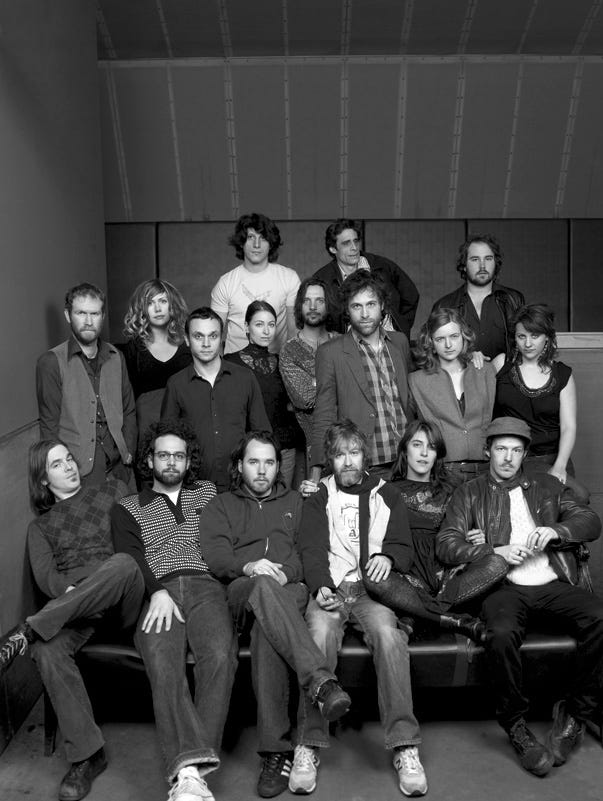
Normally something like this would be assembled by agents and promoters and marketed as a nostalgia tour. In this case, it was primarily a decision among a group of friends whose relationships began in high school, if not earlier. In 1984, for the 12th birthday of Broken Social Scene’s Charles Spearin, he and Stars’ Torquil Campbell — who went to school with Stars’ Chris Seligman and Metric’s James Shaw — saw Platinum Blonde play Nathan Phillips Square. Stars’ Amy Millan and Metric’s Emily Haines were BFFs in high school, where they met Kevin Drew.
Millan told Exclaim!, “We started talking about doing this around a dinner table for Evan [Cranley]’s birthday and not a conference table with spreadsheets, so that tells you something.” And though BSS co-founder Kevin Drew is traditionally the ringleader, he claims he took a back seat this time and let other people drive. (If true, the man has clearly changed.) “This is Metric’s party,” he told Exclaim!.
I first saw all three in the fall of 2001, when they shared a stage at Lee’s Palace. Andrew Whiteman was an acquaintance from his various projects in the ’80s and ’90s, so I went to check out the band he had just joined, Broken Social Scene. Stars were the headliner. Metric were opening; I don’t recall seeing them — perhaps I was already too old (30!) for three unknown bands on one bill? This is perhaps 20/20 hindsight, but the night did feel special. Broken Social Scene were a fiery, Dinosaur-y rock band, not at all what I was expecting, and Stars had more stage presence than stage chops at that point, but the songs were strong. The connection between the players, the bands, and the audience was palpable.
This summer, Metric are headlining; they’ve become by far the most commercially successful of the three (not including the solo career of Feist, whose story I tell in a different chapter, alongside her friends Peaches and Gonzales).
I titled the Hearts on Fire chapter about all three bands “Your Ex-Lover is in the Band,” a play on Stars’ most popular song, “Your Ex-Lover is Dead.” I did so because it’s true: there are more than a few prior romantic entanglements between all the members, who never let that fatally complicate their creative bonds — or their friendship. Hence the title of this year’s tour: “All the Feelings.”
I’ve often regretted that chapter title, though, which seems too cheeky and salacious. Far too much ink continues to be spilled on the subject: many writers found the whole situation somewhat lurid, these crazy Canadian hippies who continue to collaborate with ex-lovers, who dare to challenge the idea that co-ed bands just don’t work. (See also: the White Stripes.)
There’s something about this fascination that perhaps says more about a writer’s own jealousy and prudishness, as if any group of old friends doesn’t also have such entanglements. And anyway, what does that have to do with the music? Surely people don’t still listen to Fleetwood Mac or ABBA because of the drama.
For paid subscribers, what follows is an excerpt from Hearts on Fire, bookends from the chapter in question. I’ll remind you that if you’re interested in a signed copy, I do make deliveries in Toronto’s West End.
In 2000, two new friends in a Toronto basement made an ambient record, with a loose collection of peers and low expectations. In 2000, an ambitious Toronto couple had already bounced between Brooklyn and London and scrapped a recording with a noted British producer before starting anew in Los Angeles. In 2000, some old Toronto friends living in New York decided to move to Montreal in search of a drummer.
Some of these people grew up together. Some were total strangers. Some were or would soon be lovers and then ex-lovers but still bandmates. Many were the sons and daughters of actors, painters, poets and publishers; many also had at least one U.S.- or U.K.-born parent. One would sell millions of records as a solo artist. Together, they rewrote the rules of what a mainstream Canadian rock band could be, and the world paid attention.
One of them was called Broken Social Scene, but that name could apply to them all—and they did all end up in Broken Social Scene in one way or another, certainly in the eyes of the media, and, sometimes to their chagrin, at the expense of their own identity.
They all have their own unique story worth telling, though they’ll be forever intertwined. Superconnected.
Stars. Metric. Broken Social Scene. It’s no wonder they gravitated toward one another. Though they didn’t share a sound, they did all share a mission: big sound, big passion, love in the face of evil, hope in a time of war, lean on your peers, ageless beauty. Love would tear them apart, and forgiveness would keep them together.
--
Comments
Nothing yet. Say the first thing.
Sign in to join the conversation.