
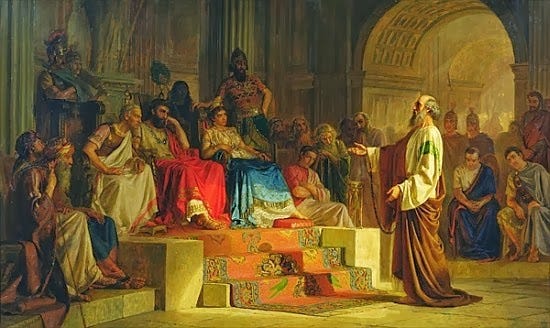
I recently received a query that asked me about my take on this assertion: “The postmodern cultural context is very similar to that of the New Testament.” I found this an intriguing statement. But is it true?
I think the quick answer is a yes and a no.
No, in that postmodernity questions the very idea of a meta-narrative and is deeply relativistic, whereas Graeco-Roman paganism in the NT world and the succeeding centuries was deeply committed to the idea that there was such a thing as truth and it could be found (whatever lies behind Pilate’s query re truth in the Gospel of John, skepticism regarding truth is not a leading characteristic of pagan philosophy and thought in the NT world). Platonism and Stoicism, both of which believed in overarching truths, were dominant in this period, both in academic and more popular forms.
On the other hand, the pluralism of the pagan Graeco-Roman world has similarities to our world: a multitude of voices clamouring for recognition and attention marked that world as it does ours. So it is in the pluralism of the Graeco-Roman environment, not the denial of objective truth (at the heart of post-modernity), that there are connections with the world in which Peter and Paul and John, and their heirs, men like Polycarp and Irenaeus and the author of the epistle to Diognetus, preached.
No posts
Comments
Nothing yet. Say the first thing.
Sign in to join the conversation.