
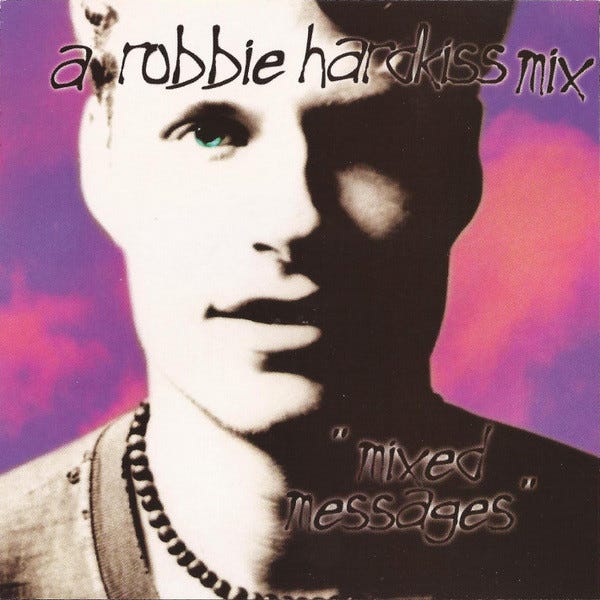
I did a lot of interviewing for The Underground Is Massive—close to four hundred in total—but a handful of them have really stayed with me. Robbie Hardkiss was one of them. He has a razor-sharp memory, and he was expansive and insightful as he shared it. I have thought about it a lot in the time since conducting it, nearly thirteen years ago, and I figured recently that it might be a trick of memory, that it couldn’t be wall-to-wall as good as I’d recalled. But it was. I did make some trims from the original transcript, but not too many: below the break, the Q&A is around 9,200 words.
The Hardkiss story is a fascinating one, on its own; they never got where they seemed to be going early on, but their canny sense of where things could go—and their position in the hugely important nineties San Francisco scene—makes them paradigmatic of the American rave story. But more than anything, Robbie was very wily and highly articulate. See (and hear) for yourself, and thanks for coming along for the ride.
ROBBIE HARDKISS: Furthur—it’s funny; it pulls back my memories and recollections of that crazy party. I probably do have more memorable moments from that party than from the hundreds of other parties that I played and went to.
MM: The first one?
Yes. These are some fuzzy memories—it’s a long time ago. But I’m pretty certain it’s the first one.
The first thing is flying into Chicago and driving four-and-a-half hours through the snowstorm with Frankie Bones, Adam X, Micro, Scott Hardkiss, Wade Randolph Hampton. I texted him [Wade] earlier to tell him I was talking to you. He has got a photographic memory. That guy’s crazy. He’s the best person to talk on so many subjects. He told me to hook you up with him. He’s a crazy busy person. But make sure to hit him again. I told him your name this morning and he’s up for it. He’s great to talk to.
So going out there—it was outdoors, winter, driving through a snowstorm to get there. Scott and I used to always get the six-a.m. sets, to play the pretty morning music. We get there and we realize, “Oh, my God—it’s really early. It’s really cold. We’re just out in the middle of nowhere.” We had to get through the whole night before playing, which was a bit of an adventure.
I have four strong memories. The first one being, massive nitrous balloons. I’ve never seen balloons this big. Not the size of a balloon—maybe five balloons. The size of five large balloons, but one big balloon. I think Wade might have gone right to that tank by a campfire and put two in my hands, two in Scott hands, and said, “Let’s get the party started.”
We made our way to a tent where Micro is pretty much killing it with breakbeat acid. It’s sparse people. People are up front dancing. We’re in back. It’s a dirt floor. It’s cold. We’re listening to the tunes, sitting there with our massive balloons looking like idiots. I’m talking to Scott; we’re talking, and the next thing I know he’s nowhere. I’m in the middle of a sentence, he was just talking to me, I turn, I’m looking all around—he’s down on the ground, sheets on dirt, perfectly still, just hugging the ground. He just had a little too much waka-waka from the balloon and was just taking a moment. So funny. Got up, he was fine—it was just that nitrous moment. It was a hilarious moment.
We made it through that whole night and then got to our time to play in the other tent. It’s a little vague for me. But the second strong memory is David Prince, who was one of the promoters—I’m sure you’ve heard about him naked? He’s as good as Wade; better on some things; Wade on other things he doesn’t know . . .
But we get ready to start up, and that’s when the cops come to break it up. We make it through the whole night, and there’s the police. All of a sudden, David Prince is jumping down and grabbing the needle off our record after we’ve spent four-and-a-half hours in a blizzard to get there. The entire night, it was light when we started, and to stay up and do our thing, to get to six a.m., to start putting on—we must have played “Belfast” by Orbital. I think Scott and I were tag-teaming. All of a sudden there’s David Prince, diving across the turntables, pulling the needle off the record. The cops were coming and he had to deal with them. He was having conversations with them. I have talked to him in subsequent years about that whole thing. I got in trouble doing that a month [before] in San Francisco.
David told me he had to turn the system off several times that night.
Yeah, that’s what I remember. I can’t say the middle of the night, I remember it being off and not having any of the rooms up and running.
What I remember about that particular event: I went to bed ten minutes into Aphex Twin because I’d been awake for three days. I think Woody McBride and I were the only two sober people there. I was nineteen. I had a lot of energy, but I couldn’t stay awake anymore.
When it was time to leave, I was in that van—I got picked up at the airport, and I was going back to the airport with the same cast of characters: Wade, Frankie, Adam X, Nigel Richards I think, Scott, and me. All hell broke loose when the cops came, the sound systems were shut off, and we hadn’t been paid. Obviously, the promoters are dealing with a lot. They’re not thinking about paying individual DJs. But that was all part of the thing: “OK, I’m going to get paid.” I got sent out of the van to go find the promoter—Kurt?
His parents were the ones caravanning everybody.
Wow. Funny. Holy crap. So I’m walking up the dirt road, sunlight, looking around: “I’ve got to get paid. I’m not going through this whole thing and going home without getting paid.” It was nice that I got sent out as rep, because I looked, I see Kurt, we’re walking toward each other, I’m going to talk to him, then I see him get wide-eyed looking over my shoulder and then suddenly duck and hide between two cars.
I turned around and my whole van load of guys was being frisked by the cops. They’d just been pulled out of the van I was in and were being frisked. My buddy—let’s just say there was a lot more in that van, maybe, than was actually found. They had a little bit of warning and were able to dump some stuff. But one friend got arrested. So that was the second person. Who did you say?
A British journalist named Sarah Champion. She wrote about it.
I think there might have been more. I’m pretty sure Wade got arrested for having weed in his pocket. The way he tells it, when they opened the van door, it was a cloud of weed smoke. It was like a joke, like a cartoon. They were all being frisked. Adam X was running down a path to empty his pockets. It was just odd. I saw that and did my own little U-turn: “I have nothing to do with that van.” Can’t even remember getting paid, actually! I probably didn’t get paid. But I didn’t get arrested.
It’s a trade-off.
Yeah. I’ll take that. There are a lot of stories like that from the past. I forget just how many big-time DJs were at that party. It was packed. I forgot Aphex Twin was there.
You didn’t catch any of his set?
I’m sure I did, but I just can’t recall. There were so many. We were huge “Analogue Bubblebath” fans, Selected Ambient Works. I’ve got a love-hate thing with him. The spots he hits that I like, I’m like, “Wow.” And yet he mostly doesn’t hit my spots—a little noisy for me.
He was playing when David was on the speakers naked. So if you remember that, you likely did hear him. With a legit, above-board booking like him, would he get half in advance and half upon arrival?
Yeah. Once you’ve been around the block a little bit. I wouldn’t board a plane if I didn’t get a deposit. You get your half to get you there, and sometimes things go pear-shaped, to use a nice term, and you go home without your second half, but at least you didn’t do it for no money. That’s pretty general. Also, at the time, you knew who you were dealing with. Occasionally you wouldn’t.
But I’ve taken a bunch of time off, being Mr. Mom for the last ten years, and I actually went to play somewhere and because it was a promoter I’d dealt with a bunch of times in the past and knew him, I didn’t get the deposit. I was like, “Oh, my God. What are you, a rookie?” Things got weird, and I didn’t get paid—I just got let on the sidewalk. Someone I knew and liked. Yeah, you’ve got to be cold and get your deposit, at least. That’s why I don’t have horrible memories of it—I got at least paid a deposit and never got the second half because things blew up.
You say [Furthur] was 1994? By that time we have to have been around the block enough if we were getting to play those parties with those guys. We’d obviously gotten to the level we were playing a lot. We would have gotten a deposit beforehand.
One other Furthur question: Were you dressed for the weather at all?
I remember being cold. That’s my first memory. I had to be a little bit dressed for the weather. I’m not an idiot. I could have been wearing a parka—a dad’s winter court, long, corduroy, fake-fur-lined inside-kind of thing. But getting out of that van: “Holy crap, we’re not even close to midnight, and it’s cold.” I think the fire—which is where the nitrous tank was—might have been a draw before the nitrous tank. We went to the fire and sat down.
Let’s go to the beginning of Hardkiss. You knew Scott from high school. Where was high school?
Potomac, Maryland, D.C. suburbs. We graduated in ‘87.
No rave scene at all?
Nothing.
Did you go to San Francisco right away?
No, I went to NYU, but dropped out my first year and went back to Maryland for a year, saved up money, collected my things, and headed to San Francisco in 1989. Meanwhile, Scott and Gavin were at U-Penn.
Gavin told me the two of them would go clubbing in New York. Were you part of that around ’88?
Definitely. I would go up to Philly. My sister also went to Moore College of Art there, so I would stay with her at the all-girls’ art college, which was pretty cool, then hook up with them at Penn, and sometimes we’d go to New York too. I bused out—I can’t recall being with Gavin in New York. He and Scott must have done that more in their final years at Penn. But since I was at NYU, Scott had come up to New York, he and I would take the train up and down from D.C. to New York.
Actually, Scott and I in our senior year of high school [laughs] went to New York, told our parents we were going to visit colleges—he was going to look at Connecticut College and I was going to look at NYU, and we were going to go together. We made fake IDs on the train. Do you remember Shark Pack Lectraset? Before digital, before computer graphic design, you used to have to push little letters off of cellophane. Oh, my god, you’d use typeset. We did that—covered up our dates, redid our licenses, made them on the train up there.
We stood in line to get into Palladium and Limelight as high school kids. Waiting behind a velvet rope at Limelight. No one but girls are getting picked, and we’re like, “Let’s speak fake French. Maybe they’ll think we’re cool Europeans.” So we’re speaking fake French, It’s like, We’re going to hook up, meet some girls in line. [laughs] We tried to go in with the girls, we chatted some girls up, and they got picked. The doorman just grabbed the rope, let the girls in, and put the rope back between the girls and us. We’re going, “Wait! Wait! Where you going?” They never looked back, just went into the Limelight. God, that’s ’87.
I remember ordering a Heineken for eight dollars: “Oh my God, I can afford one beer.” Eight-dollar beer in ’87: that’s stuck in my brain. Now—holy crap.
So Scott and I did it even before college. I remember seeing King Britt before anyone knew who he was, and Josh Wink too, at the club Revival in Philly, and the Bank. We had fun going to the Bank.
What was the draw of San Francisco?
It’s interesting—I’d never been there, but there were some people I was hanging out with in D.C.; some of my friends were artists, either into photography or fine arts. That crowd, San Francisco had a little bit of buzz in those circles. I knew one person there that moved out; she had told me about it. I was ready for an adventure and to get completely out of my world.
I loved the Northeast growing up. I loved it—I had a great time there. But now I want no part of living there. [laughs] I love to visit but something drew me out to San Francisco and once I got there, I immediately felt like, Wow, this is more natural to me. There wasn’t any real specific thing there. I knew it was a counterculture place with a lot of art going on, but that was mainly through the people I was hanging out with.
Did you know about the Full Moons or Wicked before or after Scott and Gavin arrived?
I was there before. I learned about the rave scene from Scott via letters and hooking up with him on holidays. He went to England—Oxford—he did a semester or a year abroad. In that year he happened to hit the Summer of Love in England, and got introduced to the scene there. We were both into hip-hop. I remember him writing me—talking about early breakbeat stuff like the Scientist, which is totally sped-up breakbeats. He was right.
He was like, “Listen to these crazy ‘Mentasm’ sounds. This is nuts!” He told me about it and said, “You’ve got to go look around for this in San Francisco.” I started going to record stores and started to scope out pretty quickly where parties like that were happening.
When I moved here in ’89, it really felt like a rocker town still—leather. On the dance side of things, it was industrial. Of course, there was a huge gay scene I was not a part of going on, but in my little world it was still rocker and industrial. There was a party called Mr. Floppy’s Flophouse. That was really wild. I think they were really the first raves. They were a combination of live bands, punk bands, art installations, punk art installations, and DJs playing acid house and industrial tinged stuff. Pretty wild. So I went to a few of those before Gavin and Scott came out here. Thought they were incredible.
Then ToonTown happened, which felt like the first rave-rave, with Doc Martin, who was already—he was from here but lived in L.A. He was a popular rave DJ in L.A. He’d come back and forth and play those ToonTown parties. Scott and Gavin came quickly after that. We might have gone to our first ToonTown together.
But in those very early days—you said Burning Man? Our very first parties also predate the digital age. We were going to make our flyers at Kinko’s, and one night at Kinko’s—you would be there for hours doing your flyers—we went in with our ideas and have to execute it there. It was funny. But it was on Market Street, right near the Castro. We started talking to these guys and they told us what they were doing. It was Burning Man. It was an early Burning Man flyer they were making, and we were making flyers.
We were like, “That sounds incredible. We have got to go.” We hooked up with them before anyone knew what Burning Man was. I think it started in the city on Baker Beach. We were talking to them then.
You threw parties on the beach occasionally yourselves. Was Baker Beach one of them?
I don’t know that we did them on the beach in the city—not Baker Beach. Grey Whale Cove, down the coast a little bit; we threw a party—our first party was in a funky little club on a heroin-cracky block, Sixth between Market and Mission, a horrible block to have a happy-scrappy party.
That party, we set up the sound system ourselves, bought these JBL speakers. It was called Shel’s Rendezvous. It was an old, divey lounge. I had a right pocket full of acid, a left pocket full of Ecstasy, and was giving that to people. We played ambient music to a point of frustration for the people. Scott had this plan: “If we just drag this out until the place is filled, and they’re just dying for music, once we hit ‘em with the beats, it’s going to go off.” That was the theory. You can see how it can work, but also it’s a pain in the ass and it was horrible. But it was pretty funny.
Anyway, he starts banging; I’m running around working lights, got my pockets full of things. Some guy runs up to me: “The speaker’s on fire.”
I’m like, “Yeah, it’s crazy!”
“No—on fire. Literally on fire.”
The coil caught on fire. I run out to the dance floor: “Holy crap, it’s on fire!” I get the bouncer-doorman guy. He takes the thing, throws it out in the alley, and hits it with the fire extinguisher. We’re like, “OK, we’re rocking with one speaker.” We kept going until the other one caught on fire. That party ended way early.
We said, “Everyone give us your name. We’re going to throw a free outdoor party for you.” That was our second party, which was where the story started, at Candlestick Park, near Hunter’s Point, where there were a bunch of parties. Also not a great place to throw a party. Some really hoody stuff around there.
A bunch of kids in the middle of the night—I seem to remember some kind of gunplay. Not on our night; we really didn’t have that many people there. I think I went to a party where some shots were fired.
But the night we did the party, we had rental speakers. In the middle of the night we’ve got our little dance floor, people going, and the sprinklers go off in the middle. We were right where the sprinklers were. I remember standing on the sprinkler trying to prevent the water from getting on the turntables and mixer. Nightmare number two, right out of the box.
You’re batting 1.000 in the early days.
Yeah. Those two parties—the funny thing was; I have such fond memories of them. The first night was a nightmare; the second one was just fun. By the time I was on the sprinkler, I had to laugh. It was like, “Wow.” The people who came out with us stayed through the sunrise. You know Dani Siciliano?
The singer? Yes. I’ve not talked to her.
She was married to Herbert. I know she split up. She was at that party with us. She was one of our early friends. Gavin chatted her up at the ToonTown dance floor, at 650 Howard. We were at a ToonTown party. He started chatting her up. [laughs]
Gavin’s from South Africa, so he has the accent. But you know how there’s some different way of talking that’s essentially African—like Nelson Mandela. It’s from somewhere different entirely. It’s like a [British] accent but from a different part of your voice box. When he said, “Hi, how are ya?” she thought he was deaf because of his South African accent. She was like, “How cool is this deaf guy out here dancing, just feeling the bass?”
He introduced us to her. We hung out that night. When the party ended, Dani and we all clicked. She’s from the D.C. area also, the Virginia side, so Scott and I clicked with her on that. We used to run around the same clubs in D.C.
We’re like, “Let’s go to the park.” We went home on the bus, got a case of Miller Genuine Draft, our boom box with Spacemen 3 CD, a tent, and Dani. The three of us, Scott, Gavin, and Robbie, and Dani Siciliano went to Golden Gate Park and set up a tent, as if you could just camp in Golden Gate Park, and had our after-party in a tent. Laid back in a tent, had our beers and our boom box, and put Spacemen 3 on.
We’re chilling for maybe five minutes before VROOOOOOOOM! Dirt bikes circling our tent. The cops are asking us, “What are you doing? What do you think you’re doing?” Separating us and asking us Dani’s name. We didn’t know her last name. We didn’t have IDs. So they’re trying to confirm up our names trying to get real information. We’d just met her: “I think it’s Dana something?” [laughs] So funny. Been friends with her ever since.
Those early parties—how many people came?
Ours, the first one was in a tiny dive bar—a hundred-some people. Less than that, maybe, on the thing outside. I think for what we did shortly after that, where that ToonTown was, we cut a deal with that club, 650 Howard, to do a regular party, a monthly there called Sunny Side Up. Then we started having bigger shows at that point, more proper venues people were used to going to.
How many people went to the other parties you attended?
Hard to say. Mr. Floppy’s was hundreds of people, maybe a thousand—could it have been that much? I don’t think so. I would say I’m a bad estimator at numbers. The ToonTowns were the biggest of the kind at that time. That was hundreds—if you had a big spot, and they had some big, couple-thousand people parties. They got well bigger after. Those early ones? The 650 Howard club wasn’t really big. That club filled up; that dance floor filled. It had to be hundreds.
Gavin told me you three moved in together and started to DJ together. Scott already was DJing.
Yeah. I learned on Scott’s records. The turntables were there. I just started playing there.
You probably had your own music as well.
I did have music, but not vinyl at that point, not there—I’d left my vinyl back east and was listening to CDs. I didn’t know when I moved to San Francisco that I was going to become a DJ. I actually started playing bass and jamming with some guys, teaching myself, banging on drums and playing a bass before Scott and Gavin came out here.
Gavin told me when they arrived you weren’t necessarily in the rave scene per se, and that they basically said, “Here’s what we want to do.” And you said, “Yeah, I’m down.”
Pretty much that. I think Scott had told me of their plans a bit before they came out. Those guys had thrown parties at Ten in Philly. They just graduated college and were going off to do their thing, find their fortune, find their place in life. They were close and knew each other. I didn’t necessarily know Gavin. Gavin dated my sister before, in college.
They had a plan to make music. Scott wanted to make music and he was into parties. We talked about—I don’t think they were quite ready. I think Gavin had to get to know me before he signed onto having me as a business partner, if you want to call it that. I’m sure he thought about that, coming from Penn business school. I’m sure he was thinking along those lines a little bit. He probably got spun off of that way of thinking after we got started. But in the very first moment we had to all throw down together and do it, so there was a little bit of that.
When I think back to those years, it seems like this big, long period of time. My girlfriend at the time—it was such a big, massive breakup. I remember how heartbroken it was, what a big deal it was. But we were together maybe two years. So much happened in those two years, Ninety-one, Ninety-two, Ninety-three. We wanted to start a record label. After we’d hung out a little bit they pretty quickly brought me into the fold, asked me if I wanted to do this also. I was like, “Hell yeah. Of course I will do this.” That is how it got started.
Was his business-school background antithetical to the ethos of San Francisco?
Yeah. I don’t have memories of Gavin acting or thinking like that. Gavin was, in the group, definitely the most pragmatic thinker. He carried a heavy load, as we got rolling, making sure shit got done. But yeah, I would say that he’d agree that he got wowed by seeing this open-minded counterculture world. All three of us came up in a world that was laid out for us. You go to this good high school, you get into a good college, you pick one of these professions, and you’re all set up. It’s an easy trap to just jump on. If you’re responsible and smart, you’ll be successful.
When you come out of that world, it takes a little something to break from it. You have to first be exposed to something different, and that was definitely the ethos of San Francisco and the rave scene and house music, dancing. It was quite different from that way of thinking.
I got the sense that there was some animosity in S.F. toward not just Hardkiss, but any entity—ToonTown as well—from some of the more community-oriented people.
Yeah. Maybe more on the more hippie side of things. Scott and Gavin coming from the East Coast, and Scott in particular, in the way he’d announce himself—always, for his whole life, a more brash way of doing things that was not comfortable in that social environment of peace-love-happiness. Even if he is into supporting, believing in the same things, it’s more a form versus content kind of argument. I remember the first flyer said, “This is your wake-up call, Bay Area!” Scott wrote that on the flyer. People totally took offense to that.
There was definitely some animosity from the Wicked crew—it’s pretty funny now to think back on. I do remember, especially, the Wicked girlfriends being more hostile to us. I remember a few moments: “Ooh, Scott.” But now those girls are different. Over time—it was that brash introduction to the scene in doing it, coming from the Northeast: “Here we are!” You know? “We’ve got to market ourselves,” even thinking in those terms a little bit—we wanted to get over. So we definitely thought, “If you say something in print, people believe it.” We talked about doing it.
We wanted to make beautiful music and make people dance. The intent was the same. But yeah, I’d say we had a different approach that—as we spent more time in it with everyone—it wasn’t really that different. We were all doing the same thing. But maybe they were better marketers when it came to party-throwing.
April 11, 1992: Saturday night. ToonTown threw UFOs are Real with Moby at the Fashion Center, around the corner, the Gathering held a party billed as its last.
There’s a new one I just got an invitation to.
That’s Martin, still?
Yes.
This got written about a lot, because the parties came a month after the start of SF-Raves. A lot of discussion is around—to simplify—it’s college students in 1992 debating which is the “realer” party. The Nineties were a time obsessed with realness.
Yeah. Being forty-five now, been through it all, seen it all, lived it from the beginning, the truth is, they weren’t that different, unless you felt different. I completely understand the difference. But in essence, if you’re going to pat yourself on the back too much for being one or the other, you’re not being real, right there. The music, what I would prefer of those two parties—I would prefer the one with the Wicked DJs. But that’s a preference.
They would maybe call—I remember thinking it myself—part of the rave scene was anti-fashion, getting comfortable with yourself and dancing, not putting on a show, as had just been done in the Eighties nightclubs. It was a reaction to that. The English traveler crew that came—it was all part of that, being comfortable just dancing, just being together. That was a strong sentiment. I was completely flipped up in it too.
At the same time, I didn’t care to—I would prefer that party, but if somebody liked the Moby songs better [he giggles] you know, that Moby song was not that far off. If you took a track listing from what Tony might have played that night at the Gallery—it might not be as different as you’d think. It’s more like a style or the image of the brand of the promoter.
Cool World, they’re obviously jumping on a big Hollywood cartoon movie. It was goofy. And it was an obvious, shameless, way to market to be successful and get numbers. They were going for that. I’m not saying that’s bad. I’m saying they were doing that, and they’d say the same thing. I’m sure they were successful. Loads of people went to loads of their parties and had loads of fun.
The Wicked boys and the Gathering—they had their own brand, a different brand. I personally preferred the music at those parties more, myself. I loved Thomas of Wicked—he was my favorite DJ at the time. First Jeno, when I first heard him play acid breaks, I lost it. He was the DJ in San Francisco in those days. We used to go hear him all the time. We were all over that. So many great memories of seeing the fog machine in the strobe, with him lifting the spaceship up. It was just incredible. I preferred that.
Looking back as an adult, you’re going to—it’s being over upfront or not thinking that marketing is a bad thing, maybe ToonTown. You know? They were still charging money to go to their parties, right?
I’ve talked to Garth and Thomas. The Wicked guys were throwing a weekly for profit and throwing the outdoor parties for nothing. I feel like that was pretty common. A lot of people doing paid parties to pay for free parties.
It was great. It also really worked. It was really smart, if you were looking at it. It worked for the brand, having a big epic free event every month. I’m not saying they’re doing it in a cold, calculating way like that. I was right there with them. We were all feeling like we were part of something special. We weren’t thinking like, “MARKETING.” Even if we were doing it, we weren’t thinking like that.
You were thinking “scene,” it sounds like.
We were thinking, “Wow, we are all together, and we are part of some wave, some movement. These places are beautiful and friendly and we dance together. Look what we can make. We can make something out of nothing if we come together and do it.” We were feeling that, and we were doing it, and it was beautiful.
I’m sure: All of us as adults, some of that bickering and talk on SF-Raves wouldn’t happen now. You know how it is. People argue about the music and who’s real and who’s not, when there’s very fine lines.
I don’t necessarily mean there was a lot of bickering on SF-Raves, just the two parties were compared and contrasted a lot. When you get there, it seems like the late Eighties, early Nineties is the next big psychedelic flowering there. Drugs are easy and cheap to come by—good ones.
Sure.
What was in the air at that time?
It’s a huge part in the whole scene happening. It really goes more back to England. That’s why those guys—by the time they got here, they’d been doing this already. It was brand new for everyone doing it here. Even if certain people got like, “These parties are great, this is cool,” the Brits that had been in the game for a while had been doing it—were more refined, maybe, even? I don’t know.
As far as drugs—house music and acid house from Chicago and New York made it to England at the same time as Ecstasy hit in England. There you have it, right? Born right there, I would think.
We knew about Ecstasy before we came to California in the Eighties. I think Scott and I did it twice: at a Cure concert [laughs] and at a De La Soul concert. I can’t remember which one was first. It was pretty funny. It was totally clean then.
Scott had it in his mind somehow, “We should do this on an empty stomach, so it hits us harder.” Which is really stupid, looking back. But do it on an empty stomach, yeah, it hits you harder—it makes you throw up. It’s not like it won’t get into your bloodstream. It was a funny, goofy thing he had in his head. So I remember going outside to throw up at the 9:30 Club in D.C. when De La Soul came on to play.
I do remember going upstairs and going, “This is incredible,” and walking back to the car and seeing rats and going, “Oh my God—they’re beautiful!” Sitting at the bar at the off-room away from the music. Scott’s going, “Let’s go listen to the music!” I’m like: “Nooo . . . I’m so perfect right here. I’m so happy, I’m never leaving this stool.”
By the time we got out to San Francisco, the Brits when the parties started, it was already part of their scene in England—Ecstasy, acid, candy-flipping. All of that was going on. Pretty big part of it—huge part of it.
People have mentioned things like DMT and another recipe called 2-CB. I’m curious about things other than the obvious ecstasy and acid.
There were [a lot of experimental drugs]. There was GHB, which scared me, I think. I can’t talk on it; I have little experience with those. GHB and Ketamine. It was a huge thing. That scene—it’s nuts to me. It seems obvious to me what Ecstasy and acid were doing for you. The others? Not so sure, other than just absolute fuck-up-for-fuck-up’s-sake; twisted.
I remember being scared because a friend was passed out on GHB at a beach party. Do you just let her sleep it off? Do you take her to an ambulance? We took her behind the smart bar. She was fine. She was breathing and sleeping and woke up in a little while. Got lucky there. But when I think back, that’s a horrifying moment. We probably escaped one or two of those by the hair on our chinny-chin-chin.
You just reminded me of the smart bar. That was really interesting, those early parties. People were trying to nourish themselves, too, while they were doing that. That also seemed a little to me like, worked for the brand and marketing, they were selling these things. It was a hot thing for a while and then it disappeared.
DMT. Terence McKenna was a bit of a hero out here. Jonah Sharp, you probably talked to him about [that]. I think I even remixed that record he did with Terence McKenna talking on it. We went to hear him speak. I think Jonah played live when he spoke. I wasn’t so much into it. I think at a certain point I had my early moments with psychedelics, and then I brushed it off. I was more the straight party boy—liked my drinks. But it was definitely here.
Who was behind Cool World?
I can’t remember.
Did you ever play or go to the Your Sister’s House parties?
I must have, but I can’t recall.
They were small parties, an all-woman collective, along the lines of a feminist collective.
There was one called Butterfly, where I was friends with Charlotte the Baroness and Dani Siciliano played. Emma Kirby from DIY Sound Systems was here for a while, and she played. I think Dani played Your Sister’s House sometimes too. I can’t recall specifics.
There’s a party—to jump ahead a bit—do you remember in November 1995 in Chicago called Ladybug 2? It was canceled. You were on the bill. The afterparty happened.
That rings a bell, Ladybug 2. Chicago. Canceled.
It’s one of the parties I’m writing about in the book [I didn’t—MM]. I’m a Minneapolis guy and did a little bit of road-tripping—Chicago parties were notorious for being busted. Just to be pedantic, the other people on the bill were Keoki, Kimball Collins, James Christian, Micro, Kikoman, and Eric Haupt. They had a Sunday morning after-party that did occur.
Who was that? I do remember going to some after-party with Spencer Kincy and maybe Derrick and Mark playing. Was that the after-party? At Red Dog or something?
You got it. Sunday morning: Paul Johnson, Diz, Mindrive, Derrick Carter, Mystic Bill, Traxx, Terry Mullan, Shapeshifter, and Lenny Love.
That sounds like a better party to me than the first one.
I agree.
[It happened] Daytime, windows with light in there. I remember the DJ was up high on a catwalk. I don’t remember much. I loved those DJs. I’m sure I was just having some beers. Maybe at that point, Jägermeister. I had some naughty times in Chicago. I don’t know if that was one of them. Like, were we going to play Detroit the next night or something? I can’t remember. I remember the place having windows and light. I would be with the Red Nail guys, Derrick and Mark. I would stay at their place. So I traveled to the party with them. But yeah, sorry.
Derrick and Mark were roommates?
Yeah. In a warehouse with Glenn G-Most and Chris Mazuka. Red Nail Studios, they all had rigs in their bedrooms. It was funny—they’d all mix at each other. It was a warehouse space, and their walls didn’t go all the way to the ceiling, but there were four sets of turntables. There were four DJs living in that place. It was pretty cool. But when they were playing they’d end up mixing with each other. Mark, Derrick, Chris, Glenn. G-Most was more of a hip-hop DJ.
It seemed like after-parties became more and more common across the States as the Nineties progressed.
Always, always. In San Francisco, the End Up was aptly named. Come Sunday, that’s where you ended up after going to party, after-party, nap, party, after-party, or no nap. That was everywhere. There came a point pretty quickly—it didn’t take long for me to want the music from the after-party more than the main floor, myself. I didn’t want it so banging. So I was always wanting to do the after-party. I don’t think there was ever a party that didn’t have an after-party, at the very minimum, at someone’s house.
I remember getting thrown off the turntables at an after-party in Paris because I was playing Parliament-Funkadelic. “What are you doing?” I’m like, “The sun is up! Do we have to play 135 BPM?” I just wanted to funk out: “No, no, no. No, no, no.”
What did they want?
Very fast house music. Maybe Laurent Garnier would be nice music or something.
Gavin told me you spent a fair amount of time on a major label record for Sony that never came out. Can you tell me about that?
We were putting out our singles. We made Delusions of Grandeur. That did well. I guess it came time when major labels were looking to sign some people. Honestly, I think Scott was ready to make the leap to have more power behind an album. We signed a deal with Sony. We shopped a deal. We also got hooked up with management at the time.
Not Wade?
No. This was Howard Jones’ manager—the Eighties-revival thing. But I guess it followed the normal course of major-label deals. When I look back, I’m laughing at how naive we were with the whole situation. We decided to stop Hardkiss and work on a couple albums, and make a big push. Things got off the rails.
Without getting into the details that I can’t remember very well, it’s a little clichéd—there were lawyers and managers and different interests. Then our A&R person leaving Columbia. So there was a delay in the making of music. Then you don’t have anyone at Columbia anymore that signed you, that’s supporting you. You have no one on your side in there. Things got weird.
Then, trying to figure our way how to deal with that, delayed things and delayed things. It took a long time to figure out what to do. We’d just get through the legal work and the paperwork just to get out of there, so we could get making music again.
It’s the moment that Hardkiss stopped functioning as a label. We were all still making music and DJing. Everything got off the rails. Then there are adults’ personal life issues that come into play; I’m not going to get into it. There were a lot of things converging at the right time, and all of a sudden, it wasn’t working for us as a crew anymore.
What was the time frame of the Sony deal?
Around ’97, maybe?
’97 to ’99?
Yeah.
This is the prime time of electronica.
Yeah. We were part of that—where all the labels were trying to find people. Josh Wink was one that Columbia signed, also. He was ready to go. He had stuff. In all honesty, Gavin and I were not ready for major label albums, or didn’t know how ready we were or weren’t.
Scott’s vision got so big for his album, it was loads and loads of live tracking, to do the ultimate electronic-fused-with-live. It’s funny, a matter of months later, maybe, and the software started to come out that would have made that happen a lot more quickly. It’s very interesting: There was no Ableton Live at that moment that could put live performances on a grid quickly. Scott had an engineer that was writing code to do this kind of thing. It was insane. It was really crazy. We were working forever on this album.
But we never got the album to them. Then the other stuff crept in, once it was delayed, with managers. I don’t really need to get into it, but there was some bad counsel. For my part, I was too naive to see what was happening.
Before the Sony deal, you each put a mix CD on Hardkiss but through Moonshine. How was dealing with Moonshine?
They didn’t have a great reputation, I remember that. But it’s funny—I don’t remember a whole lot of these things. I remember a vibe—I don’t remember specifics. I can’t really say I had any problem with them, because I think our deal was such that they put out our mix CDs, and they pressed up vinyl. They paid for the production of our vinyl—we were like, “Cool. We get some mix-CDs out and we get our vinyl pressed up.” Would I trust accounting or anything? Are there any labels I would trust accounting on? I don’t know. Being on a small label side of things, I also understand it. I do think there was a sign they were making a lot of money, Moonshine.
Moonshine was really the first U.S. label to go in on mix CDs.
Yeah. They did really well there for a while with that.
Did you sell a lot of mixtapes on your own?
We didn’t do many. We had a studio. It was a thing where you’d make a couple bucks there. But we as a crew almost never put them out. There were other people putting them out all the time. But we had a few out there.
Were you bootlegged much?
Oh yeah. The whole back catalog, Delusions of Grandeur, people have made money off that, but not us. [laughs] In the U.K. and all around the world, the number of bootlegs of that album is crazy, so who knows?
As far as DJ mixes being recorded live and then sold? Had to have happened. I used to be like, “Don’t record.” I’d find a recorder and turn it off, just to protect against that stuff. Because I wanted to OK anything that went out with my name on it. But it was just part of it. I didn’t sell many. You would promote it. It was more like being out there, promotions. I did one live recording at Pure Space that I made a little cover for and sold cassettes.
Scott—one of the first thing he did was make a recording called The Haze that he started spreading around and getting to people in L.A. That was part of him becoming recognized. But I do think part of Hardkiss’s allure was our infrequent releases. We put a lot of time, we wanted to do full color, we did it more expensive than just the cheapest 12-inch. We wanted quality vinyl, quality cover art, to try to make sure the records were as good as they could be. So we took a lot of time between releases.
It seems like you all went your own directions after the Sony deal went bust.
Yeah, it was partly where we were, our adult lives, getting married, getting divorced, moving on. I remember my wife and I were ready to get out of San Francisco and do something new. Scott lived in New York first. Then my wife and I went to Austin. We were in three different places for a while doing our own thing.
Did you feel divorced from the scene, per se, after that?
No. In the beginning I was still traveling a lot from Austin, still working on music for a good while there, until I had a kid. We’d traveled around the world so much that we were still connected to so many people, and still traveling. I’d still run into the same people—from the San Francisco scene, in particular. I still maintain so many friendships, and when people would come through Austin and I would end up out here or anywhere on the road, still felt connected—still felt like it was always a big global thing anyway, not just a San Francisco thing.
I’m asking because this is around the period the crackdowns begin. Disco Donnie is busted in August 2000. Did things tail off for you in that way?
Definitely so at that time; 2000 is the year I left for Austin. As I said before, some of that really hard music in the big rooms, I couldn’t stand it. And I was being booked in these really big rooms, sandwiched between happy hardcore and gabber—I was going, “What? Who hired me and put me here?”
As a DJ, I was in a tough spot—I’m never going to ignore the crowd that’s in front of me. I’m going to try my hardest to make them happy; I’m not going to just turn around and please myself. It was definitely a strange time for me. I only played things I liked, but I had to find the hardest stuff I liked to play. [laughs] I had to slide in stuff I wanted to hear. So I’m becoming disillusioned as a DJ at that point, with those gigs. I was really happy to get smaller, for a more club-oriented thing myself.
I was not up in arms with parties getting shut down. I mean, I didn’t like it; I wouldn’t want it to happen. But in my own selfish way, it wasn’t bothering me so much because I wasn’t enjoying being at those parties. I would rather be in groovier environments at that point.
Why Austin?
I gigged there sometimes. Just loved it. My wife is from Texas—not Austin, but three hours away. When I hit the point when we were thinking about going somewhere else, when you start thinking about the places you want to go in the country, that one is kind of small. It was looking to get out of the city. Even San Francisco, which is kind of a light, easy city, in a way, I wanted to be around a little more trees and people, not have such a hectic life. Austin was big enough and small enough.
Now that I’ve lived East Coast, West Coast, you know the old cliche—don’t live in New York too long or you’ll become too hard; don’t live in San Francisco too long, you become too soft. I kind of believe that. There’s something to that: the head-in-the-clouds aspect out there; the hard, in-your-face of New York.
I like down-to-earth realism and I think Austin is right in the middle of the country. It’s weird enough; you’ve got counterculture. But it’s also like, I lived in Marin County. You can do yoga if you want [in Austin], but you don’t have to like you have to there.
Was there an Austin scene when you moved there?
There was a little one. There were promoters and parties; I played a couple of raves. Like you say, the timing—the big parties were fading. Very small little house music scene. I would play here and there, not much. Austin is a big music scene—tiny little crew of house-music people.
New Music Seminar in 1992 was where people got into a fight at the techno panel. Adam X was in the audience, he told me about it; it was mostly about European rave and the Detroit people were pissed.
I was at a panel—I can’t remember who the guy was—it was the way they were talking about making a dance hit. It was so funny; I had to laugh so hard at actually sitting in a panel; that’s the last panel I ever went to. It seemed so funny, the way he was talking about it. We were all in the scene and wanted to have hit records, but it seemed hilarious to have this guy from—was he Dutch? German? I do remember the guy talking and there being some kind of thing. I don’t remember any hardcore fight.
I quickly realized that Miami was so much more fun. Being in that lobby, I saw the Rabbit in the Moon logo on a promo that Dave had had under his arm. I’d heard that record from Jon Williams in Seattle. I recognized the logo: “That is crazy, that song.” I saw the logo, went up, introduced myself: “Oh my God, we love this record. You made this record? Holy crap!” That’s how we ended up putting it out: “Out of Body Experience.”
You’re from San Francisco and there’s a great deal of overlap between the San Francisco sound and the Florida sound.
Florida breaks, yeah.
What was the mood of the early WMC? My sense is that it was very much New York house guys on spring vacation.
Yeah, definitely very New York-centric. I guess it was big enough for a bit of European action, too. But that New York house scene was pretty developed. It’s been doing it since the Eighties.
From my own perspective, we were like hippies in the middle of that scene. We crashed on Dave and Three’s hotel floor. We went to the Fontainebleau and once again the price of a cocktail—we bought a pina colada for twelve bucks. It’s like, “Wow. Tomorrow we’re bringing a bottle of rum to put in our record bag, and buy one pina colada and keep refilling.”
It was just a schmooze-fest—spring-break schmooze-fest, but then you could go walking to endless clubs. Those New York guys—you wanted to hear Tony Humphries. That was the place we would—he would show up in town maybe once in a blue moon. But you got to see that down in Miami, and that was huge, yummy.
I wrote about the 1993 WMC with the early techno people: Richie Hawtin, Nigel Richards, Tommie Sunshine met down there and saw Tony Humphries. He wowed them by playing “Plastic Dreams” at -6, which was being played by rave DJs at +2.
Totally. It was already fast.
He also told me there was a bit of—not necessarily animosity—Barbara Tucker told me, “What we did, you didn’t need drugs.” There was a lot of house snobbery toward the rave scene.
Yes. For sure. We were definitely a merry band of pranksters. We were rock and roll. It was like Seventies acid rock in a lot of ways. We were living a rock and roll life. They were not. We were all over the place. The clubs were just one place we were partying, house music clubs. We were on beaches and houses and after-parties and rock venues. It was definitely different.
More of a total lifestyle?
Yeah. And yet, they had their lifestyle too. It annoys the hell out of me, living this life—how tribal we still are. That’s bugged me in that—what you were talking about a little bit, what happened on SF-Raves: “You’re not doing it right. You’re not being real. You’re not real sons of disco.” It’s just—oh man, having felt the power and the beautiful feeling of being caught up in a wave with a lot of other people, I totally understand it.
I look now, once there becomes group thought, once it has a name and a fashion [laughs], a set of rules, loose as they may be, I don’t like it. I get a little uncomfortable with group-thought. It leads to that. It’s camps.
Those New York house people—we were these young guys totally turned on by what they did. I’m sure there was some of that snobbery. I didn’t see a lot of it, personally. But you know it’s there.
Comments
Nothing yet. Say the first thing.
Sign in to join the conversation.