
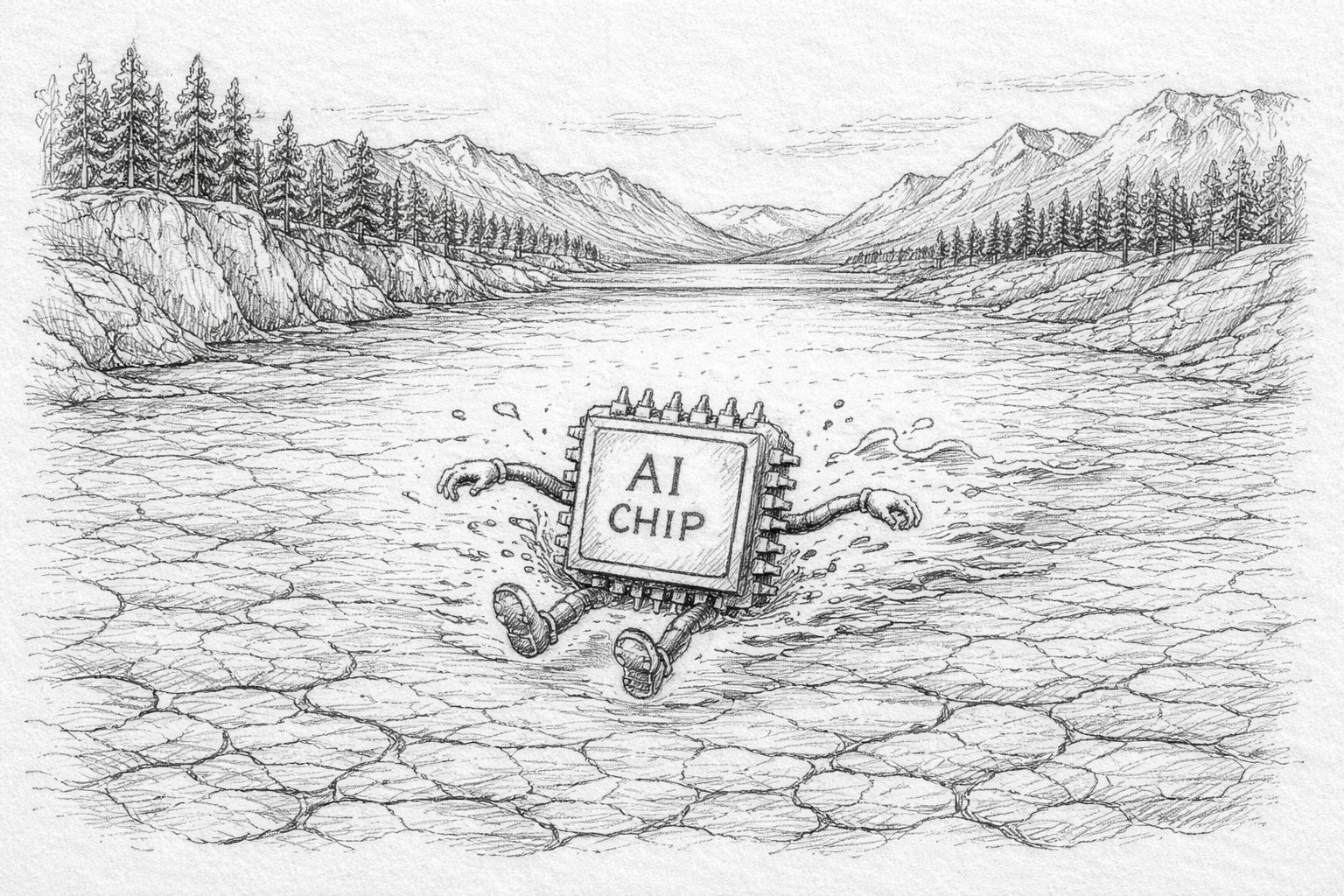
For years a good part of my work has been telling people what their website costs. Not the price of building it, which is the easy part, but the cost it carries once it is live, the energy it draws every time someone loads it and the carbon that energy turns into, measured in grams and set down in a report a client can actually read. I have run countless sites through the calculators we use for this, and I have grown comfortable handing over that figure as a fair account of the footprint a website leaves behind. It is a useful number, and an honest one as far as it goes. The trouble is that I have always known how far that was, and it was never the whole way.
Anyone who has spent real time in digital sustainability understands that a carbon figure describes one slice of a much larger cost. The buildings that serve these sites are cooled with water, built from metals pulled out of the ground, and raised on land that has to be cleared and given over to them, and none of that shows up in a grams-of-CO2 reading. I could explain all of this to a client in conversation, and often did. What I could not do was put it in the report, because a report runs on figures, and for the water in particular there were simply no numbers I trusted enough to calculate from. You cannot bill a suspicion, and you cannot ask a client to act on one either.
That is what changed for me when I read the report the United Nations University put out this year, published under the plain title of the Environmental Cost of AI’s Energy Use. The name points at AI, and most of the coverage has stayed there, but what the report really does is gather the parts of the bill that usually sit in separate conversations, the carbon and the water and the land and the electronic waste, and attach real, recent numbers to each of them. For someone whose job is to measure, that is the part that matters. The figures are finally specific enough, and current enough, to do arithmetic with.
The water is the clearest example, because it slots straight into work I already do. When I measure a site, what I am really measuring is electricity, the kilowatt hours it draws, which I then convert into carbon. Water has a figure of the same shape sitting beside the one for power, tracked across the industry as Water Usage Effectiveness, the litres a facility uses for cooling against every kilowatt hour of computing it does. How much that comes to depends heavily on where a data center stands and how it is cooled, ranging from a fraction of a litre at the most efficient sites, the ones that cool with outside air or run a closed loop, up to well over a litre where water is evaporated away in hotter, drier climates, with the figure most often quoted as an industry average sitting near 1.8 litres for every kilowatt hour. So the same kilowatt hours I have always turned into grams of CO2 can now be turned into litres of water as well. I am not measuring something new. I am running a measurement I already take through a second conversion that, until now, I had no reliable figures to perform.
I want to be plain about the scale, because it would be easy to oversell this. The water behind an ordinary website is small, almost embarrassingly so, next to the figures that have made the headlines. A single generated video, or a large model working through a prompt, draws far more than a marketing site or a blog ever will, and I am not going to pretend otherwise. If you calculate the litres behind a normal site you get a modest number, and on its own it will not alarm anyone.
The value is not in the size of the figure, though, but in the fact that we can produce it at all. For as long as I have done this work, the impact of a website has been reported as a single number standing in for everything, and now it can be reported as several, each describing a different real cost. Once you have a defensible way to calculate the water, the same report hands you the means to begin reckoning with the land these buildings occupy and the critical minerals and discarded hardware behind them. We are moving from one dimension to several, and even when the individual numbers are small, that shift is the right direction for the field to be heading.
I would be misleading you if I made it sound exact. The true footprint of a website is never a settled figure, and anyone who measures these things seriously knows it. It depends on the carbon intensity of the grid at the hour the page is loaded, which is not the same at noon as it is at midnight. It depends on how many people visit, and on the devices they use to do it, and on how those devices are themselves powered, and on a dozen other variables that no calculator captures cleanly. Any figure I produce, for carbon or for water, is an estimate built on a set of assumptions, and I would never present it as more than that.
An estimate that reaches across four kinds of cost still tells a fuller truth than a precise figure describing only one. I would rather give a client a rough account of the carbon and the water and the land and the waste their site is responsible for than an exact account of the carbon alone, because the exact number, for all its neatness, leaves the impression that the rest of the cost does not exist. A step toward measuring the whole thing
None of this changes the case I have been making for most of my career, that we should build websites which are light and fast and efficient, and it does not need to. What it changes is how completely I can show why that case holds. I have argued it on carbon for years, with the one number I had, and now I can argue it on water as well, and begin to argue it on the land and the materials too, all from figures solid enough to put in front of a client without flinching.
The report was written about AI, and the irony is not lost on me that the clearest numbers we have ever had for the cost of running software arrived under a banner that has little to do with most of what I build. But numbers do not care what they were gathered for. What the report has handed those of us who measure this work is a way to make the account fuller than it was, and a fuller account, even an imperfect one, is how this field gets more honest. That is the step worth taking, and it is one we can finally take.
Comments
Nothing yet. Say the first thing.
Sign in to join the conversation.