
Dear Friends, In thinking about prayer, I found that I was getting stuck in the mental traffic of definitions and neatly-boxed conceptions of prayer that are contained, limited, and preserved. But prayer is neither tamed nor is it unordered. Prayer is . . . well, that is, after all, my title for this meditation.
“Pray without ceasing, give thanks in all circumstances; for this is the will of God in Christ Jesus for you” (1 Thess. 5:16–18).
Prayer begins, perhaps, where certainty ends.
Prayer is the human soul, stubborn and singing, lifting “Great Is Thy Faithfulness” amid the rubble where skepticism laughs and calls it folly. It is a strange music—at once defiant and tender—rising where no song should live.
Prayer is the promised child of Abraham, born where barrenness had already written its final word. From the withered hope of Sarah’s womb comes a blessing for a darkened world: with God, all things are possible. Prayer is what happens when impossibility is quietly contradicted by grace.
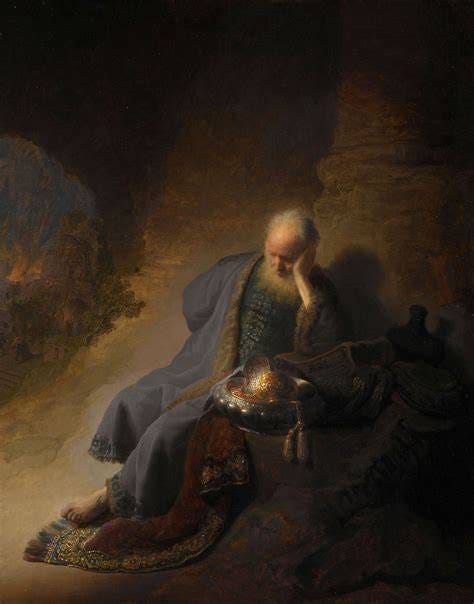
Prayer is Job, ruined and undone, his body failing, his children gone, his life a landscape of ash and accusation. Even there—especially there—his voice breaks but does not yield: “Though he slay me, I will hope in him.” It is not certainty that speaks, but something deeper than certainty.
Prayer is the quiet defiance of faith that does not need to shout over the giant’s curses, because it knows the end of the story. It is the Shunammite woman, walking through grief with a strange composure, laying her lifeless son before the prophet, as if death itself might yet be interrupted.
Prayer is a young woman in Nazareth, startled but not undone, receiving the impossible with a trembling assent: “Let it be unto me according to Thy word.” It is consent to a mystery that will reorder the world and pierce her own soul.
Prayer is the unthinkable: God in the flesh, suspended between heaven and earth, crucified by those He formed, upon wood He created, breathing forgiveness into the very violence that consumes Him: “Father, forgive them…” Here, prayer is no longer merely spoken; it is embodied, poured out, accomplished.
Prayer is the centurion, standing beneath a darkened sky, watching the cosmos unravel around a dying man, and finding himself compelled into confession: “Surely this was the Son of God.” Prayer, here, is recognition—sudden, unbidden, irreversible.
Prayer is not a transaction by which man binds God to his will. It is a transformation by which God frees man into His presence. It is less about getting something from God than being brought, sometimes against our own resistance, into the reality of God.
Those who trust in their own wisdom and deny the unseen will, in the end, confront what they cannot master. And those who cling, however falteringly, to the crucified Christ stand in quiet defiance of the madness of evil and death.
The dragon may roar. Its claws may churn the dark waters. But it does not prevail. There is a truth—singular, piercing—that cuts through the storm like a distant light, steady and searching, sweeping across the black horizon.
These things are prayer.
And there are mercies and movements within prayer—effects unseen, perhaps unknowable—that bend histories, both personal and cosmic, in ways we will only understand in the unveiled light of eternity.
So we speak our small words. With tired voices. With trembling hands. With tears we cannot quite explain. We reach upward—sometimes barely—against the gravity of doubt, if not despair.
To God the Father,
through the authority of God the Son,
by the power of God the Holy Spirit.
—Michael A. Milton
The Golden Book of the True Christian Life by John Calvin, Prayer by Ole Hallesby, and A Shepherd Looks at Psalm 23 by W. Phillip Keller.
Ethical writing. The author wrote all of his material. It may be edited for spelling and structure via programs such as Grammarly. Our statement stands despite the LLM scanners that distrust prose and poetry in essay writing as if it is something peculiar to the human mind and expression.
Comments
Nothing yet. Say the first thing.
Sign in to join the conversation.