
Being a type-B creative is a bit of a cosmic giggle. Don’t get excited, you’re not in on it - but some ambivalent AI running Sims 5000 is watching us struggle with lofty aspirations and conflicting personality traits with a chuckle.
(and to that I say: ai overlord, bestie, if you want to add genius or ambitious or just any of the traits that come with focused moodlets, you have my encouragement. cntrl, shift, c, they haven’t changed it.)
In the meantime, let’s talk about one of the inescapable ironies of being a chaotic creative and one of the tools I’ve found that actually helps.
Now, if I know my audience, some of you can relate to this: you have endless ideas, including some real good ones. However, what you lack is execution - in fact, let’s go one further: what you lack is the mental clarity (and maybe executive function) for effective execution. You have a million-dollar idea, but your brain short-circuits the moment you sit down to plan it.
I know because I’ve been there. I am, in fact, still there. Unfortunately, it seems I will be there, on and on, repeatedly, for the rest of my life. (yes, i know repeatedly after on and on was redunant, i refuse to apologise for it.)
Overwhelm aside, the bread must be obtained; bread being financial, social, aspirational, etc - this metaphor is doing a lot of heavy lifting. The point is: you can’t just roll over and die, both because mentally that’s not gonna be great and also because you can’t afford it. Sorry for the reminder.
So what do you do? Well it’s pretty simple:
When we are planning, or working through complex problems, we’re actually asking quite a lot of our brain. Whether that’s being able to visualise multiple steps at once, wrangle all the offshoots of an idea into something comprehensible, or even just to be able to immediately make sense of the big ball of inspiration you threw at it.
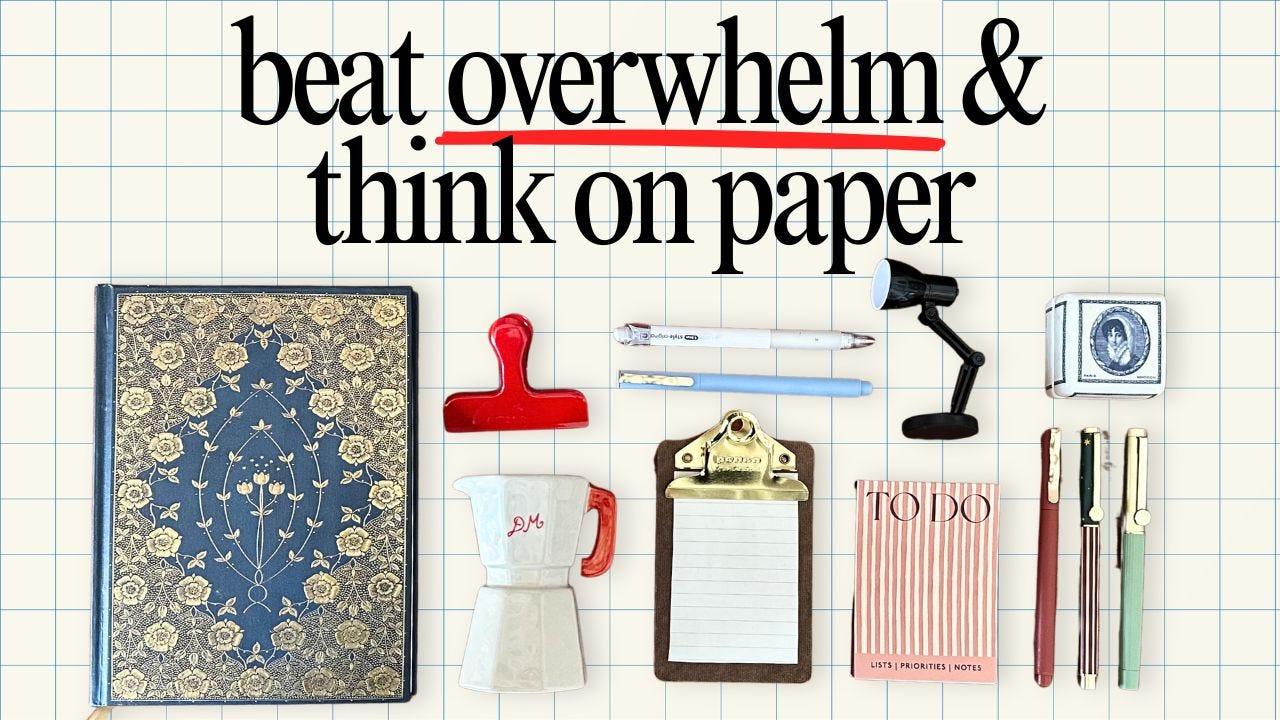
When I’m talking about exporting your thinking, what I specifically mean is thinking on paper, as a way to structure and guide your thoughts, rather than feeling overwhelmed trying to hold them all in or doing all the organisation internally.
As a quick example: one of the common ways this shows up for me is cleaning. If I walk into a super messy room, my brain just fries. So I tend to write out my deep-cleans into step-by-step checklists, rather than just…winging it. But how can you use this for your big ideas?
I 100% credit this idea to the brilliant Rachelle In Theory. I first watched her video on starting a thinking book many moons ago and can attest that it’s one of the most useful things I’ve done for my creative projects!
Essentially, a thinking book is a dedicated space to thinking on paper, the draft to the draft. Think, make it ugly, get your ideas out - and then move the nice shiny finished thoughts to their proper home.
You can do this on scrap paper, but having a book keeps your thoughts in one place and that can be useful to come back to. Personally, I don’t have separate thinking notebooks but, in both my personal and my business refillable journals, the first inserts are thinking books. And that’s where I work through things, unjumble my thoughts, and really start the execution part of ideas.
If you’re someone like me, who definitely struggles with feeling overwhelmed, it can be a really good tool to help you sit down and start working your way through big tasks and projects.
Now, you might be thinking: okay, but how is this any different from a general notebook, or a braindump book? And it’s not really, but until someone said, ‘hey, you should create a dedicated space for thinking and problem solving on paper’ I never thought to do it.
But now that I have a thinking book, and I regularly practice thinking on paper, it’s become indispensable to my process. Whenever I have a tricky idea, or a concept I want to work through, it is my first port of call. And it bloody helps.
So this is me, sitting in front you, passing on the information that you should start a thinking book.
For each page, I name it and set a purpose.
The fear of the blank page is real, so the first thing I do is just write down what exactly I’m thinking about. What’s the purpose, what’s the problem? As an example, I had a page that literally said: I am overwhelmed and trying to prioritise, where I brain dumped all my to-dos and priorities, so I could visually group and order them.
This was a tip from Rachelle’s video and another really useful thing she shared was some specific page structures she uses. I don’t want to rip her off, so go check out her video for those.
Remember that the benefit of paper is being linear is not a requirement.
This is not a notebook. I mean, yes, it is literally a notebook but you don’t need to write in full sentences, or be neat. The benefit of this book is that I can think how I think - not limited by neatness or, really, even rereadability. I can use arrows to convey offshoot ideas, doodle mockups, draft up tables and mindmaps. However it is useful for me to process information, whether that’s visual or written or a blend of both, this is my space.
If you want to see some of these pages in action, feel free to check out my video!
I’ve been using thinking books for maybe 7 months now and it’s genuinely one of my favourite tools for seeing an idea through to execution. So, if you’re a fellow overwhelmed queen, highly recommend giving one of these a try!
Comments
Nothing yet. Say the first thing.
Sign in to join the conversation.