

There’s a particular kind of stress I hate. I mean, obviously, all stress is bad, but at least some stress feels earned. There’s a big, bad scary thing looming over me? Well, I’d argue that stress is the natural - dare I say logical - reaction.
On the other hand, you know that low-level, seemingly baseless kind of stress? When you wake up on a Saturday with a whole weekend free, maybe a very manageable to-do list, but you still feel like you’re being hounded by Peter Thiel? (honestly, that’s a valid feeling - you probably are.) That kind of stress is less tolerable.
Alas, both of these scenarios are occurring in my life right now and, to mitigate the big, bad scary, I need to actually be on top of my shit. So today, we are trying to manage that second type of stress by exploring the mental lag that unfinished tasks cause us… and closing some of those loops. Let’s go!
I think we can all agree that big unfinished tasks cause us stress; however, what if the same mental strain applies to everything you don’t finish? Minute things like laundry, unanswered texts, the book you want to finish, that one item you’ve been planning to sell, and so on and so forth. Even if the task doesn’t come with the same glaring warning sign, if all those little unfinished tasks come with their own cognitive drain… well, there’s only so much soup in the pot.
For this post, let’s call all these incomplete tasks, no matter how little, open loops.
What we’re talking about today is an idea that comes up in ADHD online spaces a lot, but I think it’s applicable just in general:
TL;DR: Having all these open loops constantly playing on your mind is a mental drain and a contributor to that feeling of low-level stress and overwhelm. Setting time aside to intentionally close those loops can make you feel better.
(yes, i know the TL;DR should be at the top. i’m doing it here anyway.)
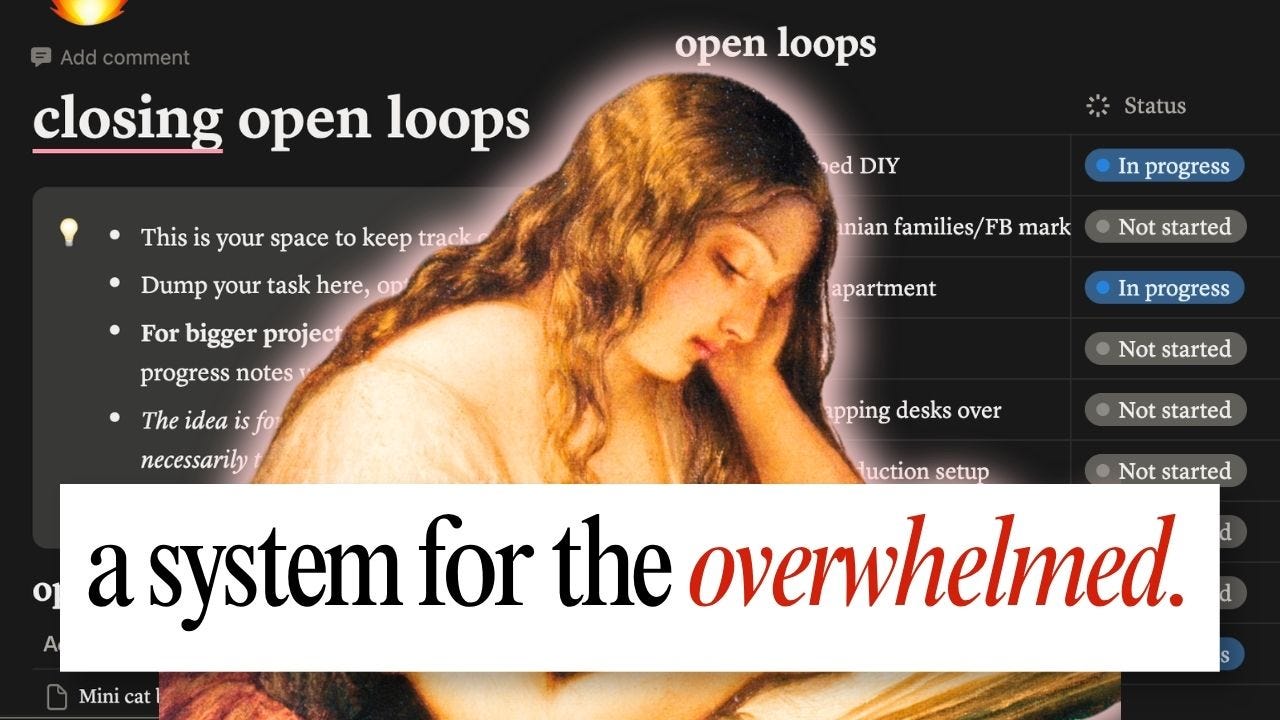
Now, let’s actually talk about what we mean by closing loops - because it’s not as be-all, end-all as it sounds.
Essentially, we’re just taking those unfinished, constantly cycling tasks from our brains, and doing at least a small step (even if that’s just writing them down) to signal to our brain: hey, chill, this is getting worked on. It doesn’t have to be the whole thing; you can break tasks down into smaller chunks or micro-loops and you can even set aside a dedicated time or day to work through them. We’re just making some kind of tangible progress.
But where does this idea come from anyway?
The Zeigarnik Effect is a psychological term that coins this very thing - to put it simply, the brain remembers incomplete tasks better than completed ones. This phenomenon was initially observed with waiters, who could remember their incomplete unpaid orders, but would promptly forget completed ones.
Quick fact check - first of all, not a scientist nor a psychologist, simply a crow girly with a keyboard, you know how it goes. This section is here as context to the idea, as my introduction to the closing loops concept was through the ADHD tips side of the internet, where it is usually brought up with the Zeigarnik effect.
However, in researching the Zeigarnik effect for this, one thing I found was that it’s not an airtight theory, or without its controversies. Apparently, the effect has been hard to reproduce in modern studies, and it kind of overlaps with other things, yada yada yada.
Unfortunately, Google has fucking ruined search results, the AI feature I didn’t ask for is not only annoying but is also completely useless and hallucinates random crap that doesn’t even slightly reflect its own linked sources, so I found it hard to pinpoint exactly what the actual critiques were, outside of one YouTube video.
(and I can make Youtube videos, so we can’t take them as gospel)
Wikipedia was useful in pointing to a meta-analysis of studies exploring the Zeigarnik effect, which is where I pulled those critiques. All that said: while I will always do my best not to spread misinformation, this actually isn’t that important outside of explaining the context of the closing open loops idea, so… we’re leaving it there!
(To see this in play, skip to 06:05 in my Youtube video - and you can also watch me try and fail to close some loops)
Our battle plan is simple:
Brain dump everything you need to do, every outstanding task demanding your attention.
There’ll probably be some mental trash kicking around - write it off.
With your revised task list, you’re going to move it over to… well, whatever place you will actually check it. I used Notion because it’s where my business hub is, so I check daily (and, for big projects, it’s useful to store links etc) but a journal would also work! It’s up to you what information would be useful to track but I included:
- Importance (high, mid, low)
- Progress (not started, in progress, complete)
- Task notes (challenges I was facing to start, a step-by-step list for myself, supplies needed etc.) This one I’d probably leave off a journal spread.Now that you have your tasks written out to work through, you can either start working through them or mentally set a date to come back to it.
Ultimately, the idea of closing open loops is really simple - but I feel a lot better for having given myself a set space and dedicated time to try it. With running my own business and life, tasks constantly pile up and - as a chronically overwhelmed girl - it was quite nice to clear a few off my plate.
Comments
Nothing yet. Say the first thing.
Sign in to join the conversation.