
Imagine waking up every morning filled with purpose, an innate drive to do that special thing that fills you with soul-deep satisfaction. (if your first response was ‘imagine having something that fills you with soul-deep satisfaction’, may i interest you in the mountains? i’m being so serious right now; I had a mental breakdown trip to the mountains just last month, it was great)
watch this post
If you’re me, the fires of your early-morning passion are stoked by the siren call of coffee.
If you’re an extreme cave diver, it might look like strolling past your adoring wife and beautiful children to squeeze yourself down a one-way tunnel the size of a watermelon, probably while there are active earthquake warnings in the area.
A lot of popular advice from careers to general life satisfaction revolves around the concept of passion; this elusive, near-mystical force that, once found, can act as the cornerstone for your life. Sounds great; I’m sure we all want to get in on that.
Now, spoiler alert, I actually agree with the hype. I have one definitive passion in my life - reading and, by extension, writing - and, not to be too Live Laugh Love about it, but it has been a guiding force in my life. It’s influenced my career choices (i mean, hello, we are here right now) and kept me very well occupied hobby-wise too.
However, I was rather lucky and discovered that passion pretty much before I gained sentience. My mother was reading to me while I was still an NPC.
What if you don’t have a passion yet? Or if, like myself, you have a passion in one aspect of your life but feel that there’s more inside you to give. (and, if we’re being honest, that you like sugary things with enough passion that you need to balance the scales lest diabetes come knocking)
Well, that is what we are here to find out today.*
*within reason. i’m neither a scientist nor a psychologist, and these posts are the culmination of me reading about a topic that interests me for a few weeks. use them as a starting point if you are also interested in these things, but don’t bet it all on black :)
Let me reach into my crystal ball real quick. In your quest for a passion, have you ever tried something new, felt absolutely nothing special, and dropped it thinking “this just isn’t for me”?
Let’s start by establishing the simple fact that learning something new is genuinely hard. It is taxing on our brain, and that’s often an uncomfortable feeling - especially if you’re learning something new for the purpose of enjoyment.
I read an interesting Medium article on this topic, so if you need someone external to validate that it’s okay to not be fun and hot and sexy at everything the first time you try it, to quote:
‘This is explained by cognitive load theory, which states that the brain has a limited capacity for processing new information. When we first encounter complex material, we’re juggling multiple layers of unfamiliar information leading to a high cognitive load. Initially, everything feels difficult because there’s a lot to hold in working memory, but over time, as we become more familiar with basic concepts, we free up cognitive resources to handle more complex tasks. The key is repeated exposure and practice, which reduces the cognitive load over time.’
Why am I starting with this? Because although we all logically know learning new things is hard, emotionally… well, sometimes we don’t.
Growth mindset sounds like the name of a dropshipping course, so sorry for the jump scare, but it’s actually pretty simple:
A growth mindset means that a person believes they can improve and develop their abilities.
Whereas a fixed mindset is a limiting belief that you can’t meaningfully improve your abilities.
On the surface, I’m sure we all agree that people can improve in skills. So let’s look at how Psychology Today expands on the fixed mindset. (because I know some of you are harboring darkness.)
I’m not good at anything. I always strike out. Everyone else does better than I do. They are convinced that they can’t learn anything new and that it’s far too late for them to try because they will fail anyway. They feel they struggle too much in their tasks, and they feel inferior to the seemingly easy success of the people around them.
(you, in the bathroom mirror, probably) (jk, it’s from Psychology Today)
Okay, so why do you care?
The root of it is that people who believe they can develop their abilities respond better to mistakes and the natural stumbling blocks that come with trying new things. Which is pretty make-or-break when you’re tackling a new hobby.
Still, why are we talking about new hobbies when you’re on a quest for passion?
The psychologist Carol Dweck, who was also behind the growth mindset theory, also looked into how we think about our own interests and passions. And bless her for consistency because she found we tend to fall into one of two camps: the growth vs fixed.
Ironically, in this case, the fixed theory is probably the one a lot of us are defaulting to; the idea that our passions already exist within us somewhere, just waiting to be found. You’ll try it once and just… know. Sounds romantic, right?
Much like with love, the problem with that belief is that, if something doesn’t grab you right away, it’s easy to think “okay, that’s not my passion”. And that’s the end of that.
On the other hand, we have the growth theory of interests: the idea that passions aren’t found fully formed; they’re developed over time. As you practice and get better at something, it starts to grow on you.
Basically, when you’re trying new things, if you’re waiting for that instant “this is it!” feeling, you might be writing off things that — given a little more time — could have become a real passion. So maybe the question isn’t just “what’s my passion?” Maybe it’s “am I even looking for passion the right way?”
Back to my crystal ball moment from the start: you’ve tried something once, felt nothing special, and decided it’s not for you.
Well, hopefully, we can now look at that example and see some of the issues.
Almost nobody discovers a real passion on the first try. As we discussed, learning things is hard for our brains, and difficulty isn’t the most fun feeling to sit with. It’s certainly not the instant connection you may be hoping for.
On that, though - what exactly were you hoping for? What did you expect the activity to feel like?
I’d argue you’re probably searching for the ‘flow state’; where you’re so locked into an activity that everything else falls away, and you’re truly immersed in what you’re doing. Like being sucked into a TikTok doomspiral, except you exit the dopamine dungeon feeling good about yourself.
The reason I bring up flow-state is actually because I remembered something I came across for an old video of mine - so take a quick detour with me.
Drexel University did a neuroimaging study on jazz musicians accessing the creative flow state. And to quote:
The findings reveal the creative flow state involves two key factors: extensive experience, which leads to a network of brain areas specialized for generating the desired type of ideas, plus the release of control – “letting go” – to allow this network to work with little or no conscious supervision.
So what happens when you try a new hobby for the first time? You don’t have the skill yet! You don’t fully understand what you’re doing, and you’re probably too busy trying not to mess up to actually enjoy it, let alone let go. So are we likely to enter that flow state? I fear not.
But that doesn’t mean the activity isn’t for you — it just means you need a bit more practice and experience before you can judge.
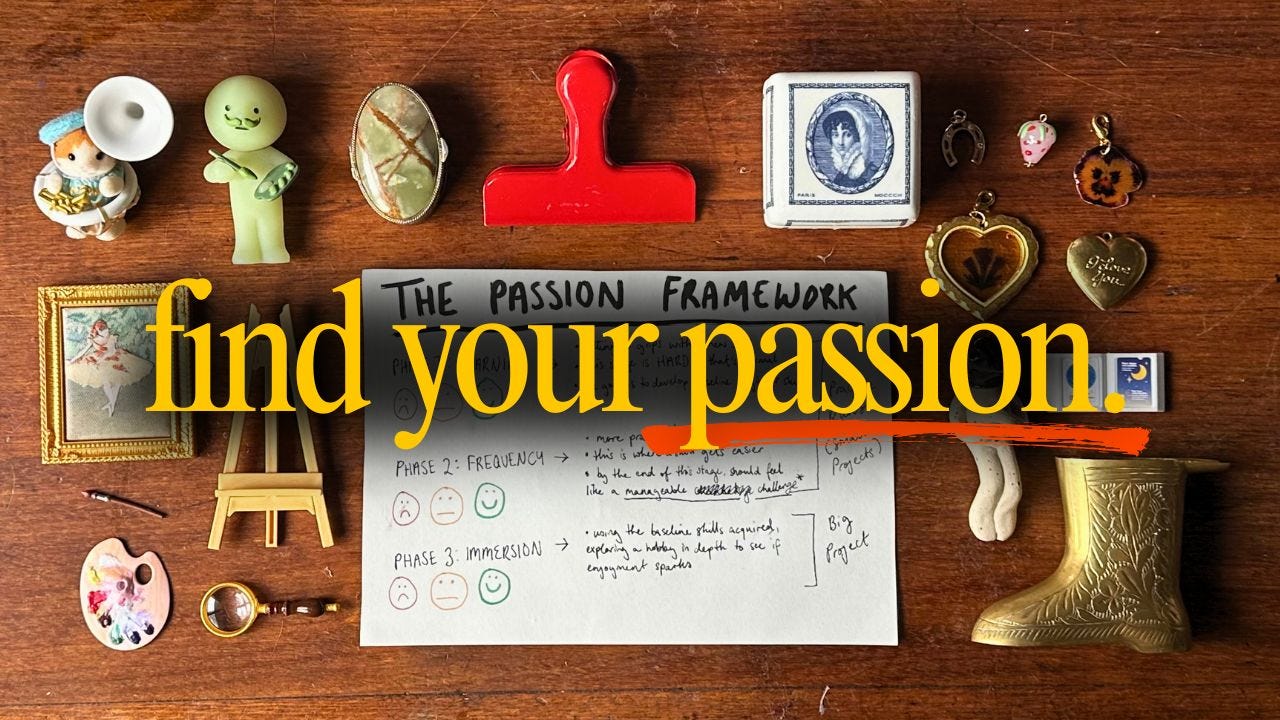
And so, we get to the fun part of this article: how can I actually apply any of this? Well, my friends, you know me - and you know that I love a cheat sheet, I love a template. So I created a simple framework for myself to follow when I am exploring if a hobby has passion potential.
Phase 1 is learning
Phase 2 is frequency
Phase 3 is full immersion
In phases 1 and 2, I’ll basically just be doing small practice runs to get my head around a new skill. Once I have those baseline sessions under my belt and we’re out of flailing panic mode, that’s when I’ll progress to a big start-to-finish project. Something really immersive, ideally quite time-consuming - and it needs to be a bit of a challenge. Once I’ve worked through that, hopefully I’ll have an answer on whether a new hobby could become a passion.
Check out my first attempt below!
<3
Comments
Nothing yet. Say the first thing.
Sign in to join the conversation.