

I’ve been thinking a lot about research as a leisure activity — approaching my curiosity with the rigor of someone in school, minus the grades, assessments, and shudder class participation. There are so many people, things, places I want to learn about! Ever since Kel Rakowski suggested the idea of creating mini syllabi for personal use in one of her newsletters, I’ve wanted to do this for Agnes Varda, Carl Jung, modernism, The Odyssey…random areas of interest I’ve never explored.
The other night I was listening to Overmono’s Fabric set when their remix of “I Have a Love” came on. The track sits in my sonic sweet spot (think Bicep + The Streets), and its words took my breath away. As I wondered about the story behind the visceral narration, I realized: Every song is a syllabus. Usually I enjoy the beat without going below the surface, but this time I had to know: what’s going on here?
My deep dive turned into a mini syllabus about a poet named Paul Curran, a place called Coolock, and the art of making music from grief.
⬇️ START HERE
⬇️ “I Have a Love” by David Balfe
This is the original track that Overmono remixed. David Balfe wrote it as a tribute to his best friend and bandmate, Paul Curran, a spoken-word poet who died by suicide in 2018.
I have a love, and it never fades
From red garden sheds
To watching lads on steds knocking heads
From the two by two fuck you punk stage
To a warehouse rave, with a bloke we met on the way
Dancing til day
I have a love, and it never fades
Full of plights and gripes, like Achilles who loves fights
Like you did, right?
Like we did, twice
I will love you beyond life
I have a love, and it never fades
You are God’s son across the bеlly
Rememberеd by pictures on your telly
Your body laying in its glow
Surrounded by those you know
Crying for you words, and your soul
And the final loss of your glimmer of hope
That we heard every time that ya spoke
And choked up rooms, and blocks, and venues
And lads and mots, with words that spoke soft of those lost
Now we send you off on funeral cloth
⬇️ Burnt Out, For Those I Love, The Murder Capital
Balfe and Curran were in at least three bands together; the most notable was the collective Burnt Out. VICE called it one of the most thrilling short-lived projects in Irish music history, even though only two songs, “wounded street anthems,” saw the light of day:
The boys had been besties for 13 years when Curran died. Their friendship started in the first week of secondary school, when Balfe spotted Curran’s At the Drive-In badge on his backpack. It was a great example of one of my favorite sayings: “We’re not strangers if we like the same band.”
When Curran passed, Balfe channeled his grief into an album called “For Those I Love.” The work is threaded with WhatsApp voice notes and old phone recordings of Curran, including his laughter, voice, and readings of his poems. It sounds like an audiobook scored by Jamie XX or Burial — melancholic and ravey.
The loss impacted their friend group and also inspired The Murder Capital’s album “When I Have Fears,” produced by Flood, known for his work with PJ Harvey and Foals. Recommended if you like Joy Division or Idles.
⬇️ Coolock, Ireland
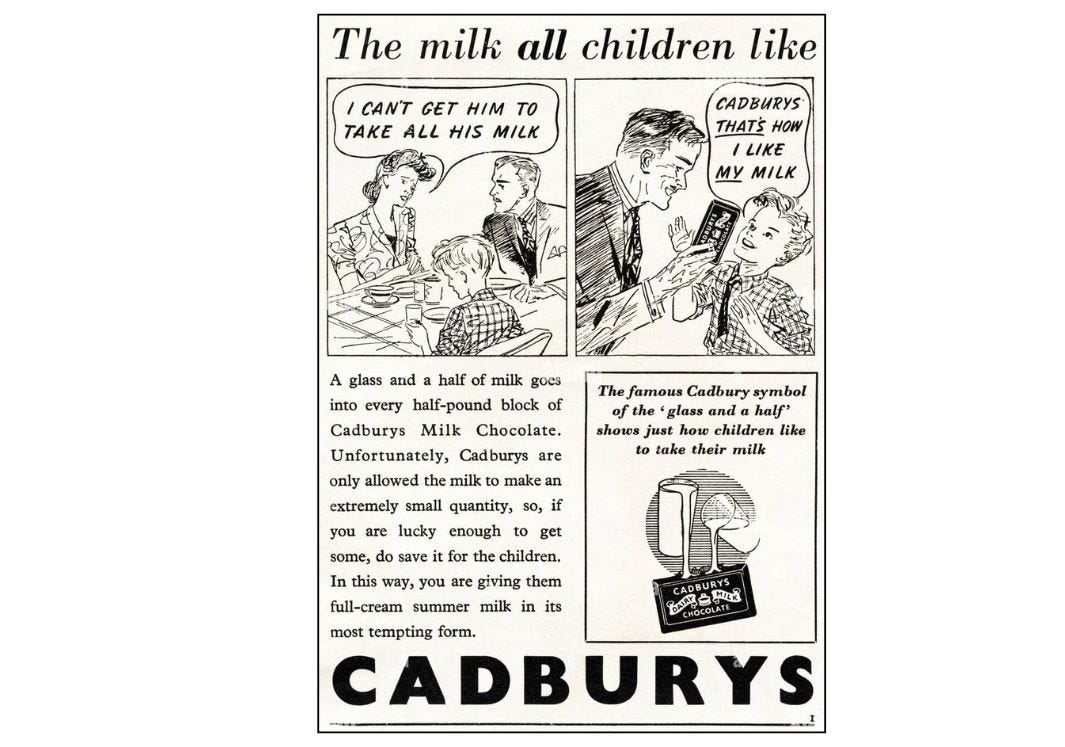
The friends were from Coolock, in north Dublin, and Curran’s poetry was about working-class life there. Derived from the Irish An Chúlóg (“the little corner”), Coolock has been inhabited for over 3,500 years and was a primary location for the 1991 film, “The Commitments.” It’s also home to the Cadbury chocolate factory.
⬇️ Deindustrialization
Cadbury arrived in Coolock in 1957, just as Dublin housing programs were moving thousands of working-class families from the inner city into new suburbs. The factory was one of the area’s steadiest employers for decades until layoffs in 2006 began a slow drawdown, triggering economic precarity across the region. This slide made me curious about deindustrialization, the decline of manufacturing within a region, and its social and economic impact in the US and UK. I curated a list on Margins of related fiction and nonfiction in case I want to do deeper.
⬇️ Paul Curran’s poetry
Curran didn’t call it deindustrialization; he called it “the art that never gets made.” His poem “Just Saying” detailed the grind of being a working artist in a depressed environment, from the track “Joyrider”:
“You get 50 quid to do a gig / the 50 quid goes off a bill / a bill that never gets paid... e and weed and speed and ket … the type of shite that leads to death … your brain turns to mush... you don’t do what you love as much … the art that never gets made.”
I got chills when I found this video of Curran performing his work. His poem “Taxi” details how an ordinary cab ride can be a story of class and compassion.
“He makes a thousand ten minute friends a night, under the glow of his taxi light”
I recommend turning on the transcript and following along:
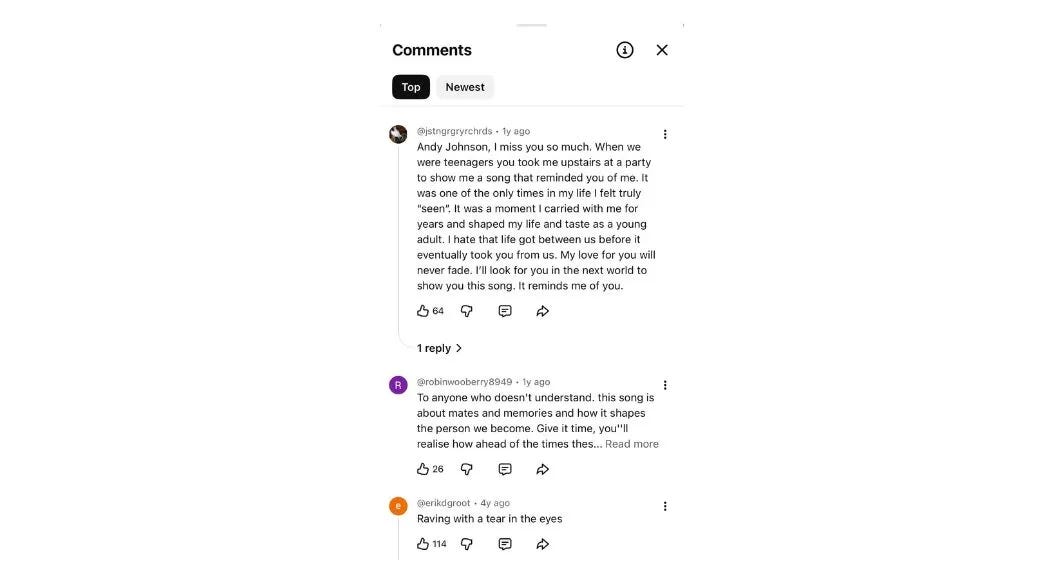
Here’s a piece from someone who knew Paul in the last five years of his life:
⬇️ Grief in community
Curran also loved Shelbourne Football Club. In the aftermath of his death, Balfe and friends scattered his ashes at the center circle. Balfe noted to The Irish Times how important it was to be able to hand over his grief to something bigger than himself: a game, a crowd, a collective experience…
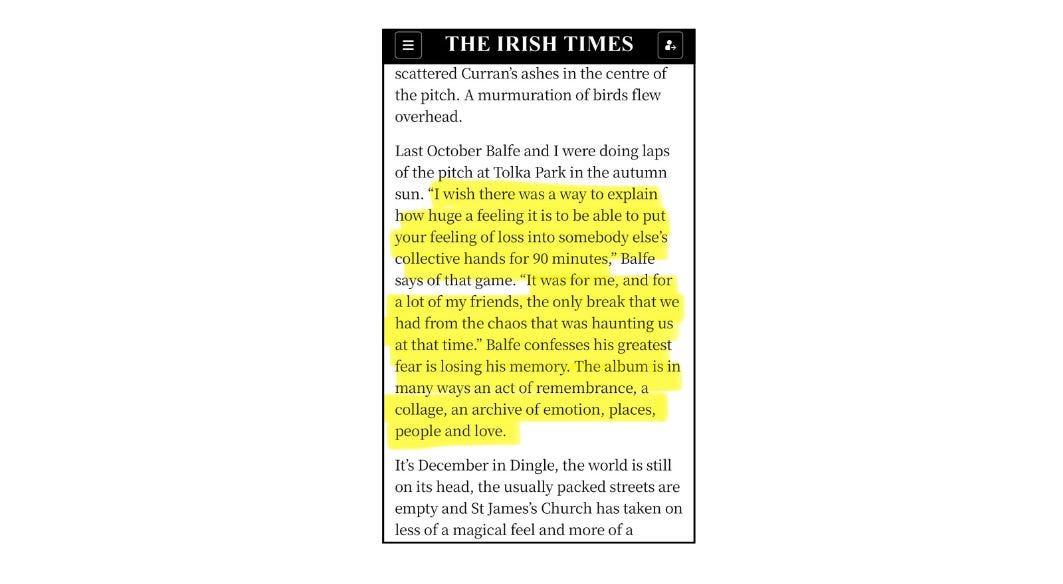
The cathartic communal space happened to be a soccer pitch, but it could’ve just as easily been the dancefloor. Which is exactly why Overmono remixed “I Have a Love” and invited us in.

No posts
Comments
Nothing yet. Say the first thing.
Sign in to join the conversation.