
I’m worldbuilding an easy-to-write Space Opera/Adventure setting and it’s time to drill down to how space travel works.
The previous Conflict Diagrams treated the tropes themselves as positions at stake in a conflict between reality and… well more tropes.
I ended up with:
Fuel is purchased
Need bases and supply dumps.
Fuel refined at wormholes
Wormholes for very long journeys.
FTL Drive
Travel in hops between systems.
Interesting systems spread out.
So now we step into the starfarer’s shoes and imagine how this would look from the inside. This requires another Conflict Diagram, but one that’s more like a flow diagram capturing how a ship would move through a star system.
The result is somewhat sprawling, but I have a 32” monitor so I’m OK…
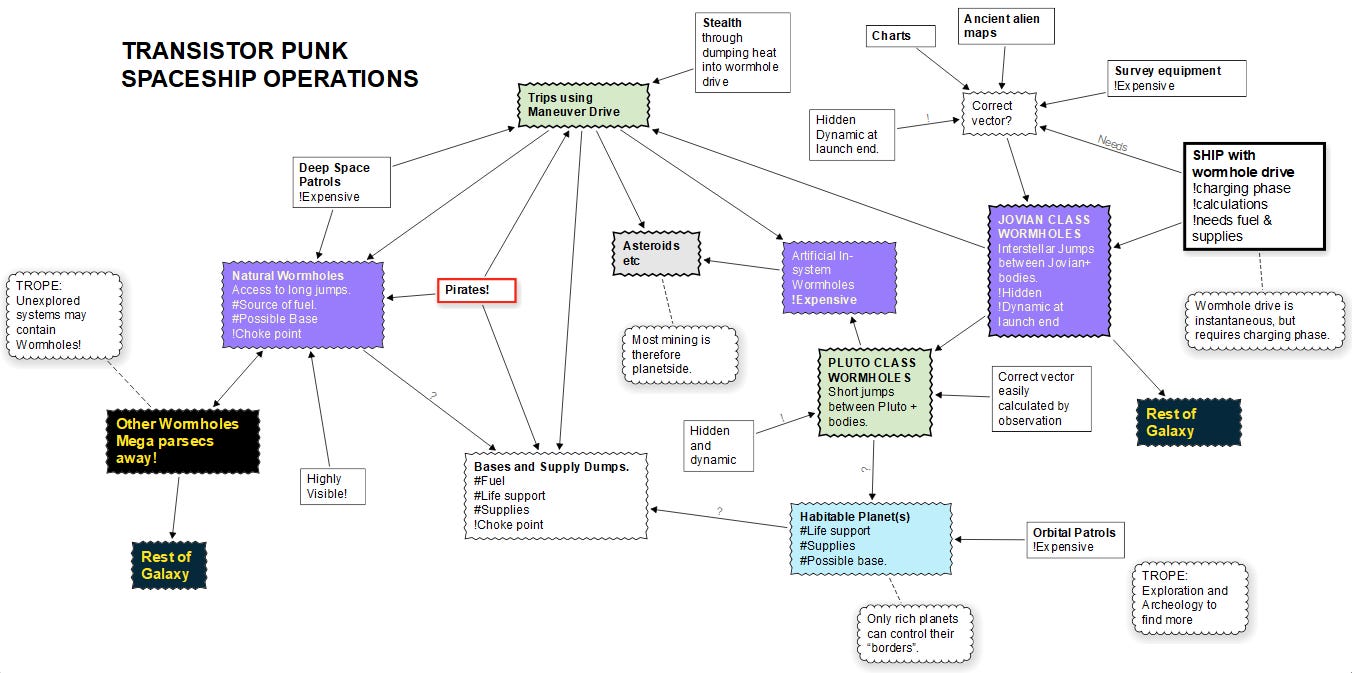
Looking up at that, I can see I need to do Spaceship Design and Economics & Logistics next. However, what I have now is almost enough for me write or GM using this setting.
There’s actually no need for me to write supporting text for my own use. In creating the diagram, I have internalised it. If I need a reminder, the diagram will suffice.
However, clients and maybe other people wanting to play in the same sandbox, generally need to see some text, so here’s a draft…
(Draft material. All terms are placeholders.)
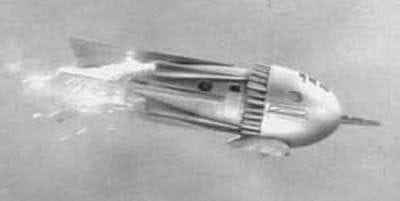
Spaceships range from the equivalent of 1930s flying boats through to liners and bulk carriers and everything in between. Some are designed for endurance, others are cramped and good for one trip between systems.
Wormhole Drive allows near-instantaneous travel through wormholes that connect different regions of space. They must recharge after each trip, expending “mojo”, a special fuel refined at natural wormholes (see below).
Ships usually enter and leave a system via a Jovian Class Wormhole. These connect Jupiter-like bodies in different star systems and are both invisible and dynamic. This means you need a chart or expensive survey equipment to locate the wormhole, and then the time to complete the vector calculations. Commercial archaeology often focusses on sourcing lost wormhole charts.
Once in a system, a ship uses Pluto Class Wormholes to jump between planetary nor near planetary bodies of Pluto size or greater, potentially reaching a habitable planet. These wormholes are also invisible and dynamic. However, you can detect them by observing the system.
Habitable Planets are a good source of supplies, especially for life support, and often have bases and supply dumps. Since jumps are into near orbit, only rich worlds can truly control their “borders” and prevent smugglers and “Space Vikings”. (Given the limitations on technology, defence systems and patrols are human controlled and expensive.)
Bases and Supply Dumps are necessary for provision of “mojo” to fuel the wormhole drive, and — where not available from a habitable planet — as a source of life support and fuel. This makes them a choke point exploitable by pirates.
Maneuver Drive, a inertialess propulsion system similar to Wormhole Drive, enables ships to travel, slowly, to sub-Pluto sized bodies without wormholes. These potentially include hidden supply dumps (see above) and bases on small moons and asteroids.
The inaccessibility of Asteroids means that most mining is on a planetary surface, unless somebody has constructed a very expensive Artificial In-System Wormhole.
Imperfect Stealth can be attained by dumping heat into the maneuver drives and thus into hyperspace. A square law applies, making stealthy easier for small ships, thus favouring pirates and smugglers. Really expensive military ships have reliable detection equipment that can only be countered by even more expensive stealth equipment. Skilled operators make a difference at both ends of the equation.
Natural Wormholes are highly visible vortices connecting distant systems thousands or even hundreds of thousands of lightyears away, without the need of a wormhole drive. These can be of immense strategic and economic significance. Unfortunately, you can usually only reach them using maneuver drive, making you vulnerable to pirates.
(Historical note: the onset of the technology-killing Effect coincided with the sudden appearance of “natural wormholes” in systems across the galaxy.)
Mojo, the fuel required by wormhole drives, is exclusively refined at natural wormholes, making them a good location for an installation.
Key Tropes: Some worlds maintain costly Deep Space Patrols, especially where there are natural wormholes. Pirates prey on traffic to bases and natural wormholes. Smugglers and Space Vikings make unlicensed visits to the planetary surface. Scouts, Archaeologists and historians look for lost wormhole charts and forgotten Natural Wormholes.
I think that’s pretty good so far!
I’ll tackle spaceship design next, which should provide some figures to flesh out the bones I’ve sketched.
If you’re interested in Conflict Diagrams, you can find an introduction in my old Storyteller Tools book.
Comments
Nothing yet. Say the first thing.
Sign in to join the conversation.