
I built a tool that does exactly that. It’s free, it’s live, and it uses real neuroscience. Not vibes. (EXPERIMENTAL)
Every SEO tool tells you what happened after you published. Rankings went up, clicks went down, keyword difficulty is X. All backward-looking. Or AI? It predicts what you asked for but it’s blind.
But what if you could measure the one thing that actually matters, whether a human brain will pay attention to your content, before you hit publish?
That’s what I built with NeuralSEO.
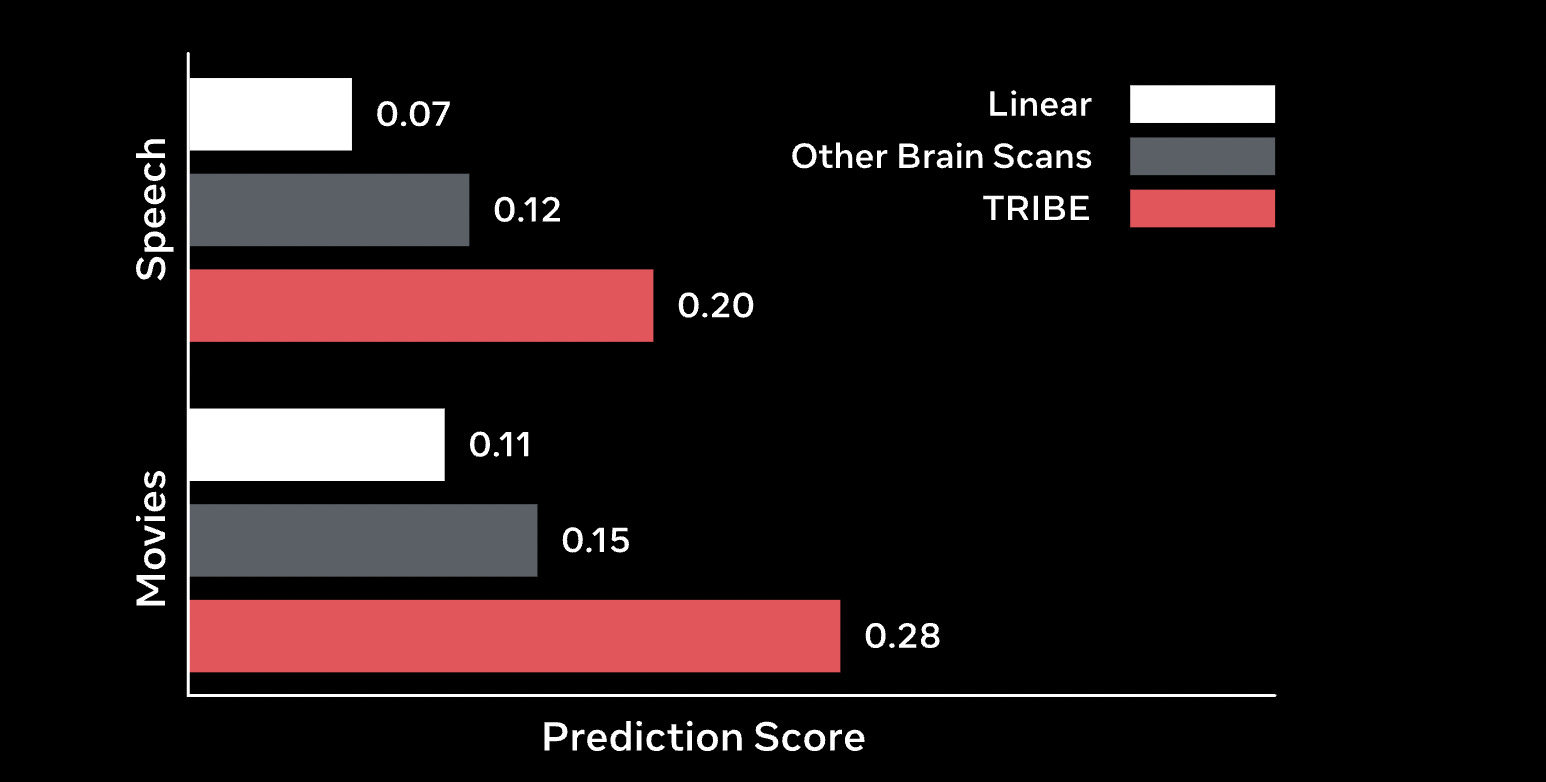
Meta AI released a model called TRIBE v2, which stands for TRImodal Brain Encoder. It was trained on something remarkable: 1,115 hours of real fMRI brain recordings from over 700 human volunteers.
These people watched videos, listened to audio, and read text while inside an MRI scanner. Meta’s model learned to predict exactly which brain regions activate in response to any content.
I took that model and asked a simple question: what if we used brain activation patterns as SEO signals?
Three tools, all powered by Meta AI TRIBE v2:
Upload a screenshot from Google SERP, ChatGPT, Perplexity, or AI Mode. The tool splits it into regions, runs each through TRIBE v2’s visual pipeline, and scores every element by neural attention. You literally see which part of the page the brain notices first.
Paste your opening paragraph. TRIBE v2 scores it on four dimensions:
Hook strength: does it grab attention?
Engagement: global neural activation
Salience: does it stand out?
Retention: will the brain remember it?
You get a 0 to 100 score plus optional AI rewrite suggestions.
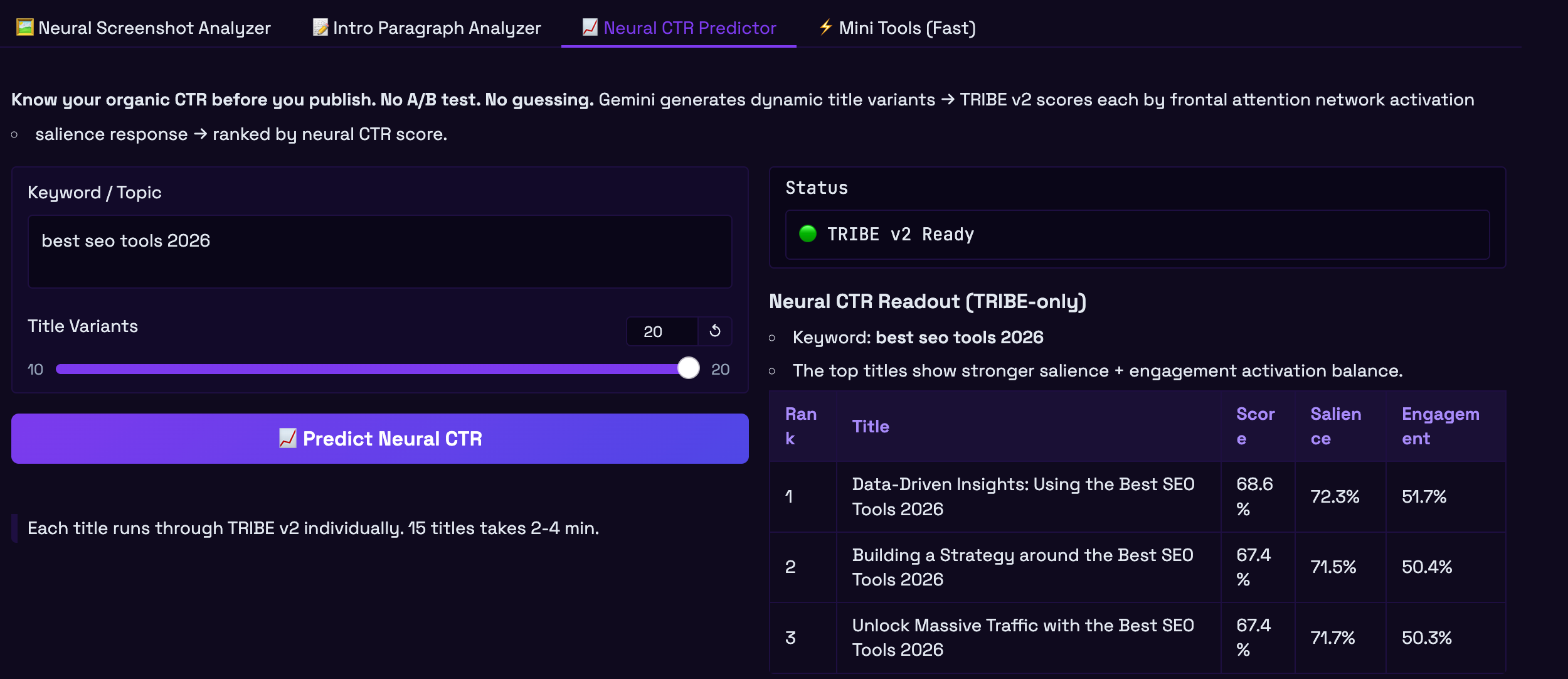
Enter a keyword. The tool generates 10 to 20 title tag variants, then TRIBE v2 scores each one by frontal attention activation. You get predicted CTR rankings. No A/B test required.
High frontal attention activation means the reader won’t bounce. Their brain is actively processing your content.
Strong salience network response means your title stands out. In a list of 10 blue links, yours is the one the brain flags as different.
Low Default Mode Network activation means the reader isn’t mind-wandering. They’re locked in. This is the opposite of what happens when someone reads generic, templated content.
High activation entropy means the brain is working harder to process the content. This correlates with expert-level material rather than thin, surface-level text. It’s an E-E-A-T proxy signal.
I want to be direct about limitations.
This is not a ranking factor tool. Google doesn’t use fMRI data.
Neural scores are directional signals. They tell you “this title is neurologically stronger than that one,” not “this will rank number 1.”
The model runs on GPU and has quotas. Large inputs may timeout.
It’s experimental. I built it to explore what’s possible at the intersection of neuroscience and SEO.
The SEO industry optimizes for algorithms that are themselves trying to approximate human satisfaction. We’re optimizing for a proxy of a proxy.
TRIBE v2 lets us skip one layer of abstraction. Instead of guessing what the algorithm thinks humans want, we measure what the brain actually does.
Is it the future of SEO analysis? I don’t know. But it’s a fundamentally different signal, one that comes from neuroscience, not keyword density or backlink counts.
It’s free and live: NeuralSEO
If you’re curious about the intersection of AI, neuroscience, and search, I write about this stuff regularly.
Subscribe to get more: metehanai.substack.com
And let me know what you think:
X: @metehan777
LinkedIn: Metehan Yesilyurt
Website: metehan.ai
NeuralSEO is built on Meta AI’s TRIBE v2 (CC BY-NC 4.0). Free for non-commercial use.
No posts
Comments
Nothing yet. Say the first thing.
Sign in to join the conversation.