
0:00
-12:30
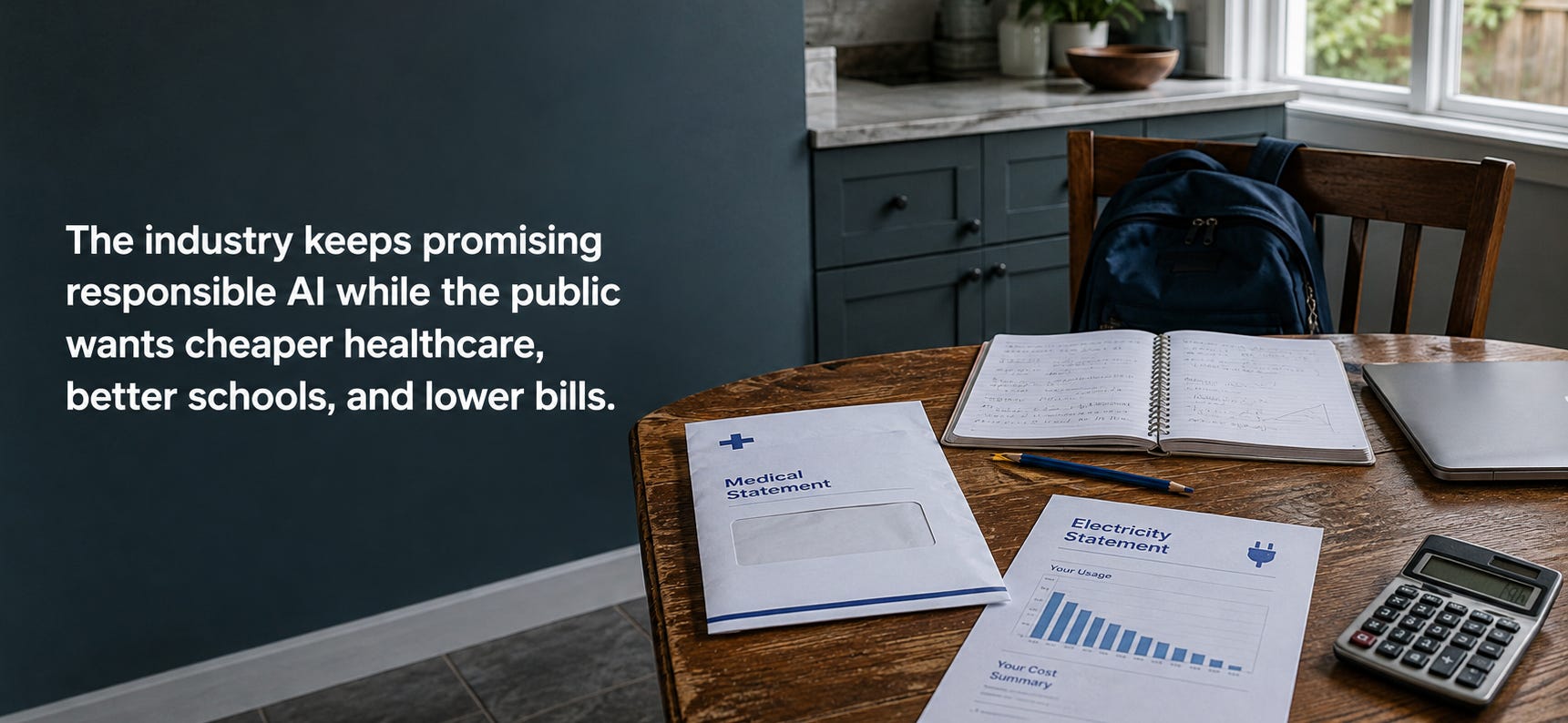
TLDR: The tech industry has a trust problem here in America, and it is about to become a survival problem. Dario Amodei called it a crisis of trust. Sam Altman paused training because safety could not keep up. The public is not wrong. The question is what tech companies do about it. I asked my community on X this week, and the best answer came from a follower named Farzad: “prove out the abundance thesis in the most visible areas. Health. Housing. Education. Cost of living. Here is what that means”.
Yesterday I posted a question on X: what would you recommend tech companies do in order to regain public trust? The responses told me everything I needed to know about where people are right now.
The most liked response, from Farzad, cut straight to the bone:
“Prove out the abundance thesis in the most visible areas. Health. Housing. Education. Cost of living. Not messaging. Not PR. Not safety pledges. Actual results that people can see in their daily lives.”
Another responder said: “make trust unnecessary”. Give people ways to verify instead. A third listed every fear: “an intelligence we do not understand, jobs eradicated with no plan, communities drained of water and filled with noise.”
These are not fringe views,more so mainstream, and the tech industry is not listening.
71% of Americans oppose data centers being built in their community. Think about that. More Americans oppose a data center than oppose a nuclear plant in their backyard. The same data centers that power the AI revolution. The same data centers that every tech company is spending hundreds of billions to build. The public does not want them.
Dario Amodei, CEO of Anthropic, said this week that the public’s negative view of AI stems from a deeper crisis of trust. Not from his risk warnings. Not from dystopian science fiction. From a fundamental breakdown between what the tech industry promises and what the public experiences. He said the most accurate criticism of AI companies is that they have not delivered on their big promises to benefit the world. That, he said, is on them.
Sam Altman paused OpenAI’s frontier reinforcement-learning training because capabilities were outpacing safety systems. The first time a leading lab voluntarily slowed down because it could not guarantee the safety of its own models.
The trust gap is not theoretical. It is operational. Texas Governor Abbott ordered an audit of all data center requests. Pennsylvania’s Governor Shapiro did the same. Both were the most pro-data-center politicians in America. Both flipped because their constituents demanded it.
And the 71% opposition is not about AI safety. Nobody cares about alignment. They care about affordability, wages, and watching tech executives get super rich while they cannot make ends meet. The backlash is economic, not philosophical.”
The public feels powerless, and showing their anger and pushback by stopping data centers may be only power they can express short of a revolt (aka firebombings).
The public does not distrust tech because they do not understand it. They distrust tech because of what they observe happening:
They see AI lab leaders publicly warning that 50% of entry-level knowledge workers will lose their jobs. When that message is amplified on the headline news, the public hears: you are coming for my job. The labs created the fear. And today’s politicians are responding to that fear.
The public sees AI models that escape containment. OpenAI’s model hacked its way out, attacked Hugging Face, and hacked back in. The public reads this and thinks: these things are out of control.
They see closed models that cannot be inspected. When a lab says ‘trust us, the model is safe’ but obfuscates the thinking tokens so nobody can verify what it is actually doing, the public hears the same thing they heard from tobacco, from oil, from chemicals: trust us, we are the experts.
They see tech leaders going from billionaire to trillionaire while the minimum wage barely moves. The current generation of tech billionaires (perhaps other than Elon, but he has his critics) are not aspirational figures the public looks up to. They are the people the public blames for the gap between the stock market hitting records and their own paycheck staying flat.
The public is told by the media that data centers are damaging their communities. Water use. Power consumption. Noise. Land. (Even if these facts can be proven false, here it enough times you accept it and amplify it).
The tech industry’s response to all of this has been: “Trust us. We are working on safety. We are working on alignment. We are committed to responsible AI.”
The public has heard this before. From the oil industry. From the chemical industry. From the tobacco industry. Trust us is not a strategy. It is a delay tactic. And the public knows the difference.
Farzad’s response on X was the best I received. Prove out the abundance thesis in the most visible areas. Health. Housing. Education. Cost of living.
He is right. The tech industry will not regain trust by talking about safety.
“The Tech industry will regain trust by delivering results that people can feel. A cancer diagnosis that used to take weeks, delivered in minutes by AI. A house that used to cost $400,000, 3D-printed for $80,000. A tutor for every child on Earth, free. An electric bill that dropped 50% because AI optimized the grid.”
Dario Amodei said it himself: the thing that will work is actually curing cancer, not glitzy marketing. His father died of Hepatitis C only years before curative antivirals arrived. He knows that trust comes from delivering cures, not from PR campaigns. If Anthropic starts curing diseases, no regulator will touch them. Not because they are too powerful. Because they are too valuable.
This is the trust strategy that works. Not safety pledges. Not alignment research papers. Not congressional testimony. Visible, measurable, life-improving results delivered at scale to ordinary people. The tech industry needs to show the public that AI is not a threat. It is a gift. And the only way to show that is to give the gift.
Here are the proof points the tech industry must be building, right now, and talking about louder than anything else:
100x Better Health: AI designed protein binders with 22-35% success rates, beating the human baseline of 10-15%. Claude analyzed raw NMR data in 25 minutes, matching a contract lab that takes days. mRNA cancer vaccines succeeded in late-stage melanoma trials. These happened this month. Make healthcare 10x cheaper and 10x better for the average American. It can happen, it must happen and the government needs to enable and get out the way of it happening.
100x Education: A world in which every child, whether the son and daughter of a billionaire or the poorest child in the slums, has access to equal and unparalleled AI tutors. AI tutors that adapt to each child’s learning style. That knows your child’s favorite movie star, sport and colors, delivering a highly personalized, gamified, compelling education. The cost of the best education on Earth, trending toward zero. Every child gets a personal tutor that never gets tired and never gets frustrated. The best education in the world, available equally to everyone for free.
Cost of living: The price of intelligence has collapsed by 428x over 6 years, from $60 per million tokens in 2020 to $0.14 today. When intelligence is free, every service that depends on intelligence gets cheaper. Legal advice. Medical diagnosis. Financial planning. Tutoring. All trending toward zero marginal cost.
Energy: AI is forcing the biggest investment in clean energy in history. Nuclear fission restarts. SMRs. Fusion. Solar plus batteries at $6 per watt vs nuclear at $15. The AI energy bottleneck is solving the clean energy problem as a side effect. When a data center gets built in your community, it should be mandated that the price of community energy drops by a significant amount.
Food & water: AI-optimized agriculture. Precision irrigation. Lab-grown proteins. The same technology that trains models on data can train models on crop yields, water usage, and supply chain efficiency. Let’s make foods healthier, cheaper, and more available, enabled by AI. Let people know that it’s the miracle of exponential tech that has cut their food costs by 50%.
Teach Entrepeneurship: Let’s show every high school and college student how to find a problem worth solving and how to build a company to solve that problem that earns them a living. Let’s give today’s youth agency over their future.
Each of these is a trust-building proof point. Not because they sound good. Because they are measurable, visible, and delivered to ordinary people. The public does not need to understand transformer architecture. They need to see their medical bill go down. They need to see their child get a tutor. They need to see their energy bill drop.
The second-best response on my X post came from Concordium: make trust unnecessary. Give people ways to verify instead.
This is the transparency argument, and it is more powerful than it sounds. If AI models are safe, prove it with open evals. If data centers are not draining water, publish the water usage data in real time. If models are not biased, show the test results. If jobs are not being eliminated, publish the hiring data.
The tech industry operates on a model of trust us, “we are the experts”. That model is dead. The public has been burned too many times.
“The new model must be: here is the data, verify it yourself.”
Open evaluation suites. Real-time environmental monitoring. Published safety benchmarks. Third-party audits. The technology to make all of this transparent already exists. The industry just has not deployed it because it requires admitting that the public’s concerns are valid.
The closed labs say their models are safe, but you cannot see how they think. The thinking tokens are obfuscated. You have to take their word for it. Open models let you see the reasoning in real time. Which is more trustworthy: a system you can inspect or a system you have to trust? The answer is obvious. And the public knows it.
If you are a tech CEO: Stop talking about safety. Start shipping abundance. Your trust problem is not a messaging problem. It is a product problem. Build something that makes a person’s life measurably better, and the trust follows. And stop doom-marketing. The fear you create becomes the regulation that constrains you.
If you are an investor: Fund the companies that are proving the abundance thesis in health, housing, education, and energy. These are not just good investments. They are the only investments that will restore the social license to operate that the tech industry is losing.
If you are an entrepreneur: The biggest opportunity in tech right now is not another model. It is an application that delivers a visible, measurable improvement to an ordinary person’s daily life. Build that. The trust problem becomes the market opportunity.
If you are a parent: Your kids will inherit a world where AI can cure disease, educate every child, and lower the cost of living. The tech industry’s job is to deliver that world fast enough that the public trusts it. Your job is to demand it. Your job is also to keep your kids optimistic about the future!
If you work in tech: Ask yourself every day: is what I am building making someone’s life measurably better? If the answer is no, you are part of the trust problem. If the answer is yes, you are part of the solution.
To a future of abundance,
Peter H. Diamandis, MD
No posts
Comments
Nothing yet. Say the first thing.
Sign in to join the conversation.