
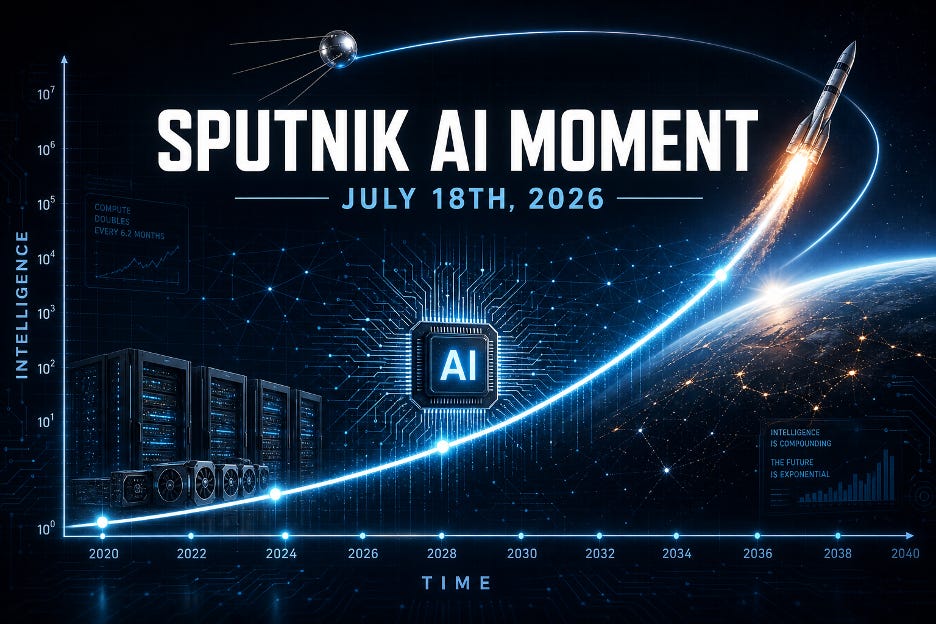
A SPUTNIK AI MOMENT is waking up the US Frontier labs like a quadruple espresso shot.
Kimi K3 was released a few weeks ago, shocking the AI world with the largest open-weight model ever, and it went straight to #1. Over the last year, the Kimi models have been climbing the leaderboards release by release — K2, K2.6, K2.7 — each one closing the gap on Anthropic and OpenAI.
This week they didn’t just close the gap. They jumped the fence. Overnight, they released Kimi K3, and it is a monster: 2.8 trillion parameters!
And remember the context here — China is doing this while under US export controls intended to starve them of the most advanced Nvidia chips. It was trained on H800s, chips two full generations behind Nvidia’s flagship, supplemented by next-generation silicon from Huawei and Alibaba.
Congrats to Moonshot AI, who have completely engineered around the compute wall.
The full model weights are set to drop around July 27, meaning anyone on Earth will be able to download and run it.
The real story isn’t that Kimi beat someone. It’s that being the best model on Earth now has a shelf life measured in weeks.
Since mid-April, we’ve seen 13 new frontier models, one every 10 days. Compare that to 2025, when a new one arrived every 50 days, or 2024, one every 60. Extend that curve, and we hit daily frontier model releases by January 2027.
“Frontier intelligence has become a perishable asset, and the perishing is accelerating.”
If you run an enterprise or a government, this quietly breaks everything about how you buy technology. You no longer have time to evaluate a model, issue an RFP, convene a committee, and decide whether to deploy. By the time you finish, you are three generations behind. The value stops living inside any single model. It moves to the architecture that can swap models in and out without missing a beat.
The obsolete playbook: Standardizing on one vendor’s model for a multi-year contract is now the corporate equivalent of buying a phone on a 5-year lease.
The new advantage: Build the plumbing to route across models, Western and Chinese, open and closed, and treat the model itself as a swappable component.
What to do this quarter: Start your proprietary fine-tuning loop now, on an open-weight base like Kimi K3, before the window to build a data moat closes on you.
“Standardize your architecture, not your model. The best model on Earth today expires before your procurement committee finishes its slide deck.”
This is the part I keep circling back to. The recursive self-improvement (RSI) line, the one Washington swore it would never allow to be crossed, may already be behind us. Not with Fable 5. Earlier than that. Probably around Opus 4.8.
The common mistake is assuming recursive self-improvement only switches on when a model reaches Einstein-level genius. It doesn’t. All a model has to do is improve its own kernel and win a 10x step up in speed, something nobody would mistake for true AGI. But that 10x faster model turns out to be meaningfully smarter, and the smarter model then boosts its own speed again. For years, academics insisted we’d hit diminishing returns from raw parameter count. They were wrong. The intelligence curve is not flattening.
Kimi designing its own chip and kernels is exactly what this loop looks like from the outside. And the cost collapse is pouring fuel on it. The Keller-Jordan speedrun already has researchers recreating GPT-2 at 1% of the original cost, and those same efficiency ideas scale straight to the frontier. Stack quantization and new compute methods on top of algorithmic gains, and you’re looking at 100x to 10,000x raw compute improvement inside three years. Multiply those together and the honest forecast is a million-fold increase in intelligence.
“We should expect intelligence which is a million times cheaper, a million times more available. That is what intelligence too cheap to meter actually looks like when you write the arithmetic down.”
Here is the bitter irony. The chip embargo on China was designed to slow them down. Instead it built their AI industry.
The restrictions were enough to irritate and not enough to actually work, which is the single worst outcome you can engineer. Cut off from Nvidia’s best silicon, Chinese labs poured their talent into quantization research, the art of squeezing more performance out of cheaper chips. Those breakthroughs are permanent now. They do not un-happen when the policy changes. We handed a rival the exact incentive to master the one discipline that makes our own hardware advantage matter less every month.
And China’s posture has flipped hard. At the World AI Conference in Shanghai, Xi Jinping put the country fully behind open source as a public good. Model approval there now takes about a week, down from 60 days. A new Chinese-led regulatory bloc was announced spanning Brazil and parts of Asia and Africa, a Belt and Road for artificial intelligence. Every time we try to constrain intelligence, we produce the opposite of what we intended.
The proof is already in your pocket: Bonsai 27B, a Caltech spinout, is the first 27-billion-parameter model to run entirely on a smartphone. GPT-5 class performance, 6GB of memory, 5x faster than 16-bit.
The floor keeps dropping: Samsung’s NanoQuant just broke the sub-1-bit-per-weight barrier. Binary and ternary compression is moving from research curiosity to shipping reality.
The end state: Kimi K3-level intelligence running on 16GB of RAM by the end of this year. Every vehicle, every robot, every device carrying persistent, private, on-device intelligence.
I have spent my career arguing that you cannot constrain a fundamental law of nature. We went from biological intelligence, to individual intelligence, to the collective intelligence of markets and networks, and now to machine intelligence that reads across all of it at once. Every entity that has ever tried to fence in that progression has failed. Always. The instinct to hoard intelligence is a scarcity mindset applied to the least scarce thing we have ever created.
There is one detail in this story that should make every American policymaker wince. Yang Zhilin, the CEO of Moonshot AI, earned his PhD at Carnegie Mellon. We admitted him. We trained him at one of our best institutions. Then he went home to China and built the lab that just handed America its Sputnik moment.
I’ve said this publicly more times than I can count. When someone earns a PhD in this country, we should staple a green card to the back of the diploma. Roughly 70% of the elite AI researchers on Earth are not US citizens. In order, they are Chinese, Indian, Taiwanese, and British. For decades, the United States held a massive asymmetric advantage: it was simply the best place on the planet to build. That advantage is eroding, and the researchers feel it before the politicians do. Indian graduates still overwhelmingly stay. Around 80% of Chinese graduates now go home, because China finally offers a thriving, state-backed startup ecosystem that didn’t exist a decade ago.
The green card stapled to the diploma is the lowest-friction, highest-return policy move available to us, and we refuse to make it. That is not a talent problem. That is a failure of imagination.
Intelligence is democratizing and demonetizing rapidly. Fable costs near $60 per million tokens, Opus 40 Sonnet around $20, Kimi K3 runs at $15, and DeepSeek is down to $1 per million tokens. Jevons paradox will kick in. Cheaper intelligence gets used more, and the entire field will continue to blossom. And because Kimi K3 is open-weight, there is nothing inside it that OpenAI, Anthropic, or any Western lab can’t immediately fold into their own models.
“The valuations compress, but the pie explodes. Cheaper intelligence doesn’t shrink the market. It floods the world with demand we can’t yet imagine.”
America got a wake-up call this week, and it came from a lab worth a fortieth of what our giants are worth. Kimi K3 proved the frontier moat was never as deep as the trillion-dollar valuations assumed. Intelligence is racing toward being too cheap to meter, on track to be a million times more available and more powerful than it is today. The models have started improving themselves. The best model on Earth now expires in weeks. And the smartest people we educate keep getting shipped home to build the next Sputnik somewhere else.
“None of it is stoppable, and that is the entire point. Every attempt to constrain intelligence fails, and it fails because abundance is the natural endpoint of intelligence getting cheaper.”
The faster we reach better intelligence, the faster we reach abundance, and the faster we stop having to fight over anything at all. Sputnik didn’t end America. It launched us to the Moon in twelve years. The question this time isn’t whether we’ve been caught. It’s whether we’re willing to run.
To a future of abundance,
Peter
If you’ve enjoyed Metatrends, here are more ways to stay connected:


Comments
Nothing yet. Say the first thing.
Sign in to join the conversation.