
0:00
-8:00
TLDR: NASA has a new Administrator (Jared Isaacman) who built a $100-billion-a-year payments company, flew himself to orbit twice, and now wants his probes to think and his Moon base enabled by robots before a single astronaut arrives. Isaacman is a rockstar who is putting NASA on an exponential roadmap. We are about to speed-run Star Trek.
We have been exploring the solar system by postal mail. So I asked Jared the the following question on my Moonshot’s podcast, “Can you imagine near-term missions where every probe and robot runs an AGI/ASI model, the world’s smartest scientist onboard remotely directing the entire mission – deciding what to explore and what experiments to run, without waiting for directions from mission control on Earth?”
“A hundred percent. And there’s already a mission designed for that, which is DAVINCI, which is going to Venus.”
— Jared Isaacman, NASA Administrator
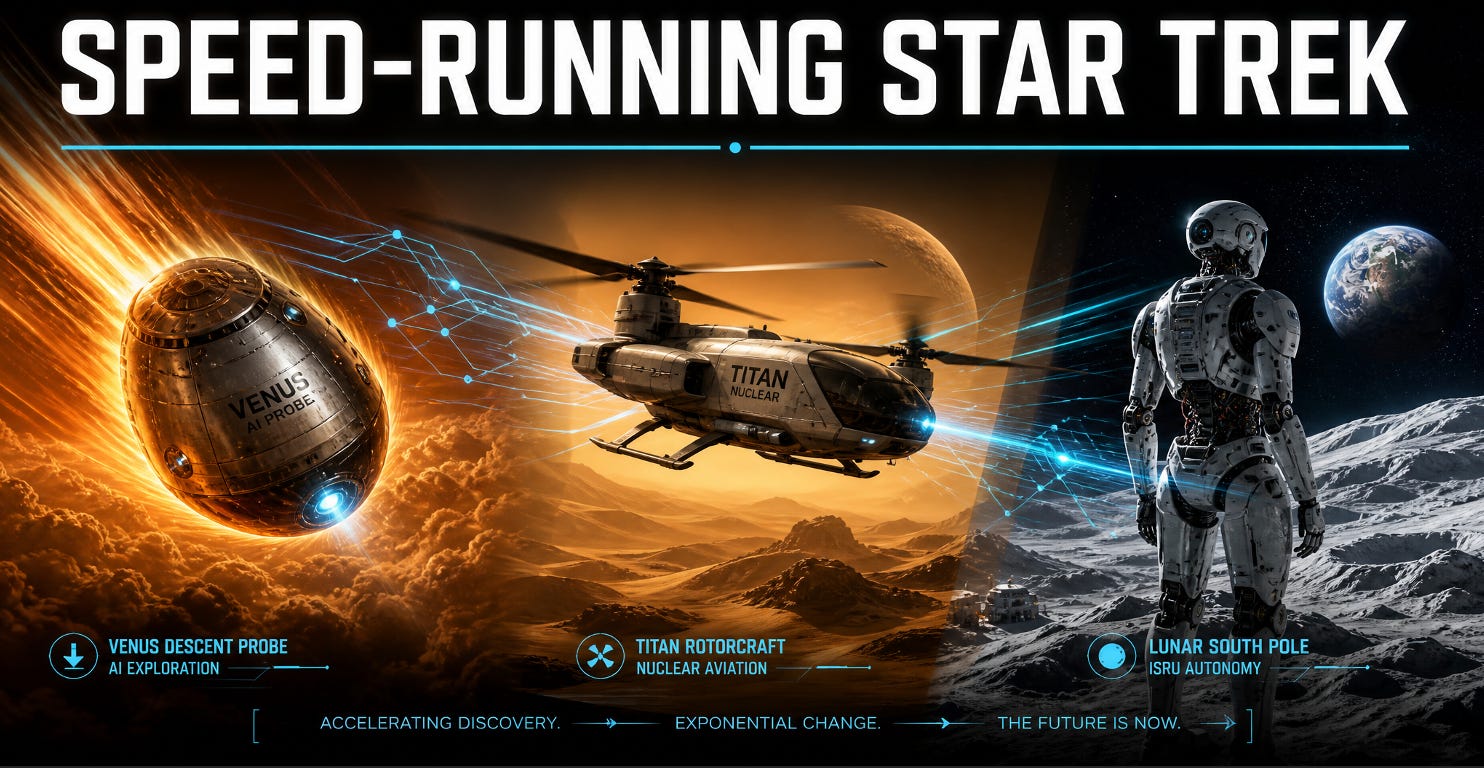
DAVINCI is the perfect proving ground, because it is a probe on a death clock. Launching around December 2030, it drops a descent sphere through the Venusian atmosphere over the Alpha Regio highlands with roughly one hour of life. Surface pressure there is about 90 times Earth’s, temperatures near 465 C, hot enough to melt lead. Five instruments, including a mass spectrometer and tunable laser spectrometer, sample noble gases on the way down to answer whether Venus ever had an ocean.
No time to phone home. So NASA designs the judgment into the vehicle. As Jared put it, “the on-mission AI decides what data matters most in the least time it has and sends the data home before it dies. A machine rewriting its own science plan while plunging to its death. That is not Voyager.”
Then there is Dragonfly, pure science fiction made real: a nuclear-powered octocopter, a drone the size of a small car with eight rotors, flying across the orange dunes of Titan. Launch July 2028, arrival 2034. It lands, flies again up to 8 kilometers per hop and 4 kilometers high, running on a plutonium battery through Titan’s 8-Earth-day nights. A flying chemistry lab hunting the ingredients of life. You cannot joystick that when your signal takes 80-plus minutes each way. It has to think for itself.
And these are just the landers. Europa Clipper, the largest planetary spacecraft NASA has ever built, arrives at Jupiter in April 2030 for 49 flybys of an ocean moon. The Nancy Grace Roman Space Telescope launches August 30 on a Falcon Heavy with a field of view 100 times wider than Hubble’s. Every one is about to disgorge more data than humans can read.
Jared’s second AI play is just as impactful: Let AI analyze all the data. There is six decades of archived data nobody has fully read, and a lot more coming. The only intelligence able to unpack the hidden massive discoveries will be AI.
The uncomfortable truth about human spaceflight: we are squishy. We need oxygen, water, food, radiation shielding, and a ride home. We have always been the rate-limiting step. And the coming Moon base NASA is building on the south pole of the Moon has an environment that is genuinely trying to kill us.
“You’re talking about negative four hundred degrees in some of the permanently shaded regions. We actually have survival problems in the south pole of the Moon that exceed that of Mars.”
— Jared Isaacman, NASA Administrator
Read that twice. The lunar south pole is harder to survive than Mars, and we go there on purpose, because that is where the water ice is. What’s the solution? Robots, lots of robots including humanoid robots.
“You want the fewest reasons possible to ever put an astronaut in a suit outside the base unless there was no other alternative. And humanoid robots are going to give you that.”
— Jared Isaacman, NASA Administrator
Any place we plant a human outpost, he said, it would be crazy not to put humanoid robots there first as a force multiplier, from infrastructure buildout to logistics. This is not a thought experiment. NASA has built humanoids for years, from its Valkyrie robot at Johnson Space Center to its partnership with Apptronik, whose founders cut their teeth on Valkyrie and now build the Apollo humanoid with Google DeepMind. Elon calls Optimus the ultimate von Neumann probe for the solar system.
So I pushed for the number that matters. Over-under, when does the first humanoid robot walk on the Moon?
“I’d kind of be shocked if somebody didn’t smuggle one on board.”
— Jared Isaacman, on the uncrewed lander demos before the 2028 crewed landing
His real window: four to six years for robots to start building infrastructure. But since both SpaceX and Blue Origin owe NASA uncrewed lander demos before the 2028 crewed landing, he expects someone to sneak a humanoid onto one early. Optimus or Figure or Apollo boots may hit the lunar surface before human boots do, this decade.
What I loved was his refusal to sell the pretty version. Phase one is not a glass dome with crop farms. He plans to drop landers and rovers near-monthly before astronauts arrive, learn what breaks at 400 below, and leave a mess. His word for it was a junkyard. Mercury before Gemini, Gemini before Apollo. The robots move in during phase two, once Starship is flying often and orbital propellant transfer works, because that is when you can land enough mass to field armies of them.
Now feel the acceleration. NASA’s Science Mission Directorate runs about $7 billion a year, and historically that buys one flagship per decade, each ballooning from $1 billion to $3 billion because it cannot fail. So I asked whether AI and collapsing manufacturing costs let him 10x or 100x the number of science missions. He fired it straight back.
“Between AI and additive manufacturing, $7 billion a year could be cranking out seven Dragonflies a year”
— Jared Isaacman, NASA Administrator
Seven Titan-class missions a year instead of one per decade. A 70x jump in the rate of scientific discovery to help us explore for life. The obstacle, he was honest, is human, not technical. People build moats around their jobs and never want to engineer themselves out of one. In his words: he does not want his grandchildren to be excited about these missions. He wants to be excited about them, now.
If you’re an entrepreneur: Autonomous science is a green field: onboard inference under brutal power and radiation limits, robotic manipulation in vacuum, and tools that mine 60 years of NASA archives. The archive play needs no launch license.
If you’re an executive: Jared inherited a $25 billion agency asked to please everyone and answered with brutal focus. Audit what your organization has already paid for and never shipped.
If you’re an investor: Follow the near-monthly CLPS lander cadence and the humanoid suppliers, Apptronik and the Optimus supply chain. A recurring lander program is revenue, not a moonshot.
If you’re a student: A teenager in Texas found new galaxies in NASA’s own data and got an internship. The archives are public. Nobody is stopping you.
If you’re a parent: Your kids will likely watch a humanoid robot take the first step on the Moon before an astronaut does. Tell them the robot got there because a human decided it should.
For 60 years we explored space at the speed of a mailed letter. In one 90-minute conversation, Jared laid out a NASA where the rover decides, the base builds itself, and the mission rate goes up 70-fold. The change is not coming. It is here, accelerating faster than the org chart can keep up.
So here is what I cannot stop turning over. If a probe can choose what to investigate at Titan without asking us, and a robot can pour the foundation before we arrive, what exactly is the human job out there?
I have a guess. But I would rather hear yours.
To a future of abundance,
Peter
No posts
Comments
Nothing yet. Say the first thing.
Sign in to join the conversation.