“The map is not the territory.” A much-quoted aphorism… but I’ve often wondered what it means.
Who ever thought that the map was the territory? No one could make this mistake regarding an actual map. Apparently this is a metaphor… What is it supposed to imply?1
The basic meaning of the metaphor is that representations (such as maps) do not perfectly reflect what they represent. Unthinkingly following an inaccurate map, you might try to drive to an island in the Pacific Ocean. Analogous mistakes are more common with other sorts of representations.
This essay uses the metaphor to introduce several key themes of In the Cells of the Eggplant. That is a book about how to improve science and engineering through meta-rationality: a better understanding of how rationality works in practice. The ways we use representations, and relate them with reality, are central topics. This essay may be a useful alternative introduction to the subject.
“The map is not the territory” is an important cautionary insight. However, it can also be a misleading metaphor. Maps are unlike most representations in significant ways, which we’ll explore in this essay. Specifically, many scientific and engineering models work in ways that are more complicated and different from maps. Unthinking application of the metaphor tends to reinforce simplistic “rationalist” theories of how technical work works.
In the course of the essay, we’ll develop more sophisticated understandings of rationality, truth, and science, and will introduce some themes of meta-rationality.
A simple interpretation
Let’s go with the metaphor for a minute, and see what’s right about it, before exploring ways it breaks down.
Here are some commonly-cited cautions:
- Any map is likely to be wrong about some things. It might mark a one-way street in the wrong direction, or show a hiking trail crossing a gulch that is actually impassable.
- There will always be some uncertainty about whether a mark on a map is correct. Cartographers (map-makers) sometimes make mistakes. The data they start from are also always fallible and somewhat outdated.
- When you discover that the map you are using is wrong, you should update it.2
- No map can represent all the details of the territory—that is impossible, and also the map would have to be just as large, which would make it useless. You would do better to just look at reality. “The best material model of a cat is another, or preferably the same, cat.”―Norbert Wiener.3
- No map can be perfectly accurate, even at its scale. Wiggly lines never wiggle exactly the same way as the roads they represent. They are an approximation only.
Non-metaphorical versions of these limitations to technical knowledge are taught in undergraduate STEM classes, and probably won’t come as news for you.4
They make sense in a common rationalist explanation of how representations relate to reality. A theory, a model, or metaphorically a map, is a collection of statements that are either true or false of the territory. This correspondence theory of truth says that “snow is white” is true because “snow” means snow and “white” means white, and snow is white.
Applied to maps, it says that if there’s a horizontal line labeled “Fell Street” that goes from a line labeled “Market Street” to the green rectangle labeled “Golden Gate Park,” then the map is correct because Fell Street in San Francisco does run east-west from Market Street to the park. A map is a concise and convenient presentation of an equivalent collection of propositional statements.
Then “the map is not the territory” just means “the map does not necessarily provide the complete set of true facts about the territory.” Some of what it says may be false, or slightly off. In a probabilist framework, the caution is “don’t assign belief-strength 1.0 to everything the map says.” Also, it may offer no opinion about some things you care about: if they are too small, for example.
These considerations are valid and important to understand. High school may lead you to believe Science has all the answers; by the end of your undergraduate education, you should have realized that it doesn’t. Even having repeatedly discovered this, it’s easy to set aside your knowledge that the standard model of a domain leaves out important factors. (“It wasn’t my fault—everyone uses a Gaussian distribution!”)
In technical work, it’s common to develop a correct formal solution to a formal problem, and then be surprised when it doesn’t work in the real world. This is confusing the map with the territory . The aphorism is a useful warning against that.
Metaphors may mislead
“The map is not the territory” can be a valuable metaphor, but it can also be misleading. Most representations work differently from maps; and even literal maps work differently than in the rationalist interpretation of the saying.
Does this matter? Everyone does understand that “the map is not the territory” is only a metaphor. But metaphors shape thought. The phrase imports a mass of implicit, embodied experiences of using maps, and additional associated concepts and practices that “representation” and “model” don’t. That unhelpfully directs attention away from ways maps are atypical.
The relationship between literal maps and territories is also uncommonly straightforward. Taking maps as prototypes gives the mistaken impression that simply correcting factual errors, or improving quantitative accuracy, is the whole task of rationality. That omits most of what we do in science and engineering. If our metaphors pass over those parts, we will neglect them both in theory and in practice, and progress suffers.
Maps are used as a metaphor for a particularly simplistic version of the correspondence theory of truth. That theory is not outright false. It’s more-or-less true in many cases. However, it glosses over many complexities in representation/reality relationships. “Factually wrong” and “only approximately correct” are just two of the many possible shortcomings in a model. The metaphor becomes misleading if maps are used as the prototype for all representation.
Meta-rationality, investigating this question more seriously, finds diversity and complexity. We will explore several specific phenomena in representation/represented interactions here. Each shows a way the correspondence theory of truth is insufficient as an explanation of how representations work. Yet the list could be extended indefinitely; the details of representation/reality relationships are fractally unenumerable.
Because the map metaphor is misleading, it’s not ideal for explaining how either rationality or meta-rationality work. The Eggplant uses a variety of better explanations. I am expanding on this metaphor partly because a common reaction to hearing about the book is “isn’t this just saying that the map isn’t the territory?” So this essay explains how that is at most a starting point for understanding what it is about.
I’ll link to relevant chapters of The Eggplant you can read if you’d like to go deeper.
Nebulosity and more-or-less truth

The illustration above is a bit of the U.S. Geological Survey’s Topographical Map Symbols brochure. You might find it fun to look through the whole thing (four pages). And you might consider the photograph of a marsh above… where would you draw the lines between the USGS categories “pond,” “submerged marsh,” “marsh,” “land subject to inundation,” “shrubland,” and “woodland”?
In many places there is no truth as to whether your choice is correct. This is not a matter of uncertainty. It is not that you do not know where the pond ends and the marsh begins, but that there is some Cosmic Truth about it. It is a matter of nebulosity: the territory itself is indefinite, neither one thing nor another. It’s only more-or-less true that the bottom half of the photograph above is mostly more-or-less marsh.

This is not to deny that maps, or other representations, can be wrong. Marking Death Valley as a marsh would be unambiguously false. Rather, I’m pointing out that “may be false” is not an full account of “the map is not the territory”—and beginning to explain some of the reasons.
Approximate truth
Wiggly lines on a map wiggle only approximately the same way as wiggly roads, I said. “Approximately” here may mean something very specific. If a map is accurate to within 10 meters, then there’s a numerical bound on how much the wiggles can deviate from reality. A statement is “approximately true” if it involves a numerical value that is wrong, but the true value is numerically close. Approximate truths are common in physics, and in the adjacent engineering fields. They are rare in most disciplines, including some science and engineering fields.
If you leave an eggplant long enough in a refrigerator, it eventually becomes a non-eggplant. (Eww!) At what point does “there is an eggplant in the refrigerator” cease to be true? At intermediate times, this is not “approximately true” in the sense of a numerical error bound.
Genes are interesting to geneticists, but what counts as one is notoriously impossible to define.5 Examples of “sort of” genes—marginal cases under a definition—are common. However, a particular bit of DNA is never “approximately” a gene, in the sense of “to within an error bound.”
The chapter “Overdriving Approximation” in The Eggplant has more on why approximation is an inadequate understanding of more-or-less right explanations.
Localities and non-locality
Because bits of a map correspond to locations on the earth’s surface, a bit of the map is accurate or inaccurate all on its own. The rest of the map (and the rest of the earth) is irrelevant. If Las Vegas sprouts a new suburb, it doesn’t invalidate a Nevada map’s treatment of Reno. This is not typical for representations in general, nor for technical models in particular.
Often unenumerably many factors are relevant. A good model can take only some of them into account, but even so it is accurate or inaccurate only overall, not piece-by-piece. The individual bits of the model may be meaningless without the rest.
In cell biology, pretty much everything causes pretty much everything else. You can’t understand parts of a cell accurately other than in terms of other parts. This is not an undifferentiated New Age wow-man holism; different parts affect each other in different ways and to different extents. But everything is somewhat relevant, and almost anything could be affected by a missing or mistaken understanding of almost anything else.
Locality makes it easy to check whether a particular bit of a literal map is accurate: you can just go there and see. Most scientific theories can’t be evaluated locally. Taking “map” as a metaphor makes you blind to the problem of “confirmation holism”: individual hypotheses can never be tested experimentally, because unenumerable additional factors might be relevant.6 You have to assume that your experimental apparatus works as you believe it to, that your materials are what you think they are, and that you have controlled for all unexpected sources of systematic variation. Achieving this as an absolute is impossible in theory, and achieving it adequately is difficult in practice.
A classic example of the problem was the mid-19th century discovery that the orbit of Uranus does not accurately conform to Newtonian mechanics. Either Newton was wrong, or something else. Unenumerable “something else”s are imaginable. Astronomers guessed that there might exist a previously unimagined planet perturbing Uranus’s orbit—an unexpected, non-local source of systematic variation. Based on the specifics of the anomaly, they predicted its location, velocity, and mass, and pointed a telescope there, and thereby discovered Neptune.
Uranus’ anomalous orbit didn’t prove Newton wrong, but neither did the observation of Neptune prove him right. And of course, he was wrong. Mercury doesn’t conform to Newtonian mechanics either—in that case due to Einsteinian relativity.
“The Spanish Inquisition” and “The probability of green cheese” discuss this problem further. “Reductio ad reductionem” explains why reductionism does not solve it. “Are eggplants fruits?” explains why you cannot even define the meaning of biological terms other than as part of an unbounded web of other terms for other biological phenomena.
The map can’t do the work for you
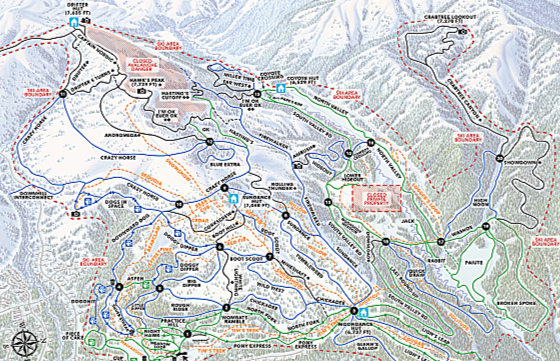
We went cross-country skiing. They gave us a paper map. (I guess XC is a sport for old people?)
The map was… less helpful than ideal.
In Days Of Yore, streets in some regions had signs at every junction saying which they were. Then you could find them reliably on your map.7 The XC trail system did have some signs scattered about… mostly not where you’d want one… and sometimes halfway between two trails, at a junction, so it wasn’t clear which it referred to.
More than once, we spent several minutes looking back and forth between the map and the territory, trying to figure out what it was trying to say. Everything on both was either snow or a pine tree, so it wasn’t obvious. We’re at a trail junction… but which? Is that hill this thing on the map? Or is it that one? Does it even count as steep enough to belong on the map? Is the bend we just came around that squiggle, or is it too sharp, and it must be something else?
The point here is not that the map was bad (although it was). It’s that, no matter how good a map is, it still takes work to figure out what it means for what you’re doing.
This used to be a constant hassle with paper maps. GPS direction-giving systems automate much of that work, but their instructions are still sometimes annoyingly ambiguous, and you wind up taking the wrong turn.
“Instructed activity” in The Eggplant expands on this theme. A good example is assembling flat-pack furniture. Locating the bits referred to in the instructions is notoriously difficult. (Is this “Snap fastener (J)” or “Plastic insert (C)”?) Often the question is “what is this even trying to say?” The instructions are a representation—a “map”—of what you are supposed to do, but they won’t do it for you. You can’t just “follow the map,” because much of the time it makes no sense—until you get it figured out.
Glossing over the details of how we relate representations with reality is a major failing of rationalism. Part One of The Eggplant discusses this absence of explanation extensively, starting in “Reference: rationalism’s reality problem.” Much of Part Two explains work we do to connect representations and reality; “Meaningful perception” could be a good starting point. The correspondence theory of truth is a nice idea, but there are no correspondence fairies magically bridging the metaphysical gap between maps and territories for us.
As with maps, to use a rational model, we have to relate it to reality. Mostly this is concrete practical activity, not formal problem solving. The Eggplant calls this hard work circumrationality , and it is a major topic of Part Three. That Part isn’t written yet, but there’s a summary discussion of circumrationality here.
Circumrationality may involve informal reasoning, but it’s usually more a matter of perception and action. Taking the ski map as a metaphor for a rational system: our using it required the circumrational work of looking back and forth between it and the pine trees, discussing our guesses about where we were, and going a few hundred yards along a plausible trail to see if an expected landmark showed up.
Popping out of the metaphor, circumrationality is the work of identifying the physical phenomena a rational system’s formal objects refer to, and carrying out the actions it calls for (but underspecifies).
Circumrationality is generally routine. It does not require significant understanding of the rational system itself, only of how a particular, perhaps tiny part of it relates to the job at hand. Circumrationality is not necessarily easy, though. It may involve extensive inexplicit, bodily skills. Often that makes it harder to automate than rationality, whose skills are mainly explicit, and therefore easier to encode in a computer program.
Systematicity and completeness
As a cartographer, you can systematically survey a city and be effectively certain your map isn’t missing anything. You aren’t going to learn next year that there’s a Narroway in Manhattan, running parallel to Broadway, that you somehow overlooked. You aren’t going to discover an entire secret system of Manhattan streets running 45 degrees to the grid you knew about.8
Such systematicity is atypical. In most domains, you can expect there are significant features, and types of features, you don’t know about at all. An example is the 2015 discovery of the meningeal lymphatic vessels, a system of tubes that drain waste from the brain. This anatomical feature had been overlooked, and it was explicitly believed that nothing like it existed. Until 2015, it was thought that the brain had no lymphatic system, and waste could only be eliminated by passive diffusion. It’s now known that the brain is “washed” during sleep by actively pumping fluid through it and flushing into the meningeal lymphatic vessels. It’s now considered that malfunctioning of this system may be the cause of multiple degenerative brain diseases, such as Alzheimer’s.
Is there a there there?
With a literal map, you know there is a territory, and which one it is. It could be a lousy map, but it’s definitely a map of something, and you know what.9
In science, it’s frequently unclear what a model is a model of, or even whether it’s a model of anything. Figuring that out often constitutes major scientific progress.
A famous case is polywater, an unusual form of water with fascinating properties, consistent with the theory that water molecules get polymerized into chains. Lots of experiments measured these properties precisely and explored practical applications. Eventually it turned out that there was no such thing; supposed “polywater” was ordinary water contaminated during sample preparation.
When I studied molecular genetics, the professor told us confidentially that “Okazaki fragments”—short bits of DNA extracted from bacteria—were not a thing. They were a hot topic at the time, but he said they were just artifacts of sloppy sample preparation that broke up chromosomes, not biological phenomena in living cells. Reading the Wikipedia article now, it seems he was wrong. They are totally a thing.
A current open example is “ego depletion.” It seems that willpower is a limited resource, and it gets used up in difficult, unpleasant tasks. Hundreds of experiments have found factors that increase or decrease the rate of depletion, explored its physiological basis, and measured it using objective EEG methods.
Recently, larger, more careful experiments suggest that there is no such thing.10 Apparently, the detailed, scientific map of the ego depletion territory is a map of Narnia.
But, everyone’s personal experience suggests that there must be such a thing; we all experience it at the end of a long tiresome day.
This is currently up for grabs. Ego depletion now seems to be mostly not a thing, but maybe somewhat a thing, but it’s not clear what sort of a thing it is, probably a different sort of thing than people thought five years ago, or maybe it’s several vaguely similar things, and anyway the hundreds of papers were all pretty much nonsense (probably?) because the thing that people thought it was mostly isn’t one.11
Different maps for different trips
A road map is useless when you are going for a hike. You need a topographic map that shows trails, altitudes, streams, and peaks. Road maps and topographic maps are both useless in a seismic safety analysis. For that you need a map that shows geological formations, soil types, and faults.
These three kinds of maps express three different ontologies of the same territory. By “an ontology” I mean a system of categories, properties, and relationships you ascribe to the world.12 In the map analogy, it’s the set of symbols and features the cartographers chose to limit themselves to.
Which ontology is useful depends on your purpose. Ontologies are not theories; none of them is more or less “true” or accurate than the others. They are largely incommensurable. They describe the same territory, but they do not contradict; the ways they portray the world are just different. This is characteristic of ontologies. Consequently, accurate representations are only accurate in a particular sense, and for particular purposes; and different representations of the same phenomena may be accurate in different senses.
… Oof! That got pretty thick. I’m thinking it must be time for an entertainment break. This video makes many of the same points as my essay—including this point about different sorts of maps—and it’s way more fun!
… OK, back to business.
With literal maps, it’s generally obvious which sort to use for a particular purpose. This is often not true when using rational models. A major aspect of meta-rationality is figuring out an appropriate ontology for a particular job, and what sort of model to use within that ontology.
A typical rationalist failure mode is overlooking the necessity of making this choice explicitly. It’s common instead to apply an ontology by default, without thinking about it. Tacitly assuming a Gaussian distribution is a common, sometimes famously disastrous example.
Can’t you combine all map types, to make a more complete, more accurate model? In fact, shouldn’t a map ideally show features of all sorts, to be useful for all purposes? No; that would make an unreadable mess. There can be no overarching universal ontology, combining all possible categorizations. That is an infinite task—impossible in principle, infeasible in practice, and useless if somehow achieved. It’s like the fantasy of a perfectly detailed, but unusably enormous, map.
Sometimes you can combine a few, carefully-selected ontologies into a broader framework.13 Sometimes that is useful. Sometimes it’s infeasible; often it’s just confusing. Figuring that out is a meta-rational operation.
Beyond choosing or combining existing map types, a novel task type sometimes demands an entirely new one. When the augmented reality game Pokemon Go came out, suddenly everyone wanted to know where to find PokéStops—places in the real world where you could find monsters and treasure in the virtual one. Entrepreneurs created web sites that superimposed that information on Google Maps. Analogously, meta-rationality may involve developing a new ontology.
These are all issues that “the map is not the territory” tends to draw attention away from, by suggesting that the only issue is whether the map is accurate.
The Eggplant describes this mistake as “being an oblivious geek.” That is failure to notice that a rational system is not interfacing well with its context.
It is like “confusing the map with the territory,” but at a more abstract level. Rather than assuming that you map you have is accurate, you assume that the type of map you have could be made adequate through rational/empirical improvement. But you can’t make a road map usable for mountain hiking—not without expanding its ontology to include an entirely different set of features. You can’t accurately predict planetary movements with any finite combination of circular motions, nor financial market movements with any finite combination of Gaussian distributions.
An as-yet unfinished section of The Eggplant will explain how to notice this obliviousness when you make tacit ontological choices, and how to correct it. In short: the antidote to oblivious geekery is to apply meta-rationality.
Fitting the territory to the map
Maps, and other simple models, work best when representing standardized, engineered artifacts, such as roads. Those are designed to minimize nebulosity. By and large, either there’s a road there, or there isn’t. Mostly we don’t build vague sort-of roads, because they wouldn’t work reliably.14 Mostly, we give specific names to roads, and put those on the map; there is usually no ambiguity about which road you are on.15
Much in reality—like marshes—isn’t like this. The territory doesn’t come neatly divided into objects with standard names and unambiguous properties and relationships. Often, simple models can only be simplistic, i.e. wrong. With increasing complexity and nebulosity of phenomena, effective understandings become increasingly dissimilar to literal maps.
Sometimes, when the map doesn’t fit the territory, it is easier to fix the territory than the map! We reshape our environment to fit our categories.
This is literally true when a municipality or development company plans a new residential subdivision. They draw a road map, and send in bulldozers to make the territory conform to it.
More generally, engineering design often produces a map-like representation—a blueprint or circuit diagram—that a manufacturer makes bits of reality conform to. Still more abstractly, manufacturing standards and specifications, even if not geometrical or topological, are models that we make reality match.
Deficiencies in a rational system often show up first in circumrationality. You can’t identify the real-world objects or properties the formalism supposedly refers to; or the actions it calls for make no sense in context due to factors it does not take into account. When you notice circumrationality breaking down, because it’s too difficult to bridge the representation/reality gap—it’s time to get meta-rational!
The work of many technical professionals is done entirely within abstracted formal representations. In that case, you may have little motivation to understand how those representations relate to reality. Being an oblivious geek works just fine, so long as someone else does the work of translating real-world problems into your formal language and your formal solutions into real-world work. That translation requires a quite different skill set: meta-rationality.
Circumrationality and meta-rationality both operate at the interface between a rational system and its surrounds, but differ in scope.
- Circumrationality takes the rational system as given and immutable, and relates it to concrete circumstances in order to get a particular job done.
- Meta-rationality stands outside a rational system, surveys its operation as a whole from above, understands its relationships with its broad context, and intervenes to modify the system and/or its surrounds so they work better together.
Literal maps can be a misleading metaphor for rational models, and they are even less good for explaining meta-rationality. But at this stage in the essay, we are committed! We have skied deep into a wilderness of tangled metaphors where everything looks like a map. So let’s try to follow the metaphor, and see if we can find our way home…
 ">16.For example: “Just as it would seem absurd to claim that a map in some strong sense controlled the traveler’s movements through the world, it is wrong to imagine plans as controlling actions. However, the questions of how a map is produced for specific purposes, how in any actual instance it is interpreted vis-à-vis the world, and how its use is a resource for traversing the world are both reasonable and productive. In the last analysis, it is in the interaction of representation and represented where, so to speak, the action is. To get at the action in situ requires accounts not only of efficient, symbolic representations but also of their productive interaction with the unique, unrepresented circumstances in which action in every instance and invariably occurs.” p. 186.
Comments
Nothing yet. Say the first thing.
Sign in to join the conversation.