
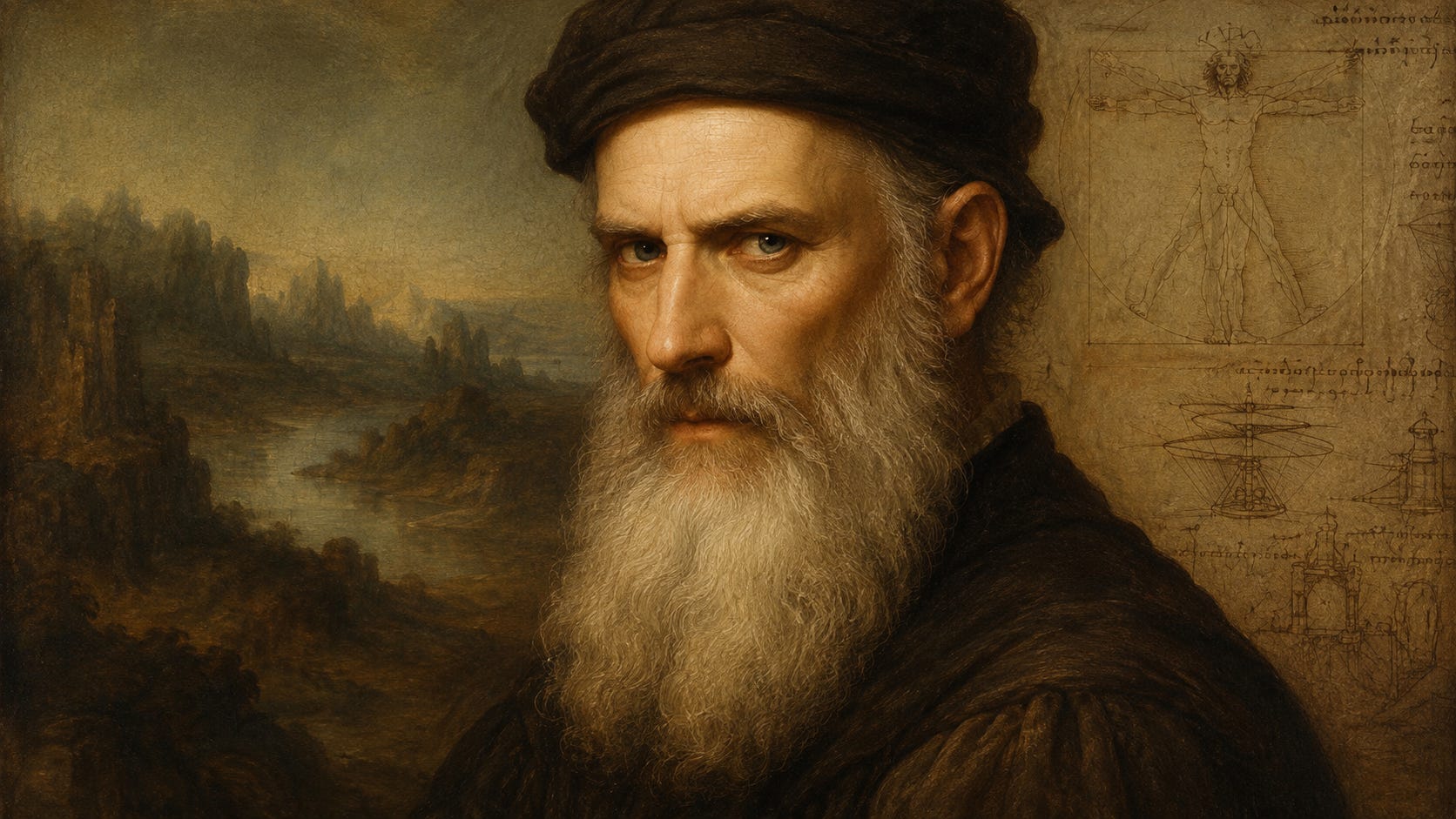
Artists created this world. The rest of us are just living in it, trying to catch up.
Here’s the thing: The seed of every new idea, of every foundational memetic construct, was initially spawned in the mind of an artist. Artists always arrive first. Philosophers second. And entrepreneurs come in third. Not only can this universal pattern be observed in the data provided by the history of cultural evolution, it’s also, as I’ll explain in the following, a logical necessity.
By now, the attentive and well-informed reader has probably figured out that I’m referring to the five-step model of metamemetic development from my unreleased book The 6 Hidden Patterns. You can read about the model in the free introduction chapter on the Metamoderna site here, and if you’re interested in learning more you can sign up for the updated master class in metamodernism here.
Here’s a breakdown of the model: the Five-step Sequence of Metamemetic Development:
Art
Philosophy
Entrepreneurship
Politics
Morality
Briefly, the model states that art always comes first, or more specifically, that the first manifestations of a new stage of socio-cultural development (the metamemes) always occur within the arts (or what corresponds with artistic expression within the particular time and context, bearing in mind that our contemporary conception of “art” is largely a modern and to some extent Western construct).
Only, once there has already been some artistic souls expressing the new emerging sensibilities (in whatever medium available and conducive to the task) is it possible for philosophers and other thinkers to begin formulating the so-called “code” of the new stage of socio-cultural development. A culture without works of art expressing the new emerging stage (metameme) will not produce any corresponding philosophy. It just won’t happen. And without the philosophers, the rest of us simply won’t obtain the necessary code to transform society to a new stage of development.
—
Let’s bring all of this into context: Historically speaking there wouldn’t have been a Scientific Revolution without the Renaissance. Without the new humanism of 14th century Italy, in which artists and poets began moving away from religious motifs in favor of human potentials, reason, civic virtue, and the value of a worldly education in the humanities, it’s unlikely that the following centuries would have experienced the birth of modern philosophy and a revolution in scientific reasoning.
The Renaissance was above all a revolution of the arts. Despite the importance that the rediscovery of Aristoteles (via the Arabs and exile Byzantines) had on Renaissance thinking, and despite Leonardo da Vinci’s tinkering with modern, rational ideas and technical innovations, it wasn’t until Descartes and the subsequent Scientific Revolution of the 17th century that we encounter a transformation of thought that can be described as thoroughly modern. What was modern about the Renaissance was the way in which artists and poets broke with the past to express something entirely novel, something that went beyond the religious paradigm that everything had been seeped in until then.
Despite coming close, neither Aristoteles, the Arabs, or Leonardo da Vinci ever expressed something like the scientific method—a cornerstone of the Modern metameme. Key concepts such as “induction” and “deduction” were ever only formally expressed following the end of the Renaissance. However, although Renaissance artists didn’t have a formal language to articulate such sensibilities, they did in fact implicitly express these two central ideas of modernity in the groundbreaking Renaissance innovations within the visual arts: “Deduction”, in the form of mathematically correct perspective, or single point perspective, invented in Northern Italy—and “induction” in the form of the natural lighting oil paintings techniques pioneered by the Flemish masters:
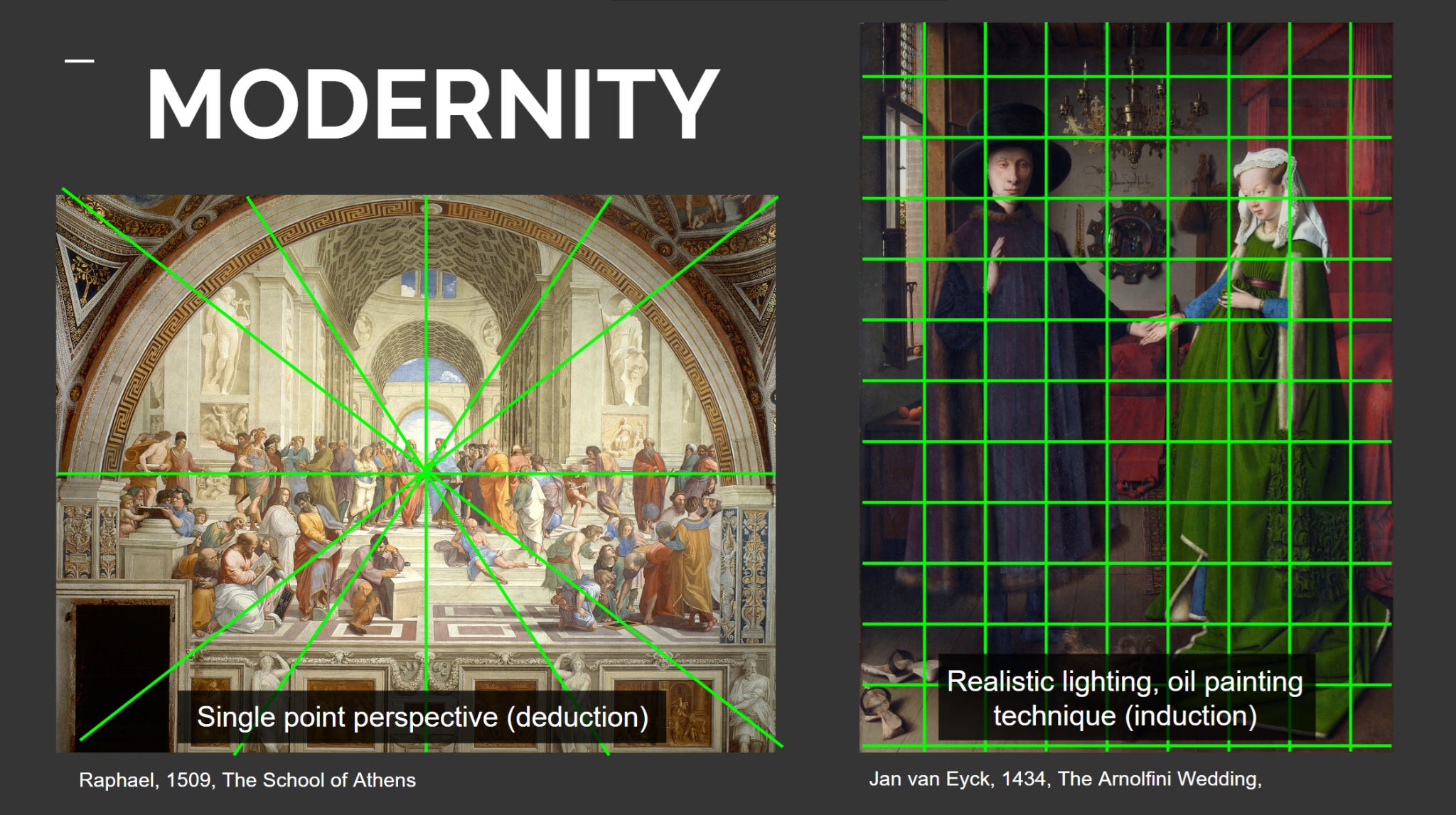
(from the Updated Master Class in Metamodernism)
And if you take a close look at the Van Eyck painting to the right, you’ll see another inherently modern innovation peeking out: the individual:
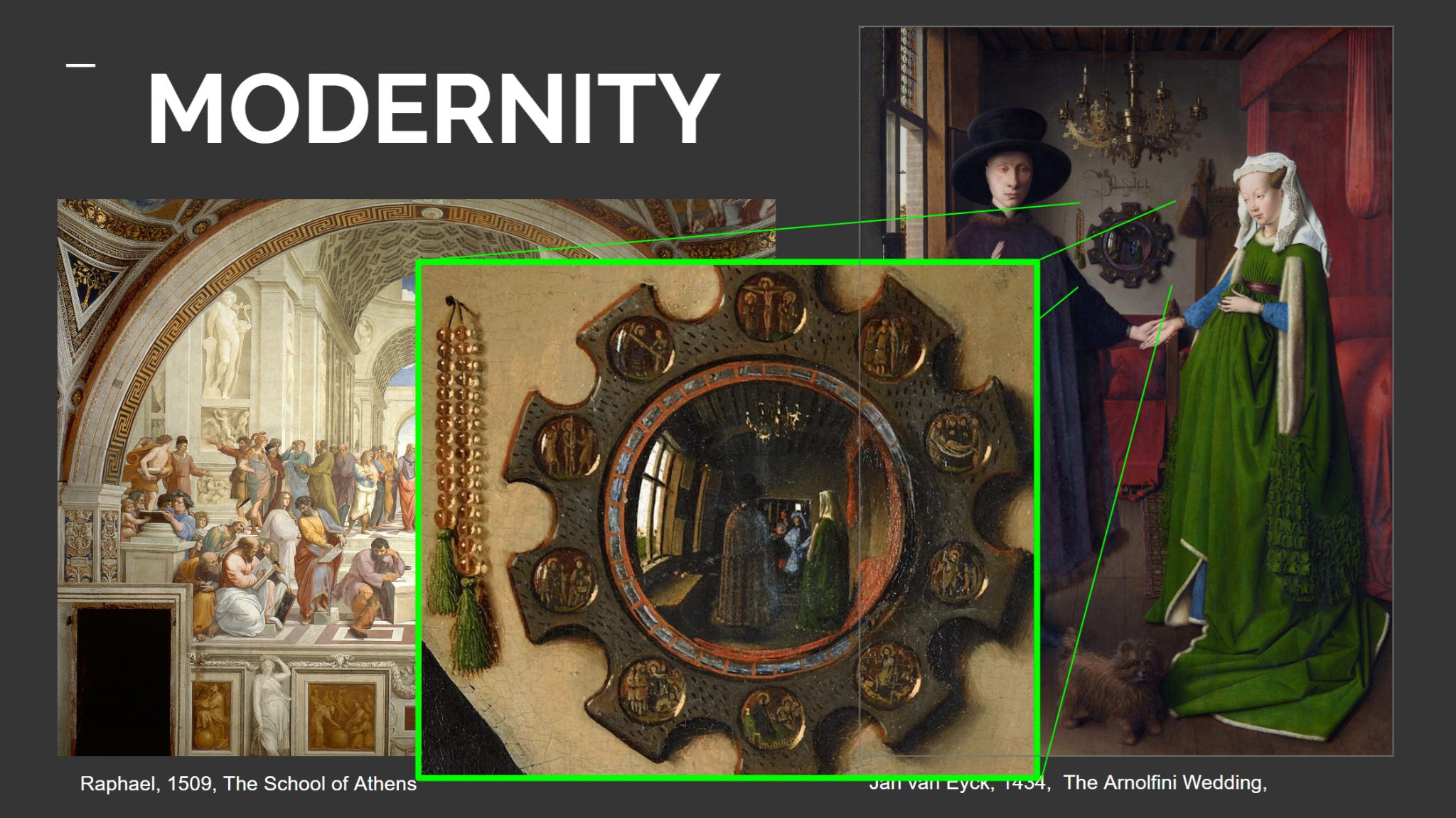
Prior to the Renaissance, artists were considered mere craftsmen like any other, and their individuality (as well as any other non-noble’s) was largely irrelevant. As a consequence, painters and sculptors usually didn’t sign their work. This of course changed with the rise of modernity, and the seed of this development began among the artists of the Renaissance who broke out of the confines of humble craftsmanship to become something more elevated: the artist, the prodigy soul with something unique to offer the world that neither kings nor popes could ever compete with.
In a way, we can speak of a certain “trickle-down” effect—from the “memetically endowed”, such as artists and philosophers, to the less memetically privileged, commoners and nobles alike. Trickle-down economics is, as should be well-established by now, a scam—but trickle-down memetics, on the other hand, is solidly backed by sociological and historical fact. Thus, it’s no coincidence that elites have always surrounded themselves with artists and philosophers, supporting them financially and promoting their work; not only to reap the greater status that goes along with showing off such endeavors, but also to be the first to nip at the source of those sweet, sweet cutting-edge memes before everyone else. Adopting and integrating the latest manifestations of a new metameme will, over time and on average, grant you wealth and influence. And that power can best be obtained from being as close as possible to the source from where it all originates: art.
So, following the innovations of the artist and philosophers there will be cunning “entrepreneurs” (in the broader connotation of the word) picking up the new sensibilities and applying them in the practical and social world. And as the various technical and social innovations begin transforming society and the economy, they eventually start to reshape politics, and finally a new moral attitude takes root in the general populace. This process can take centuries.
The 500-year history of modernity offers a good illustration of this five-step sequence of development:
Art: The Renaissance, 1400s in Northern Italy and Flanders.
Philosophy: Scientific Revolution, 1500-1600s in North Western Europe.
Entrepreneurship: Industrial Revolution, 1700s - 1800s in Great Britain.
Politics: Civil rights and modern bureaucracy, 1800s – 1900s in North Western Europe and North America.
Morality: arguably only after 1945 with human rights, alternatively after the cultural revolution in 1968. Globally, primarily in wealthy urban and other privileged regions in the world. Large parts of the industrial world still subscribe to premodern morality, especially in the Bible Belt of the US and parts of Eastern and Southern Europe.
However, please keep in mind that the pattern of this sequence of development also applies to the postmodern as well as the premodern metamemes.
Postmodernism didn’t start with the post-structural debate in the 1960s and 1970s. In fact, it can be traced all the way back to the late 19th century. Just take a look at Van Gogh: Here we have a decisive break with the modern project dedicated to manufacturing objective, naturalistic representations of the world as accurately as possible. What would later evolve into 20th century abstract art began in the late 19th century. Hence, the abstract art of Picasso may be hanging on the walls of so-called “modern art” museums, but that kind of art isn’t modern, technically speaking, it’s postmodern. Modern art is more like the photorealistic stuff someone like Rembrandt would paint. Makes sense now you think about, right? Objectively accurate representations of the world, with mathematically correctly deduced perspective and photo-realistically induced lightning—that’s very, very modern. A rejection of traditional aesthetic standards, a negligence of craftsmanship, collapsing perspectives, and a thorough deconstruction of forms and colors—now, that’s so, so postmodern indeed.
A good example of the way in which Picasso is postmodern can be demonstrated by his blatant deconstruction of Diego Velazquez’ Las Meninas. Just take a look at these two images:
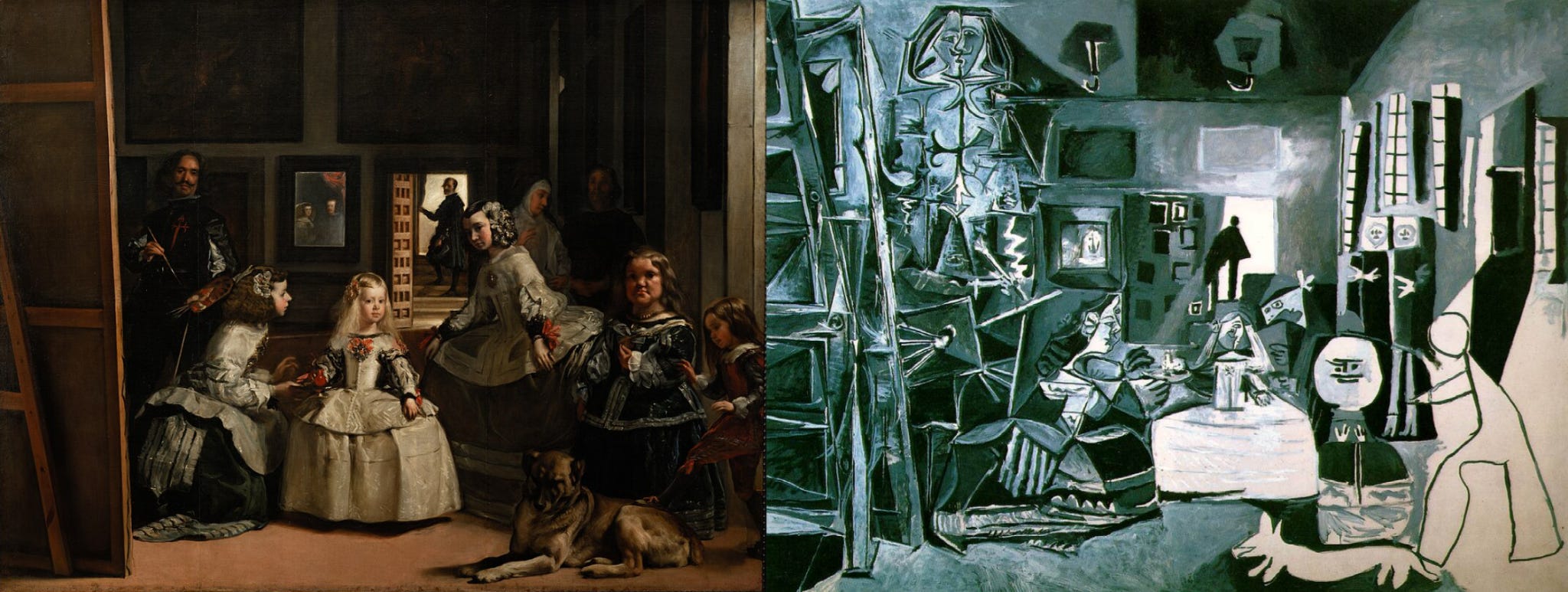
I’d argue it’s pretty obvious, so I’ll allow you, my dear reader, to determine on your own which one is modern and which one is postmodern. (Also, check out the dog!)
—
Back to the main argument: Art always comes first—and this also applies to the premodern metamemes. If we consider the sentiments of the Axial Age, the revolution of thought that occurred during the middle of the first millennium BCE, (and which later paved the way for the Postfaustian (or traditional or religious) metameme, which flourished in the following two millennia during what in the West is referred to as the Medieval period) we can already find many of the elements that came to shape this period (and thus the great moral religions of today) in the literature of the ancient world, for instance in the Sumerian epic Gilgamesh. Just listen to this:
“Gilgamesh, where are you roaming? You will never find the eternal life that you seek. When the gods created mankind, they also created death, and they held back eternal life for themselves alone. Humans are born, they live, then they die, this is the order that the gods have decreed.”
The Epic of Gilgamesh is believed to have originated and evolved in the period from 2100 to 1200 BCE. The story introduces Gilgamesh, king of Uruk. Gilgamesh, two-thirds god and one-third man, who’s oppressing his people and cries out to the gods for help. The story revolves around Gilgamesh’s friendship with the wild man Enkidu. After they defeat monsters and anger the gods, Enkidu dies, prompting Gilgamesh to fear death and embark on a quest for immortality. After facing many trials, Gilgamesh fails to achieve immortality, learning from Utnapishtim that it isn’t meant for mortals. He eventually returns to Uruk, accepting his fate. His journey ultimately leads him to accept that true immortality is found in one’s legacy and the lasting works they leave behind, like the impressive walls he built around his city.
Although the story takes place in a fully faustian or pre-axial setting that revolves around the accomplishments of a great warrior king and doesn’t refer to any transcendental realms (perhaps the most central axial idea), the postfaustian elements are quite clear: first of all it tackles the issue that all the power in the world doesn’t grant you immortality, and secondly it points towards a legacy that goes beyond the immediate gains that power brings; that the warrior king has a higher purpose than his own, namely to build and to serve an order that persists after his death. These themes are thoroughly postfaustian and would later become emblematic of the philosophies and wisdom traditions of the Axial Age (c. 800 - 200 BCE).
So how about the even earlier Faustian metameme, which emerged following the Agricultural Revolution and flourished with the great pyramid-building civilizations; who’s the Picasso, da Vinci, or Gilgamesh of the Faustian metameme? The artistic manifestation of a new emerging stage of socio-cultural development that predates all others? Here’s a suggestion:
In 1995 a group of archaeologists at Göbekli Tepe in Türkiye discovered the ruins of a huge monumental complex consisting of several large buildings and 6-meter-tall erected pillars. The most extraordinary thing about this site was not its size however, nor that it had been hidden for so long—what was so astounding was its age. The oldest parts of the complex are estimated to have been built during the 10th millennium BCE. That is, prior to the transition to agriculture in the region. This means that the enormous stone structures had been built by hunter-gatherers.
The conventional view among scholars is that temples and other large monumental buildings only appear many centuries after the transition to agriculture and the appearance of the first small villages. But the findings at Göbekli Tepe put this view on its head. For some strange reason, 10 000 years ago a group of hunter-gatherers decided to build a temple first, and only after that did they begin to farm and settle down in villages. Somehow a foraging society managed to move and erect up to 50 ton heavy rocks—and apparently, for no particular practical reason whatsoever. No traces of domesticated plants or animals have been found. None of the buildings have been used for food storage, or even been suitable for that purpose. And no one seems to have been living in the buildings either. There are remains of richly decorated artworks in the form of carefully, and for the time quite skillfully, crafted ornaments. This suggests that the purpose must have been artistic, or even religious—between which there was little to no difference in those times.
The rock carvings at Göbekli Tepe consist mostly of various animals and show relatively few humans, just like in the artworks of the animistic era. But the kinds of animals and the way they and the humans are depicted is a considerable departure from what we usually find among foragers. First of all there are no depictions of hunting raids, and the wild game hunter-gatherers usually depended on such as deer is largely ignored. Instead, there’s a great emphasis on predators, such as lions, foxes, and raptors, along with other dangerous animals like scorpions, snakes, and spiders. Vultures are also prominently featured. Most of the animals are male, depicted with erect penises, just like the few humans. But humans are sometimes depicted without heads (but still with erect penises), and there’re lots of disembodied human skulls that predators play around with. One of the most frequently occurring images is that of raptors taking human heads. If I didn’t know better, it could easily be mistaken for the cover art of a heavy metal album.
Regarding the imagery, it’s worth mentioning that throughout the entire Paleolithic period, as far as we know, no one ever cared to draw a spider or a scorpion, for instance. Instead, artists mostly preoccupied themselves with depicting their preferred sources of protein, such as bison, horses, aurochs, and deer, and what we must assume to be their favorite activity, namely hunting. We have no reason to believe that the people at Göbekli Tepe had begun to eat spiders, or that lions had started to play an important role in their everyday lives (besides from the occasional encounter).
So what exactly had begun to change in people’s minds since they all of a sudden began to express themselves in such a radically different way? Well, the depictions of formidable and dangerous animals, rather than wild game, suggest that something related to the perceived power of these creatures had begun to play a role in people’s imagination. That humans, rather than animals, are depicted as prey may be an indication that the faustian theme of a powerful being dominating other human beings had begun to surface. It’s no coincidence that lions and eagles are often figured in the emblems of medieval kings. Kings and warriors have often identified with predators. And somewhere between the transition from the Animist to the Faustian metameme, the act of predation began shifting away from a way of getting food towards a way of enacting dominance over other human beings.
Even if the features of Göbekli Tepe are not as clear-cut faustian as the god kings and mythological beasts found in the subsequent civilizations of ancient Egypt and Mesopotamia, the emphasis on powerful and dangerous creatures from the animal kingdom is remarkably different from the animistic artworks merely depicting wild game and hunting raids.
We can only guess what they sought to gain from these magnificent beasts. But a qualified one would be that it revolved around a quest for power; and not only the power attributed to these beasts, but more importantly the newly obtained power from gathering large groups of people and coordinating their labor. We don’t know the exact path leading up to the day someone finally decided to build these large structures, but contrary to the Agricultural Revolution it cannot have been a coincidence. Some powerful and charismatic hunter-gatherer must have developed a faustian mindset before anything of this kind could have been realized; a mindset that made it possible to exert authority over large numbers of people and their labor.
And from that day, art has been unmistakably connected to power, and power to art. Power is derived from having the best narrative at your disposal, and the most powerful means to convey compelling stories is of course art.
Art is power. Art gives you a competitive edge.
—
As illustrated in the previous paragraphs, the five-step sequence—Art -> Philosophy -> Entrepreneurship -> Politics -> Morality—is a universal pattern that has occurred at every stage of metamemetic development throughout history.
There’s a logical and self-evident reason why cultural evolution always progresses along this sequence: First of all, it only takes one gifted soul to envision an entirely novel work of art. Artists tend to be highly sensitive individuals with a well-developed imagination. Accordingly they can sense into the unrealized potentials of the universe, imagine things that are yet to emerge, and then manifest their visions aesthetically—entirely without any formalized language or pre-existing conceptions to guide them (which, by the way, is the philosophers’ job). Artistic innovation tends to happen as a spontaneous “lightning strike” in a single individual. It can’t be forced. And it can’t be will-powered into existence. It’s an emergent phenomenon that simply cannot be planned. But because it only takes one individual, artists will always be first. Philosophy, on the other hand, is (contrary to popular belief) not an individual endeavor. For text to become philosophy, it needs to go through a drawn-out peer-review process (whether modern academic standard or otherwise). For an idea to become philosophy, it needs to be subjected to intersubjective verification/falsification. Hence, philosophy is a communal effort, with layers of revisions and additions, forth and back, painstakingly slow, and that makes it destined to emerge later than art.
Artists can just express themselves however they want and without adhering to any rules—philosophers, on the other hand, need to engage in an intersubjective verification process with their peers in order to produce philosophy. Entrepreneurship takes even longer, due to the many practical and social implications involved, such as assembling a team of agents who are competent and motivated enough to actually carry out the risky endeavor of creating something new.
And then there’s politics and morality, which only manifest themselves in accordance with a new metameme once a great many stakeholders and later at least a solid majority of the population are onboard.
Here’s a breakdown of the five-step sequence and the corresponding quantitative social logic of each step:
Art: Individual
Philosophy: Peers
Entrepreneurship: Team
Politics: Stakeholders
Morality: Everyone (or at least a solid majority)
As you can see, there’s a logical reason why art always comes first—and why morality, or more accurately the formation of a new norm system—sadly, always emerges last. Alas, it explains so clearly why European imperialism and the Holocaust came after the Enlightenment; why we’re still struggling with that pesky and inconvenient idea that all (wo)men are created equal.
—
Let’s bring this one home, dear reader, and answer the golden question why all of this is relevant to you and how you can gain a competitive edge from the wisdom that art always comes first.
So, as a matter of fact, it just happens to be that the overarching metamemetic pattern from cultural evolution that I’ve labored to describe in this article can also be applied to the way in which organizations evolve over time. This is something that Robert Kelley Ayala and Emil Ejner Friis have been successfully teaching in their widely applauded leadership program. Below is a screenshot from the course:
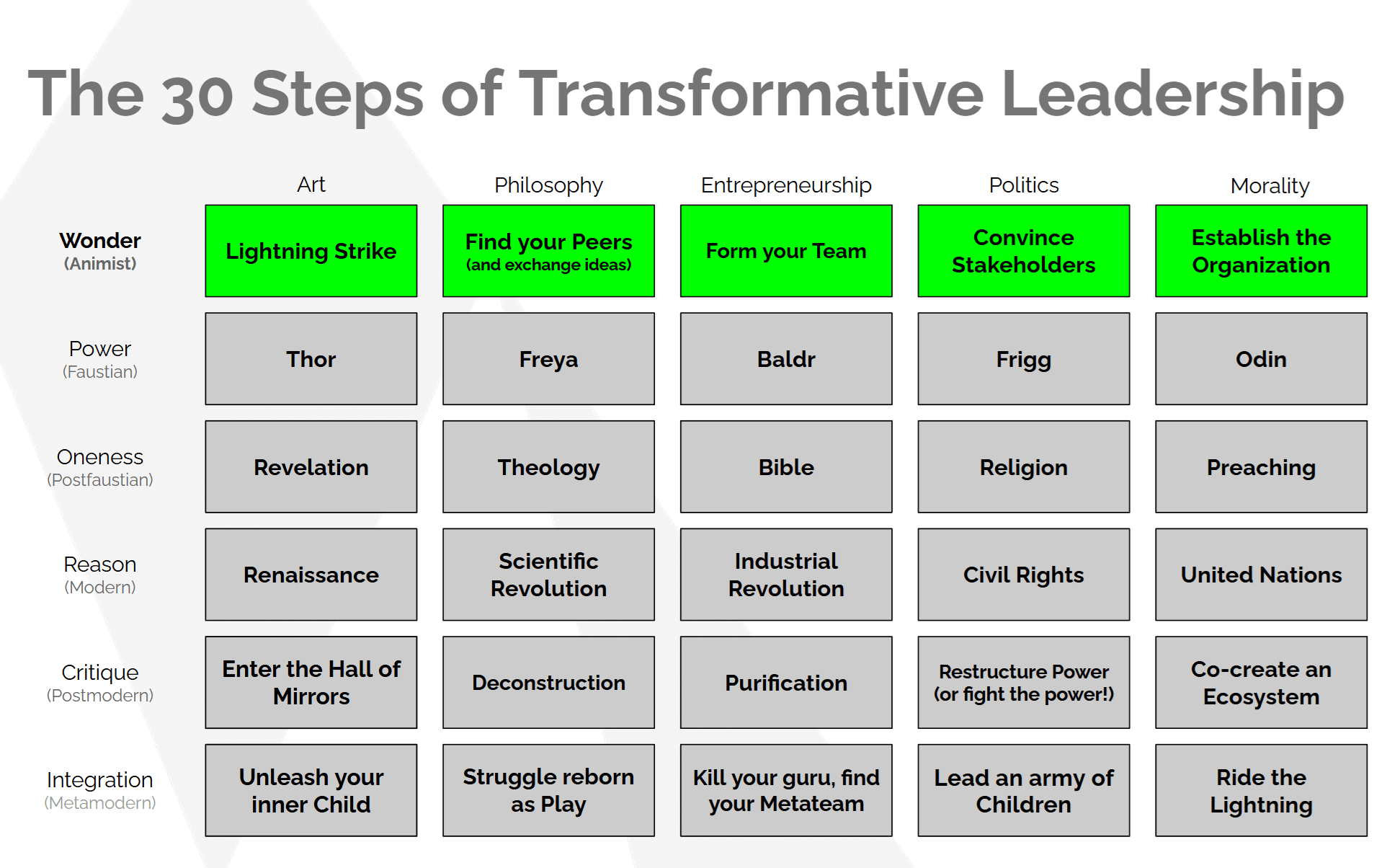
Without going into too much detail, what I want to emphasize here is that at every phase transition of an organization’s development (the first columns to the left), you start anew as an “artist”. “Art” is a useful approximation to describe what is going on at this sub-step since the role of the artist is to imagine things that are yet to exist. Every transition to a new and higher stage begins with a foundational innovation or set of innovations and a new vision for what the organization should become. The initial purpose of this novel revelation is to “update” the “code” of the organization, so to speak; that is, to reinvent or come up with a new vision for what kind of entity the organization should be, what it should do, and how. In this broader sense of the term, you initiate every transition to a new frequency as an “artist”.
And finally, such innovative breakthroughs typically occur within the mind of an “Individual”, an exceptionally well-endowed individual to be more precise. Very few individuals have the capacity to initiate a transition to a new stage, it takes an unusually gifted soul who is cunning enough and sufficiently in tune with what the world needs and what the organization can deliver. But, it only takes one single person. It does not need a large group of people seeped in the new stage’s form of thinking, only one person who is sufficiently ahead of their time and with the right skills to express the unrealized potentials of a new and higher stage and how it should be applied to the organization in question
This makes art extraordinarily powerful. It’s therefore no coincidence that elites tend to obsess about art, always curious about what the avantgarde is up to. Marinating yourself in art makes it more likely that you’ll innovate. It gives you a competitive edge. Accordingly, it’s recommended that you spend time in art museums, check out new cultural events, and that you look at new trends in popular culture, whether that’s music, tv-series and so on.
Sadly, I feel that the metamodern and especially integral and post-integral spaces are lacking in this department. There’s plenty of cutting edge theory, deep spiritual practices, but when it comes to aesthetics, something seems to be lacking.
Consequently, I’ll urge our little community to take art seriously, to start developing our aesthetic sensibilities, so that we can take things to the next stage and become increasingly relevant as a force of change in today’s culture.
This is an invitation. To be struck by lightning.
If you’re interested in learning more about metamodernism and the philosophy of Hanzi Freinacht, the Metamodern Academy with Emil Ejner Friis is offering an online introduction course in November 2026 here, and if you’re interested in a more comprehensive experience, you can join the new Updated Master Class here.
—
Hanzi Freinacht is a political philosopher, historian, and sociologist, author of ‘The Listening Society’, ‘Nordic Ideology’ and ’12 Commandments’. Much of his time is spent alone in the Swiss Alps. You can follow Hanzi on Facebook, Twitter, and Medium, and you can speed up the process of new metamodern content reaching the world by making a donation to Hanzi here.
No posts
Comments
Nothing yet. Say the first thing.
Sign in to join the conversation.