
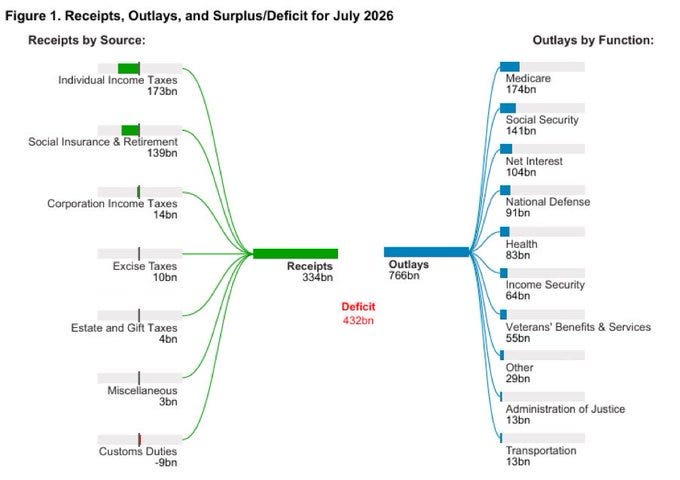
The July budget report was not merely another ugly deficit number. It was a look inside the fiscal machine at a moment when the economy is supposedly strong, equity markets remain elevated, and policymakers have spent years promising that spending restraint is just around the corner.
The Treasury reported a $432.3 billion July deficit, the largest July gap on record.
Receipts totaled $334.0 billion while outlays reached $766.3 billion.
That means the government borrowed or financed roughly $0.56 for every $1.00 it spent during the month. Think about that.
The more important number may be the cost of carrying the past. Gross interest on Treasury debt reached $117.6 billion in July, up about $26 billion from a year earlier, and gross interest payments have totaled ~$1.2 trillion through the first 10 months of fiscal 2026.
The government is now spending an extraordinary share of its available fiscal capacity simply to service obligations already incurred. There is no war-time emergency, no economic collapse, and no recession-driven revenue drought to explain the scale of this gap.
This is the baseline. And the baseline is why the United States cannot tolerate persistently higher interest rates, why material spending cuts keep disappearing from the political agenda, and why the eventual answer will be more financial repression, more liquidity, and a weaker dollar.
That is the debt and debasement trade, it is exceptionally bullish for gold, silver, real assets, and miners, and it hasn’t yet kicked off in earnest.
Why is a record $432 billion July deficit especially alarming when it occurred during a period of relatively resilient economic activity rather than a recession?
What does ~$1.2 trillion of gross interest paid in 10 months reveal about the government’s ability to live with higher yields?
And why do the composition of federal spending and the political calendar make rapid deficit reduction unlikely, leaving liquidity support and currency debasement as the path of least resistance?
The July number is not an isolated problem. It is a snapshot of a fiscal structure in which interest costs, mandatory programs, defense needs, and future A.I.-related capital requirements are all competing for capital at the same time. Read on to see why the arithmetic increasingly points toward a weaker currency and a far stronger hard-asset cycle. So, let’s dig in…
Comments
Nothing yet. Say the first thing.
Sign in to join the conversation.