
Forget the speeches and the narratives for a moment. The most important question for markets is not what the Federal Reserve says about inflation, but what its balance sheet is doing with real dollars.
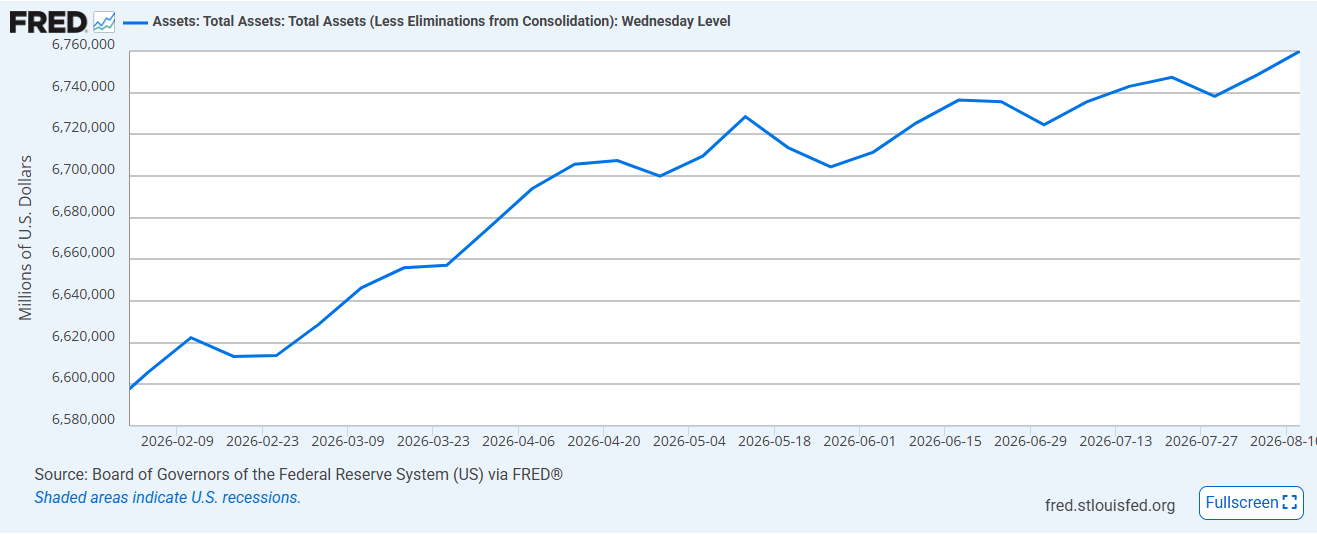
The latest H.4.1 release shows that the Fed’s total assets increased by $11.388 billion in the week ending August 12, bringing the balance sheet to approximately $6.760 trillion. Treasury holdings rose by roughly $8.3 billion during the same week.
This is not an academic distinction. A central bank whose balance sheet is expanding is adding liquidity to the financial system, even while officials continue to speak in the language of inflation discipline.
A single weekly increase does not, by itself, prove the start of a new quantitative-easing program. Balance-sheet totals move for operational reasons, and the policy rate remains the Fed’s primary instrument.
But the trend on the chart is still revealing. Since early February, and really mid-December, total assets have risen materially, with no recession or obvious market seizure forcing an emergency response. The real test will arrive when the United States must simultaneously finance huge Treasury needs and maintain the A.I. infrastructure race against China. This is quickly expanding.
That collision is already placing unprecedented pressure on yields and liquidity. When it is in full bloom, the Fed will not be able to protect both the long-term purchasing power of the dollar and the smooth funding of the debt-and-infrastructure machine.
Us investors should pay attention to what the Fed does, because the next major expansion in liquidity would be profoundly bullish for precious metals and miners.
Why does an $11.388 billion weekly increase in Fed assets matter more than another rhetorical commitment to a 2% inflation target?
Why is the balance sheet already rising without an acute crisis, and what would happen to it if Treasury financing and A.I. infrastructure borrowing trigger real market stress?
And how does a future liquidity response translate into dollar debasement, stronger gold and silver prices, and a capital wave into mining equities?
The balance sheet is the evidence, not the press conference. Read on to see why the Fed’s current liquidity behavior, the Treasury’s debt burden, and the capital needs of the A.I. race are converging toward a collision that could force a much larger round of monetary support. So, let’s dig in…
Comments
Nothing yet. Say the first thing.
Sign in to join the conversation.