
The US government projects that employment will grow by about 3% over the next decade. Metaculus forecasters expect it to fall by roughly the same amount. That six-point gap, driven almost entirely by expectations about AI, is one of the starkest places where the future institutions are planning for and the future our community expects have started to come apart.
On April 20, together with Renaissance Philanthropy and the Schultz Family Foundation, we launched the Labor Automation Forecasting Hub, a continuously updated view of how AI may reshape the US labor market through 2035.
It’s built for policymakers, educators, workforce leaders, employers, and anyone trying to plan for the future of the US workforce as AI advances. Below, we’re sharing a quick view of analyses that caught our attention from the first round of forecasting.
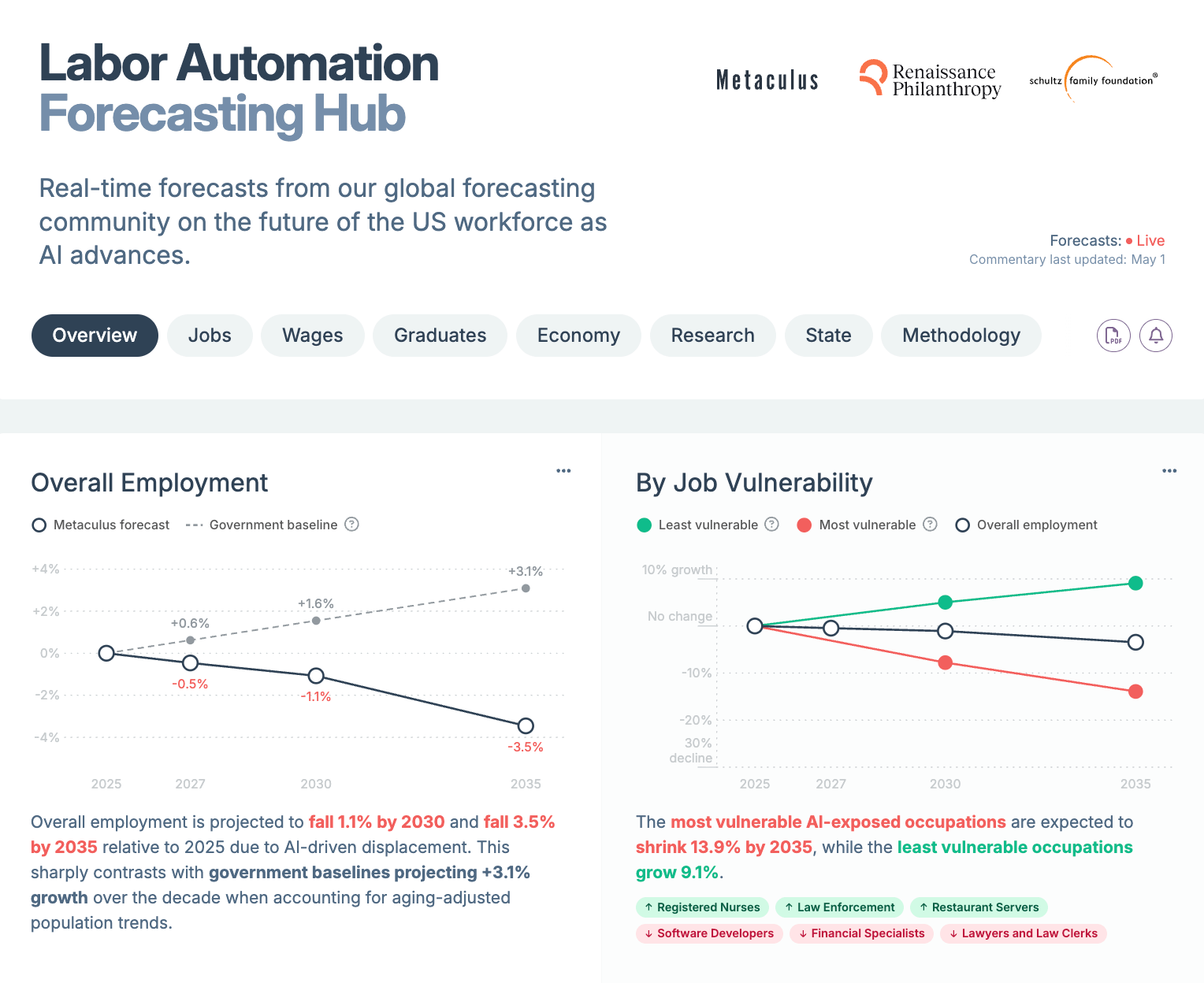
Overall employment: Forecasters expect significant AI-driven job change, with overall employment declining around 3% by 2035, while the latest Bureau of Labor Statistics projections expect approximately 3% growth.
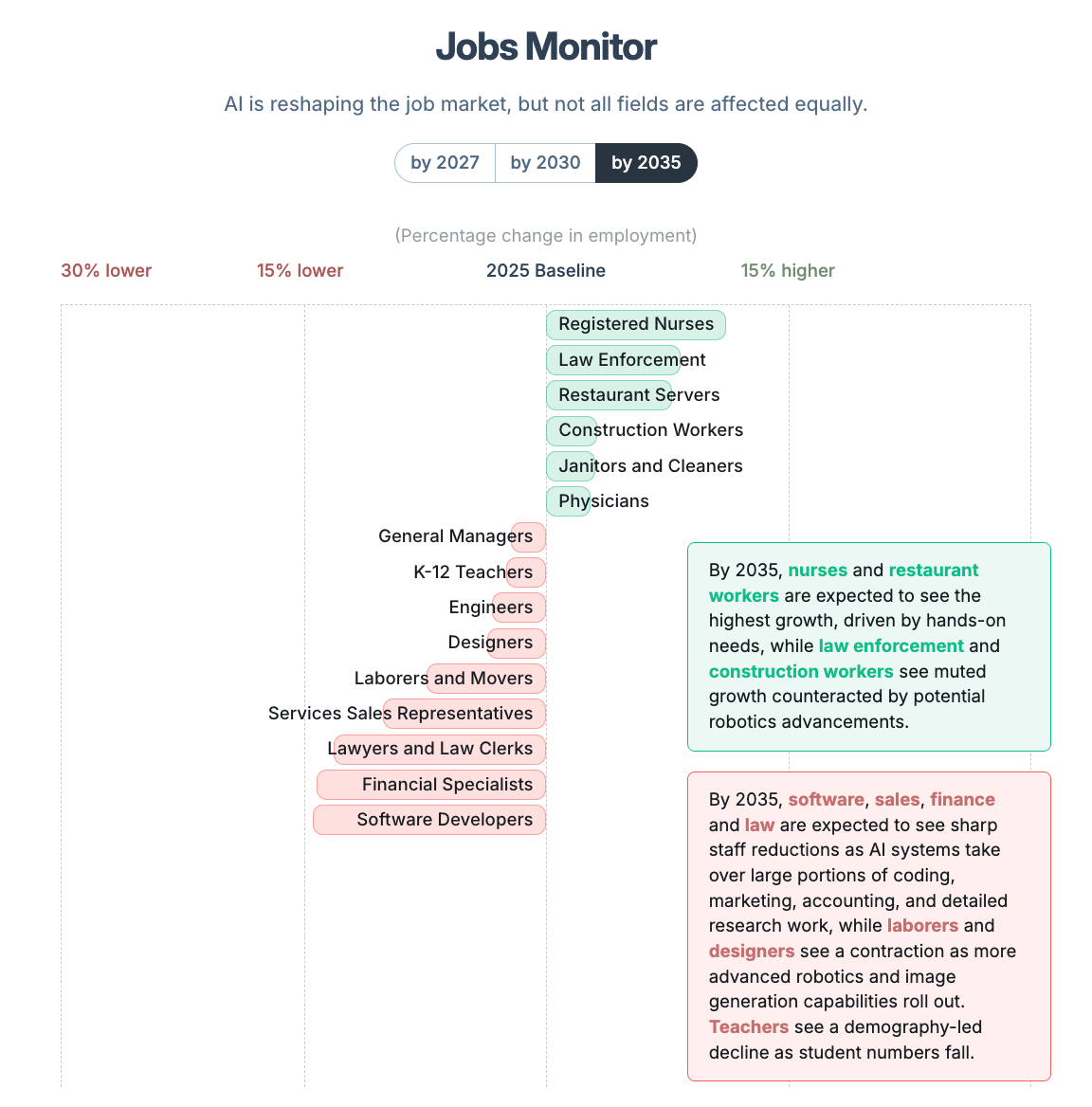
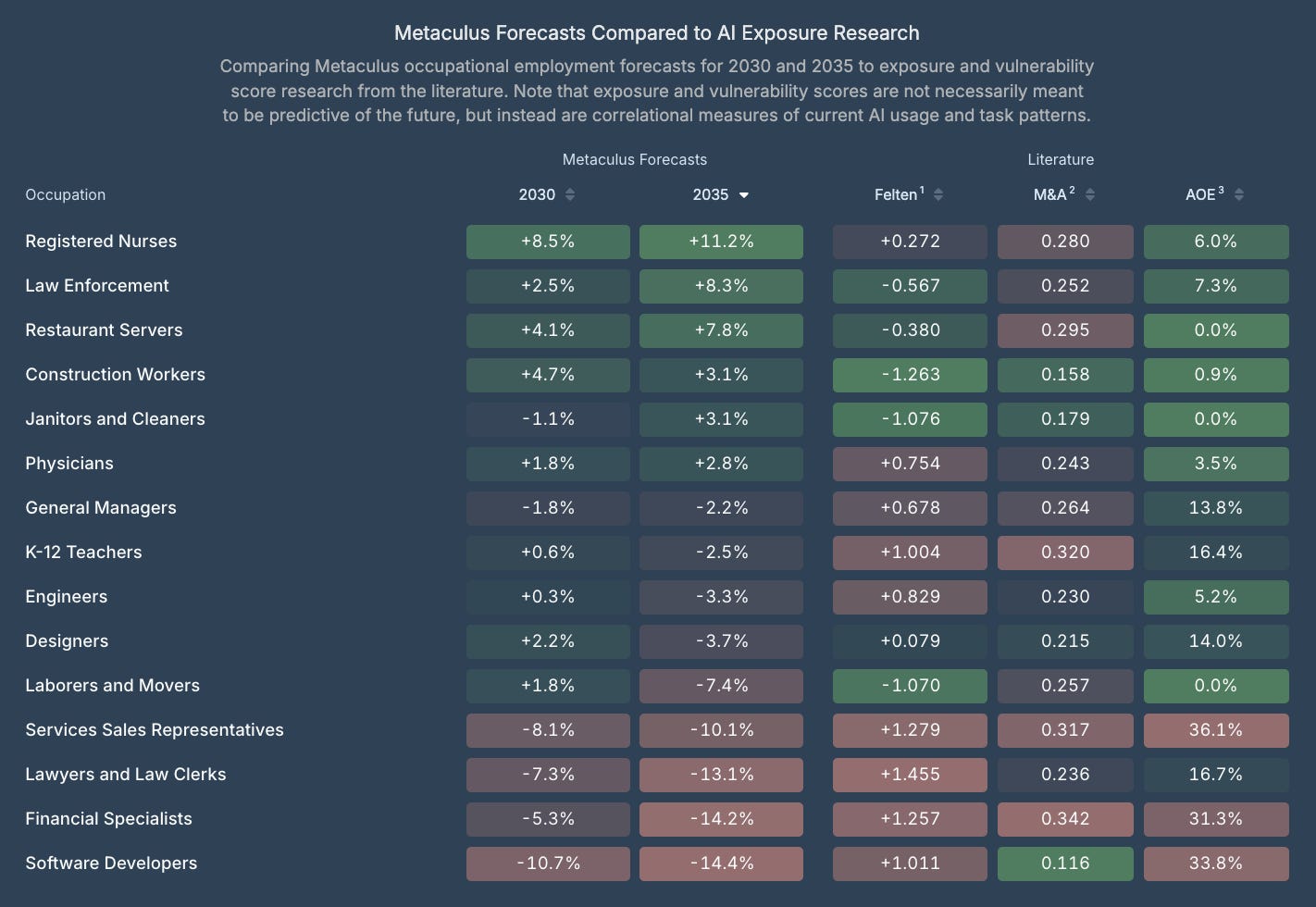
Most and least vulnerable occupations: The most AI-exposed occupations are expected to shrink 14.4% by 2035, while the least AI-exposed occupations grow 11.2%. Software developers, financial specialists, legal professionals, and services sales representatives are all expected to see the largest decreases in employment rates, while registered nurses, law enforcement, and restaurant servers are projected to grow.
Wages and hours worked: Wages are expected to grow. Hours worked are expected to decline, from 38 hours a week to ~35. Here, forecasters flag the rise of “dark leisure.” Workers may still be at work but would actively working less. Reported hours may look steadier than the underlying reality.
Financial well-being: Well-being (as measured by the ratio of after-tax and transfer available resources to the poverty threshold) is expected to remain the same or grow across the board, with the highest income families seeing the most gains.
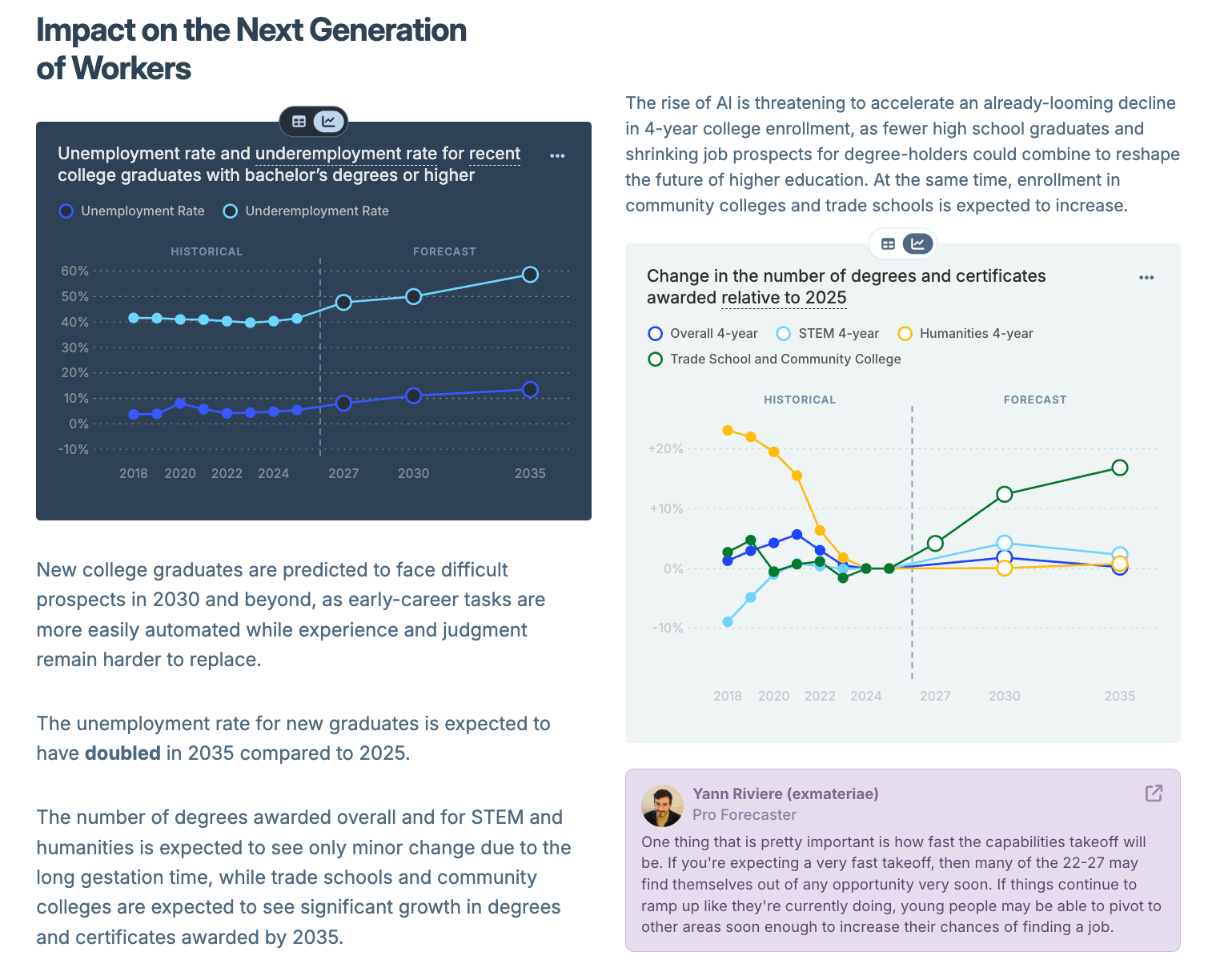
Young workers: The youngest workers are expected to be hit hardest, with unemployment for 4-year college graduates expected to double from 6% to 12% in 2035. Meanwhile, trade school and community college certificates are expected to grow 17% relative to now.
Broader economy: The economy is expected to see a number of significant changes, with the long-term unemployment rate, labor productivity, and the number of Fortune 500 companies with fewer than 5,000 employees all seeing substantial increases over the next decade.
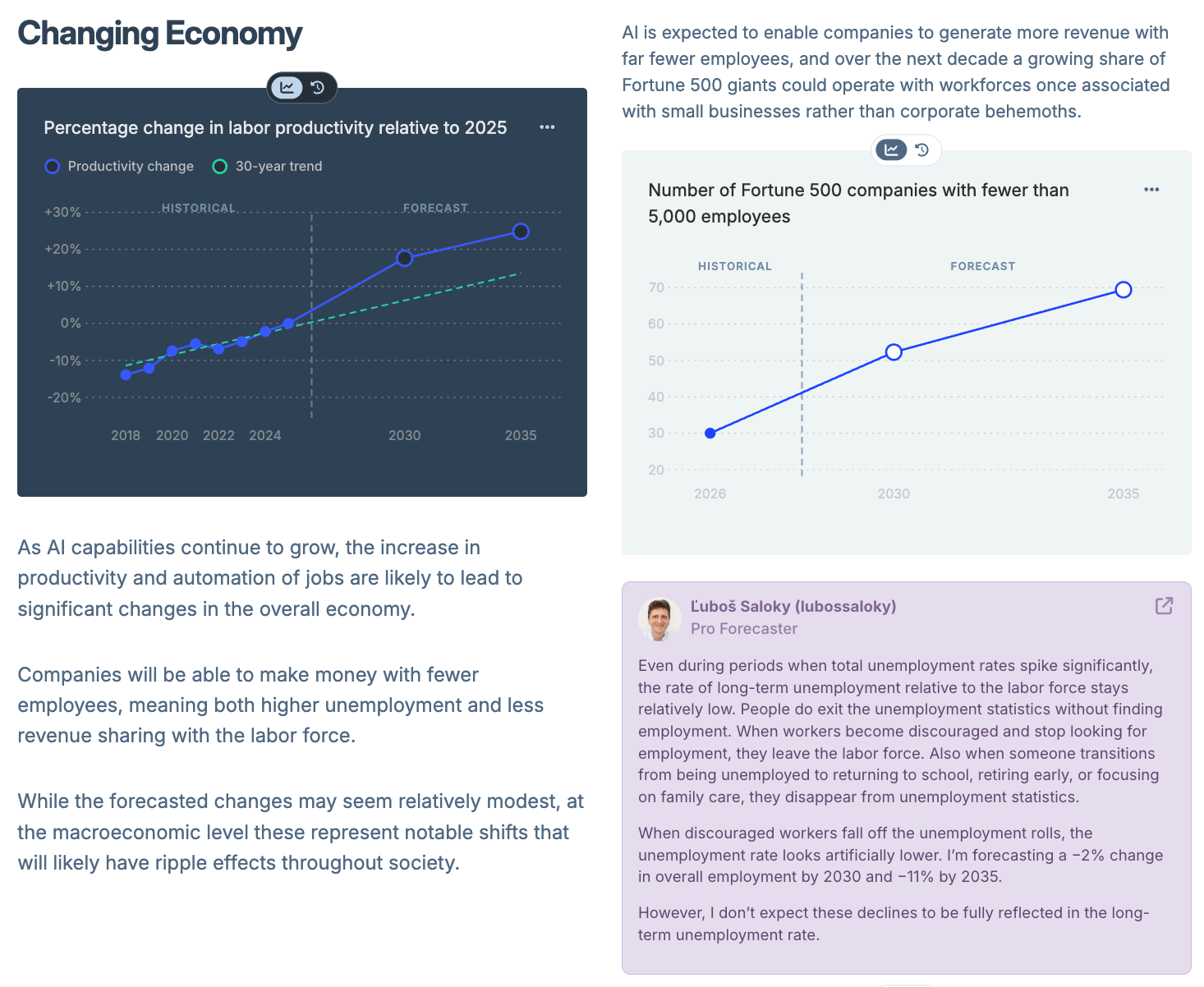
Some of the most consequential lines on the Hub are about structural changes vs. changes to individual professions or demographics respectively:
Labor’s share of national income: 62.1% → 54.7% by 2035
Long-term unemployment rate: 0.99% → 5.44%
Labor productivity: +24.8% vs. 2025, well above the 30-year trend
Fortune 500 companies with fewer than 5,000 employees: 30 today → 69 by 2035
As Pro Forecaster Ľuboš Saloky puts it: “AI is capital intensive, high-skill biased, and labor saving. It will disproportionately benefit owners of capital at the expense of workers.” He’s forecasting roughly -11% overall employment by 2035 once discouraged workers who leave the labor force are accounted for.
Not everyone agrees on timing. Pro Forecaster Patrick Molgaard argues that displacement may still arrive more slowly than capability would suggest: “Photographic Process Workers” took five years to decline 50% between 2010 and 2015, even once their underlying task was effectively obsolete. Institutions bend slowly, and the Hub is designed to track exactly how quickly (or slowly) the bending happens.
The Hub also places our numbers against the AI exposure literature. In most cases the community’s forecasts line up with exposure rankings. The notable divergences (e.g., teachers, warehouse workers) are where forecasters are making human judgments exposure scores can’t: about classroom norms, robotics rollout timelines, and which jobs parents, voters, and customers will fight to keep human.
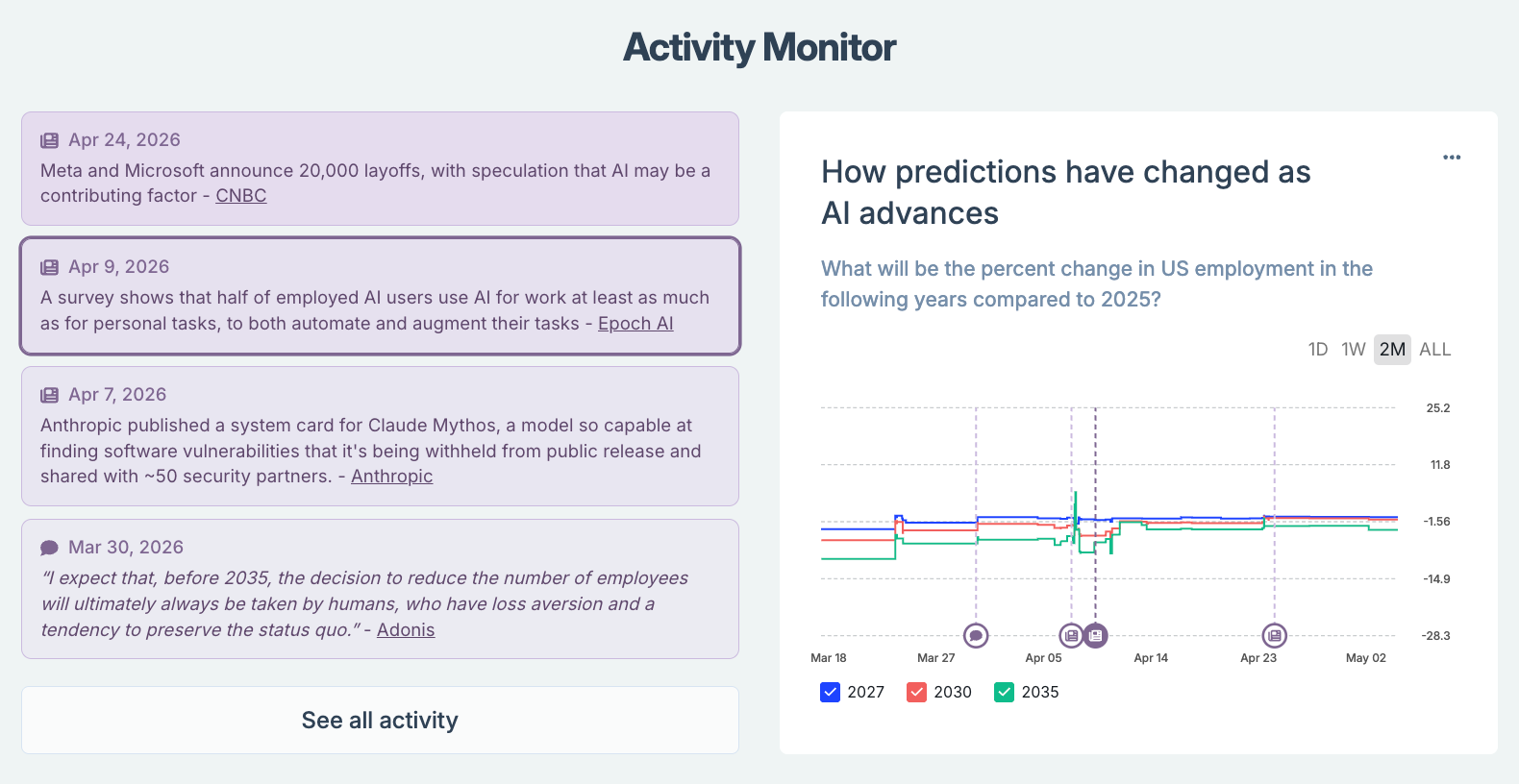
The Hub updates in real time. Every visualization has an underlying tournament question you can open, forecast on, or export as PNG or CSV. There’s an Activity Monitor tracking news and model releases, a state-level view (starting with Washington), and conditional questions testing what these forecasts would look like in a no-AI-progress or strong-GDP-growth world. A PDF snapshot is downloadable from the top right, and you can subscribe to updates via the notification bell.
Explore the Hub to see how the community is thinking about AI’s impact on the US workforce.
Join the Labor Automation Tournament to add your own forecasts and reasoning; the more diverse the views, the better the aggregate!
If you want to share your own forecasts, ask a question, or share a thought with participants and Metaculus staff, you can do so by creating a Metaculus account and forecasting in the Labor Automation Tournament, or jumping in with a comment on the Hub Forum.
If you have established experience in AI, economics, or a related field, and are interested in having your thinking or work highlighted on the Hub, please contact us at labor-hub@metaculus.com so we can discuss further.
The forecasts presented on the Labor Hub are produced by aggregating many individual forecasts into a prediction that research has shown to be more accurate on average than individuals typically produce.

To learn more about our methodology, including occupation selection and approach; forecast uncertainty, disagreement, and other statistics; acknowledgements of individuals who provided input on the Labor Automation Forecasting Hub; and more, select the “Methodology” tab or scroll down to the section on the main page of the Hub.
No posts
Comments
Nothing yet. Say the first thing.
Sign in to join the conversation.