
The omega-3 to omega-6 ratio is always focused on and it’s treated as common knowledge, yet the story is incomplete.
In a study, Glauber supplemented six men with established type II diabetes with omega-3 for one month and tracked what happened to their blood sugar. A healthy adult holds fasting glucose around 5 mmol/L. These diabetic men were already running at 13.1 before the supplement, and after a month of omega-3 it climbed to 15.3, taking already-poor numbers measurably higher.
The liver was dumping about 25% more sugar into the bloodstream between meals, adding to the load. Insulin response to meals fell by roughly a third, taking away the tool the body uses to clear that sugar. The result was more sugar entering the bloodstream and less ability to clear it, every metabolic axis moving worse, and signs of dysfunction increasing.
When the supplement was stopped, every measurement reversed toward baseline. Fish oil was supposed to help these men’s metabolic health. Instead it made every measurement worse, reversibly. The supplement itself caused the worsening.

One small study isn’t the whole case, and Glauber’s six men aren’t a verdict on their own. It would be dishonest to claim so. The 1988 result is one entry into a larger question which the rest of the literature confirms when the studies are read through the underlying biology.
Once fish oil arrives inside the body, it gets built into the membranes of every cell, fed into the cellular gates that decide how energy is made, and folded into the signaling pathways that set thyroid output. The supplement’s effects on glucose, insulin, and energy turn out to be downstream of what kind of fat it actually is and where the body puts it.
Before fish oil’s effects on glucose, on the thyroid, on the membranes of the heart and liver and brain can be tracked, we need to understand the fat itself.
Omega-3 sits inside a wider class of fats whose defining feature is its chemistry once it gets inside a cell.
Some fats are extremely stable; others are extremely reactive. What decides which is which is how many double bonds the fat is carrying.
A double bond is a place in the fat molecule where two hydrogens are missing, and chemists treat each one as a chemically weak spot. The more weak spots, the more readily the fat reacts with oxygen, heat, and the cellular machinery once it sits inside your tissue. They are all fats, yet the composition changes their properties and behavior significantly.
We often don’t go much further into the discussion surrounding omega-3 to omega-6 ratio except by claiming we need more omega 3, and the ratio question leaves the deeper variable untouched.
The “essential fatty acid” label dates to 1929, when Burr and Burr fed rats no-fat diets and saw dermatitis and growth failure, and the term has carried that weight ever since. Later work discredited this slightly. When animals are kept on PUFA-free diets, the body builds its own substitute (Mead acid, a fat with three double bonds made from oleic acid) and continues to function. The less omega-6 you eat, the less omega-3 you need to balance against it, because the inflammatory pressure the omega-3 is meant to counter is no longer there. The dietary “need” for omega-3 is partly an issue of an omega-6-saturated food environment.
Three structural classes carry the weight of dietary fat. Saturated fats (butter, tallow, coconut, dairy fat) carry no double bonds, which keeps them tight and stable. Monounsaturated fats (olive oil is the familiar one) carry exactly one. Polyunsaturated fats, or PUFA, carry two or more, and this class loads the most reactive raw material into the body.
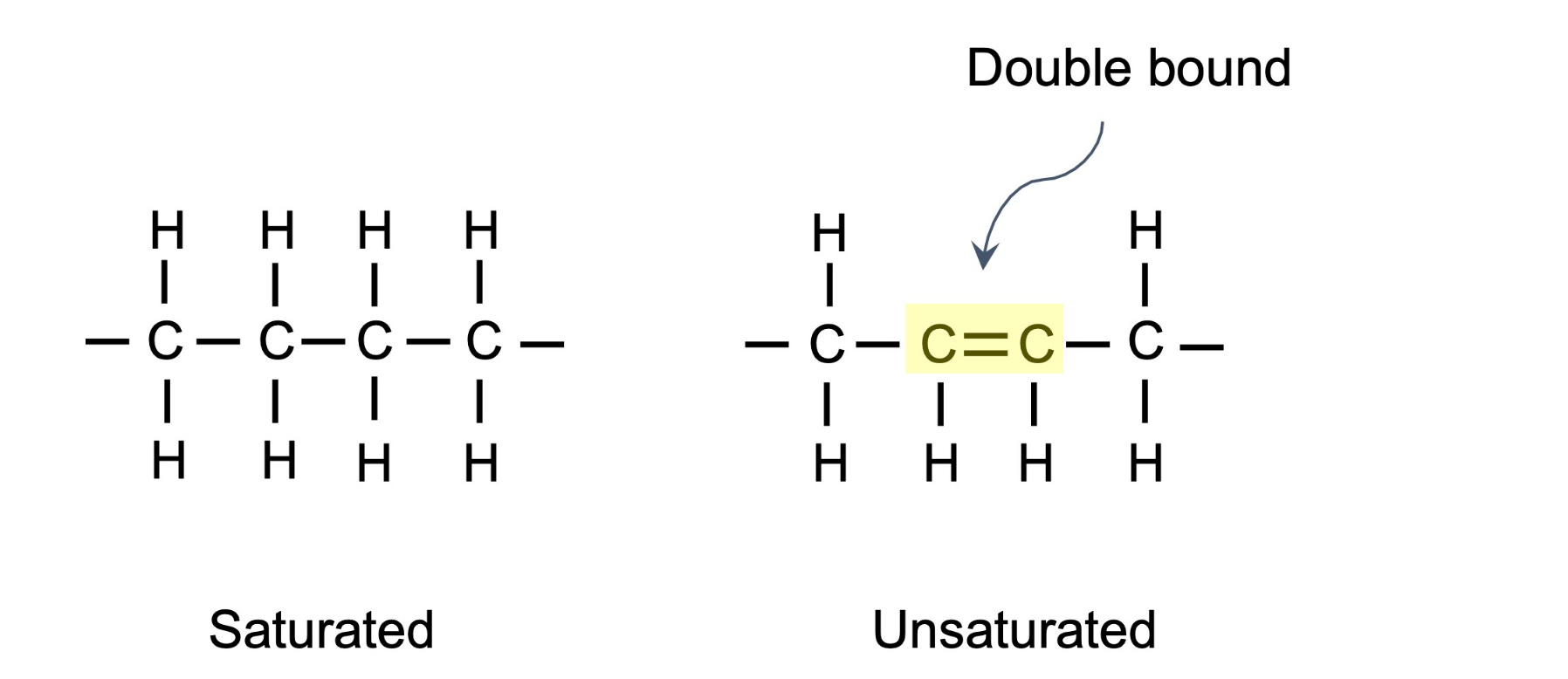
EPA, the shorter omega-3, carries five double bonds. DHA, the longer one, carries six. Nothing else in human nutrition sits this high. It’s the most peroxidizable fat, more than any other seed oil, including the linoleic-acid-heavy oils plenty of readers already know to avoid.
The fat being analyzed here is the supplemental kind, the concentrated EPA and DHA people swallow as pills, not fresh whole fish eaten as food. Those are biochemically different exposures. The broader seed oil argument is laid out in The Seed Oil Bible:
Knowing that the amount of double-bonds in fats make it more reactive, what does the body do with the most unsaturated fat? Let’s begin by looking inside mitochondria.
Mitochondria are the parts of your cells that turn the food you ate into the energy you actually run on. Every step of being warm, alert, recovering from exertion, and feeling good after a meal traces back to mitochondria doing their job well.
When they slow down, you feel it across the whole body. So the question of what fish oil does to mitochondria is the question of what fish oil does to your daily experience of having energy.
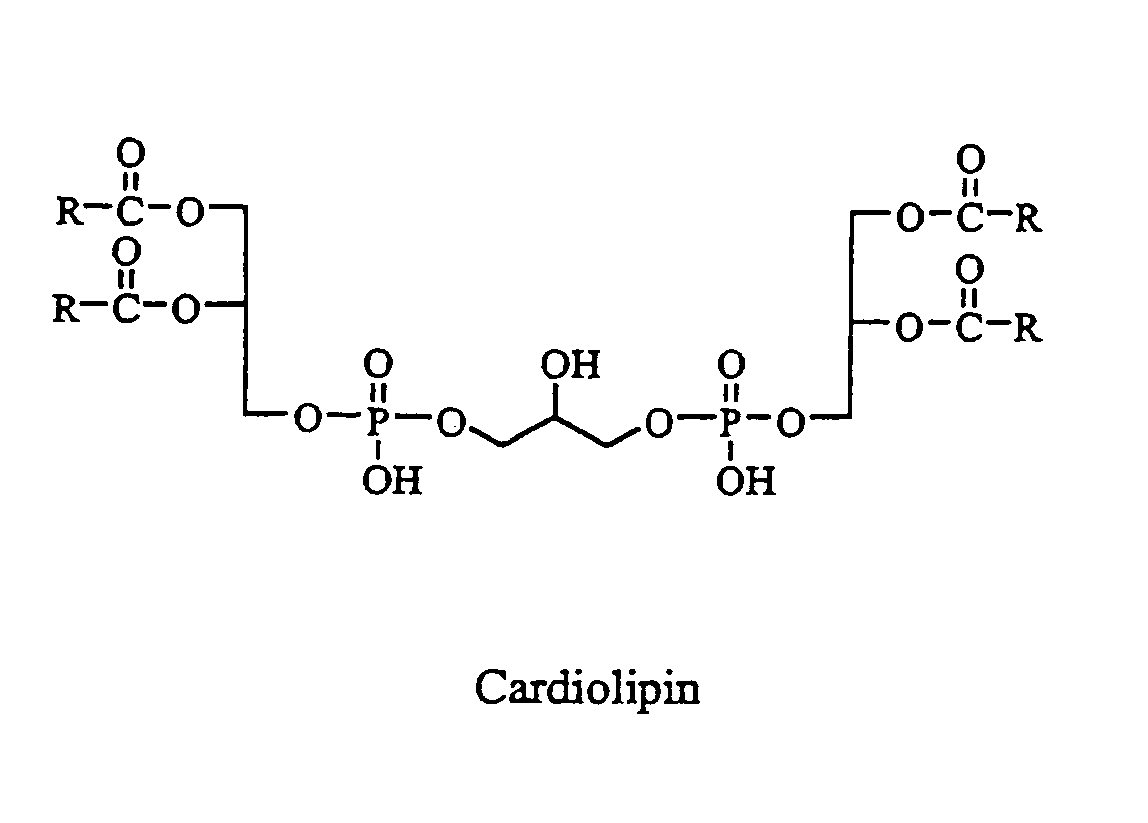
The damage starts at a specific lipid called cardiolipin, which sits in the inner mitochondrial wall and physically supports the enzyme that finishes respiration and lets ATP get made. Cardiolipin wraps directly around that enzyme, stabilizes its shape, and lets it pump protons across the membrane efficiently. When cardiolipin is built from stable fat, the enzyme runs cleanly. When cardiolipin is built from reactive fat, the enzyme cannot do its job properly even if every other piece of the respiratory chain is in place.
Cardiolipin starts out built mostly from palmitic acid, a stable saturated fat. When we’re born, cardiolipin is rich in this saturated fat. Over years on a high-PUFA diet, palmitic acid slowly gets replaced by PUFA. The replacement is just a function of which fats are available when the body rebuilds the membrane. Fish oil delivers EPA and DHA, the most unsaturated fats in human nutrition. Every PUFA in the diet pushes cardiolipin in this direction, but fish oil pushes hardest as each molecule carries the highest reactivity available.
A fraction of every dose ends up sitting against the respiratory enzyme, where it least belongs. Dr. Peat anchored this lifelong remodeling of cardiolipin away from saturated fat as one of the structural reasons metabolic rate declines from the twenties into the fifties and beyond.
“Aging”, can be partly sidestepped knowing this.
Once cardiolipin is loaded with omega-3 fatty acids, the cell itself starts dismantling the membrane. The enzyme that does the dismantling is phospholipase A2, an enzyme whose job is to clip fatty acids out of phospholipids. Omega-3-enriched cardiolipin activates this enzyme more strongly than normal cardiolipin does, and the result is membrane breakdown right where ATP is made.
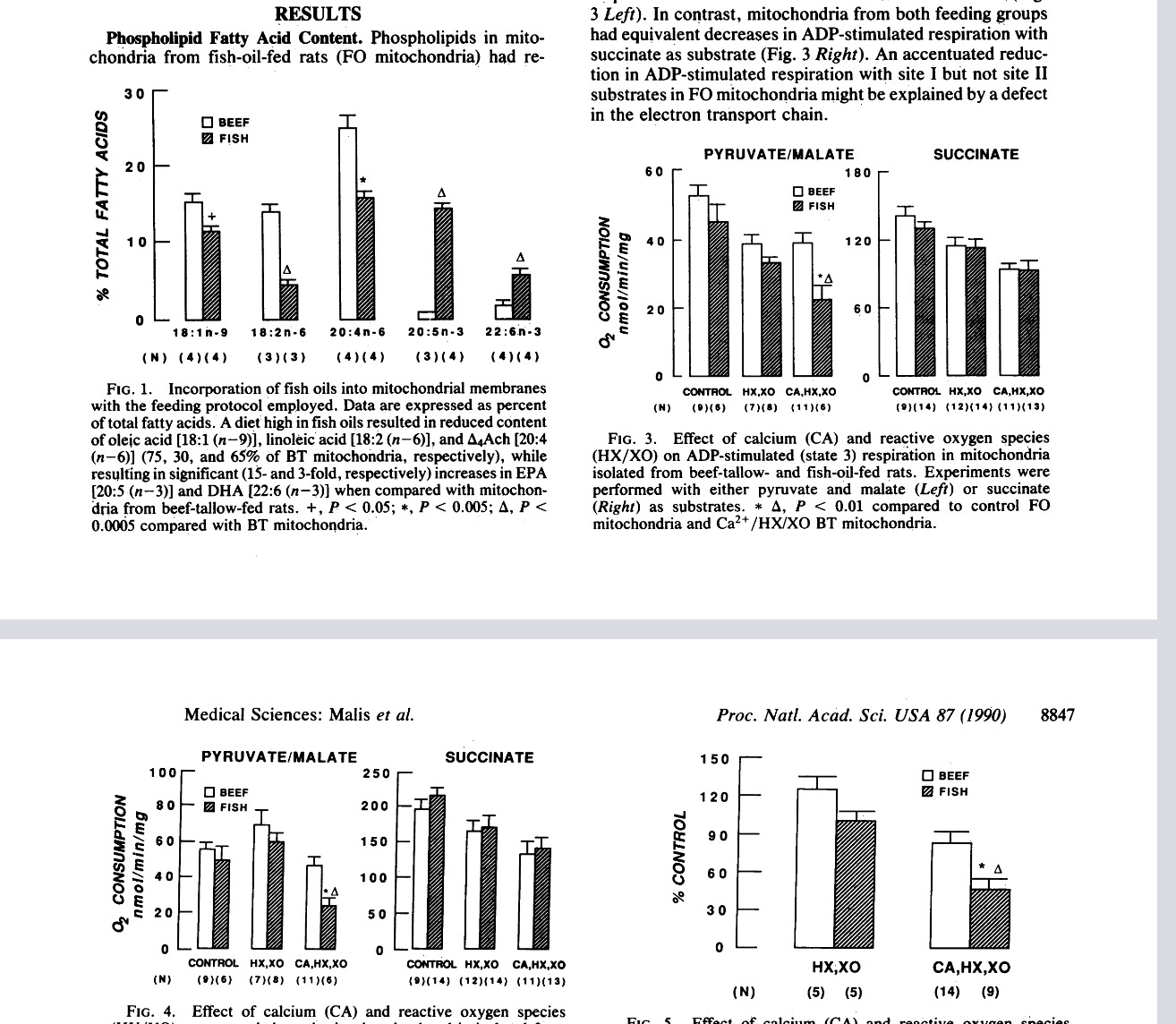
Malis (1990) demonstrated this directly:
Rats fed fish oil and rats fed beef tallow were compared under oxidative stress. In the fish-oil group, the first step of the respiratory chain fell to 45% of normal.
In the beef-tallow group, the same step held at 85%. Blocking phospholipase A2 with dibucaine restored function, which confirms the enzyme as the actor doing the damage.
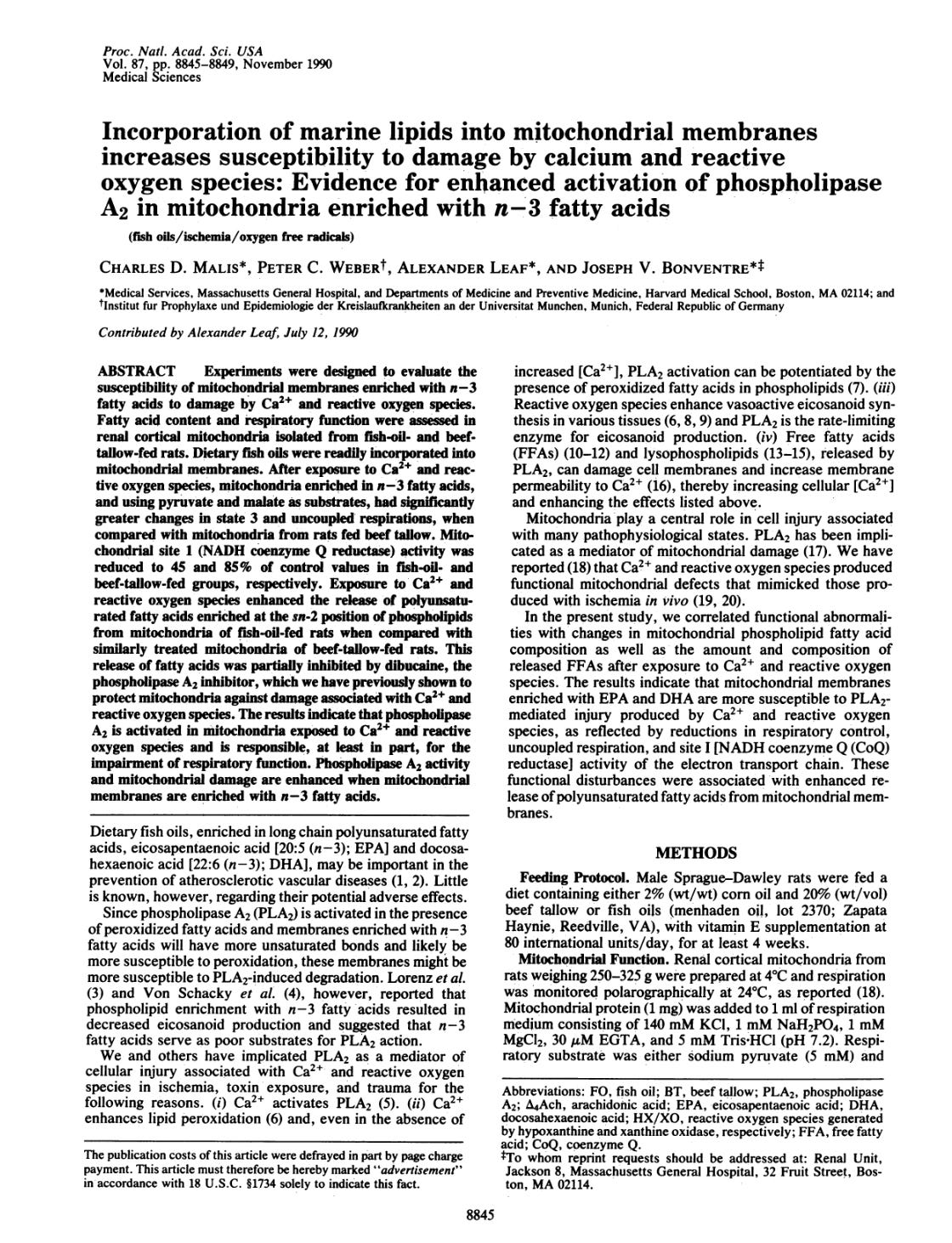
This is more direct evidence that fish oil delivers a fat to your cells that the cells then actively destroy themselves with. The mainstream claim that fish oil supports mitochondrial health predicts the opposite of what the data shows.
Across decades this shows up as a gradual decline in warmth, recovery, and energy. The body burns worse because the membrane where ATP is made has been progressively rebuilt out of more reactive fats.
Eliminate dietary PUFA, and cardiolipin returns toward its saturated profile on the same timescale it took to remodel in the wrong direction. Respiratory enzyme activity recovers in step. The respiratory chain itself was always intact, but the substrate it had been given is what drove the decline, and changing the substrate changes the trajectory.
The membrane is one problem, but the oils cause a second problem inside the cell, at the enzyme that decides whether the food you ate becomes clean energy or backs up into lactate.
Glucose is your most efficient fuel per unit of O2. It produces disproportionately more warmth, CO2 (a protective intracellular signal), alertness and increases your metabolism compared to other fuels.
When you’re unable to efficiently burn glucose, it backs up into lactate, the same acidic byproduct your muscles make during a sprint. You feel post-meal heaviness, brain fog, and the carb crash often blamed on the carbs itself. I’d like to emphasize that the issue is rarely the carbs, instead it’s the system handling them. Here, the issue is at the cellular gate that decides which way glucose goes.
There is an enzyme that decides which way called PDH, short for pyruvate dehydrogenase. When PDH runs well, sugar burns well and you feel warm and steady. When PDH stalls, that same sugar piles up and becomes a source of dysfunction.
PDH needs several helper molecules to work. The well-known one is thiamine, vitamin B1. The less-discussed one is lipoic acid. Lipoic acid is a small piece of the enzyme that physically moves the substrate from one step to the next. Damage it, and the enzyme stalls even if every other helper is present and every other condition is right.
When PUFA breaks down inside your tissue, which happens continuously and proportionally to how much PUFA you have consumed over the years, it fragments into chemically reactive pieces.
The most aggressive of those pieces is called 4-HNE, even linked in Alzheimers and lots of other dysfunctional states. These reactive fragments stick permanently to lipoic acid and lock it in place. The enzyme has everything else it needs, but the moving part is jammed, so nothing passes through. Fish oil produces a close chemical cousin of 4-HNE called 4-HHE from its omega-3 fats, which does the same kind of damage to the same target.
I have described this elsewhere as a second thiamine deficiency, where the deficiency lives at the enzyme itself rather than in what you eat. Your blood thiamine test comes back normal, but the enzyme still doesn’t work properly.
The animal demonstration comes from a UC Riverside study. Vitamin-fortified mice fed soybean oil for eighteen weeks developed measurable thiamine deficiency in liver and blood, even though they were getting plenty of thiamine in their food.
The seed oil itself caused the deficiency. Fish oil delivers more reactive fat than soybean oil per gram, so it should drive this same problem harder.
PDH does not need stress to show this damage, but stress amplifies it. When fat circulates in the bloodstream, it competes with sugar at the burning step and slows PDH down, a tradeoff Randle’s 1963 work nailed down and is aptly named the “Randle Cycle.
The kind of fat you have stored decides how reactive the released fats are. PUFA gets stored more readily than saturated fat, so a body that has been constantly eating fish oil releases more reactive fat into circulation precisely when energy is most needed. The carbs you ate sit there causing dysfunction because the gate is locked. The fat you released is the wrong substrate, causing even more problems.
The acute pool of circulating fat and reactive fragments turns over fast and changes quickly once you stop adding to it, which is why the diabetic men explained in the first paragraph quickly reversed the effects when stopping omega 3 supplementation. But the membrane damage from years of exposure is on a longer timescale, and takes a couple years to reverse. This is because cardiolipin is structural and the body rebuilds it slowly.
Fish oil shows up at one more site, outside the cell, on the thyroid axis, and it works from four different places at once.
Thyroid hormone sets your body’s metabolic rate. It governs how warmly you run through the day, how readily you make energy from food, how alert you feel in the first hour after waking, how easily you recover from physical or emotional stress. When thyroid signaling drops, every one of those drops with it. The thyroid gland is one input into a much longer chain, and the chain is where fish oil does its damage.
Thyroid signaling runs through four steps.
First, the gland releases hormones, mostly in a storage form called T4.
Second, that hormone moves through the bloodstream attached to carrier proteins that move it from the gland to wherever it’s needed.
Third, the liver converts the storage form into the active form, called T3, the version cells actually respond to.
Fourth, the cell reads the active hormone at the outer membrane of the cell and triggers the energy response on the inside.
Knock out any one of these steps and the blood tests can still look fine while the body fails to receive the signal.
Fish oil interferes at every step.
At the gland, unsaturated fats blunt hormone release directly.
At the carrier-protein step, human binding studies show unsaturated fatty acids displace T4 from its main carrier (the protein called TBG, which along with transthyretin and albumin ferries over 99% of thyroid hormone through the blood); saturated fats tested in the same studies don’t displace it.
The same thing shows up in the free-fatty-acid surge that accompanies serious illness, where impaired binding and impaired downstream conversion move together.
At the liver, the T4-to-active-T3 conversion costs energy and depends heavily on glucose availability. Once that machinery stalls at PDH, conversion stalls with it.
The fourth step is where the most interesting damage happens.
The cell membrane the hormone arrives at is not a passive wall. Far from it. It is part of how the cell reads the signal. A membrane built heavy in PUFA reads the same hormone differently than a membrane built out of saturated fat.
Pacheco-Moisés (1981) fed rats either corn oil or lard, then measured how their red blood cell membranes responded to normal doses of T3 and T4. They looked at the same hormone in the same dose.
In the corn-oil-fed rats, the hormone suppressed an energy-using membrane enzyme. In the lard-fed rats, the same hormone activated it. This is heavy evidence that a body running on PUFA reads thyroid signals differently than a body running on saturated fat. The hormone in your blood can be perfectly normal, yet the response in your tissues is shaped by the fat the membrane is built from.
Yes, that demonstration is one study done on rats, but the principle it nails down (the fat environment of the membrane shapes the hormone response) is supported by adjacent human work on transport-protein binding. This experiment is a clean demonstration of it.
The suppression scales with how many double bonds the fat carries. The more double bonds, the more reactive the fat, and the harder it lands on every step in the chain. EPA carries five. DHA carries six. Both sit at the top of the curve, which puts fish oil at the strongest dose of the peroxidizable fats you can supplement.
Fatty fish consumption tracks with higher TSH in epidemiology, which is what tissue-level hypothyroidism looks like when the gland tries to compensate. You do not want elevated TSH.
This is why some might sit in front of an endocrinologist with symptoms that closely match hypothyroidism and low metabolism, and the lab panel comes back inside the reference range.
The panel measures hormone in the blood. The body lives in how the tissues read that hormone, and when PUFA is loaded into those tissues, the reading is bent. Three converging sites of damage now have a mechanism each.
If all of this is true, the obvious next question is why do the trial headlines keep saying fish oil is good for you?
If all of this is true, why do some trials show fish oil benefit?
Reading those trials through the mechanism is how you make sense of them.
Abbott (2020) ran a 12-week trial in 22 overweight non-diabetic men taking about a gram of fish oil per day, compared with corn oil. Testosterone rose in the fish-oil group, along with improved insulin sensitivity.
One might conclude that fish oil supports testosterone. A closer look is that fish oil reduced inflammation in already-inflamed men, which lifted an inflammation-driven suppression of testosterone. The effect is real but it is narrow.
You’re seeing the relief of a specific suppression in a specific phenotype across a specific window of time, not evidence that fish oil supports the underlying testosterone-making machinery.
Compare that with Mostad’s 1988 study. In diabetic men, every metabolic measurement worsened. Your state shapes what fish oil does in the body when you swallow it.
Laupsa-Borge (2023) ran a crossover trial of 4g per day of EPA and DHA for 7 weeks in obese adults. In men, insulin sensitivity worsened significantly. In women, those same measurements improved by similar magnitudes in the opposite direction. The substrate is doing different things depending on the body it lands in.
Short trials catch what fish oil does to inflammation in inflamed populations across weeks. They don’t catch what membrane incorporation does to enzyme function and cardiolipin composition across decades. A 7- or 12-week trial is too short to see the structural damage piling up underneath, and the structural damage is the part the mechanism walks above describe. Inside that short window, your response depends on starting state, meaning sex, obesity, inflammation status, metabolic state, and how much PUFA is already stored in your tissue.
The trials sit inside their own margin of error too. A study run in inflamed non-diabetics with a moderate dose across 12 weeks lands inside one slice of human metabolism, where temporary inflammation-relief dominates and structural damage hasn’t had time to accumulate.
The same molecule given to already-diabetic men lands inside a different slice, where the body has no spare capacity to absorb the added substrate stress. Both trials are real, and they sit on different sides of a margin..
The meta-analyses that average across those margins end up telling you a larger story.
Ni (2015) followed metabolically-healthy-obese Chinese adults for 10 years. Two unsaturated fatty acids in blood predicted metabolic syndrome years before it appeared clinically. In that trial, the unsaturated fats in your blood signal trouble before that trouble becomes clinically visible, and the shorter studies miss this entirely because they measure too short of a window.
That leaves the question of actual fish eaten today. Salmon at dinner, the tuna sandwich at lunch, the fish fillet in the pan. It’s the same mechanism with a different dose, and the type of fish does most of the work.
Fatty fish (salmon, mackerel, sardines, herring, tuna) delivers EPA and DHA at doses that approach a supplement on a per-serving basis; lean white fish (cod, halibut, sole, fluke) and shellfish (shrimp, scallops, oysters, crab) are mostly protein with very little PUFA.
A weekly sushi night built around shellfish and lean white fish with some salmon mixed in sits in a very different place than daily salmon or a 4g capsule every morning.
The co-nutrients in whole fish (selenium, iodine, protein) provide buffering against the oxidative stress that an isolated capsule doesn’t have, and raw fish hasn’t begun the oxidation that bottled fish oil has already started.
The mechanism above scales with how much EPA and DHA actually ends up in your tissues across years, which depends on the type of fish, how often you eat it, how it was cooked, and what else is on your plate.
If you read each study as a standalone verdict, the literature looks constantly contradictory, leaving you to reach for whichever paper matches your prior. Read the trials through the mechanism instead and the contradictions become information about how fish oil behaves under different conditions inside different bodies.
Fish oil is the most unsaturated fat in human nutrition, and it does what unsaturated fats do, more strongly. It sits in the inner mitochondrial membrane where stable saturated fat used to sit and slows respiration at the enzyme that finishes the job. Inside the same cell it generates reactive breakdown products that lock up the moving part of the enzyme that burns glucose, so the carbs you ate back up into lactate instead of running warm. It interferes with thyroid signaling at every step from gland secretion to how the cell membrane reads the active hormone. And when stress mobilizes stored fat, a body loaded with EPA and DHA releases a more reactive substrate into circulation precisely when energy is most needed.
What you do with this depends on where you are. If you are currently taking a daily capsule, this is information to weigh against your own situation.
The Metabolic Blueprint is the result of years of studies, health research, analysis and trial & error. The all-in-one guide for reclaiming your youthful health energy.
Here’s 20% off: https://metabolicprint.gumroad.com/l/blueprint/liaanuz

No posts
Comments
Nothing yet. Say the first thing.
Sign in to join the conversation.