
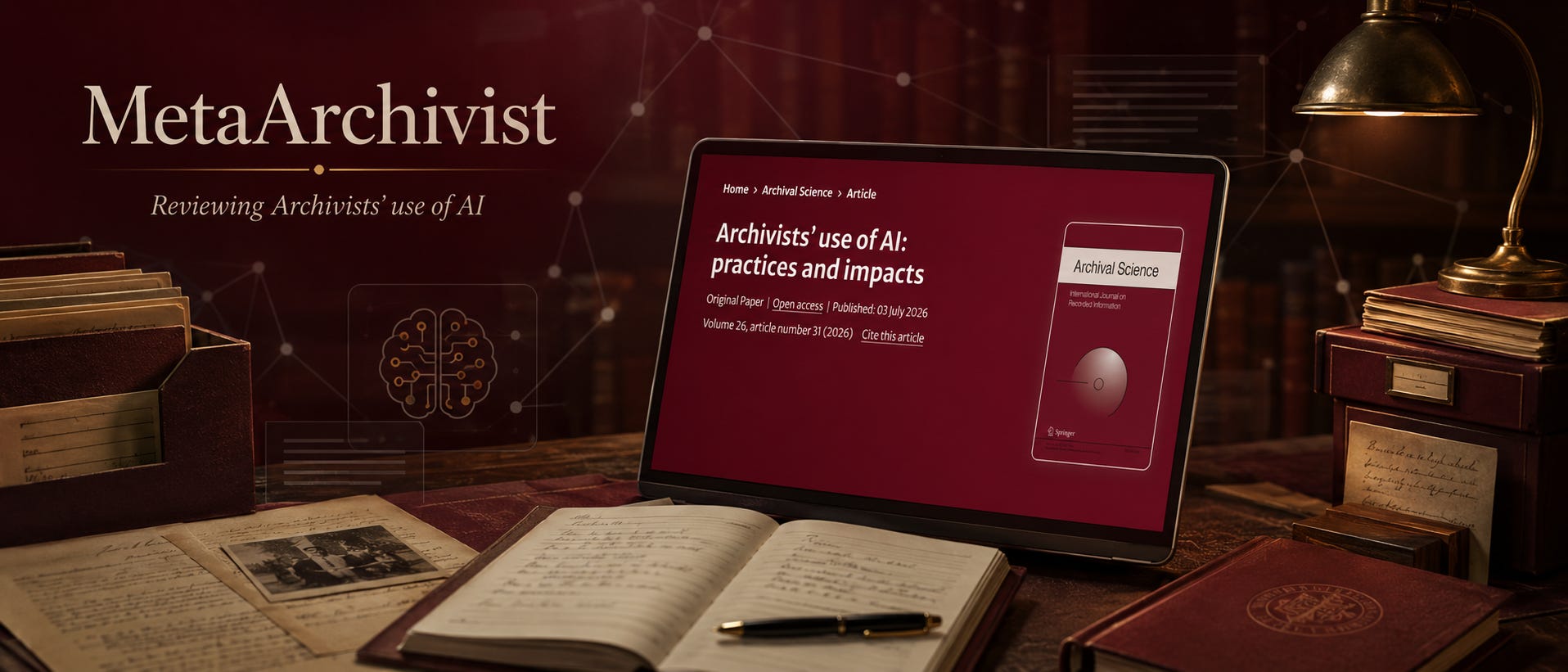
We have spent two years arguing about whether AI will take archivists’ jobs on the basis of almost no evidence. Elon Musk says coding careers die by December 2026. OECD economists say organizational inertia will slow everything down. Vendors say their tool will clear your backlog. Nobody in that conversation had actually asked working archivists what happened after they turned the thing on.
Jinfang Niu has now done that. Archivists’ use of AI: practices and impacts, out in Archival Science this summer, reports interviews with fifteen practicing archivists — thirteen American, one British, one Canadian — conducted in December 2025 and January 2026. It is, as far as I can tell, the first dedicated empirical study of what AI adoption has actually done to archival work rather than what it might do.
The headline finding is the one you’d expect if you’ve been paying attention rather than reading press releases: none of the interviewees knew of an archivist who had lost a job to AI, and they generally expected staffing to remain stable in the foreseeable future. Note the shape of that sentence. It is a claim about what fifteen people had observed and what they anticipated — not a measurement of displacement. Several explicitly declined to forecast ten years out on the grounds that the technology was moving too fast to model. Hold onto that distinction; the rest of this depends on it.
The interesting material is underneath the headline anyway.
This review is free to read, and I intend to keep article reviews that way. If you value close readings of new archival research, independent source-checking, and analysis that goes beyond abstracts and headlines, consider becoming a paid subscriber. Your support helps fund the deeper investigations and original research that make MetaArchivist possible.
Niu sorts AI use along three axes, and the third one is the one worth stealing. General versus archival use is a familiar distinction that mostly collapses on contact — Interviewee 3 used AI to write Python scripts hitting the ArchivesSpace API for bulk description work, which is “general” coding right up until it becomes core archival practice. Experimental versus production is useful mainly because it lets Niu make a claim I’ve not seen stated this cleanly.
The third axis is interface-level versus system-level use, and it is doing real work. Interface-level means prompting a chatbot or uploading a file to Otter. System-level means configuring pipelines, scripting, understanding what a model is actually doing. Niu splits system-level into two tiers: work an archivist with strong technical literacy can do, and work that requires an actual software engineer.
That distinction explains the capability gap between institutions better than any budget figure. Interviewee 1’s shop uploads oral histories to Otter by hand, because the collection grows slowly and that’s fine. Interviewee 6’s shop runs AWS Transcribe with automated ingestion at scale, because their backlog demands it. Same technology, categorically different institutional position. Ten of the fifteen interviewees described projects that required a digital archivist and a software engineer working together. This is the actual adoption story, and it is a staffing story.
The most quotable line in the paper comes from Interviewee 10, who was mid-transition from experiment to production:
“I think AI companies really benefit from this narrative that AI is instantaneous and it delivers you the perfect thing immediately and I think leadership was also under this expectation initially, but I think we have slowly worn them down… getting it from the AI output to something that is high quality enough that we want to use it is actually a very time-consuming process. And so is it more efficient in the long run? Yes. But is it instantaneous? absolutely not.”
Niu’s finding is that efficiency gains materialize only at full production maturity. Partial production: no dramatic gains. Transitioning: gains anticipated, not yet arrived. Full production: transcription that took days now takes minutes; Interviewee 6 doubled news processing throughput from 3.5 to 7.5 hours of content per day.
Every director who has been shown a demo should sit with that sequencing. The gap between pilot and payoff is where budgets die.
The paper’s most practically valuable section identifies three distinct forms of AI-specific quality-control work: pre-processing (filtering out material AI will choke on), quality assessment, and remediation. Niu is careful here in a way worth repeating — quality control has always been part of archival work. What AI introduced are new forms of it aimed specifically at AI’s failure modes. Interviewee 10’s team learned that the author field hallucinates, so post-processing now verifies that the generated author string appears somewhere in the source document and flags it for human review when it doesn’t.
That is not “AI doing description.” That is descriptive labor moving downstream into validation and remediation. Cushing and Osti predicted the general shape of this in 2023 — their focus-group participants anticipated AI generating additional tasks rather than eliminating existing ones — and Niu’s data supports it.
That is not “AI doing description.” That is descriptive labor moving downstream into validation and remediation.
Niu also names something the field has been doing without admitting: archivists run implicit cost-benefit analyses on error tolerance. Interviewee 6 surveyed faculty, showed them imperfect transcripts, and asked whether they’d use them anyway. Overwhelmingly yes. “The data is better than no data… we’ve had to sacrifice some of that accuracy for volume.” Niu correctly connects this to Cordell’s dirty OCR argument. Interviewee 14’s institution went the other way — transcripts too rough to publish, but useful internally for triaging copyright and PII exposure before releasing the audio. Same technology, opposite decisions, both defensible.
Here is where I’d push. The interviewees’ stated reasons for expecting stable staffing include: AI can’t process analog collections, AI can’t handle human interaction, AI can’t do research and compliance work, ethics, and unions. Niu, to her credit, flags several of these as artifacts of what current tools happen to do — only Interviewee 2 raised robotics; the affective-labor assumption is already contested.
But there’s a sharper point available. The most durable reason for stability in the data isn’t that AI can’t do the work. It’s Interviewee 12 explaining that her nonprofit’s AWS build-out is funded by a one-time donation and staffed by Amazon-supplied engineers who leave when the project ends — and Interviewee 8 laying off staff after losing federal funding, with no AI involved at all. Archival staffing is set by budgets, not by technical capability. In a government archive, that may mean appropriations. In a university it may mean institutional priorities. In Interviewee 12’s nonprofit it means a one-time donor and Amazon-funded engineering labor with an expiration date.
Niu makes the general version of this argument herself — staffing levels are shaped primarily by budgetary conditions, which are in turn shaped by institutional priorities, economic conditions, and policy environments — and concludes that where funding holds steady, efficiency produces reallocation and backlog reduction rather than cuts. I’d only add that this cuts both ways, and the second way is not comforting. A workforce that survives automation because nobody could afford the automation is not a protected workforce. It’s an underfunded one that hasn’t been tested yet.
Here is what I think is actually the most important finding in the paper, and it isn’t the one that will get quoted.
Niu explicitly distinguishes task replacement from job replacement, and the task-level record is substantial. Manual transcription disappears. Factual translation is automated. A cataloger who worked item by item is reassigned to quality control of AI-generated metadata. Student workers and staff assistants who manually updated archival descriptions are redirected to rehousing physical materials. Five interviewees report hiring data or AI engineers. One institution replaced a summary-writing role with a data engineer — not by firing anyone, but by waiting for the incumbent to retire.
That is not an absence of labor substitution. It is labor substitution below the resolution of the job title. The position survives on the org chart while the work inside it is recomposed, and the skills required to hold it shift toward technical capacity the current workforce largely doesn’t have. Counting jobs will miss all of it.
Niu is admirably direct about her limitations, and I want to amplify them because the citation pattern is predictable. Fifteen people. Twelve organizations. Ten in leadership roles — directors, heads, assistant deans — whose days are supervision and decision-making, precisely the work AI has touched least. Ten of fifteen have system-level technical capacity, which she rightly says is unlikely to represent the profession. No for-profit corporate archives at all, which is exactly the sector where cost pressure would bite hardest. Recruitment ran through SAA Connect, the AI4LAM Google Group and Slack, authors of published AI case studies, and participant referrals — a sampling frame strongly predisposed toward finding archivists already engaged with AI.
So this is disproportionately a study of technically capable managers in nonprofit, academic, and public institutions who were reachable precisely because they were already engaged with AI. (Engaged, not necessarily enthusiastic — Interviewee 13’s caution was explicitly grounded in the view that AI “has potential for as much harm as good.”)
But the problem is more specific than “n=15 is small,” and Niu points at it herself: AI currently affects technical and operational work often performed by practicing archivists, student workers, interns, and paraprofessionals — while her sample disproportionately captures leadership. Combine that with the previous section, and the difficulty comes into focus. Managers are well positioned to observe whether a line disappears from an org chart. They are considerably less well positioned to report what happened to the paraprofessional, student, contingent, and entry-level labor underneath them — which is the exact layer where task-level displacement would surface first.
That it found no job displacement is meaningful. It is not the same as finding that no displacement is occurring, and the distance between those two statements is where the next round of citations will get sloppy.
Niu says the field needs a larger survey in one to two years. She’s right, and someone should fund it now so it exists when the argument gets serious.
The maturity taxonomy and the quality-control typology are immediately usable — put them in your AI planning documents. The efficiency-timing finding is the one to show your dean before you promise anything. And the workforce conclusion is correct but load-bearing on assumptions worth stating out loud: stable funding, current tool capability, nonprofit and academic institutional logic. Change any one and the projection changes.
Mostly, though, I’d stop treating “did anyone lose a job” as the question. Niu’s own data says the work is being recomposed right now — tasks migrating, roles redefined around validation, technical specialists hired into archival units, entry-level and paraprofessional work redirected. If the profession only monitors headcount, it will report stability right up until it discovers that the ladder into the field has quietly lost several rungs.
Niu notes that BLS projects roughly 4% employment growth for archivists from 2024 to 2034. She treats that correctly, as a labor-market projection rather than evidence about AI, and so should we. It isn’t a rebuttal to displacement concerns; it’s a forecast that will be revised annually like every other. Nothing in this paper should make anyone relax about description backlogs or processing budgets — which, as usual, is the actual constraint wearing a technology costume.
As always, tell me what I’m missing, particularly if you’re running one of these workflows in production and your experience diverges.
Niu, J. Archivists’ use of AI: practices and impacts. Arch Sci 26, 31 (2026). https://doi.org/10.1007/s10502-026-09553-w. Open access under CC BY-NC-ND.
No posts
Comments
Nothing yet. Say the first thing.
Sign in to join the conversation.