
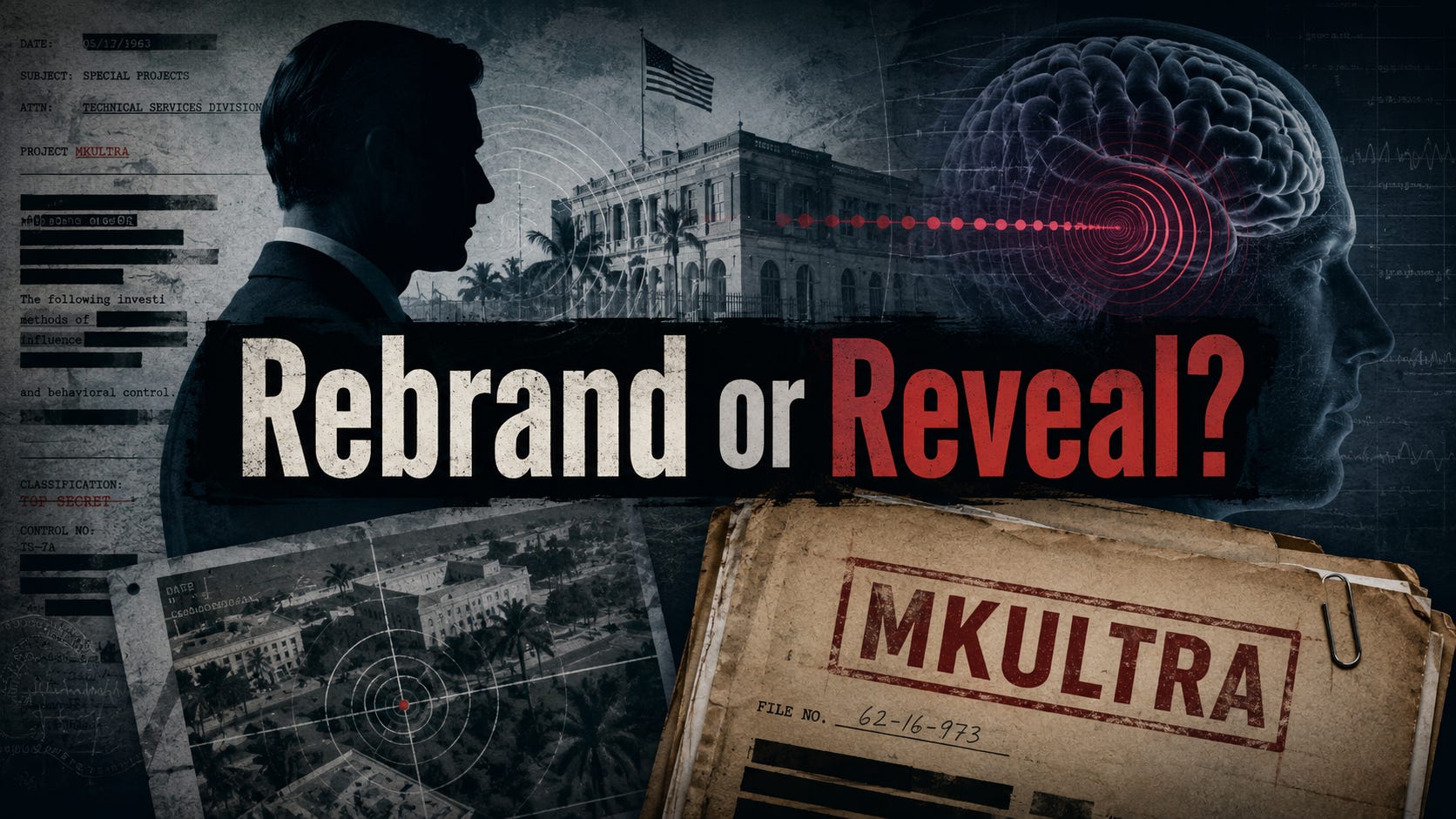
The federal government has apparently decided that Havana Syndrome needed another name change, because nothing clears up a decade-long neurological mystery quite like sending it through the Pentagon’s branding department. The first public label, Havana Syndrome, at least told people where the story began and acknowledged that a recognizable cluster of symptoms appeared to be happening to real human beings. The replacement, “anomalous health incidents,” turned those people into a collection of administrative irregularities. Now the Pentagon has renamed its Anomalous Health Incidents Cross Functional Team the Directed Energy Bio Effects Cross Functional Team, while announcing that it has distributed nearly $3 million in HAVANA Act compensation. The department says the renamed team will concentrate on medical care, research, countermeasures, and what it calls “non kinetic threats.”
Read that sequence again without the protective coating of government prose. First, employees reported abrupt directional sensations, piercing sounds, head pressure, vertigo, cognitive disruption, and other neurological problems. The public called it Havana Syndrome. The government replaced that memorable name with a phrase so bloodless that it could describe a printer malfunction. Intelligence agencies then spent years suggesting that hostile directed energy was improbable. The Pentagon has now named the team investigating the matter Directed Energy Bio Effects and begun paying affected personnel under a law whose full name is the Helping American Victims Afflicted by Neurological Attacks Act. A person does not need a corkboard, red yarn, or a basement radio show to notice that the nouns keep becoming more specific whenever the government believes nobody is looking.
The new title gives away what the government spent years avoiding: the Pentagon is treating directed energy as the operative mechanism while still refusing to say who deployed it or how many people were targeted. It makes the earlier rhetorical fog much harder to ignore. “Anomalous health incident” pretended to describe a mystery without favoring a cause. “Directed Energy Bio Effects” describes both a physical mechanism and its biological consequences. The Pentagon has not renamed the team “Stress, Crickets, and Mysterious Air Conditioning Bio Effects.” It has placed the words directed energy directly over the office door.
Personnel at the American embassy in Havana began reporting unusual symptoms in 2016. Some described a sound or sensation that seemed to come from a particular direction, followed by ear or head pain, pressure, vibration, dizziness, tinnitus, vision trouble, balance problems, and cognitive difficulty. Once similar reports surfaced in China, Europe, Washington, and other locations, the government adopted the term anomalous health incidents, or AHIs. The Government Accountability Office explained that the media initially used Havana Syndrome and that the government changed the terminology when reports were no longer confined to Cuba. By January 2024, at least 334 people had qualified for related care through the military health system, although official estimates of the total affected population varied.
There was a practical reason to move away from a geographic name. An incident in Vienna is not technically a Havana incident, and a case reported near Washington cannot sensibly be filed as a Cuban workplace injury. Yet bureaucratic language does more than organize geography. A syndrome suggests a recognizable medical pattern. An incident is something that happened, although the word does not say what happened, whether anyone caused it, or whether the injured person possesses a medically coherent condition. Add anomalous, and the event becomes an exception floating outside ordinary explanation. The person is no longer suffering from a named syndrome. The person is reporting an odd occurrence that a committee may or may not eventually place into the correct folder.
That distinction shapes medical treatment, intelligence analysis, compensation disputes, and court proceedings. Federal court opinions now routinely repeat the government’s terminology. In a 2024 records case, a federal court described Havana Syndrome as what the government calls AHIs. A 2025 opinion involving CIA records referred to hundreds of federal personnel and relatives reporting AHIs at domestic and foreign posts. A separate federal case filed in June 2026 by several individuals and an advocacy organization likewise uses AHI terminology while seeking civilian diagnostic guidance and access to research. The label has therefore migrated from agency memoranda into the language through which judges, lawyers, researchers, and claimants discuss the entire controversy.
This is why government renaming deserves more attention than it usually receives. A new phrase can widen a category while simultaneously draining it of meaning. It can allow officials to count cases without conceding that the cases share a cause. It can authorize treatment while avoiding a diagnosis, permit compensation without assigning responsibility, and support classified research without publicly admitting what the research is intended to detect. The phrase AHI performed all of those jobs beautifully. It gave the government a term broad enough to contain genuine neurological injury, environmental illness, unrelated medical conditions, stress reactions, possible surveillance effects, and potential directed energy exposure without requiring officials to separate one from another in public.
That ambiguity doesn’t seem to be merely philosophical. A Senate Intelligence Committee review found that the unresolved definition of an AHI affected access to care and compensation. Whether a person received special assistance could depend partly on whether officials believed the event resulted from an external attack rather than a conventional medical condition. The committee also found that the CIA’s changing analytic position influenced its programs and policies, even though the intelligence assessment was neither definitive nor final.
The government had therefore created an extraordinary arrangement. The people investigating whether an attack occurred could influence whether the person reporting it received benefits reserved for attack related injuries. Once analysts leaned away from the attack theory, medical and compensation decisions could lean with them. The Senate review reported that counterintelligence analysts had a role in processes informing care and benefit decisions, which made some individual claims difficult to judge independently of the agency’s preferred overall explanation. The committee described serious distrust, moral injury, and increased stress among personnel who felt they had to fight their own employer to be believed.
The public discussion has often been forced into a childish choice between two complete explanations. Either every case came from a Russian superweapon, or every sufferer heard a cricket, became frightened, and developed symptoms through suggestion. The actual government record is much less tidy and far more revealing.
A National Academies committee convened at the request of the State Department concluded in 2020 that directed, pulsed radiofrequency energy was a plausible mechanism for the distinctive acute cases it reviewed. The committee did not identify an attacker or declare the matter solved, but it considered the directional onset and unusual sensory features more consistent with a directed radiofrequency event than with the other mechanisms examined.
In 2024, NIH researchers reported that they had not found a consistent pattern of MRI detectable brain injury or biological abnormality among more than 80 affected participants when compared with controls. That result has frequently been flattened into “nothing happened,” although the investigators themselves said otherwise. The NIH noted that the symptoms were real, disabling, and sometimes prolonged, and one lead researcher specifically explained that the absence of persistent MRI findings did not exclude an adverse event affecting the brain at the time symptoms began. A transient disruption, an injury below the sensitivity of later imaging, or a physiological effect that does not leave the signature of a stroke or severe head trauma would not necessarily announce itself on a scan performed weeks later.
Then came the January 2025 intelligence update, which sounded reassuring in its headline and considerably less reassuring in its details. Five intelligence components continued to assess that foreign involvement was very unlikely. Yet two components changed portions of their judgments after reviewing newer information about foreign directed energy research. One component assessed that a foreign actor likely possessed a radiofrequency antipersonnel capability capable of producing biological effects consistent with some reported symptoms. Another judged that there was roughly an even chance such a capability existed. One component also saw roughly even odds that a foreign actor had used a novel device against a small, undetermined subset of those reporting incidents, although its confidence was low. The intelligence community further acknowledged that it could not rule out foreign involvement in a small number of cases and that some recent laboratory findings had produced mixed preliminary results.
Those findings do not add up to “case closed.” They add up to a sprawling pool of reports in which many cases may have ordinary explanations, some remain genuinely peculiar, and a smaller core may involve an external mechanism that intelligence agencies have not confidently attributed. That is precisely what happens when a broad administrative label swallows events that may not belong in one category. If a thousand headaches, HVAC exposures, vestibular disorders, episodes of dizziness, unexplained directional sensations, and possible targeted exposures are dumped into a single bucket, investigators can truthfully announce that no single weapon explains the bucket. The announcement tells us little about the handful of objects sitting at its bottom.
The Pentagon’s July 2026 rename appears to recognize this distinction without saying so plainly. The old AHI team was responsible for a category defined by uncertainty. The Directed Energy Bio Effects team is organized around a specific research problem: how directed energy may affect human biology, how such exposure could be detected, how injured personnel should be treated, and how countermeasures might be developed. The official statement does not claim that directed energy caused every AHI. It does reveal that the possibility is substantial enough to deserve an enduring military research structure and a name that would have been dismissed as feverish speculation only a few years ago.
This is where MKULTRA stops being a historical footnote and starts looking like a blueprint: the government has already experimented on human perception, behavior, and physiology, so pretending Havana Syndrome is too bizarre to be real is willful amnesia.
MKULTRA was not merely “the CIA gave some people LSD,” although that description is horrifying enough. The recovered congressional record described 149 subprojects covering behavioral drugs, alcohol, hypnosis, combinations of hypnosis and drugs, sleep studies, psychotherapy, motivational research, polygraphs, toxins and other chemical weapons, supposed biological materials, covert delivery methods, electroshock, harassment techniques, radiation, and the study of stimulus and response in biological systems. Some projects involved volunteers. Others involved unwitting subjects. The network extended through universities, hospitals, research organizations, pharmaceutical interests, and prisons, often using intermediaries that concealed the CIA’s involvement.
The project’s most infamous known death involved Army scientist Frank Olson, who unknowingly consumed LSD at a CIA gathering in 1953 and died after falling from a New York hotel window days later. The 1977 Senate hearing also confirmed that agency drugging occurred without subjects’ knowledge or consent, that universities and researchers were sometimes involved without understanding the true sponsor, and that records concerning the experimentation had been destroyed in 1973 under orders approved at the highest levels of the agency. Documents that survived were discovered later because financial records had been stored somewhere investigators had not originally searched.
That history changes the frame because it demonstrates an institutional method, not merely a list of gruesome experiments. The method involved defining the human nervous system as a field of national security research, dividing the work into compartmentalized projects, routing money through respectable institutions, protecting the sponsor’s identity, exploiting the difference between medical research and intelligence operations, testing methods that altered perception or behavior, and destroying records when scrutiny became dangerous. The scientists did not need to understand the entire program. The subjects certainly were not invited to understand it. Each participant occupied a small room inside a much larger structure.
No released document establishes that Havana Syndrome is an extension of MKULTRA, that American agencies deliberately caused the reported incidents, or that the two programs share a direct operational lineage. The historical connection is more unsettling because it does not require any of those claims. MKULTRA established that intelligence agencies were intensely interested in controlling, confusing, disabling, and studying human beings through chemical, psychological, electrical, and other biological means. It established that these agencies funded distributed research through civilian institutions. It established that unwitting Americans could become subjects. It established that officials could describe ethically grotesque experimentation as defensive research required to understand what hostile powers might do. It established that records could disappear and that congressional investigators might learn the truth only because a forgotten box escaped destruction.
Once that history exists, the phrase “our government would never study ways to remotely alter human physiology” becomes almost comically unserious. The government already studied radiation, electroshock, incapacitating substances, harassment techniques, brain concussion, and stimulus response relationships under the broad pursuit of behavioral control. The available records do not show a modern microwave weapon program growing directly from those projects, but they show a national security establishment that has treated the body, brain, and senses as operational territory for more than seventy years.
The resemblance between MKULTRA and the AHI controversy is not found in a single machine hidden in a diplomatic attic. It appears in the institutional grammar surrounding the events.
Both stories begin with the claim that foreign adversaries may possess a frightening capability. During the early Cold War, American intelligence officials feared Soviet and Chinese methods of interrogation, conditioning, and “brainwashing.” That fear supplied the justification for domestic experimentation intended to create both defenses and offensive capabilities. In the AHI story, officials have once again studied potential foreign capabilities while supporting laboratory research into how radiofrequency energy and other mechanisms might affect the nervous system. The 2025 intelligence assessment openly stated that agencies were examining foreign weapons development and assisting government affiliated laboratories studying whether radiofrequency signals could produce biological effects consistent with reported experiences.
Both stories also contain a gap between what the institution studies and what it publicly feels comfortable acknowledging. During MKULTRA, money passed through foundations and outside facilities so that researchers and institutions did not always know who was behind the work. In the current controversy, the public is told that foreign attacks are improbable while the Pentagon funds biological effects research, develops countermeasures, provides specialized treatment, and now names its responsible team after directed energy. The secrecy may be justified as protection of sensitive research, but the result is familiar: officials ask the public to trust conclusions while withholding much of the evidence and methodology required to evaluate them.
Both stories produce injuries that become inconvenient to the institution. Acknowledging an injured person may require admitting that a dangerous capability exists, that protective systems failed, that employees were not warned, that medical care was mishandled, or that prior public statements were premature. Denying the person carries its own cost, particularly when the person holds a security clearance, served overseas, and recognizes the difference between an ordinary migraine and an abrupt directional event. The Senate committee found that CIA communication became poorly coordinated and reactionary, that the agency began scaling back AHI efforts before its dedicated investigation was completed, and that its response created a deep trust deficit among affected personnel. It also reported that the CIA stopped collecting certain clinical data while Defense Department research continued.
That last detail should make even the most institutionally obedient reader uncomfortable. A mystery involving neurological symptoms is not clarified by stopping the collection of clinical data. Data allow researchers to distinguish a genuine cluster from a bag of unrelated complaints. Without consistent acute examinations, environmental measurements, blood samples, imaging protocols, exposure histories, and long term follow up, later investigators inherit stories instead of evidence. The passage of time then becomes part of the defense: nothing conclusive was found, although the systems needed to find it were late, inconsistent, or abandoned.
The MKULTRA records show the extreme version of this process. Destroy the documents, fragment the sponsorship, conceal the program’s identity, and eventually announce that the surviving record cannot answer every question. The AHI record does not show destruction on that scale, but it does show missing information, inconsistent definitions, delayed care, disputed eligibility, incomplete clinical records, and classified evidence that prevents outsiders from independently testing the government’s confidence. The rhyme is not that every official is secretly administering mind control rays. The rhyme is that secrecy creates uncertainty, uncertainty protects the institution, and the resulting lack of proof is later offered as reassurance.
The government’s shifting vocabulary may be the most honest witness in the room. “Havana Syndrome” attached the events to a location and implied a medical pattern. “Anomalous health incidents” broke that pattern apart, removed the geography, and avoided saying whether anyone had suffered an attack. The HAVANA Act nevertheless retained the word attacks in its full title and authorized payments for certain neurological injuries. Federal agencies continued researching mechanisms capable of producing the reported effects. Courts adopted the AHI label. Intelligence agencies largely rejected a global foreign campaign while conceding uncertainty about a smaller number of cases and acknowledging progress in foreign directed energy capabilities. The Pentagon has now replaced the generic team name with Directed Energy Bio Effects and has described the mission in terms of non kinetic threats.
This does not look like a straight march from ignorance to knowledge. It looks like several parts of the government negotiating how much reality each can afford to admit. Medical offices can treat the symptoms without declaring an attack. Compensation programs can pay selected people without identifying a perpetrator. Intelligence agencies can reject a coordinated foreign campaign while leaving open a few targeted events. Military researchers can study directed energy without confirming its use. Courts can discuss AHIs without deciding what an AHI physically is. Everyone can be technically accurate while the central question remains untouched.
Perhaps most reported incidents do have unrelated medical, environmental, or psychological explanations (I really don’t think so). That possibility does not make the rebranding less suspicious; it makes the original decision to combine everything under one label more consequential. A category broad enough to include almost anything is excellent camouflage for the few events that may be something extraordinary. The intelligence community can point to hundreds of explainable reports and declare the overall pattern inconsistent with a weapon, while an adversary would only need a small number of successful operations for the capability to carry enormous strategic significance.
MKULTRA should have taught us that the history of human experimentation is not populated by cartoon villains announcing their plans from underground laboratories. It is populated by committees, grants, medical partnerships, classified justifications, respectable researchers, obscure acronyms, and officials who persuade themselves that secrecy is necessary because the enemy may be doing something worse. The horror becomes visible only later, when the language changes, the records surface, and everyone insists the old program has been terminated.
Havana Syndrome may ultimately prove to contain many different phenomena rather than one grand explanation (but I doubt it). Yet the Pentagon’s newest title has accidentally clarified the real issue. The government spent years replacing a vivid name with an administrative abstraction, only to circle back and establish a team explicitly devoted to the biological effects of directed energy. That is not a confession that every sufferer was attacked. It is an admission that the mechanism once mocked as fantastical is serious enough for military research, countermeasures, medical protocols, and compensation.
The mystery did not disappear when Havana Syndrome became an anomalous health incident. The accountability disappeared into the wording. Now that the wording has changed again, the strange little bureaucratic cloud is beginning to resemble something with a direction, an energy source, and a biological target.
No posts
Comments
Nothing yet. Say the first thing.
Sign in to join the conversation.