

There is something deeply strange about telling people that leaving an abusive relationship is the path to safety and then handing their former partner a legal system that can require years of continued access to them. When children, support, property, custody, or protective orders are involved, separation does not necessarily mean separation in any meaningful psychological sense. It can mean that the relationship has simply moved into a courthouse, where the contact is now mandatory, the accusations are filed instead of shouted, and the person on the receiving end is expected to treat every new round as an entirely separate event.
This is one of the reasons I have started thinking about certain family court experiences I have heard about recently as a form of psychological battery through coercive control. I am not using that phrase as a formal diagnosis for anyone who is in family court or pretending that every contentious custody case qualifies. I mean something much more specific: the cumulative effect of being psychologically “hit” in the same vulnerable places throughout your nervous system over and over until the nervous system begins responding before the next blow even arrives. The individual events may look unimpressive when somebody pulls them apart. A motion gets filed. Money suddenly becomes an issue. A child is pulled into another dispute. An allegation appears that has to be answered. A settled matter somehow becomes unsettled again. Another hearing is scheduled. Another packet arrives. Another few hundred or few thousand dollars disappears into responding. Any one of those things can happen in completely legitimate litigation, but when they repeatedly occur inside a longstanding pattern of control, the effect on the person living through it can be very different from what the court sees on paper. But does abuse really cease to exist when it is given a family court case number?

Family court is remarkably good at breaking human behavior into administrative pieces. Custody goes in one file, support in another, domestic violence in another, finances somewhere else, and every new hearing tends to focus on whatever happened most recently. The legal system has practical reasons for doing this, but psychologically it can create a ridiculous picture of what abuse actually looks like. If someone has spent ten years using money, threats, children, surveillance, humiliation, third-pary harassment, litigation, and institutional complaints to keep another person off balance, it makes very little sense to evaluate each episode as if everybody involved woke up with amnesia the morning before it happened.
Psychology does not work that way because the human nervous system does not work that way. The brain does not neatly store the financial threat in one folder, the custody threat in another, the humiliating email somewhere else, and the court filing in a completely separate mental cabinet. Repeated threat becomes an environment. People adapt to environments, and sometimes those adaptations continue long after outsiders think the person should have “moved on.” Hypervigilance, compulsive documentation, sleep disruption, emotional flooding, avoidance, irritability, exaggerated startle responses, difficulty concentrating, and constantly scanning for the next problem can all make much more sense when they are viewed as responses to prolonged exposure rather than personality defects or simply high conflict interpersonal disputes.
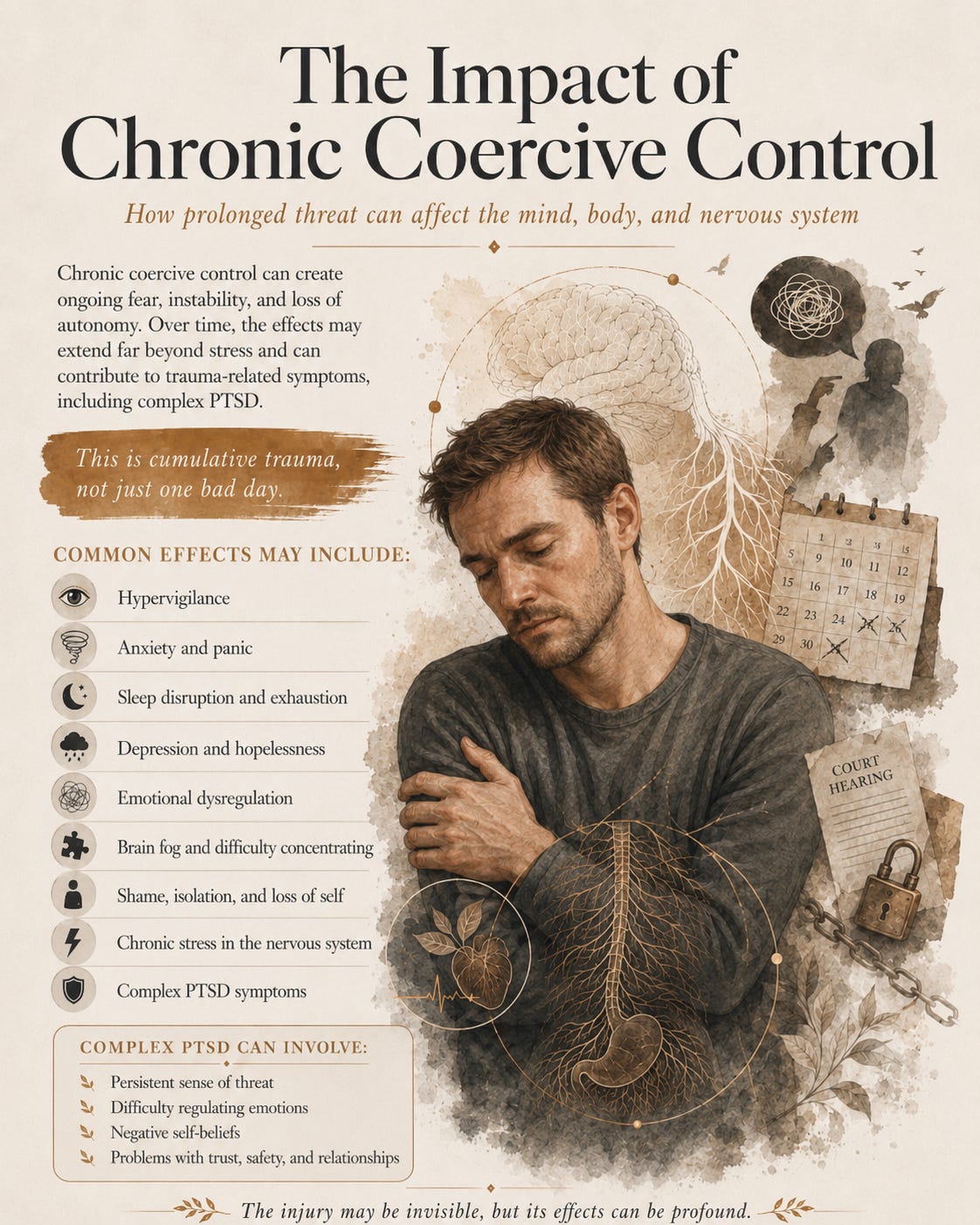
This is where family court and trauma science often seem to be having two completely different conversations. Trauma research increasingly looks at accumulated exposure, coercive patterns, loss of autonomy, continuing threat, and what happens when a person cannot fully escape the source of the stress. Family law, depending on the state, may still be asking whether a particular act qualifies as stalking, harassment, assault, a credible threat, financial abuse, or some other specific legal category. The science is looking at the structure of the experience while the law is often still looking for an event it can put a date next to.
That gap becomes especially obvious with complex PTSD. The World Health Organization recognizes complex PTSD in ICD-11, and the diagnosis reflects what can happen after prolonged or repeated trauma rather than one isolated terrifying incident. People can develop persistent problems with emotional regulation, self-concept, relationships, trust, and threat perception in addition to the more familiar symptoms associated with PTSD. Then some of those same people enter family court and discover that the behaviors trauma can produce may be interpreted as evidence against them. A person who saves everything is described as obsessive. A person who is constantly anticipating another legal problem is described as paranoid. A person who becomes emotional in court is unstable, while a person who shows very little emotion may be treated as cold or calculating. Someone who tries to explain years of context can be accused of refusing to let go of the past, even when the entire legal question is whether a longstanding pattern exists.
Law enforcement and court systems remain highly practiced at documenting injuries that can be seen, photographed, measured, or pointed to on an X-ray. They know what to do with bruises, fractures, lacerations, and other visible evidence of harm because those injuries fit neatly into the evidentiary framework the legal system already understands. What they are far less equipped to recognize is the damage caused by years of chronic threat, coercion, fear, and psychological destabilization when the injury is carried in the brain, nervous system, stress response, sleep, cognition, and autonomic regulation rather than on the surface of the skin. The absence of a visible wound has never meant the absence of an injury; it has only meant that our institutions have been looking for evidence in the places they were trained to look.
The most frustrating part is that laws are starting to recognize pieces of this while still lagging far behind the psychology. Washington has expressly addressed abusive litigation. Massachusetts has written repeated unwarranted court actions into its coercive control framework. California focuses on patterns that interfere with free will and personal liberty. Nebraska recognizes emotional abuse, economic abuse, coercion, and even the use of a child to maintain power and control over another parent. Other states still rely heavily on older models built around physical violence, threats, stalking, or harassment. A person can therefore describe nearly identical behavior in two different states and find that one court has statutory language designed to see the pattern while the other may require that pattern to be broken into smaller legal categories before anybody can do anything with it.
That is what I want to dig into here, because the interesting question is no longer whether psychological abuse can cause serious harm. We have plenty of evidence that it can. The more uncomfortable question is what happens when prolonged psychological abuse collides with a legal system that was never really designed to understand this type of cumulative harm, and what happens when the very process meant to resolve family conflict becomes another place where the nervous system is forced to stay on alert and used to continue the cycle of abuse.
This is the part I think we are going to look back on twenty years from now and wonder how we missed it. We still talk about psychological abuse as though the word psychological somehow removes the body from the equation. If somebody has a bruise, we photograph it. If somebody breaks an arm, we order an X-ray. If there is concern for a brain injury, we start looking at cognition, neurological symptoms, imaging, and functioning. Yet someone can spend years living under chronic threat, intimidation, financial control, surveillance, unpredictable conflict, or repeated legal pressure, develop significant changes in the way her brain and nervous system respond to threat, and the court may never consider whether there is anything physiological to measure at all.There already is.
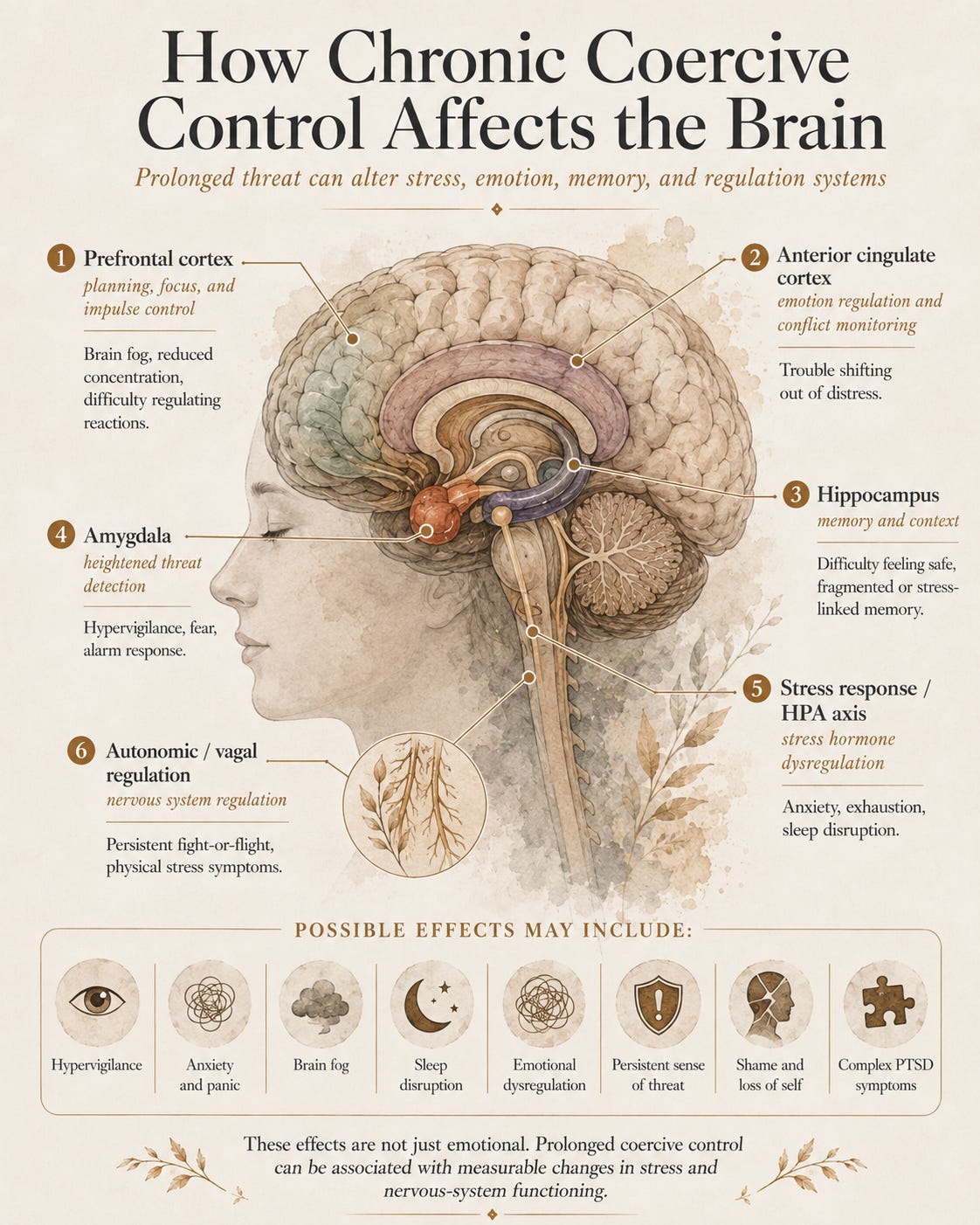
Researchers studying women exposed to intimate partner violence have found differences in brain systems involved in threat detection, emotional regulation, attention, memory, and decision-making. MRI and functional MRI studies have identified altered activity or connectivity involving areas such as the amygdala, anterior cingulate cortex, insula, prefrontal regions, thalamus, and temporal regions. Not every study finds the exact same thing, and none of this means an MRI can tell a judge who abused whom. Human brains are far too complicated for that. What the research does show is that prolonged interpersonal trauma can be associated with measurable differences in how the brain processes and regulates threat.
That becomes especially interesting when you look at the autonomic nervous system. The vagus nerve is one of the major pathways involved in the parasympathetic system, which helps regulate heart rate, breathing, digestion, recovery after stress, and the body’s ability to settle after a threat has passed. Researchers can study aspects of that regulation through heart-rate variability, particularly measures associated with vagal influence over the heart. PTSD research has repeatedly found lower vagally mediated heart-rate variability and other signs of autonomic dysregulation compared with people without PTSD.
That does not mean coercive control literally “damages the vagus nerve” in the same way a knife could physically sever it, and I would not make that claim because the research does not support it. What we can say is much more defensible and, frankly, just as remarkable: chronic trauma can be associated with measurable changes in the way the autonomic nervous system regulates the body. The person who says she feels as though her body is constantly waiting for the next disaster may be describing something that can show up in actual physiological measurements.
The stress-hormone system can be affected too. Researchers studying intimate partner violence and PTSD have found abnormalities involving cortisol and the HPA axis, one of the body’s major stress-regulation systems. Again, the findings are not identical in every person or every study, because biology rarely behaves that neatly. Some people show one pattern of cortisol disruption and others show another. Sleep, medication, other trauma, illness, childhood experiences, genetics, and dozens of other variables matter. That is exactly why none of these findings should ever be sold as a simple laboratory test for abuse.
They do, however, make the old separation between “physical injury” and “psychological injury” look increasingly outdated. The brain is an organ. The autonomic nervous system is part of the body. Cortisol is not imaginary. Heart-rate variability is not imaginary. Neural activity is not imaginary. If prolonged traumatic stress changes how those systems function, calling the original experience psychological does not make the biological consequences any less real.
What family courts generally do not have yet is a routine way to translate those findings into individualized damages. There is no standard family-court blood test that says this much cortisol dysregulation came from this former partner, and there is no MRI that can date a particular neural change to a custody threat made six years ago. Causation is much harder than simply demonstrating that chronic trauma can produce measurable biological effects. That is probably one of the reasons the legal system has been slow to deal with this. A broken bone has an obvious image and a relatively straightforward causal story. Chronic trauma rarely hands the court anything that tidy.
Still, I think it is worth asking why we are not looking more closely. If somebody claims years of coercive control left her unable to sleep normally, unable to regulate stress, constantly hypervigilant, cognitively exhausted, and physically reactive to reminders of the litigation, why is the conversation so often limited to whether she appears emotional in court? Why are we studying her demeanor instead of asking whether the prolonged stress she is describing has affected her health and functioning in ways medicine can actually evaluate?
We may eventually reach a point where trauma-related autonomic testing, neuropsychological evaluation, sleep studies, endocrine findings, and other physiological measures become more common when serious psychological injury is alleged. We are not there yet, and I would be suspicious of anybody claiming current neuroscience can cleanly prove an individual coercive-control case. The science is much more complicated than that. But the larger premise is already difficult to deny: prolonged psychological trauma can have measurable biological consequences.
That changes how I think about the person who starts shaking when another court notice arrives, cannot sleep for three nights before a hearing, compulsively checks the docket, or feels physically sick when the other person’s name appears on a phone screen or hearing the sound of their voice. Those reactions may look disproportionate if you evaluate the notification standing alone. They make considerably more sense when the body has spent years learning that seemingly ordinary things can be followed by another round of conflict, expense, accusations, or fear.
Law enforcement and court systems remain highly practiced at documenting injuries that can be seen, photographed, measured, or pointed to on an X-ray. They know what to do with bruises, fractures, lacerations, and other visible evidence of harm because those injuries fit neatly into the evidentiary framework the legal system already understands. What they are far less equipped to recognize is the damage caused by years of chronic threat, coercion, fear, and psychological destabilization when the injury is carried in the brain, nervous system, stress response, sleep, cognition, and autonomic regulation rather than on the surface of the skin. The absence of a visible wound has never meant the absence of an injury; it has only meant that our institutions have been looking for evidence in the places they were trained to look.

No posts
Comments
Nothing yet. Say the first thing.
Sign in to join the conversation.