
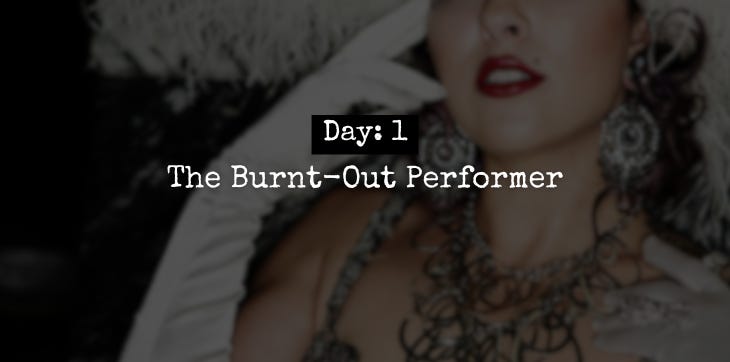
She said seven. Not a minute after.
By the time I arrive, she’s already on stage. The crowd is alive, swaying in rhythm to a song I don’t recognize. She moves like she was born for it. Every beat lands. Every turn is perfect. She’s a golden girl, bright and seamless, red hair shimmering beneath the lights. From here, I can almost smell her perfume, powder and roses, a trace of exhaustion hidden beneath the glamour.
I wait near the side curtain, notebook in hand, watching as she glances toward the audience between lines, scanning for approval. Her eyes, my eyes, are warm brown but sharp. Calculated. They search for proof that the show is working. That she is still adored.
The song ends to thunderous applause. She bows with practiced grace, steps off the stage, and heads straight toward me, heels clicking in steady rhythm. Her lipstick is perfect, the cat-eye precise, not a hair out of place.
“You’re late,” she says without looking up from her mirror. She is already unpinning curls, wiping her brow, reapplying the same red she wore on stage. “I have another set in twenty minutes.”
She doesn’t sit. She doesn’t stop. She answers a crew member calling for cables, fixes a mic stand that won’t hold, and gives someone directions to the lighting board, all while blotting lipstick and checking her reflection.
I start the recorder anyway.
“I appreciate you making the time,” I say.
She gives a soft laugh, somewhere between charm and exhaustion. “Time is elastic when you run a sold-out show twenty-four hours a day.” She reaches for her phone, typing a quick reply. The notification tone chimes again. “Emails don’t answer themselves.”
She isn’t wrong. Her inbox is never silent. Late-night replies, early-morning follow-ups, thoughtful messages that carry more energy than she has to spare. Others have teams to manage things like this. Not her. She’s the show, the crew, the cleanup, and the promotion.
“Why do you keep performing?” I ask. “Even when you’re tired?”
She pauses, finally meeting my eyes in the mirror. “Someone has to keep the lights on.”
Her reflection tilts her head, studying me. There’s pity in her gaze. Not unkind, but heavy with understanding. “If I stop, who takes over?” she asks softly, though it’s not really a question for me.
A knock at the door interrupts us. A young stagehand pokes his head in. “They’re asking for you.”
She waves him off, multitasking even in dismissal. “Two minutes.” Then, to me, “See what I mean? Everyone needs something.”
I nod, watching how she stretches the tension from her shoulders but never fully relaxes. Every gesture is control disguised as grace. Even her exhaustion has choreography.
“What does it feel like?” I ask quietly. “To keep holding it all?”
She straightens, checking her reflection again. “It feels like being applauded for bleeding beautifully.”
The words hang in the air between us. She catches sight of the crew adjusting a prop wrong, excuses herself, and fixes it mid-sentence without breaking thought. Hyper independence dressed as professionalism. When she returns, she continues as if no time passed. “People rely on me. That’s the point, isn’t it? Being needed?”
The next track begins faintly through the curtain. She hums the melody under her breath, mentally mapping her steps. “I can’t drop the rhythm,” she says. “If I do, the whole thing unravels.”
I want to tell her that she’s allowed to unravel. That it’s human to miss a beat. But she’s already halfway through adjusting her shoes. The left one looks tight. She winces as she forces her foot in.
“Who would you be if no one was watching?” I ask.
She doesn’t answer right away. The hum stops. Her reflection meets mine again, and for the first time, I see the weariness behind the painted perfection. “No one,” she says finally. “Does a falling tree even make a sound if no one is there to hear it?”
Another crew member interrupts to ask about the lighting sequence. She handles it effortlessly. No sign of irritation, no pause, just smooth transition from despair back into order. Her control is a reflex. A safety net.
“Don’t you ever want to stop?” I ask.
Her laugh is small but sharp. “Stop? I don’t know what that means anymore.” She grabs a small sandwich from a tray, takes two bites while adjusting her costume, and continues speaking between chews. “If I stop, the silence might kill me. And besides, the show must go on.”
I close my notebook slowly. “You’re tired,” I say. It isn’t a question.
She nods without denying it. “But I’m good at it. That’s the curse, isn’t it? Being so good at surviving that no one thinks to ask if you’re okay.”
The stagehand signals again. “You’re up.”
She exhales through her nose, lifts her chin, smooths her skirt. “We’ll finish this another time,” she says, but I know we won’t. She doesn’t make time for reflection. Only for performance.
Before she leaves, I ask one last question. “What do you need from me?”
She glances back over her shoulder. “Permission to stop when the meter hits red.” A faint smile, tired but real. “To rest without apology.”
Then she’s gone, swallowed by the light.
I watch her silhouette through the curtain as she steps into the spotlight again. The crowd roars, and her posture shifts, shoulders square, smile fixed. The exhaustion dissolves beneath the glow of validation. She moves with precision, with purpose. The applause feels like oxygen, like safety.
The world does not end when the music stops. Maybe it’s time to step offstage, not as failure, but as freedom. Giving myself the permission to be part of the audience and enjoy the show. To feel the weight lift, to breathe, to let the applause fade into something quieter and truer.
It’s okay to miss a step. It’s okay to let the lights dim. The show will wait for me.
Comments
Nothing yet. Say the first thing.
Sign in to join the conversation.