
Ben Mallet is Director of International Campaigns at The Messina Group. A former advisor to British Prime Ministers Boris Johnson and David Cameron, as well as Foreign Office Minister Lord Zac Goldsmith, Ben has served as senior counsel and campaign director for numerous U.K., U.S., and European politicians, including as campaign director for the London Conservative Party during the recent London mayoral elections.
In particularly tumultuous times, American voters have long gravitated toward proven executive leaders on Election Day, elevating experienced Governors–Jefferson, Monroe, the Roosevelts, Reagan, and a dozen of their brethren–to the Presidency. Recently, this historical trend appears to have crossed the pond to the United Kingdom, where I live and work as Director of International Campaigns for The Messina Group.
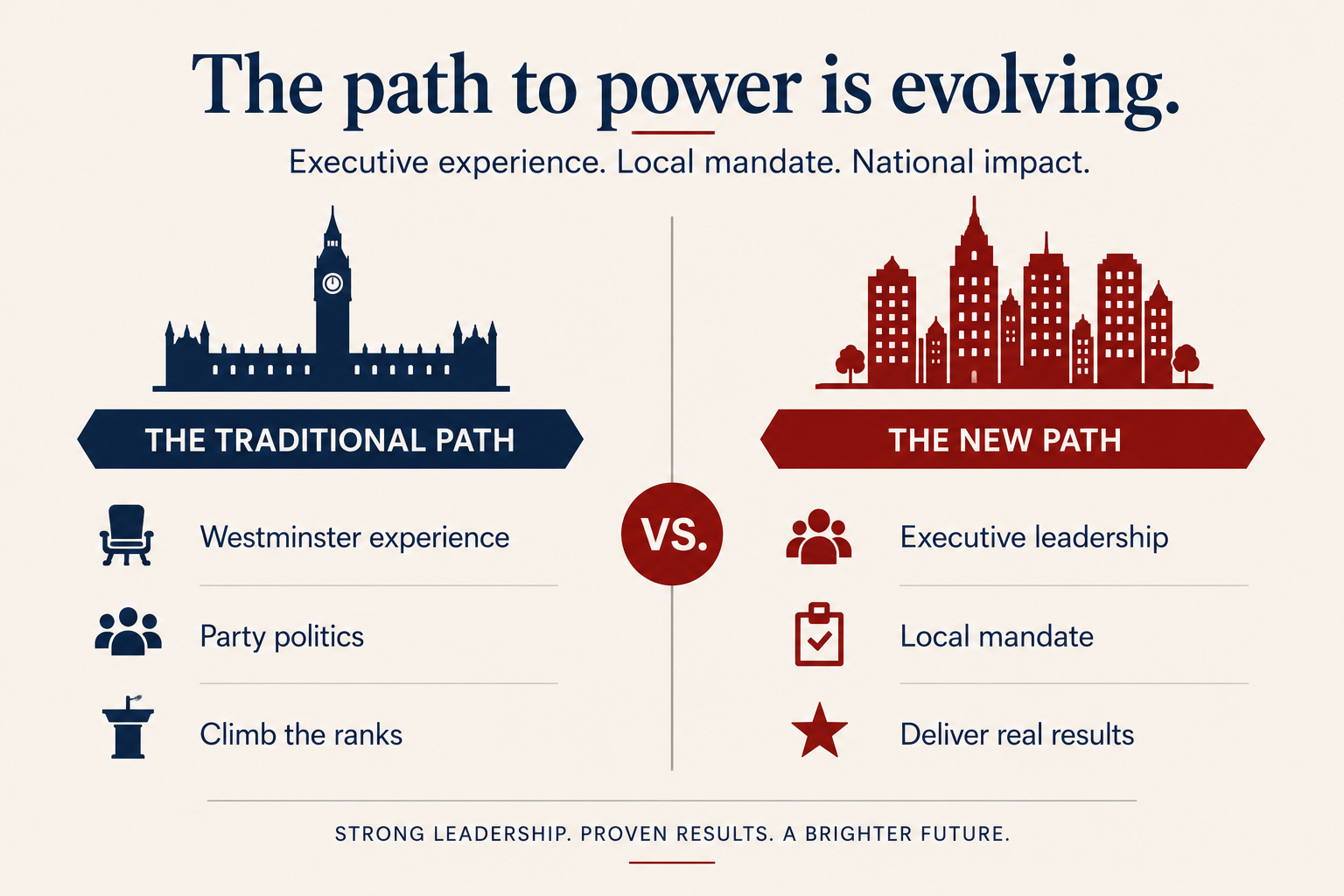
Following the political volatility caused by the Brexit referendum in 2016, we’ve seen seven prime ministers in the last ten years, prompting a number of pundits to ask if Britain is, in fact, ungovernable. To lead us out of parliamentary gridlock, political chaos, and a splintered party system, the U.K. Conservative Party, back in 2019, looked to Boris Johnson, a successful two-term Mayor of London and leader of the subsequent Vote Leave campaign. And now, in this most recent moment of crisis, the Labour Party has, too, turned to an outsider with significant executive leadership experience to right our ship of state: Last month, Andy Burnham, the longtime Mayor of Greater Manchester, was appointed Prime Minister. Burnham was swept into office with a mandate to scale his “Manchesterism” nationally and to deliver “the biggest rebalancing of power our country has seen.” While Johnson served as an MP and briefly in Cabinet following his term as London Mayor, Burnham is the first PM in our nation’s history to reach No. 10 directly off the back of a mayoralty, rather than a Westminster perch.
Regardless of how or for how long Burnham governs, his ascension has profound implications for every ambitious politician in Britain: U.K. campaigning is becoming increasingly Americanized, and it’s making non-traditional political experience a viable launchpad for national power. Indeed, candidates in both countries–and, increasingly, across the world–who are able to combine anti-establishment bona fides with credible executive experience and a strong personal brand are well positioned to win in this age of disruption.
A New Political Proving Ground
By the late twentieth century, Britain had become, famously, one of the most centralized democracies in the world. Under the centuries-old doctrine of parliamentary sovereignty, Westminster could make or unmake any law, and local government existed only as a creature of statute, holding powers granted by (and revocable by) Parliament.
But the turn of the millennium brought a genuine constitutional novelty: the country’s first directly elected executive office. Following a 1998 referendum in which 72% of Londoners voted for a new leadership model, the Greater London Authority Act 1999 created, for the first time, a directly elected London mayor. A push toward devolving power to England’s other cities followed, gaining statutory force with the Cities and Local Government Devolution Act 2016, which enabled combined authorities to negotiate bespoke devolution deals with Westminster and directly elect “metro mayors.” In 2017, inaugural mayoral elections were held in six areas–Liverpool City Region, the West Midlands, Tees Valley, the West of England, Cambridgeshire and Peterborough, and, most consequentially for this story, Greater Manchester.
Burnham, then a 46-year-old, fresh-faced former Cabinet minister, surprised many in the political establishment when he left the frontbench to stand in Greater Manchester’s first mayoral election, giving up his Leigh seat the following year. But ten years later, his decision seems prescient.
After almost a decade in office, Burnham now has a record of accomplishment most MPs can only envy, pointing to a clear and retail record of delivery–for instance, bringing Manchester’s buses under public control for the first time since deregulation in the 1980s. He also has both a significant and loyal base of power, and a national identity; he honed both during the pandemic, when he publicly clashed with Downing Street over COVID-19 tier restrictions and funding for the region–an opportunity that, when seized, cemented his public image at home and across the country as a champion of his people, willing to face down his own party’s leadership on behalf of his constituents.
Perhaps most crucially, Burnham’s years outside of Westminster insulated him from the decline in Labour’s national standing: even amidst the collapse of now-former PM Keir Starmer’s polling numbers and governing coalition, Burnham remains the most popular Labour figure among both the public and Labour voters, and holds one of the highest net favourability ratings of any politician polled.
“The last decade has demonstrated that it’s mayors and in cities where you can really get things done,” London Mayor Sadiq Khan told Politico reporter Jack Blanchard earlier this year. “Andy and I have shown that with our own direct mandates we can make a big impact... You can really lead, and turn your values into action.” Come 2026, with Labour in desperate need of a political savior, that record–coupled with the unique brand, popularity, and power only the mayorship could provide him–was why Burnham was widely viewed as the only candidate capable of uniting the party. In May, a Makerfield MP resigned his seat specifically so Burnham could return to Parliament. The now-former Mayor then stood unopposed for the party’s leadership.
Copying Our Cousins
To American readers of The Messina Memo, and astute students of history, my country’s recent turn away from the hallowed halls of state in its search for political salvation may feel familiar. During particularly tense, challenging, and stagnant periods, Americans have consistently called upon their own seniormost, non-federal elected executives: Governors–that is, politicians with proven experience managing large economies, overseeing massive bureaucracies, negotiating with legislatures, balancing budgets, responding to crises, and building large, diverse coalitions.
Indeed, after the U.S. Constitution was ratified, and as the country struggled to solidify its system of government and establish its authority, six of the first ten elected presidents had served as state or territorial Governors. Later, to pull Washington out of its corruption-plagued Gilded Age, voters again regularly turned towards experienced Governors; beginning with “Grover the Good” Cleveland in 1884, five of the next seven presidents had served as Governors before reaching the White House. Governor Franklin D. Roosevelt of New York was called to lead the nation out of the Great Depression. And four of the first five Presidents elected after the Watergate scandal were former or sitting Governors, charged with rebuilding a federal government Americans could once again trust.
There’s also some indication that former governors may be more effective once in office: since 1900, former governors running as sitting presidents were reelected nearly 90% of the time, while sitting presidents who had never been governors were reelected just half of the time.
Britain’s recent devolution is now building what federalism has long given our American cousins: a pipeline to national political office. American governorships and British mayorships both provide ambitious, talented politicians with a genuine executive apprenticeship in siloed media markets. They insulate these politicians from the gridlock, inaction, and intractability that plagues national government. And both offices provide their occupants with a uniquely compelling platform from which to launch a national campaign.
In 2019, Boris Johnson, the former Mayor of London, leveraged this strategy effectively during his successful bid for No. 10. Though Johnson was by then an MP and had served as Foreign Secretary, he positioned his eight years as a successful, popular mayor as central to his leadership bid: Johnson had proven he could win in a diverse, left-leaning city; he had a track record of success, from delivering the 2012 Summer Olympics to launching the “Boris Bikes” cycle hire scheme; and he had leveraged the London media scene to transition and elevate his public persona, from columnist to popular icon. Each of these factors was essential to his pitch to Conservative MPs and party members, and each helped drive his eventual appointment as PM.
Johnson’s 2019 ascent proved that a track record of local delivery as mayor could lead to national stature. Burnham has since broadened the horizon even further. Where Johnson still routed through Parliament and the Cabinet on his way to No. 10, Burnham needed only a berth in the Commons, arranged in a matter of weeks—and given the outgoing government’s “historic unpopularity,” extended Parliamentary and Cabinet service may now in fact be more a liability than a credential. Indeed, for the first time in British history, the best-positioned candidates for national office are those closer to a City Hall than to Whitehall. That should concentrate the ambition of every politician in Britain. And it should serve as a blinking red warning light to any politician beyond our shores planning a “Ready on Day One” campaign.
Who Stands To Gain
Given that I’m making some rather grand claims based on just two recent data points, it’s worth pausing to consider how Burnham actually came to arrive at No. 10. Twice he had made a more traditional bid for leadership–in 2010, following his service in the Blair and Brown governments, and again in 2015, while serving in the shadow cabinet. Both bids failed spectacularly. Only when Burnham left Parliament for Manchester and devoted himself to, as he vowed, delivering “for all people and for all places” did he at last become a plausible candidate for national leadership.
That’s not a coincidence. A British mayoral campaign, like an American gubernatorial campaign, over-indexes for personality, place-based trust, and crossover appeal to voters who don’t ordinarily follow politics closely. A Westminster career over-indexes for something narrower: party management, whip counts, and parliamentary performance. In this Age of Disruption, when voters are overwhelmingly scared of, skeptical about, and furious at the political status quo, the former is worth more at the ballot box than the latter. That’s just as true in Wisconsin and Washington as it is in Leeds and London.
So what does that mean for future elections?
In the U.K., it means talented, up-and-coming politicians now have, and should seize, this faster, more direct route to national prominence. Britain now has 14 metro mayors, covering roughly half of England’s population and more than half its GDP. That footprint is only going to expand: The English Devolution and Community Empowerment Act 2026 extends strategic authority status across the country, and the government has already announced that mayors will begin retaining a share of the income tax and business rates, with the full fiscal devolution roadmap due at the Autumn Budget. Burnham has made clear he plans to move further and faster, devolving yet more power and fiscal control to more mayors and instruments of local government across the U.K. Every county is now a potential launchpad.
The metro mayors already in office, meanwhile, have a path to national leadership and prominence, should they choose to leverage their positions. The next few years will provide ample opportunity: metro mayors already routinely out-poll their own local MPs on basic name recognition.
In America, the extraordinary tumult of the MAGA era suggests a presidential lane may be open for a candidate with a profile similar to Burnham’s come 2028. Many expect Democrats to nominate a governor, one with a genuine record of delivery, real distance from the toxic political brands of the last decade, a compelling media presence, strong local approval, and removal from some of Washington’s thorniest fights.
Will these same forces then come to reshape political ambition in capitals across the globe? As devolved and federal systems alike hand more genuine power to sub-national executives, and national political classes everywhere burn through what remains of the public’s patience, that seems to be a safe bet. The precise details will differ by country. But the shape of a winning political résumé is already converging.
No posts
Comments
Nothing yet. Say the first thing.
Sign in to join the conversation.