
Welcome to our newsletter for the China Tech Observatory (CTO) – a project of the Mercator Institute for China Studies (MERICS), funded by the German Ministry for Education and Research (BMFTR).
The China Tech Observatory takes stock of China’s progress in developing and using globally critical technology. It provides information and analysis to help decision-makers in government, business and other areas to better understand China’s aims and efforts in future technologies. In this issue, we look at:
How Beijing is orchestrating a push for future industries
What China’s first-mover approval of a brain-computer interface means for global competitors
How China is shaping AI competition through scale and low-cost deployment
How Chinese chipmakers may benefit from a global shortage of AI memory
Will XPeng’s planned investments help Europe become more competitive in electric car production?
You can find all the regularly updated research and analyses produced by the China Tech Observatory in a dashboard on the CTO website. Please also take a look at the latest published CTO report “Embodied AI: China’s ambitious path to transform its robotics industry” by Wendy Chang, Rebecca Arcesati, and Altynay Junusova.
We hope you enjoy this issue. Feel free to send us your feedback at publications@merics.de.
Best regards,
Mikko Huotari, Executive Director MERICS
Claudia Wessling, Director Communications and Publications MERICS
China’s investment in future industries surged in the first quarter of 2026, heralding their prominence in the 15th Five-Year Plan released in March. Although Beijing welcomes foreign engagement in these industries, it is also taking steps to limit foreign control over Chinese-origin technology. Beyond these mixed signals, knowing which Chinese future industries are moving from laboratory to market, and at what speed, can help European firms and policymakers gauge the required levels of openness and resilience for calibrating Europe’s industrial strategy.
China’s embodied AI saw a 60 percent year-on-year increase in investment to CNY 35 billion (EUR 4.37 billion) in Q1 2026. Investment in quantum technology and brain-computer interfaces over the same period exceeded all of 2025, reaching CNY 3.2 billion (EUR 399 million) and CNY 3.8 billion (EUR 474 million), respectively. Government funding played a decisive catalytic role. The National Venture Guidance Fund, launched in December 2025, co-led Turing Quantum’s second 2026 funding round, which raised CNY 1 billion (EUR 125 million). The National AI Industry Fund, a subsidiary of China’s Big Chip Fund, co-led Galaxy General’s CNY 2.5 billion (EUR 312 million) embodied intelligence round in March. This was the fund’s first investment outside of the semiconductor industry.
So far, foreign capital has played a minor role. But the government is courting more for the future, with Ministry of Industry and Information Technology (MIIT) Minister Li Lecheng framing future industries as a global “concerto,” not a “solo” at the March China Development Forum in Beijing. The 2025 edition of China’s Encouraged Foreign Investment Industries Catalogue, effective from February 2026, added 205 new categories, including critical robot components and biopharmaceuticals. Its aim is to attract global investors to advanced manufacturing and modern services, among others.
However, the narrative of openness is difficult to reconcile with Beijing’s simultaneous efforts to tighten state control over the flow of technology. In early April, the State Council issued Regulations on Industrial Chain and Supply Chain Security to ramp up the country’s ability to protect supply chains, deter foreign companies from de-risking, and shore up China’s economy against potential sanctions by other governments. Days later, the National Development and Reform Commission (NDRC) ordered Meta to unwind its acquisition of the AI firm Manus, a Singapore-incorporated AI startup founded by Chinese nationals, which still has certain ties to China.
Although Chinese commentators frame these steps as comparable to other countries’ foreign investment screening, such as the Committee on Foreign Investment in the United States’ (CFIUS) screening, FDI review in the EU, and Japan’s Foreign Exchange Law reforms, they are less predictable and transparent for foreign partners. The regulations grant broad, security-based discretion to launch investigations and implement countermeasures without clear, detailed ex ante screening criteria, timelines, or public reasoning.
Jeroen Groenewegen-Lau, Lead Analyst, MERICS: “Beijing in principle welcomes Western stakeholders to engage with China's future industry ecosystem as minority investors, R&D collaborators, or end-product importers. However, the Manus case shows that the rules on when this engagement crosses into strategically sensitive territory are still being written.”
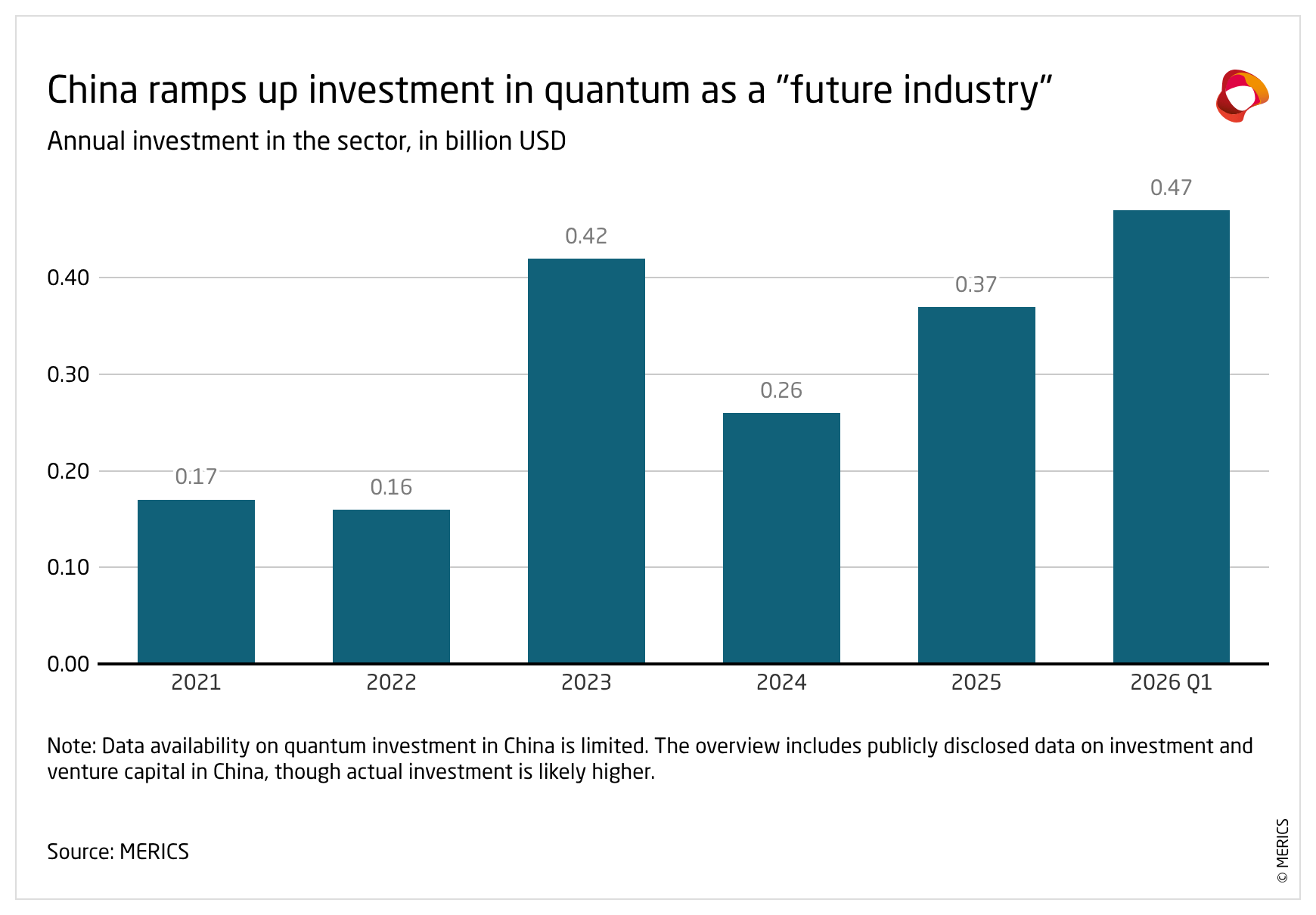
China is showing renewed interest in quantum technologies, ramping up its investment to a total of CNY 3.2 billion in the first three months of 2026, exceeding the total for all of 2025. This comes after China named quantum as a “future industry” in its 15th Five-Year Plan. After a period in which big Chinese tech companies like Baidu and Tencent scaled back or opted out of quantum investment, large- scale capital is now flowing back into the sector, suggesting a renewed focus on moving the technology from the lab to commercial applications. Compared with other future industries such as 6G or nuclear fusion, quantum is attracting strong investment momentum.
China in March approved an invasive brain-computer interface (BCI, 脑机接口) for commercial use – the first country in the world to do so. Europe’s risk-averse and ethics-heavy approach to BCI governance may harm its ability to compete in this technology.
The interface by Shanghai-based Neuracle Medical Technology (博睿康) has already helped 32 patients with spinal cord injuries to regain hand movement. It consists of a coin-sized electrode placed in the brain to pick up signals when a patient imagines movement. The signals are then wirelessly transmitted to a robotic glove. More than 30 hospitals across China now operate BCI units, with applications expanding to neurodegenerative and psychiatric care.
Europe can also boast world-class academic research and pioneering firms in this area, such as MindMaze and CorTec, but it will need to strengthen support via policy and investment to ensure that its BCI industry isn’t left behind. Neuracle’s approval is evidence that Beijing sees this frontier technology as highly strategic and even militarily significant.
In 2025, China introduced a roadmap for the development of world-class BCI companies by 2030, while its 15th Five Year Plan endorses BCI as a future industry. The government launched a CNY 11.6 billion (EUR 1.5 billion) fund for brain science in December 2025, and BCI firms raised CNY 4 billion (EUR 498 million) in investments in Q1 2026 alone, surpassing their 2025 total. Major beneficiaries include BrainCo (强脑), StairMed (阶梯), Gestala (格式塔) and NeuroXess (脑虎), who have set up “BCI super-factories” for data processing. China’s BCI ecosystem has entered the phase of commercial scaling, even if devices like Neuracle’s still have some way to go before they are commercially viable.
Moreover, China is seeking to set global vocabularies, data formats and reference architectures through the International Organization for Standardization (ISO/IEC JTC 1/SC 43) and the International Telecommunication Union. China already introduced BCI terminology for domestic use in 2025.
Altynay Junusova, Analyst, MERICS: “As China’s nascent technology excels at scale, for Europe, prioritizing safety helps mitigate risk, but it may also slow clinical translation and commercial rollout. Europe, therefore, needs to match this strategic intent and policy support that China offers its BCI industry, by strengthening investment and ensuring that the BCI industry serves EU interests, too.”
China’s flagship AI company DeepSeek released its V4 model in April, with a promotional price that puts it at a mere fraction of the cost of its North American competitors’ models. This reflects a wider trend in China’s AI sector: Instead of competing directly with companies like OpenAI, Anthropic and Google, who offer state of the art services at a premium, Chinese companies are pursuing a strategy of wide diffusion and cheap tokens to gain market share across the world. For Europe, this may pose the risk of forming a quick dependency on Chinese models as the basis for AI development, plus European talent being funneled to enhance Chinese systems.
Many Chinese AI companies have followed the DeepSeek model. They are building models that are decent, but not cutting-edge, in performance and instead are focused on high compute efficiency that lowers costs for users. They have also made their models available via open-source platforms, meaning anyone can use, fine-tune and host them for free, as opposed to proprietary models like current Western leaders. Downloads of Chinese models on open-source platform Hugging Face have surpassed US models since late 2025. Of the top ten open-weight models by performance, the top seven are all Chinese.
This approach supports their wide dissemination, particularly in fields where cost is a key consideration. One striking example is the adoption of AI foundation models for scientific research. In 2024, Chinese AI model usage in research outpaced that of US models. Even some Silicon Valley companies are experimenting with a hybrid approach, handing key decision-making tasks to premium US models and lower-level execution tasks to those from China.
The rise of agentic AI, which employs AI “agents” to independently create solutions for more complex tasks, has driven AI model usage dramatically higher. This is expected to make cost considerations even more important. Chinese AI companies often can’t benefit directly from their overseas traffic – the platforms that host their open-weight models take the profits – but their price-competitiveness and wide availability have already gained them a foothold in the global ecosystem.
Wendy Chang, Senior Analyst, MERICS: “By making its models widely available and cost effective, Chinese companies have found an alternative way to stay in the global AI competition. By leveraging a strong presence in the open-source community and extremely low token prices, the strategy hopes to capture market share across the world, even if it doesn’t translate into profits right away.”
China is capitalizing on the US and South Korean memory makers’ shift into high-margin AI chip production by building up its mass production of cheap memory chips – a trend that may create a new European dependency on China. Major Chinese memory chip makers are already benefitting from skyrocketing prices as demand grows. They are now focusing on mass production of mature Dynamic Random Access Memory (DRAM) chips and NAND flash memory, vital for core industrial sectors such as automotive electronics, industrial automation, and medical equipment.
Europe’s highly price-sensitive automotive and industrial sectors do not rely on advanced AI chips, but they do need large amounts of memory chips, for which Europe has no domestic production. And there is no new capacity on the horizon, as the European Chips Act focuses on logic and power chips rather than memory. Even if Europe leads in automotive power chips, those cars do not work without memory.
Many other industries have given up low-margin, high-volume parts of their manufacturing to China in past years. While this may boost profits in the short term, it has led to supply chain dependencies in the long run. Moreover, if history is any indication, Chinese industrial players can then use the experience they gained, the ecosystem they have built and China’s generous industrial policy to climb value chains and replace Western companies altogether.
Without policy intervention, the trend is clear: China’s two top players, Yangtze Memory Technologies (YMTC), which makes NAND chips, and ChangXin Memory Technologies (CXMT), which focuses on DRAM, will gain market share in Europe due to low prices and available stock. YMTC also announced two more fabs in April on top of one under construction, and expects to more than double capacity by 2027. CXMT is now the world’s fourth-largest DRAM maker, with 5 percent of the global market in 2025. While not at the cutting edge for AI workloads, these chips are good enough for most other applications. Even Apple is considering using them.
European companies might be enticed to switch full lines over to Chinese memory makers, especially given their current economic woes, but they would be better off stockpiling and keeping Western chips in rotation and certified. The recent Nexperia saga showed how quickly supply can be disrupted. Likewise, US and Korean chipmakers should be wary of switching all production over to AI chips and displacing traditional, diversified customers with customers in only one sector.
Antonia Hmaidi, Co-Head of Program Science, Technology and Innovation Policy, MERICS: “China will capitalize on the AI-driven memory shortage and push into the global memory market. Europe should avoid new dependencies on Chinese memory chipmakers. Policymakers across the bloc should increase long-term support for the reliable supply of legacy chips, including in memory, by updating the Chips Act, using other available instruments and incentivizing companies to not introduce new dependencies.”
EV-automaker XPeng is reportedly in talks with Volkswagen and other automakers to possibly buy a European factory, which would take the Chinese company a step further in localizing production in the EU. XPeng is currently shifting more production capacity to Europe, a move that helps it to circumvent EU tariffs on Chinese EVs. Already in 2025, XPeng partnered with contract assembly company Magna International’s Austrian plant to produce XPeng’s G6 and G9 models. More models are planned to roll off the assembly line in the near future, but whether these investments will lead to job creation in Europe, or even technology transfers, remains to be seen.
In the Magna deal, XPeng uses a semi-knocked down (SKD) approach, which means that car parts are produced in China and then shipped for final assembly to Austria, using already existing assembly lines. That way, XPeng avoids European tariffs that apply only to fully assembled cars while the technological know-how stays in China. This approach has been a lifeline for Magna as BMW and Toyota contracts approached their late 2026 expiration date and Magna’s factories in Europe were underutilized due to a decrease in orders. XPeng has hinted it might go beyond contract manufacturing in Europe and said it is following an “in Europe for Europe” strategy. The recent talks with Volkswagen could be a step in this direction, although Elvis Cheng, managing director for northeastern Europe remarked that Volkswagen facilities are a “little bit old” for building XPeng’s cutting edge EVs.
XPeng is not just building EVs, but is an industrial conglomerate with global ambitions, venturing into all spaces related to autonomous movement. It is on the forefront of developing autonomous driving systems – with a performance that has been compared to the driving experience of a Tesla. To develop these systems, XPeng has produced the “Turing” AI chip, which, according to its CEO He Xiaopeng, has an effective computing power, three times greater than the state-of-the-art Orin-X chip by Nvidia. The chip and the driving system will be sold to other car manufacturers, most notably Volkswagen, which is also an XPeng investor. Moreover, like other major Chinese EV OEMs, XPeng has expanded into the humanoid robotics space. The technological overlap between autonomous EVs and humanoid robots has enabled this effort – possibly also to open up a new revenue stream.
China’s Cyberspace Administration published guidelines for the standardized application and innovative development of artificial intelligence (AI) agents. It calls for stronger technical foundations, governance, safety measures, and industry collaboration across research, industry, public services, healthcare, and education. (Source (CN): Cyberspace Administration, May 8, 2026)
A Chinese court ruled that a tech firm in eastern China illegally fired an employee to replace him with AI, asserting that companies need to provide legal reasons like business downsizing or operational difficulties to justify layoffs. The ruling comes as Chinese companies push for quick adoption of AI systems (Source (CN/EN): Hangzhou Intermediate People’s Court, Bloomberg, April 28, 2026)
Midea has pledged to invest USD 8.7 billion (CNY 60 billion) over the next three years, specifically in AI and robotics, underlining its acceleration in robotics since the acquisition of KUKA. The funding is dedicated to embodied intelligence, humanoid robots, and cutting-edge industrial automation. (Source (EN): SCMP, March 11, 2026)
Huawei announced a new „breakthrough” in vertically stacking semiconductors to increase transistor density without the most advanced machinery. The so-called Tau Scaling law is supposed to allow Huawei to produce 1.4nm-class chips by 2031, although experts point to many problems that need to be conquered and the low yield of Huawei’s current AI chips as hurdles. For reference, TSMC is planning to mass-produce 1.4nm-class chips in 2028 (Source (CN): Huawei, May 25, 2026)
China’s second-largest chipmaker, Hua Hong Group, is preparing to produce 7nm chips to strengthen the self-sufficiency of China’s AI stack. The company hopes to join China’s number one chipmaker Semiconductor Manufacturing International Corporation (SMIC), currently the only domestic company able to produce AI accelerator chips. (Source (EN): Reuters, March 16, 2026)
The US has ordered multiple chip equipment companies to halt shipment of tools to Hua Hong, China’s second-largest chipmaker, after the company announced it had produced 7nm AI chips. (Source (EN): Reuters, April 28, 2026)
China has raised Quantum investments to CNY 2.2 billion in the first three months of 2026, nearly matching the 2025 total. This marks a return of big scale capital to the quantum sector and is a sign that China wants to further push quantum technologies. (Source (EN): QuantumInsider, April 7, 2026)
China released its first quantum computer operating system, “Origin Pilot” (本源司南), for free public download. Developed by Origin Quantum in Hefei, the system supports multiple types of quantum hardware. This is a further step to expand China’s quantum ecosystem in line with its broader push for tech self-sufficiency. (Source (CN): STDaily, February 25, 2026)
China Telecom is elevating quantum technology as a driver of growth in 2025, reporting 65.4 percent revenue growth in the sector. The telecom provider is integrating quantum technology into its broader cloud, AI, and security strategy. Its business is expanding primarily through communication services. However, it did not disclose absolute quantum revenue, which is likely small, as quantum technologies remain in the early stages of broader adoption. (Source (EN): QuantumInsider, China Telecom, March 27, 2026)
US-based Aligos Therapeutics has signed a licensing agreement with China-based Xiamen Amoytop Biotech to develop and commercialize pevifoscorvir sodium for chronic hepatitis B virus (HBV) treatment in China. Under the deal, Aligos will receive an upfront payment of USD 25 million and could earn up to USD 420 million in milestones and royalties. It will retain rights outside of China. (Source (EN): Aligos Therapeutics, April 16, 2026)
China’s National Medical Products Administration (NMPA) released the Implementation Opinion on “AI+drug regulation” to speed up the innovation cycle and integrate AI into the drug regulatory system by 2030. The opinion includes seven priority directions for advancing AI-driven drug oversight and five measures to strengthen digital infrastructure. (Source (CN): NMPA, People.cn, April 2, 2026)
Swiss drugmaker Novartis will invest over CNY 3.3 billion (USD 460 million) in China. It will upgrade its manufacturing facility in Beijing and strengthen capabilities at its R&D center in Shanghai. (Source (EN/CN): Fiercepharma, Novartis, March 23, 2026)
China has tested a new device that can repair or cut undersea cables at depths of 3,500 meters. Testing was conducted with the research vehicle “Haima” (海马) and an electro-hydrostatic actuator (EHA) for deep underwater operations. The technology could support the repair of underwater oil and gas pipelines, but it may also be able to cut subsea cables and other underwater infrastructure. (Source (CN/EN): gov.cn, SCMP, April 9, 2026)
China issued its first commercial space standard system to support innovation across the industrial chain and promote standardization and commercialization of the space industry. The system covers six categories, including industry governance, R&D and manufacturing, and launch and space application services. It also outlines plans for over 1,000 standard items across international and national standards. (Source (EN/CN): English.gov.cn, CNSA, April 24, 2026)
The Innovation Academy for Microsatellites of the Chinese Academy of Sciences (Microsat) has developed a prototype robotic cargo spacecraft “Qingzhou” (轻舟), which reportedly conducted capture and towing operations on space debris. The test flight validated key technologies for future mission and supported progress in technologies designed to clean up space debris. (Source (CN): Microsat, April 15, 2026)
The European Commission opened an in-depth anti-subsidy investigation on February 3 into Chinese wind-turbine maker Goldwind, citing preliminary findings that the company may have received Chinese state subsidies such as tax breaks and below-market-rate financing that are causing distortions in the EU market. (Source (CN): EET, February 4, 2026)
China’s Ministry of Industry and Information Technology (MIIT) launched a 2026 pilot to expand hydrogen energy use. The initiative promotes accelerating hydrogen adoption in transportation and industry, supports regional city clusters, and sets an average cost target of less than CNY 25 per kilogram. (Source (CN): MIIT, March 6, 2026)
China released new guidelines to push harder for energy conservation and carbon reduction. These include controlling fossil fuel consumption by accelerating the reduction of coal use, curbing new oil consumption, and integrating energy conservation policy into industrial capacity planning. (Source (CN): gov.cn, April 23, 2026)
Authors
Rebecca Arcesati, Co-Head of Program, MERICS
Wendy Chang, Senior Analyst, MERICS
Jeroen Groenewegen-Lau, Lead Analyst, MERICS
Niklas Hintermayer, Program Coordinator, MERICS
Antonia Hmaidi, Co-Head of Program, MERICS
Altynay Junusova, Analyst, MERICS
Johanna Krebs, Analyst, MERICS
Mauricio Selig, Student Assistant, MERICS
Editorial Team
Claudia Wessling, Director Communications and Publications, MERICS
Ellen Thalman, Freelance editor
Hannah Seidl, Senior Communications and Publications Manager, MERICS
Graphics
Alexandra Hinrichs, Graphic Designer, MERICS
Publisher
MERICS | Mercator Institute for China Studies
Alte Jakobstrasse 85–86
10179 Berlin
Tel.: +49 30 3440 999 0
Mail: info@merics.de
www.merics.org
No posts
Comments
Nothing yet. Say the first thing.
Sign in to join the conversation.