
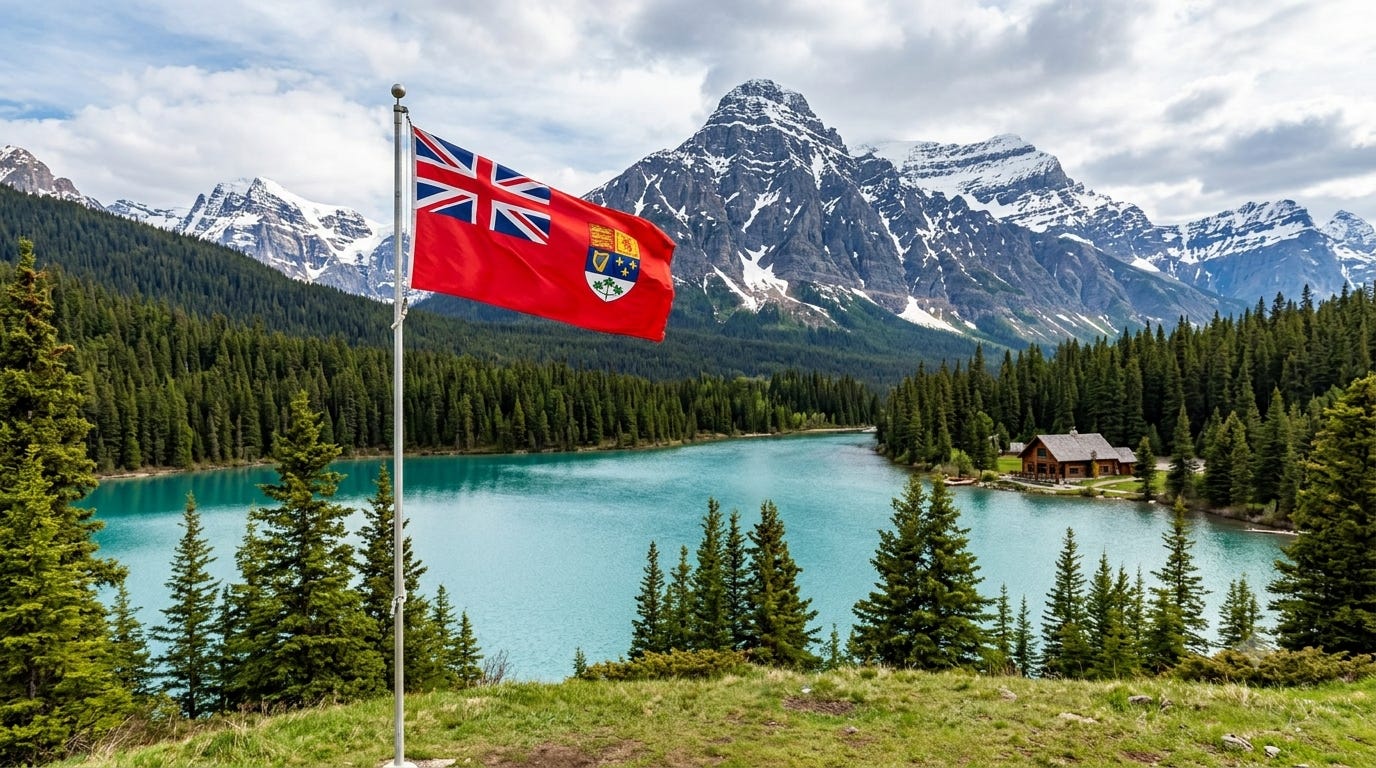
There is an old Canadian anthem called The Maple Leaf Forever, and before our official national anthem was released in the 1960s — O Canada — it functioned as the de facto anthem of English-speaking Canada. It is, quite frankly, a glorious song, and I recommend anyone listen to it, even if they are not Canadian. It is a song that could only have been written during that period we like to call the old school. It is historical, it is heavenly, it is glorious, and triumphant, but in a way that elicits a deep love of country and of neighbour. At the same time, it does not imbibe any sort of liberalism or modern ideology. Simply put, the lyrics of the song, which are beautifully written, implore you to love your land, love your God, love your nation, and love your neighbour all the more.
Every once in a while when I am feeling patriotic or nostalgic — two feelings that are really from the same place — I listen to it on repeat. It can be listened to on YouTube, and the video clips that are set to the song remind me of a place that I used to inhabit. It is the Old Canada, where the King — or Queen — was more than just a figure. Queen Elizabeth — and now King Charles — was the official Head of State of my country, but, of course, she rarely exercised any legal power over Canada. The power of the British Monarchy is symbolic at this point, and Parliament does all the work — and they often do it badly in recent years, sadly. In any event, detractors of modern monarchy will say that such symbolic monarchs are not really true monarchs, and the whole thing is pointless.
They completely misunderstand the point of monarchy, which surely does historically have a governmental role; however, the governmental activity of the monarch is at the service of something far greater and more fundamental to the health of a society.
Yes, the monarchs of today are largely symbolic, but that does not mean they are not true monarchs. Because, whatever governmental role the monarch may have in a given society, it is the symbol of the monarch itself that is the highest reality of monarchy. Yes, Queen Elizabeth, or as we lovingly called her, Ol’ Betty, was not the leader of Canada in the sense that she ran the country. But she was the leader of Canada in the sense that her sweet face and her maternal disposition gave us a real person to whom we could direct our love of country. Love cannot remain something purely abstract. If we love our country, we must actually love our country, and not just with feelings, but with our will and our actions.
We love our country by loving persons who inhabit it. We love our country by loving the ground on which we stand within it. We love our country by loving the history, which we must not only remember, but bring back to life through reenactment and ritual. The Queen stood in the place of that symbolic monarchy, but this symbol was a real person to whom we could say, “I love her.” I loved the Queen growing up, and she, as a real person who stood for a real history of a real nation and commonwealth of nations, was a person in whom I could see the story of my nation incarnated.
We are incarnational beings, which is why, in the Church, we must have sacraments and priests — we must have human beings who incarnate the Faith for us through human hands. We must receive God on our human tongues, and weep with human tears at the mystery of the Passion, and our hearts must flutter with the flutterings of human hearts at the Resurrection of the Word Incarnate.
The monarch is the incarnation of that ideal of authority which is derived from the nature of authority itself. In a way, the monarch incarnates the Creator of Heaven and Earth who creates through fiat and gives us our lives from above, and not from below. That the monarch is not elected is the whole point. The power of the monarch does not come from the people, even if the monarch must serve the people, the way any parent serves the children. True paternal, or in the case of the Queen, maternal love of subjects is only possible when the monarch is, quite literally, above the people. When our leaders come from below, they come from the same place as the subjects, and therefore we see them as equals. While we are all equal in our fundamental dignity as men and women created in the Image of God, we cannot live in a completely egalitarian state wherein the highest ideals are not presented to us as something to be achieved by conquest. Not necessarily a conquest of other persons, although that does happen, but a conquest over our sin, over our fallen nature, and over the temptations of the world.
The monarch reminds us that real human beings can, through the course of history and true conquest, rise to the highest office in the land, to a place so high that the land, in a way, becomes their own. The proper response of any moral person is not to resent the monarch, at least the monarchy as a thing, because it is to resent the idea that the human person, and the nation as a whole, can be elevated at all.
The egalitarianism that has infected us all in our modern day has not elevated us, but it has debased us. Since we are equals, we are told, none of us are better, and none of us are worse. But this is absurd, because some of us are clearly better and some are worse. In a society of total equality, we cannot admit this without, for some reason, being seen as snobbish or proud. While elitism and pride are no good, it is also the case that where there can be no person that is truly higher, and not just higher by accomplishment, but in a sense, by their inherited nature, we can also have no true triumph or true greatness. The greatness of a monarch is not only in the monarch, but it is in the family, even if the family of the monarch is far from a collection of saints. The monarch is the incarnated representation of a history of devotion to a people, even if that devotion is not always well guided, or is forgotten.
Queen Elizabeth was the Queen of Canada uniquely, and not just the Queen of England. When she would visit our country, she would come as our Queen, from across the sea, and she would bring with her an unbroken chain of history, a history that includes the glories, tragedies, defeats and spilled blood of an Empire that had almost conquered the world.
That the sun never set on the British Empire meant that it also never set on Canada, because Canada came forth from the Old Empire. Even French-speaking Canada owes the Old British Empire so much, and I am sure for most of them this would be impossible to admit. Nevertheless, the irony of history is that the Kings of England, who snatched New France from Old France, stopped, at least for almost two hundred years, New France from becoming Revolutionary France.
The Québécois could say that they were the French who never killed their king, and this was something that brought them great honour. In a funny sort of way, by the French Empire being subsumed into the English Empire in Canada, it was British North America that preserved the true glory of France, in a land separated from the Old France by a grandiose body of rough, merciless water.
Sadly, the New Frenchmen eventually did kill their King, or at least they attempted to, when they largely apostatized, which is a crime so unspeakable that the murder of a living monarch cannot compare to the attempted murder of the Everlasting Monarch.
In any event, this national hymn from the Canada that I used to live in always pulls on my heartstrings in a way that is hard to describe by any other term but reverie. It is like being caught up in a dream, which is also a history, in a land wherein the true dream is deemed by the nightmare to be the wrong dream.
The song connects me to people who, genealogically, aren’t even my people, but it ties the highest aspirations of my heart to the grandeur of their ancient stories. I am an amphibian, ethnically, with half my blood being English, and the other half Italian. My father descends from a long line of English Catholics, and my mother is an Italian immigrant. I have always lived between two worlds — that of England on the New Continent, and Italy in Ancient Rome. My heart has never been able to decide where my full allegiance should lie, because there is something about ancestry that is a spiritual quality, and it creates a bond that cannot be severed.
The text of the song ends with:
On merry England’s far famed land May kind heaven sweetly smile, God bless old Scotland evermore and Ireland’s Em’rald Isle! And swell the song both loud and long Till rocks and forest quiver! God save our King and Heaven bless The Maple Leaf forever!
The same song that imbues in me a great joy of English pride provides something of a solution to the amphibian in me that cannot decide if his heart belongs on the firm, dry ground of the Canadian Shield, or the moistened shores of the Mediterranean.
I am not Irish, but I have always been fascinated by Irish culture and history, and have felt a kinship with it, despite sharing no family relation. The Irish are a European people, in the sense that they are a Roman Catholic people, and they are also a people who have been lorded over by the British Crown for centuries. Of course, not many Irishmen would speak of that fact lovingly, but history has happened, and it cannot be changed, whether we like it or not. And, like the Quebecois, the Irish fared much better, as far as remaining faithful Catholics, when they were under the thumb of the King of England, than when they gained their ill-fated freedom therefrom. Today the Irish are free, but they are free to be secular and not to be Irish, which is to say Catholic.
French Canadians are free; they are so free that they have freely adopted the murderous spirit of Revolutionary France that undid their ancestors and replaced the King of kings with the devil queen of Freemasonry.
The great irony of the British Empire is that she was born out of a revolution from the Catholic Church, and then she preserved the Catholic Church in all places but England.
But the hymn of the maple leaf unites me to the history of my nation, which is an English history that makes me a confrere with the Irish and the Scots, who were more Irish and Scottish when they were forced to be English than they are now, since they have become independently Irish and Scottish.
I have listened to this song numerous times — too many to count — but my most recent listen inspired this reverie, and that reverie ignited in me a communion of patriotism with the Irishman and the Scotsman, even though I am neither by blood. And this, perhaps, is the point of this essay that is more dreamlike than analytical, and that point is the fact that the Old British Empire has given me a gift of kinship with so many nations, in a way that draws me closer to them than to my close neighbour to the south, which is not more than an hour’s drive away.
I have always enjoyed travelling throughout the US, and I have nothing bad to say about the many friends I have there, but the country has never felt like home. It is strange that it should not feel like home, because it is closer to home for me than most of Canada. Even stranger is that Ireland — a nation which I have visited twice — felt more like home when I was there than the America that I have spent much more time in and whose culture — both historical and popular — is sometimes more on the ready in Canada than Canadian culture.
Similarly, I have only been to England twice, and for a total of about nine days, but, as I walked the streets of London, I felt like I was breathing the same air that I breathed in my hometown of London, Ontario, which, despite the name, is nothing like London, England, in any meaningful way.
I should end shortly, before this essay becomes like the end of a dream, you know, that period in the morning when you are waking from the dream, and then it all makes no sense, and you forget the dream entirely.
I will end by saying, it is my prayer and my hope that England is restored to glory, so that Canada, and my brethren across the sea, can be restored to the glory that England preserved for us, even against our will, in a strange, providential sort of way.
God save the King, and may the King, somehow, miraculously, become the sort of man who can save England.
Comments
Nothing yet. Say the first thing.
Sign in to join the conversation.